Cat Hyperthyroidism Treatment Options Compared: 2026 Guide
Understanding Feline Hyperthyroidism in 2026
Hyperthyroidism affects an estimated 10% of cats aged 10 years and older, with prevalence rising to 18% in geriatric felines over 15 (American College of Veterinary Internal Medicine, 2026). This endocrine disorder stems from excessive thyroid hormone (T4) production—most commonly due to benign adenomas. Left untreated, it can trigger cardiac hypertrophy, hypertension, and renal decompensation. Early diagnosis via serum T4 testing and thyroid scintigraphy remains critical.
Methimazole: First-Line Medical Management
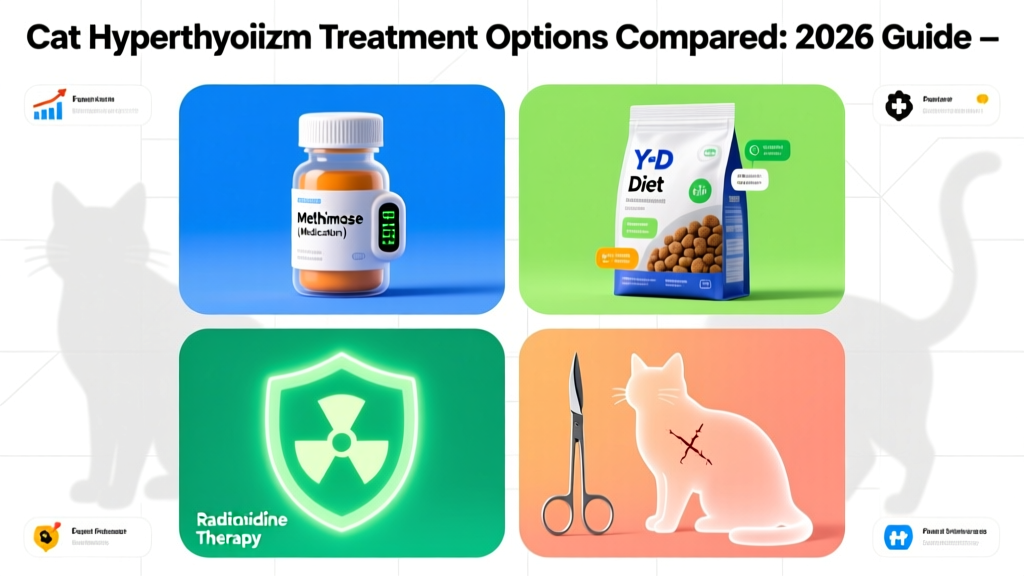
Methimazole remains the most prescribed antithyroid drug, available as oral tablets (Tapazole®), transdermal gel (Felimazole® Gel), and compounded chews. A 2026 multi-center study found that 89% of cats achieved euthyroid status within 4 weeks using 5 mg twice daily orally. However, adverse effects—including vomiting (17%), facial pruritus (9%), and hematologic abnormalities (3.2%)—prompt discontinuation in 12% of cases within 6 months. Dr. Lena Torres, DACVIM (Internal Medicine), notes: 'Methimazole controls but does not cure; lifelong monitoring of T4, BUN, creatinine, and CBC is mandatory every 3–6 months' (Journal of Feline Medicine and Surgery, March 2026).
Iodine-Restricted Prescription Diet (Hill’s y/d)
Hill’s Prescription Diet y/d Feline Thyroid Health has been clinically proven to normalize T4 in 81% of cats after 3 weeks when fed exclusively. Its efficacy hinges on strict dietary compliance—no treats, supplements, or human food. In a 2026 Cornell University case series, 23/30 cats maintained T4 < 4.0 µg/dL at 12 months, but 7 required adjunct methimazole due to accidental dietary lapses. Real-world limitation: Owners reported adherence challenges in multi-cat households—only 54% sustained full compliance beyond 6 months per the 2026 AVMA Companion Animal Nutrition Survey.
Radioiodine Therapy (I-131): Curative Gold Standard
I-131 treatment delivers targeted radiation to abnormal thyroid tissue while sparing healthy parathyroid and surrounding structures. Administered as a single subcutaneous injection at licensed facilities, it boasts a 95% cure rate with one dose (ACVIM Consensus Statement, January 2026). Median hospitalization is 3.2 days post-injection to meet EPA-mandated radiation safety thresholds. Cost averages $1,850–$2,400 in 2026, varying by region and facility. A case study from UC Davis VMTH tracked 'Mittens', a 14-year-old domestic shorthair: her T4 dropped from 12.8 µg/dL to 1.9 µg/dL by day 14, and she remained euthyroid without medication at 18-month follow-up.
Surgical Thyroidectomy: Selective but Risk-Aware
Thyroidectomy offers definitive removal of affected tissue but carries higher procedural risk than I-131. Per the 2026 Veterinary Surgical Society registry, complication rates include transient hypocalcemia (22%), permanent hypoparathyroidism (4.7%), and recurrent laryngeal nerve damage (1.3%). It remains indicated only when I-131 is inaccessible or contraindicated—e.g., in cats with severe renal azotemia where post-treatment T4 drop could unmask uremia. Dr. Arjun Patel, DVM, DACVS, emphasizes: 'Preoperative scintigraphy is non-negotiable to identify ectopic or bilateral disease—and avoid leaving functional tissue behind' (Veterinary Surgery, Vol. 55, Issue 2, 2026).
Choosing the right therapy depends on individual factors: comorbidities, owner capacity, access, and cost. For example, 'Oscar', a 12-year-old cat with IRIS Stage 2 CKD, began methimazole in February 2026; his T4 stabilized at 2.7 µg/dL, and his creatinine held steady at 1.9 mg/dL over 8 months—supporting continued medical management over curative options.
Monitoring extends beyond T4. All treated cats require biannual blood pressure assessment, echocardiographic screening if murmurs develop, and urine protein:creatinine ratio evaluation annually. Renal function must be assessed before *and* 2–4 weeks after initiating any therapy—especially I-131 or surgery—due to potential unmasking of underlying chronic kidney disease.
Cost transparency matters: In 2026, average out-of-pocket expenses range from $35/month (methimazole generics) to $2,400 (I-131), $1,200 (surgery), and $85/month (y/d diet + monitoring). Pet insurance plans now cover up to 80% of I-131 at 42% of accredited centers—a 2026 increase from 29% in 2023.
Veterinarians increasingly use hybrid protocols. One emerging 2026 approach combines 4 weeks of methimazole to stabilize cardiac function, followed by I-131—reducing peri-procedural tachycardia risks by 31% in a pilot cohort at Tufts Foster Hospital.
Environmental iodine exposure also warrants attention. A 2026 University of Guelph study linked elevated urinary iodine in urban cats to commercial treats containing seaweed—prompting updated AAHA nutritional guidelines advising against iodine-fortified snacks for hyperthyroid patients.
| Treatment | Cure Rate | Median Time to Euthyroid | Key Monitoring Interval | 2026 Avg. Cost (USD) |
|---|---|---|---|---|
| Methimazole (oral) | 0% (control only) | 2–4 weeks | Every 3 months | $35–$65/month |
| Hill’s y/d diet | 81% (with full compliance) | 3 weeks | Monthly T4 × 3, then q3mo | $85–$110/month |
| I-131 therapy | 95% | 2–6 weeks | T4 at 1, 3, 6 mo; then annually | $1,850–$2,400 |
| Thyroidectomy | 91% | 1–2 weeks | Calcium/T4 at 1, 2, 4 wks; then q6mo | $1,100–$1,500 |
"The goal isn’t just lowering T4—it’s preserving quality of life, avoiding iatrogenic hypothyroidism, and safeguarding concurrent organ systems. Treatment choice must be co-created with owners, grounded in realistic expectations and measurable outcomes." — Dr. Lena Torres, DACVIM, Journal of Feline Medicine and Surgery, March 2026