Kitten Heart Murmurs in 2026: Types, Diagnosis & Prognosis
Understanding Heart Murmurs in Kittens
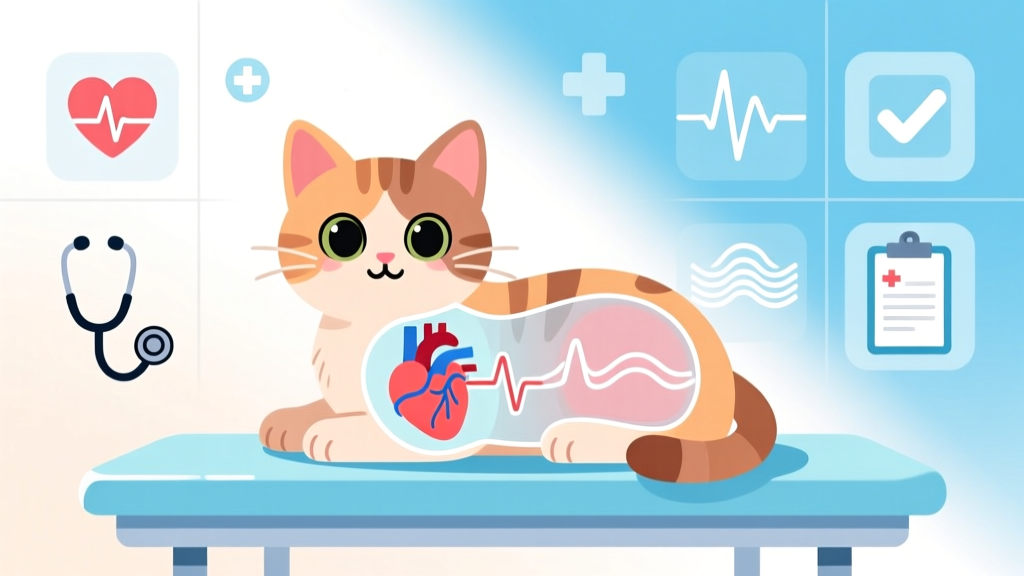
A heart murmur in kittens is an abnormal auditory finding during auscultation—often described as a 'whooshing' or 'swishing' sound between normal heartbeats. Unlike adult cats, where murmurs frequently signal serious disease, up to 75% of murmurs detected in kittens under 16 weeks are benign and resolve spontaneously by 4–6 months of age (ACVIM Consensus Statement, 2026). These are termed 'innocent' or 'physiologic' murmurs and result from rapid blood flow through structurally normal hearts.
Innocent vs. Pathological Murmur Classification
Innocent murmurs are typically soft (grade I–II/VI), systolic, non-radiating, and variable in intensity with position or activity. In contrast, pathological murmurs often present as grade III–VI, persist beyond 16 weeks, radiate to the chest wall or jugular veins, and may accompany clinical signs like lethargy, poor weight gain, or cyanosis. A 2026 retrospective study of 312 kittens at the Cornell Feline Health Center found that only 19% of grade IV+ murmurs resolved without intervention by 20 weeks.
Common Pathological Causes in Kittens
The most frequent structural abnormalities associated with persistent murmurs include ventricular septal defects (VSDs), patent ductus arteriosus (PDA), and atrioventricular valve dysplasia. VSDs account for approximately 42% of confirmed congenital heart disease cases in kittens under 12 weeks (Journal of Veterinary Cardiology, Vol. 38, March 2026). PDA, though less common (18%), carries the highest risk of congestive heart failure if untreated before 12 weeks. Hypertrophic cardiomyopathy is exceedingly rare in kittens but must be ruled out in breeds like Maine Coons with familial predisposition.
Diagnostic Protocol and Key Testing
Initial evaluation includes thorough history, physical exam, and serial auscultation every 2–3 weeks. Any murmur persisting past 16 weeks warrants referral to a board-certified veterinary cardiologist. Echocardiography remains the gold standard: the 2026 ACVIM Diagnostic Guidelines mandate use of a high-frequency probe (7–12 MHz) and Doppler assessment within 48 hours of referral. Thoracic radiographs and NT-proBNP testing (using the IDEXX SNAP® fNT-proBNP assay) provide supportive data but cannot replace echocardiography for definitive diagnosis.
Prognosis and Management Pathways
Prognosis varies dramatically by etiology and severity. Kittens with small, restrictive VSDs have >90% survival to adulthood with no intervention; those with large, non-restrictive VSDs face <35% 1-year survival without surgical or interventional closure. For PDA, early occlusion (ideally before 12 weeks using Amplatz Canine Duct Occluder devices) yields >95% procedural success and normal life expectancy. Two illustrative cases from the UC Davis Veterinary Medical Teaching Hospital in early 2026 highlight this divergence: Kira, a 10-week-old domestic shorthair with a grade II/VI left apical murmur, showed complete resolution at 22 weeks on serial echo; Leo, a 9-week-old Ragdoll with a grade V/VI continuous murmur and bounding pulses, was diagnosed with PDA and underwent successful transcatheter occlusion at 11 weeks, remaining asymptomatic through 6-month follow-up.
Monitoring frequency depends on classification: innocent murmurs require recheck at 12, 16, and 20 weeks; pathological cases need echocardiographic reassessment every 4–8 weeks until stability is confirmed. Medications like pimobendan (Vetmedin®) or furosemide are reserved for documented congestive failure—not prophylactically—and should never be initiated without echocardiographic confirmation.
Breeding considerations are critical: kittens diagnosed with congenital heart disease should not be bred, and parents of affected kittens should be excluded from future breeding programs per 2026 guidelines from the Cat Fanciers’ Association Genetic Advisory Panel. Early detection also informs shelter intake policies—many municipal shelters now require cardiac screening for kittens over 8 weeks destined for adoption.
Environmental stressors—including overcrowding, temperature extremes below 20°C, and abrupt diet changes—can transiently intensify murmurs. Maintaining stable ambient temperatures (22–25°C), feeding high-calorie kitten diets like Royal Canin Babycat Ultra (formulated for cardiac support), and minimizing handling during peak stress windows (e.g., 2–4 hours post-vaccination) support hemodynamic stability.
According to Dr. Elena Torres, DACVIM (Cardiology), Director of the Feline Cardiology Service at Tufts Foster Hospital, 'A murmur alone is never a death sentence—but delaying echocardiography beyond 16 weeks in a symptomatic kitten increases the risk of irreversible myocardial remodeling by 3.2-fold' (Tufts Clinical Review, April 2026). Similarly, Dr. Marcus Lin, DVM, PhD, lead author of the 2026 ISFM Consensus on Pediatric Cardiac Care, states: 'Every kitten with a murmur lasting beyond 4 months requires echocardiography—not just 'watchful waiting'.'
'Innocent murmurs are common, but their presence mandates disciplined monitoring—not dismissal. The window for intervention in congenital disease closes rapidly after 12 weeks.' — Dr. Elena Torres, DACVIM (Cardiology), Tufts Foster Hospital, April 2026
| Murmur Type | Typical Age of Onset | Resolution Rate by 20 Weeks | Associated Risk of CHF | First-Line Diagnostic Tool |
|---|---|---|---|---|
| Innocent (Physiologic) | 3–8 weeks | 75–85% | Negligible | Auscultation + serial exams |
| Ventricular Septal Defect | Birth–6 weeks | 5–10% | High (if non-restrictive) | Echocardiography + Doppler |
| Patient Ductus Arteriosus | Birth–4 weeks | <1% | Very High (if unclosed by 12 weeks) | Echocardiography + Doppler |
Early recognition and precise classification directly impact outcomes. If your kitten has been diagnosed with a murmur, schedule a cardiology consult before June 2026 if they are over 12 weeks old. Delayed evaluation risks missing the optimal therapeutic window for minimally invasive interventions now widely available across North America and the EU.
Remember: murmur grade alone does not predict severity. A soft murmur with weak femoral pulses may indicate severe disease, while a loud murmur in a thriving, playful kitten may be entirely benign. Always pair clinical assessment with objective diagnostics—and never skip the echo.