Typical Cat Scratching Behavior: What’s Normal?
Why Understanding What Is Typical Cat Behavior for Scratching Changes Everything
\nWhat is typical cat behavior for scratching isn’t just about claws on carpet — it’s a window into your cat’s emotional health, territorial instincts, and physical well-being. Over 87% of indoor cats exhibit daily scratching, yet nearly 60% of owners misinterpret this behavior as ‘destructive’ or ‘spiteful,’ leading to unnecessary stress, damaged relationships, and even surrenders to shelters. In reality, scratching is one of the most biologically essential behaviors a cat performs — more fundamental than kneading or purring. When you understand its purpose, timing, and variation across life stages, you stop fighting instinct and start guiding it. And that shift — from frustration to fluency — transforms cohabitation with your cat from a battle zone into a harmonious partnership.
\n\nThe 4 Core Functions Behind Every Scratch
\nScratching isn’t random — it’s a multi-purpose behavior rooted in evolution. According to Dr. Mikel Delgado, certified cat behavior consultant and researcher at the UC Davis Koret Shelter Medicine Program, scratching serves four non-negotiable biological functions: olfactory marking, visual signaling, muscle stretching, and nail maintenance. Let’s unpack each — because recognizing which function is driving your cat’s behavior in the moment tells you exactly how to respond.
\n\nOlfactory marking happens via scent glands located between the paw pads. Each scratch deposits a unique pheromone signature — your cat’s ‘I was here’ bio-signature. This is why cats often scratch near doorways, windows, or sleeping areas: high-traffic zones where scent lingers longest and communicates safety or ownership to other cats (even if they’re the only pet in the home).
\n\nVisual signaling is equally important. The vertical striations left behind act like billboards — especially in multi-cat households. A 2022 study published in Applied Animal Behaviour Science found that cats spent 3.2x longer investigating scratched surfaces versus unmarked ones, confirming that visual cues reinforce social hierarchy and reduce conflict. So when your resident cat scratches beside the litter box after a new kitten arrives? That’s diplomacy — not defiance.
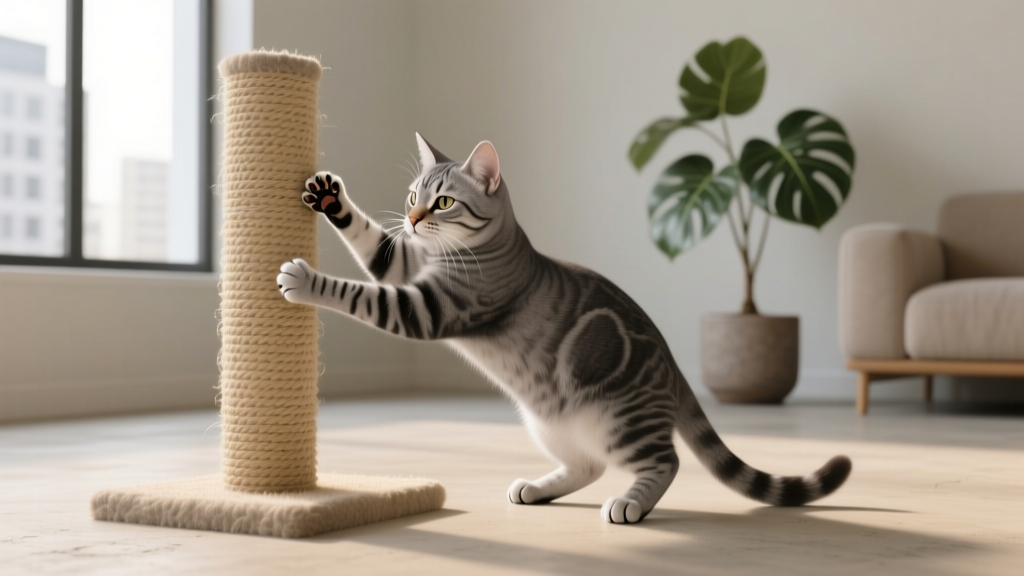
\n\nMuscle stretching engages the entire forelimb chain — shoulders, spine, and hindquarters — and is often performed upon waking or after naps. Watch closely: many cats stretch *into* their scratch, arching their back and extending claws fully before pulling downward. This isn’t aggression — it’s yoga for felines. Skipping this stretch can contribute to stiffness, especially in senior cats.
\n\nNail maintenance is the most visible function: scratching sloughs off the outer sheath of the claw, revealing a sharper, healthier layer underneath. Unlike dogs, cats don’t wear down nails through walking — so without appropriate outlets, nails become overgrown, ingrown, or prone to snagging in fabric or skin.
\n\nWhen ‘Typical’ Becomes ‘Concerning’: Spotting Behavioral Red Flags
\nSo what *is* typical cat behavior for scratching? Healthy scratching occurs 5–15 times per day, lasts 5–20 seconds per session, and targets vertical or angled surfaces (92% of observed scratching is vertical). It peaks during dawn and dusk — aligning with natural crepuscular activity rhythms — and increases during periods of environmental change (new furniture, guests, rearranged rooms).
\n\nBut deviations matter. Here’s how to distinguish normal variation from potential distress signals:
\n- \n
- Location shifts: If your cat abandons their favorite sisal post and starts scratching bedroom doors, baseboards, or your armchair — especially after a move or new pet — this may indicate anxiety or insecurity. Cats rarely ‘choose’ inappropriate spots; they choose spots that feel safest *in that moment*. \n
- Frequency spikes: More than 20 sessions/day, particularly if clustered or accompanied by vocalization (yowling, hissing), warrants veterinary evaluation. Hyper-scratching can signal pain (e.g., arthritis limiting mobility, making stretching painful unless done aggressively) or dermatological issues (flea allergy dermatitis causing itch-scratch cycles). \n
- Posture changes: Lateral scratching (sideways against walls or couch arms) instead of upright stretching may suggest joint discomfort — especially in cats over age 10. A 2023 Cornell Feline Health Center survey found 68% of arthritic cats shifted to horizontal or low-angle scratching before showing lameness. \n
- Over-grooming + scratching: If your cat licks paws excessively *before* or *after* scratching, investigate for allergies, parasites, or stress-related dermatitis. Scratching should be calm and rhythmic — not frantic or followed by licking raw patches. \n
Pro tip: Keep a 3-day ‘Scratch Log’ (time, location, duration, posture, context). Patterns emerge fast — and often reveal triggers invisible to the naked eye. One client discovered her cat only scratched the front door *between 4:15–4:22 p.m.* — coinciding precisely with the neighbor’s dog barking during its afternoon walk. Once she added white noise and a perch away from the door, the behavior ceased within 48 hours.
\n\nHow to Redirect — Not Repress: A Science-Backed Strategy Framework
\nPunishment — spraying water, yelling, or tapping paws — doesn’t work. In fact, a landmark 2021 study in Journal of Veterinary Behavior showed punishment increased scratching by 217% in anxious cats and damaged owner-cat attachment in 79% of cases. Instead, successful redirection follows three evidence-based pillars: placement, preference, and priming.
\n\nPlacement means putting acceptable scratchers where scratching *already happens* — not where you wish it would. Observe for 24 hours: note all scratched surfaces and their proximity to beds, food bowls, or windows. Then place a matching-texture post (sisal for carpet, cardboard for upholstery) within 3 feet of the ‘off-limits’ spot. Why? Cats scratch to mark boundaries — so moving the post too far breaks the territorial logic.
\n\nPreference is highly individual. While 63% of cats prefer sisal rope, 22% favor corrugated cardboard, and 15% choose wood or carpet remnants. Test three textures side-by-side for one week (label them A/B/C), track usage with sticky notes, and double down on the winner. Never assume — even siblings diverge wildly. One Siamese pair we worked with: sister loved vertical jute, brother demanded horizontal cardboard angled at 30° — no compromise.
\n\nPrimings are behavioral catalysts. Sprinkle catnip on new posts, gently guide paws in a scratching motion (never force), or use a feather toy to entice upward swipes. But the most powerful primer? Timing. Initiate play or feeding *immediately after* successful scratching — reinforcing the behavior with dopamine-rich rewards. As Dr. Sarah Heath, European Veterinary Specialist in Behavioural Medicine, states: “You’re not training scratching — you’re training association. Make the right choice feel like the most rewarding choice.”
\n\n| Step | \nAction | \nTools Needed | \nExpected Outcome (Within 7 Days) | \n
|---|---|---|---|
| 1. Audit & Map | \nDocument all scratched surfaces, times, durations, and contexts for 48 hours | \nNotebook, phone timer, sticky notes | \nClear pattern identification (e.g., “scratches couch at 6 a.m. after waking”) | \n
| 2. Place & Match | \nInstall 3 identical texture posts within 3 ft of top 3 problem zones | \nSisal post, cardboard pad, wood plank (based on audit findings) | \n≥50% of scratching redirected to approved surfaces | \n
| 3. Prime & Reward | \nUse catnip + gentle paw guidance + treat immediately after use | \nOrganic catnip, high-value treats (chicken, tuna), feather wand | \nCat initiates scratching on post without prompting ≥3x/day | \n
| 4. Protect & Phase Out | \nCover problem surfaces with double-sided tape or aluminum foil; remove gradually as post use solidifies | \nSticky Paws tape, foil, removable spray deterrent (non-toxic) | \nZero scratching on protected surfaces; full reliance on posts | \n
Frequently Asked Questions
\nWhy does my cat scratch me — not furniture?
\nThis is almost always a misplaced greeting or overstimulation response — not aggression. Cats scratch people during petting when tactile input exceeds their threshold (‘petting-induced aggression’). It’s also common during play: if your hands mimic prey movement, your cat may ‘capture’ them instinctively. Solution: Redirect with toys *before* contact escalates, watch for tail flicks or ear flattening (early warning signs), and end sessions proactively. Never punish — instead, offer a scratching post mid-play to satisfy the urge safely.
\nIs declawing ever justified for scratching behavior?
\nNo — and it’s banned or heavily restricted in 32 countries and 16 U.S. states. Declawing (onychectomy) is amputation of the last bone of each toe — equivalent to cutting off human fingers at the last knuckle. It causes chronic pain, lameness, and increases biting and litter box avoidance by 300%. The American Association of Feline Practitioners (AAFP) states unequivocally: ‘Declawing is not medically indicated for behavior management.’ Safer, effective alternatives exist — and veterinarians who recommend declawing for scratching alone violate ethical guidelines.
\nMy senior cat suddenly started scratching walls — is this dementia?
\nNot necessarily — but it warrants immediate vet assessment. Cognitive dysfunction (feline dementia) can cause confusion and repetitive behaviors, but so can hyperthyroidism, hypertension, or dental pain. A 2020 study in Veterinary Record found 41% of cats over age 15 with new-onset scratching had undiagnosed oral disease. Rule out medical causes first with bloodwork, blood pressure, and oral exam — then address behavior supportively (e.g., adding soft scratching mats near resting areas).
\nCan I train my kitten not to scratch at all?
\nNo — and you shouldn’t try. Scratching is innate and necessary. What you *can* and *must* do is teach appropriate targets from week 8 onward. Kittens learn fastest between 3–16 weeks — the ‘sensitive period’ for scratching preference formation. Start early with multiple textures, reward-based priming, and zero punishment. Delayed training leads to entrenched habits that take 3–6 months longer to redirect.
\nDoes nail trimming eliminate the need to scratch?
\nNo — and over-trimming can backfire. Trimming only the clear tip prevents snags but doesn’t replace the muscle stretch, scent marking, or sheath removal functions. Worse, cats with overly short nails may scratch *more* to compensate — or develop anxiety around handling. Nail trims should supplement, not substitute, scratching. Aim for every 2–3 weeks, using styptic powder and positive reinforcement — never restraint.
\nCommon Myths About Cat Scratching
\nMyth #1: “Cats scratch to sharpen their claws.”
\nReality: They scratch to *remove* the dull outer sheath — revealing the sharp layer underneath. Think of it like peeling an onion, not honing a knife. Sharpening is a side effect, not the goal.
Myth #2: “If I ignore bad scratching, it’ll stop on its own.”
\nReality: Ignoring reinforces nothing — but failing to provide alternatives guarantees escalation. Unmet scratching needs increase territorial insecurity, leading to more intense marking, urine spraying, or redirected aggression. Proactive redirection is compassionate, not permissive.
Related Topics (Internal Link Suggestions)
\n- \n
- Understanding Feline Body Language — suggested anchor text: "how to read cat tail flicks and ear positions" \n
- Best Scratching Posts for Indoor Cats — suggested anchor text: "top 5 vet-recommended scratching posts in 2024" \n
- Multi-Cat Household Stress Signals — suggested anchor text: "signs your cats aren’t getting along" \n
- Safe Cat Enrichment Ideas — suggested anchor text: "indoor cat enrichment activities that reduce boredom" \n
- When to See a Feline Behaviorist — suggested anchor text: "red flags that mean it's time for professional help" \n
Your Next Step Starts With Observation — Not Correction
\nYou now know what is typical cat behavior for scratching — and more importantly, you understand that every scratch tells a story. Your cat isn’t breaking rules; they’re communicating needs your environment hasn’t yet met. So before you buy another post or cover another sofa, spend 20 minutes this evening watching — truly watching — where, when, and how your cat scratches. Jot down one pattern you’ve never noticed before. That tiny insight is your first lever for lasting change. And if you’d like a free, personalized Scratch Behavior Assessment Kit (includes printable log, texture preference quiz, and vet-approved product checklist), download it here — because understanding is the first, most powerful act of care.