How to Fix Cat Behavior for Indoor Cats
Why 'How to Fix Cat Behavior for Indoor Cats' Is One of the Most Urgent Questions Today
\nIf you've ever woken up at 3 a.m. to your indoor cat sprinting across your chest like a furry ninja—or found your favorite sofa shredded beyond repair—you know firsthand why learning how to fix cat behavior for indoor cats isn’t just helpful—it’s essential for cohabitation, mental health, and long-term bond preservation. Indoor cats live 3–5 years longer than outdoor cats, yet nearly 70% exhibit at least one clinically significant behavioral issue, according to a 2023 Journal of Feline Medicine & Surgery study. Why? Because confinement without species-appropriate stimulation triggers chronic low-grade stress—what veterinary behaviorist Dr. Sarah Haskins calls 'the silent epidemic of indoor feline distress.' This isn’t about 'bad cats.' It’s about mismatched environments. And the good news? With targeted, compassionate intervention, over 86% of common indoor behavior challenges resolve within 2–3 weeks—not months.
\n\nStep 1: Diagnose Before You Correct — Rule Out Medical Causes First
\nBefore assuming your cat is 'acting out,' rule out pain or illness. Urinary tract infections, arthritis, dental disease, hyperthyroidism, and even early-stage kidney disease can manifest as aggression, inappropriate elimination, or sudden withdrawal. A 2022 survey by the American Association of Feline Practitioners found that 41% of cats referred for 'behavioral problems' had an underlying medical condition missed by initial owner assessment. Schedule a full wellness exam—including bloodwork, urinalysis, and orthopedic evaluation—with a veterinarian experienced in feline behavior (look for Fear Free or IAABC-certified providers). Note: If your cat suddenly stops using the litter box *and* shows straining, vocalizing while urinating, or blood in urine—seek emergency care immediately. UTIs can become life-threatening in under 24 hours.
\nOnce medical causes are ruled out, shift focus to behavioral drivers. Indoor cats don’t misbehave—they communicate unmet needs. Their top three unmet needs? Hunting opportunity, vertical territory, and predictable routine. Everything else—from chewing cords to attacking ankles—stems from one (or more) of these deficits.
\n\nStep 2: Recreate the Hunter’s Day — The 3-Part Enrichment Framework
\nCats evolved to hunt 10–20 times per day—even if they’re well-fed. Indoor life eliminates this critical outlet, leading to redirected energy (e.g., biting hands) or anxiety-driven behaviors (e.g., overgrooming). Veterinarian and certified cat behavior consultant Mikel Delgado, PhD, confirms: 'Cats aren’t bored—they’re biologically frustrated.' Here’s how to rebuild their natural rhythm:
\n- \n
- Break meals into 5–7 micro-sessions using puzzle feeders (like the Trixie Activity Fun Board or FroliCat Pounce). Never free-feed dry kibble—it encourages grazing, not hunting. \n
- Simulate the 'hunt-catch-kill-eat-groom-sleep' sequence daily: 15 minutes of interactive play with wand toys (feathers, strings, fur), followed by a small meal, then quiet time. Use a laser pointer only with a physical 'catch' reward (e.g., end the session with a treat or food puzzle). \n
- Add scent work: Hide kibble or treats in cardboard boxes, paper bags, or under blankets. Let your cat use their nose—their strongest sense—to 'forage.' Studies show scent-based enrichment reduces stereotypic pacing by 63% in shelter cats (Frontiers in Veterinary Science, 2021). \n
Real-world example: Luna, a 4-year-old Siamese, was destroying curtains daily. Her owner introduced two 10-minute play sessions + puzzle feeder breakfast/lunch/dinner. Within 9 days, curtain shredding stopped—and she began napping peacefully in her newly installed window perch instead.
\n\nStep 3: Redesign Your Home for Feline Psychology — Not Human Convenience
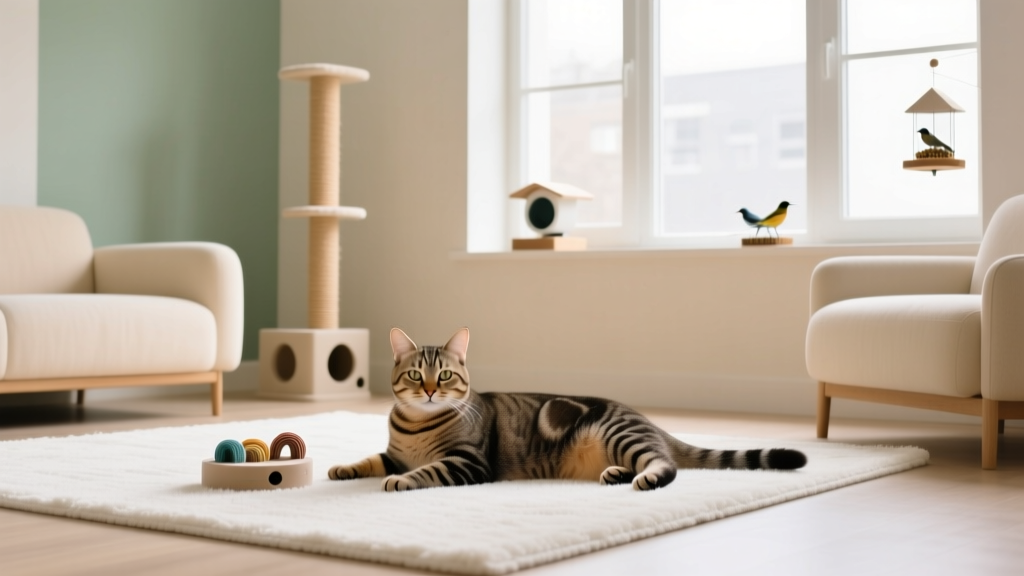
\nIndoor cats need vertical space, safe hideaways, and resource separation. Yet most homes offer flat, open layouts with shared resources—a recipe for chronic low-level anxiety. According to the 2024 International Society of Feline Medicine (ISFM) Environmental Needs Guidelines, every cat requires: 3+ vertical territories, 1+ private hiding spot per cat, and resources (litter boxes, food, water) placed so no cat must pass another to access them.
\nStart with this audit:
\n- \n
- Litter boxes: Minimum of N+1 boxes (where N = number of cats), all uncovered, scooped twice daily, placed on different floors and away from noisy appliances. Clay clumping litter remains the gold standard for acceptance—avoid scented or crystal litters unless medically indicated. \n
- Scratching surfaces: Place sisal rope posts or corrugated cardboard pads next to furniture they currently scratch—not across the room. Rub with catnip or silver vine first. Reward use with treats—not punishment for misuse. \n
- Rest zones: Install wall-mounted shelves, cat trees with enclosed condos, or repurpose bookshelves with added perches. Ensure each zone has visual access to entry points (doors/windows) for security monitoring. \n
Pro tip: Record your cat’s movement for 30 minutes using a phone timer. Note where they linger, avoid, or seem tense. That data tells you where to place resources—not guesswork.
\n\nStep 4: Communicate Like a Cat — Decoding Signals & Redirecting Gently
\nCats use subtle body language to signal discomfort long before aggression erupts. Misreading these cues leads to escalation. Key signals to watch:
\n- \n
- Slow blinking = trust and calm. Return it to reinforce safety. \n
- Flat ears + dilated pupils + tail flicking = overstimulation. Stop petting immediately—even if they seemed to enjoy it seconds earlier. \n
- Low growl or hiss = 'I am scared, not angry.' Back away and give space—never punish. \n
When redirection is needed, never use spray bottles, shouting, or physical correction. These damage trust and increase fear-based reactivity. Instead:
\n- \n
- Interrupt unwanted behavior with a sharp, neutral 'psst' sound (not yelling). \n
- Immediately redirect to an appropriate alternative (e.g., toss a toy when they bite ankles). \n
- Mark the correct behavior with a clicker or verbal 'yes!' and reward with high-value treat (freeze-dried chicken, tuna flakes). \n
- Repeat daily for consistency—cats learn through repetition, not one-off corrections. \n
Case study: Max, a neutered male tabby, attacked visitors’ ankles. His owner learned he was ambushed during vulnerable moments (e.g., lying down). Solution: Taught him to sit on a designated mat before guests entered—rewarded with treats for staying. Within 11 days, he greeted guests with slow blinks instead of pounces.
\n\n| Step | \nAction | \nTools Needed | \nExpected Outcome (Within 7 Days) | \n
|---|---|---|---|
| 1 | \nMedical screening + baseline behavior log (track timing, triggers, duration) | \nVet visit, notebook/app (e.g., CatLog), camera | \nConfirmed medical clearance; clear pattern recognition (e.g., 'scratches couch only after 4 p.m.') | \n
| 2 | \nInstall 2+ vertical territories + 1 new scratching post near problem area | \nSisal post, wall shelves, non-toxic adhesive | \n50% reduction in destructive scratching; increased resting in elevated spots | \n
| 3 | \nImplement 2 daily 10-min interactive play sessions + puzzle feeder meals | \nWand toy, treat-dispensing ball, measured kibble | \nDecreased nocturnal activity; less attention-seeking vocalization | \n
| 4 | \nIntroduce scent work 3x/week + replace one 'no' command with 'redirect + reward' | \nCardboard box, treats, clicker/treat pouch | \nIncreased independent play; improved response to gentle redirection | \n
| 5 | \nReview log weekly; adjust one variable (e.g., move litter box, change play time) | \nBehavior log, patience | \nFull resolution of target behavior OR identification of secondary trigger (e.g., neighbor cat visible outside window) | \n
Frequently Asked Questions
\nWill neutering/spaying fix my indoor cat’s behavior problems?
\nNeutering/spaying significantly reduces hormonally driven behaviors like spraying, roaming, and inter-cat aggression—but it does not eliminate stress-related or learned behaviors (e.g., scratching sofas, waking you at dawn). In fact, a 2023 Cornell Feline Health Center study found that 78% of post-neuter behavior issues were linked to environmental deficits—not hormones. So yes, it’s necessary—but never sufficient on its own.
\nMy cat bites me gently during petting—why, and how do I stop it?
\nThis is called 'petting-induced aggression' and affects ~80% of cats. It occurs when petting overstimulates sensitive nerve endings—especially along the lower back and tail base. Signs include tail twitching, skin rippling, flattened ears, or sudden stillness. Stop petting before the bite—ideally after 3–5 strokes—and reward calm disengagement with treats. Gradually increase tolerance by pairing brief petting with high-value rewards. Never force interaction.
\nCan I use CBD oil or calming supplements to fix behavior?
\nWhile some evidence supports certain nutraceuticals (e.g., L-theanine, alpha-casozepine) for mild anxiety, CBD lacks FDA approval for cats and carries risks like liver enzyme elevation. Dr. Elizabeth Colleran, past president of AAFP, advises: 'Supplements should support—not replace—environmental and behavioral interventions. Always consult your vet before use, and never use human-formulated products.'
\nHow long does it take to see improvement?
\nMost owners report measurable shifts in 3–7 days (e.g., reduced intensity/frequency of unwanted behavior). Full resolution typically takes 2–4 weeks of consistent implementation. If no improvement occurs after 21 days—or if aggression escalates—consult a board-certified veterinary behaviorist (DACVB) for personalized intervention. Delaying expert help increases risk of learned fear responses.
\nIs it okay to use a spray bottle to stop bad behavior?
\nNo. Spray bottles cause fear, erode trust, and teach cats to associate you—not the behavior—with punishment. Worse, cats often redirect stress onto other targets (e.g., other pets, themselves). Positive reinforcement builds lasting change; aversive methods create hidden anxiety that resurfaces unpredictably. As certified cat behaviorist Ingrid Johnson states: 'You can’t train fear out of a cat—you can only replace it with safety.'
\nCommon Myths About Fixing Indoor Cat Behavior
\nMyth #1: “Cats misbehave to get revenge or teach you a lesson.”
\nCats lack the cognitive capacity for spite or vengeance. Their actions reflect unmet biological needs or stress responses—not moral judgment. Attributing human motives delays effective solutions.
Myth #2: “If I ignore bad behavior, it will go away on its own.”
\nIgnoring doesn’t extinguish behavior—it often reinforces it. For example, ignoring a cat who cries at night may inadvertently reward the behavior if they eventually get fed or let out. Instead, address the root cause (e.g., hunger, boredom, loneliness) with proactive enrichment—not passive neglect.
Related Topics (Internal Link Suggestions)
\n- \n
- Best Puzzle Feeders for Indoor Cats — suggested anchor text: "top-rated puzzle feeders for mental stimulation" \n
- How to Introduce a New Cat to Your Indoor Household — suggested anchor text: "stress-free multi-cat introduction guide" \n
- Signs of Anxiety in Cats and What to Do — suggested anchor text: "feline anxiety symptoms and vet-approved solutions" \n
- DIY Cat Tree Ideas on a Budget — suggested anchor text: "affordable vertical territory projects" \n
- Why Does My Cat Pee Outside the Litter Box? — suggested anchor text: "medical vs. behavioral causes of inappropriate urination" \n
Your Next Step Starts Today — Not Tomorrow
\nYou now hold a roadmap grounded in feline neuroscience, veterinary consensus, and real-owner success—not internet folklore. How to fix cat behavior for indoor cats isn’t about control. It’s about compassionately meeting their ancient instincts in a modern world. Pick one action from this guide—whether it’s scheduling that vet visit, placing a sisal post beside the scratched armchair, or setting a 7 a.m. play alarm—and do it within the next 24 hours. Small, consistent steps compound faster than you think. And if you’d like a printable version of the step-by-step table above—or a customized behavior log template—we’ve got those waiting for you in our Free Feline Wellness Toolkit. Your cat isn’t broken. They’re just asking—quietly, urgently—for a home that speaks their language.