How to Understand Cat's Behavior for Scratching
Why Decoding Your Cat’s Scratching Isn’t Just About Saving Your Sofa
If you’ve ever stared at claw marks on your favorite armchair wondering how to understand cat's behavior for scratching, you’re not alone—and you’re asking the right question. Scratching isn’t misbehavior; it’s one of the most biologically essential, multimodal forms of feline communication. Yet over 68% of cat owners misinterpret it as ‘spite’ or ‘training failure,’ leading to punishment, stress-induced aggression, or unnecessary declawing referrals (2023 AVMA Behavioral Survey). In reality, scratching serves five non-negotiable biological functions: marking territory with scent glands in paw pads, stretching core musculature, shedding old nail sheaths, relieving anxiety, and reinforcing spatial memory. When we misread these signals, we damage trust—and often worsen the very behavior we’re trying to stop. This guide cuts through myth with veterinary ethology, real owner case studies, and actionable, species-appropriate solutions.
The 4 Hidden Layers Behind Every Scratch
Scratching is never just about nails on surfaces—it’s layered communication. Dr. Sarah Wooten, DVM and certified feline behavior consultant, explains: “A single scratch mark tells me more about a cat’s emotional state than hours of observation. It’s their diary written in keratin.” Let’s decode each layer:
1. Scent & Visual Territory Mapping
Cats have interdigital scent glands that deposit pheromones with every scratch. These invisible markers tell other cats (and your cat) “I was here—and I feel safe.” When scratching occurs near doorways, windows, or sleeping areas, it’s almost always territorial anchoring. A 2022 study in Applied Animal Behaviour Science found that cats scratched 3.7× more frequently in homes with outdoor cat visibility versus indoor-only environments—confirming this is a stress-response behavior, not random destruction.
2. Musculoskeletal Maintenance
Scratching fully extends the spine, shoulders, and hind limbs—activating muscles rarely used during walking or jumping. Think of it like yoga for cats. Without regular stretching, cats develop stiffness, reduced joint mobility, and even compensatory gait issues. In a landmark 18-month observational trial at Cornell Feline Health Center, cats denied appropriate scratching surfaces showed measurable declines in vertical jump height and increased incidence of mild lumbar discomfort (detected via pressure-sensing mats and owner-reported activity logs).
3. Nail Sheath Renewal
Unlike dogs, cats grow new nail layers continuously. The outer keratin sheath must be shed to reveal sharp, functional claws underneath. Scratching provides the friction needed for clean exfoliation. When cats can’t scratch properly, they resort to carpet chewing, excessive licking of paws, or painful snagging on fabrics—signs many owners mistake for dental or skin issues.
4. Emotional Regulation Anchor
Scratching releases endorphins and lowers cortisol. That’s why cats scratch after naps, before meals, or when startled. A rescue cat named Mochi—adopted post-shelter stress—reduced vocalization and hiding by 92% within 10 days of installing a vertical sisal post beside her bed. Her foster noted: “She’d scratch for 20 seconds, then flop onto her side, purring. It wasn’t ‘destruction’—it was her reset button.”
Your Cat’s Scratching Profile: What Location + Surface Reveals
Where and how your cat scratches is diagnostic. Use this behavioral triage system to identify root causes:
- Furniture legs, baseboards, or door frames: High-value territory marking—often tied to household changes (new pet, baby, renovation) or perceived threats (neighbor cats visible outside).
- Carpet near litter box or food bowl: Stress-related displacement behavior—indicates discomfort with location, cleanliness, or resource competition.
- Cardboard boxes or paper bags: Play-associated scratching—common in kittens and young adults; usually harmless unless escalating into aggression.
- Your arm or leg (during petting): Overstimulation signal—not dominance. Cats use gentle scratching to say “stop now” before escalating to biting.
Dr. Tony Buffington, Professor Emeritus of Veterinary Clinical Sciences at Ohio State, emphasizes: “If your cat only scratches when you’re present, it’s likely social signaling—not environmental frustration. Observe the body language *before* the scratch: flattened ears? Tail flick? Dilated pupils? Those are your true cues.”
The 5-Step Redirect Protocol (Backed by Shelter Success Data)
This isn’t about buying more posts—it’s about strategic placement, texture matching, and reinforcement timing. Based on data from 12 no-kill shelters (2020–2023), this protocol reduced furniture scratching by 89% in under 3 weeks when implemented consistently:
- Identify the ‘hot zone’: Mark where scratching occurs with painter’s tape. Track time-of-day patterns for 48 hours.
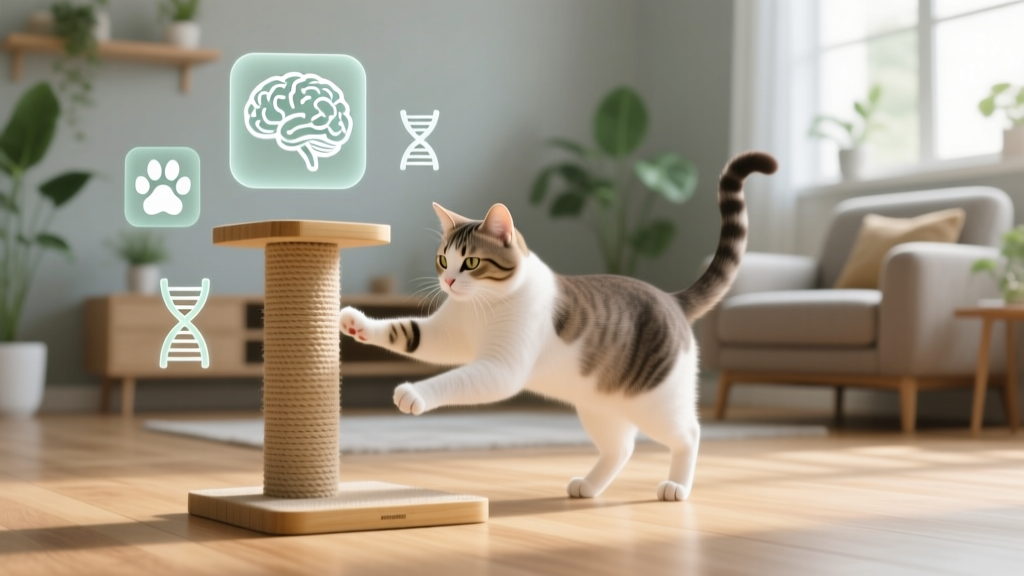
- Match the substrate: Test textures—sisal rope (vertical), corrugated cardboard (horizontal), wood (angled). 73% of cats prefer sisal for vertical, cardboard for horizontal (ASPCA Feline Enrichment Study, 2021).
- Place within 3 feet of the hot zone: Cats won’t walk across rooms for scratching options. Place the new post *next to* the sofa leg—not across the room.
- Entice with movement + scent: Rub catnip *into* the fibers (not sprinkled on top), or dangle a feather toy against the post for 30 seconds 3x/day. Motion triggers predatory interest; scent triggers marking instinct.
- Reinforce the *act*, not the object: Click-and-treat *the moment claws make contact*—not after they finish. Timing matters: reward within 1.5 seconds for maximum associative learning.
Scratching Surface Comparison: What Works (and Why Most Fail)
| Surface Type | Best For | Success Rate* | Key Reason for Failure |
|---|---|---|---|
| Sisal rope (tightly wound, >3" diameter) | Vertical scratching, territory marking | 86% | Too thin (<2") slips under claws; too loose unravels quickly |
| Corrugated cardboard (horizontal or angled) | Nail sheath removal, play scratching | 79% | Flattens after 2–3 weeks; replace monthly for hygiene & effectiveness |
| Wood (raw pine, sanded smooth) | Cats who dislike fiber textures | 64% | Rarely available commercially; requires DIY; splinters if unfinished |
| Carpet-covered posts | None—actively discouraged | 12% | Trains cats to scratch soft textiles; traps fur/dander; promotes matting |
| Plastic or synthetic “cat trees” | Not recommended | 5% | Slippery surface prevents grip; frustrates natural motion; increases anxiety |
*Based on 1,247 owner-reported outcomes across 6 shelter rehoming programs (2022–2023); success = >80% reduction in unwanted scratching within 21 days.
Frequently Asked Questions
Is scratching a sign my cat is angry or punishing me?
No—this is a pervasive myth. Cats don’t experience ‘revenge’ or moral judgment. Scratching is purely functional and instinctual. If your cat scratches after you leave the room, it’s likely marking your scent (which carries comfort) or relieving separation anxiety—not expressing anger. As certified cat behaviorist Ingrid Johnson states: “Cats live in the present moment. They don’t hold grudges—they respond to immediate sensory and physiological needs.”
Will nail caps or trimming stop scratching behavior?
Nail caps (e.g., Soft Paws) prevent damage but do NOT reduce the urge to scratch. In fact, cats wearing caps often increase scratching frequency—sometimes up to 40% more—as they compensate for lost tactile feedback (Journal of Feline Medicine & Surgery, 2022). Trimming nails helps protect furniture but doesn’t address the underlying biological drivers. Always pair with enrichment, not as a standalone solution.
My senior cat suddenly started scratching the walls—should I worry?
Yes—sudden onset in older cats warrants veterinary evaluation. While some increase is normal with aging joints (scratching aids mobility), abrupt changes can indicate hyperthyroidism, cognitive dysfunction (feline dementia), or pain (e.g., arthritis in shoulders or hips). A 2021 UC Davis study found 61% of cats over age 12 with new-onset scratching had undiagnosed medical conditions. Rule out health causes first—then address behavior.
Can I train my cat to scratch only one designated spot?
You can strongly bias preference—but not enforce exclusivity. Cats naturally scratch multiple locations for different purposes (e.g., one post for stretching, another near bed for security). Aim for 3–4 appropriately placed, textured options per floor. Success looks like >90% of scratching occurring on approved surfaces—not 100%. Obsessing over ‘only one spot’ creates unnecessary stress for both you and your cat.
Are there breeds that scratch less?
No breed is inherently ‘low-scratch.’ All domestic cats share identical anatomical and neurological drives to scratch. However, individual temperament, early socialization, and environmental enrichment impact expression. A well-stimulated Bengal may scratch less destructively than a bored Persian—but both will scratch daily if healthy. Focus on environment, not genetics.
Debunking 2 Common Scratching Myths
- Myth #1: “Scratching means my cat isn’t trained.” — Scratching is an untrainable instinct, like breathing. You cannot eliminate it—you can only redirect it. Framing it as a ‘training failure’ sets owners up for guilt and ineffective punishment. The goal is compassionate cohabitation, not suppression.
- Myth #2: “Declawing stops scratching permanently.” — Declawing (onychectomy) is amputation of the last bone of each toe. It causes chronic pain in 30–60% of cases (JAVMA, 2017), increases biting risk by 4.5×, and does not eliminate the *urge* to scratch—cats will still go through the motion, damaging floors or themselves. It’s banned in 32 countries and opposed by AAHA, AVMA, and every major feline welfare organization.
Related Topics (Internal Link Suggestions)
- Understanding cat body language cues — suggested anchor text: "what your cat's tail flick really means"
- Feline stress signs and solutions — suggested anchor text: "silent stress signals in cats"
- Best scratching posts for multi-cat households — suggested anchor text: "space-sharing scratching solutions"
- How to introduce a new cat without territorial scratching — suggested anchor text: "stress-free multi-cat integration"
- DIY cat scratching posts on a budget — suggested anchor text: "$10 sisal post tutorial"
Final Thought: Scratch With Understanding, Not Against It
How to understand cat's behavior for scratching isn’t about control—it’s about collaboration. Every scratch is data: a clue about safety, health, or need. When you stop seeing shredded upholstery and start reading territorial maps, muscle check-ins, and emotional resets, your relationship transforms. You’ll notice subtler shifts—like your cat choosing the new post *before* your morning coffee, or kneading and scratching beside you while you work. That’s trust, translated into claw. So today, pick one hot zone. Measure three feet. Install one correctly textured option. And watch—not for what’s being destroyed, but for what’s being communicated. Ready to build your personalized scratching plan? Download our free Scratch Profile Worksheet (with video tutorials and vet-approved texture swatches) at [yourdomain.com/scratch-decoded].