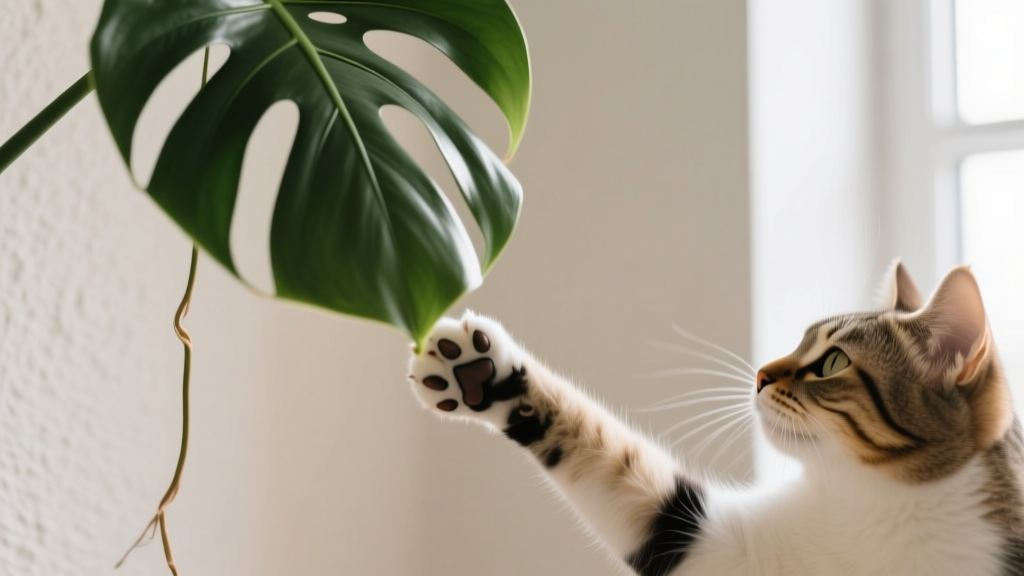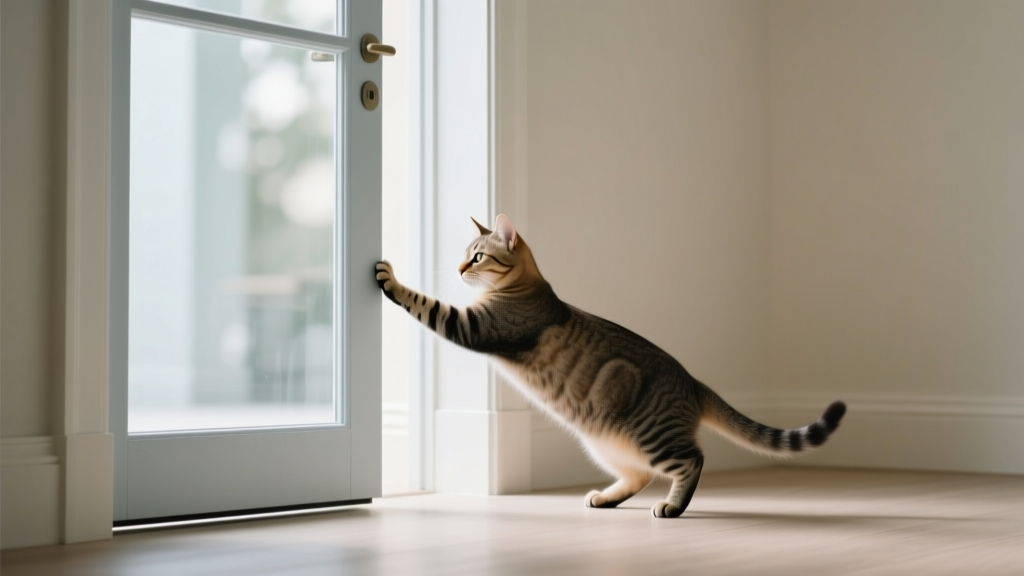
Cat Paw Pushing the Screen Door: Exit Attempt
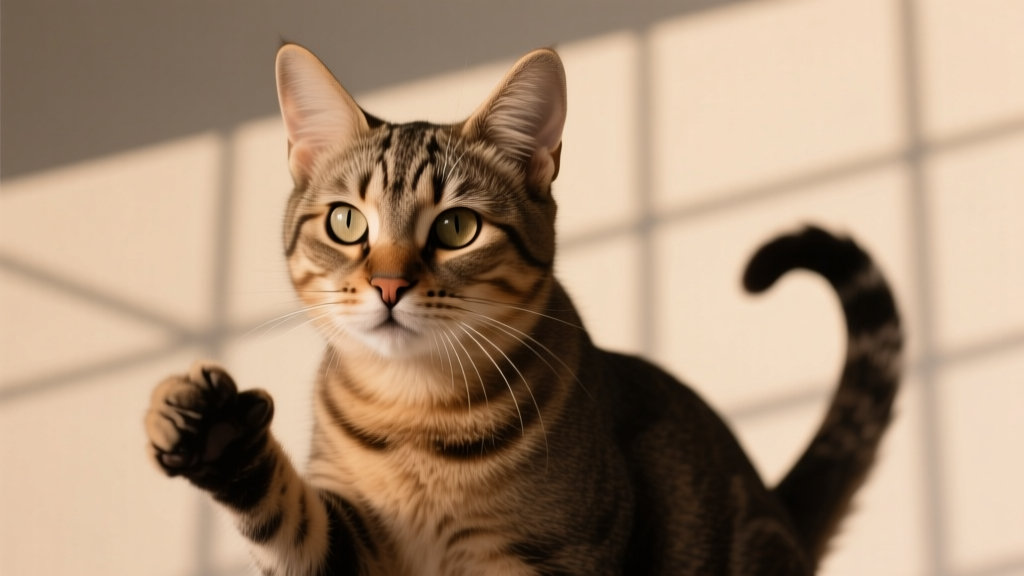
You’re in the kitchen, minding your business, when you hear it: thump… scritch… thump. You turn and there’s your cat—one paw stretched out like a tiny locksmith—pressing and tapping the screen door. Sometimes they add a dramatic little shoulder lean, as if they’re convinced this flimsy barrier will give up and swing open out of respect. If you’re lucky, there’s a chirp. If you’re not, there’s a full-on “I am being wronged” yowl.
This is one of those cat behaviors that’s both hilarious and oddly persuasive. It can look like your cat is “asking nicely” to go out… or like they’re trying to jailbreak your house. Either way, that paw on the screen door is meaningful. It’s communication, it’s curiosity, and it’s a bit of ancient feline programming bubbling to the surface.
Why Cats Push at Doors (The Science and the Wild Roots)
Domestic cats carry the instincts of small, solitary hunters. In the wild, access matters: access to prey, access to shelter, access to a safe escape route. A door—especially a screen door that lets in smells, sounds, and moving shadows—reads as a boundary between “safe home base” and “the world where interesting things happen.”
Cats are also natural problem-solvers. Their paws are sensitive, dexterous tools packed with nerve endings. When a cat presses a paw to a door, they’re doing what cats do best: gathering information. The paw push is part test, part exploration, part attempt to change the environment.
And there’s a learning component. Many cats discover—purely by accident—that pawing at a barrier gets results. Maybe you opened the door once when they pawed. Maybe you spoke to them, looked at them, or laughed. From your cat’s perspective, pawing became a button that makes humans do things. Cats are excellent at repeating whatever works.
A Breakdown of the Behavior: Different Contexts, Different Motivations
“Pushing the screen door” isn’t one single behavior with one single meaning. Think of it as a flexible tool your cat uses in different situations.
1) The “I Want Outside” Request
This is the classic. Your cat sits at the screen door, tail tip twitching, ears forward, and presses the mesh with a gentle, rhythmic paw. Often they glance back at you—an important detail. That look back is a social cue: “Hey, human. I’ve communicated my preference.”
Common triggers: birds at the feeder, neighbor cats passing through, warm breezes carrying fresh scents, dusk (prime cat activity time).
2) The Scent-and-Sound Investigation
Screen doors are sensory gold. Your cat may paw because the screen vibrates, because air moves through it, or because they’re trying to “touch” a smell. Yes, touch a smell—cats combine senses in ways that can look odd to us. The paw might be part of a full-body investigation: sniffing, rubbing the cheek, chattering at a bird, then a quick push to see what happens.
3) The “Let Me In / Let Me Out (Now)” Complaint
Some cats paw the screen door when they’re separated from you or from a preferred room. If the door is between them and their goal—food, you, a sunny spot—they may push in a more urgent way: faster paw strikes, claws catching the mesh, vocalization escalating from chirps to meows to full opera.
4) The Boredom Button
Outdoor stimulation is intense compared to indoor life. If your cat has lots of energy and not enough outlets, the screen door becomes the ultimate “maybe something interesting will happen” station. Pawing is self-rewarding: it makes noise, it feels different under the paw, it sometimes gets your attention.
5) The Territorial or Social Response
If there’s a neighborhood cat outside, your cat may paw the screen door while staring intensely. This isn’t always “I want to play.” It can be “I need to check this boundary.” You may see stiff posture, a low crouch, tail puffing, or a twitchy tail held low. The paw push becomes part of a bigger display of arousal—excitement mixed with stress.
What It Says About Your Cat’s Mood and Feelings
Your cat’s body language is the translator here. The paw on the screen is the headline; the posture is the full article.
- Curious and engaged: ears forward, whiskers relaxed or forward, slow pawing, soft chirps, a loose body, occasional sniffing and cheek rubs.
- Playful/energized: quick paw taps, bouncing between the door and you, “trill” sounds, tail up like a question mark.
- Frustrated: repeated paw strikes, claws out, louder meows, pacing, looking back and forth rapidly, increased intensity if you don’t respond.
- Stressed or territorial: stiff body, hard stare, tail lashing, ears angled sideways or back, growls or low vocalizations—especially if another animal is outside.
- Attention-seeking: pawing pauses when you look away and resumes when you glance over (yes, many cats notice this pattern).
One of the most relatable scenes: your cat paws, looks at you, paws again, then does a dramatic flop on the floor like a Victorian poet. That combination usually screams, “I have a strong preference and I’d like you to fix it.”
Related Behaviors You Might Notice
Cats rarely do just one “door thing.” If your cat is a screen-door pusher, you may also see:
- Door-handle watching: staring at the handle area and pawing higher up as if they’ve studied human mechanics.
- Window surveillance: sitting on a sill for long stretches, chattering at birds, tail tip flicking.
- Threshold hovering: standing in the doorway and hesitating—wanting out, but wanting safety too.
- “Boop and run” behavior: pawing the screen, then sprinting away, as if the door might retaliate.
- Rubbing cheeks on the frame: scent-marking the boundary with facial glands (“This edge is mine.”)
When It’s Normal (and When It Might Be a Concern)
Most of the time, screen-door pawing is perfectly normal: curiosity, communication, enrichment-seeking. It becomes more concerning when it shifts into compulsive intensity or is paired with signs of distress.
Likely normal:
- Happens at predictable times (morning, dusk, when birds appear).
- Your cat can be redirected with play, food puzzles, or attention.
- No damage, minimal vocalization, relaxed body language.
Potential concern:
- Escalating destruction: tearing the mesh, breaking nails, injuring paw pads.
- Constant agitation: pacing, yowling, inability to settle, especially at night.
- Sudden change: a previously calm cat becomes obsessed with the door out of nowhere (consider stressors, changes in routine, outdoor animal activity, or medical discomfort).
- Redirected aggression: your cat sees an outdoor cat and then lashes out at you or a housemate cat—this is a known phenomenon and worth professional support.
If your cat’s pawing is frantic, persistent, or paired with appetite changes, litter box changes, or unusual hiding, check in with your vet first. Behavior is often the first place cats show that something’s off.
How to Respond (Without Accidentally Training a Door-Obsessed Cat)
You don’t have to ignore your cat’s communication—but you do want to respond thoughtfully so the behavior doesn’t become a nonstop “open sesame” routine.
Offer safe alternatives to “going out”
- Create a bird-watching station: a window perch + bird feeder outside (placed safely to prevent window collisions for birds).
- Try a catio or secure outdoor enclosure: many cats thrive with safe outdoor access.
- Harness training: for some cats, supervised walks reduce door fixation because they get a predictable outlet.
Teach a clearer communication cue
If you prefer your cat not to paw the screen (especially if claws are involved), teach a replacement behavior:
- Place a mat near the door and reward your cat for sitting on it.
- Only open the door or offer outdoor time when they’re on the mat, not when pawing.
- Be consistent—cats learn patterns faster than we do.
Meet the “why” behind the paw
- If it’s boredom: add two short daily play sessions (wand toys, chase games), then end with a small meal to mimic hunt-eat-groom-sleep.
- If it’s anxiety or territorial stress: block visual access temporarily, use frosted film on lower panels, and consider pheromone diffusers. Reduce outdoor cat visits by removing food sources and using humane deterrents.
- If it’s attention-seeking: give attention proactively (scheduled play and cuddle times) so your cat doesn’t have to “ring the doorbell” to summon you.
Protect the screen (and your cat’s paws)
- Use a screen protector panel or pet-resistant screening material.
- Keep nails trimmed to reduce snagging.
- Never punish pawing—punishment can increase stress and make door behavior more intense or sneaky.
Fun Facts and Research-Flavor Nuggets
- Cats are excellent at learning cause-and-effect: if a behavior reliably produces a response (you getting up, talking, opening the door), it becomes more likely to repeat.
- The paw is a sensory powerhouse: cats use their paws to test texture, movement, and stability—especially with novel or semi-flexible surfaces like screens.
- Doorways are “hotspots” in cat geography: thresholds concentrate scent, airflow, and social information. To a cat, a doorway is basically a bulletin board with a breeze.
- Some cats prefer screens because they’re interactive: unlike a solid door, a screen responds—it flexes, vibrates, and carries outside smells inside. It’s the cat equivalent of a responsive touchscreen.
FAQ: Cat Pawing at the Screen Door
Why does my cat paw the screen door and then look at me?
That look-back is communication. Your cat is checking whether you noticed and whether your behavior changes. Many cats learn that a human glance predicts action—talking, approaching, opening the door, or offering attention.
Is my cat trying to escape or just curious?
Often it’s both. Curiosity pulls them toward outdoor sights and smells, and the pawing tests whether access is possible. If your cat is relaxed and easily redirected, it’s usually curiosity. If they’re intense, vocal, and persistent, they may be strongly motivated to go out—or frustrated by the barrier.
Will ignoring the behavior make it stop?
Ignoring can help if the pawing is purely attention-driven, but it won’t address boredom, territorial stress, or genuine desire for stimulation. The most effective approach is to reward an alternative behavior (like sitting on a mat) and increase enrichment so the door isn’t the main event of the day.
My cat is shredding the screen—what should I do?
First, protect the screen with a pet-resistant screen or guard panel to prevent injury. Then address the motivation: add play and enrichment, reduce outdoor triggers (like visiting cats), and teach an alternative cue for “I want to go out.” If your cat seems frantic or distressed, consult your vet and/or a qualified behavior professional.
Is it safe to let my cat outside if they keep asking?
Unsupervised outdoor access can increase risks (cars, predators, toxins, parasites, fights). Safer options include a catio, enclosed yard system, or harness-and-leash time. Many cats get the “outside fix” they want without the danger.
Why does my cat paw the screen door more at night?
Cats are naturally crepuscular (most active at dawn and dusk). Nighttime can also bring more wildlife sounds and smells, plus outdoor cats roaming. If it becomes nightly distress, increase evening play, close blinds to reduce triggers, and create a calm bedtime routine.
Your cat pushing the screen door with a paw isn’t just mischief—it’s problem-solving, sensory exploration, and communication rolled into one fuzzy little gesture. When you read the context (body language + timing + triggers), you can respond in a way that keeps your cat enriched, safe, and understood.
Does your cat do the one-paw press, the two-paw “let me OUT,” or the dramatic full-body lean like they’re auditioning for a prison break movie? Share your cat’s screen-door stories with us on catloversbase.com—we’d love to hear the quirky details.