How to Fix Cat Behavior for Weight Loss
Why Fixing Your Cat’s Behavior Is the Missing Piece in Their Weight Loss Journey
If you’ve ever searched how to fix cat behavior for weight loss, you’re not alone—and you’re asking the right question. Most cat owners focus solely on portion control or switching foods, only to watch their cat gain back lost pounds within months. The truth? Up to 63% of overweight cats relapse not because of poor nutrition choices, but because underlying behavioral drivers—like food obsession, attention-seeking eating, or sedentary routines—were never addressed. As Dr. Sarah Wooten, DVM and certified feline behavior consultant, explains: “Weight loss fails when we treat the symptom (excess fat) instead of the cause (learned behaviors reinforced over years).” In this guide, you’ll discover how to rewire your cat’s relationship with food, activity, and attention—safely, humanely, and sustainably.
1. Decode the ‘Why’ Behind Your Cat’s Food-Driven Behaviors
Cats don’t overeat out of greed—they respond to deeply wired instincts and learned associations. Before changing behavior, you must understand its root. Common triggers include:
- Learned reinforcement: If your cat meows at 5 a.m. and gets fed—even once—they now associate vocalizing with reward. A single accidental reinforcement can cement a habit for life.
- Environmental stress: Boredom, multi-cat tension, or inconsistent schedules elevate cortisol, increasing appetite and reducing metabolic efficiency (per a 2022 study in Journal of Feline Medicine and Surgery).
- Food insecurity conditioning: Cats adopted from shelters or with prior scarcity history may hoard food, graze compulsively, or guard bowls—even when well-fed.
- Attention substitution: Many cats quickly learn that begging = human interaction. When affection is scarce, food becomes the most reliable way to access you.
Start with a 3-day ‘Behavior Log’: Note every food-related incident (begging, stealing, pacing, vocalizing), time, location, what happened before/after, and your response. Patterns will emerge—e.g., “Begins 15 min before dinner → I give treats → repeats daily.” This isn’t about blame—it’s about clarity.
2. Redesign Feeding to Rewire Instinct, Not Restrict Calories
Free-feeding or timed bowl drops reinforce passivity and disconnection from natural hunting rhythms. Instead, shift to foraging-based feeding—a method proven to increase daily energy expenditure by up to 28% (Cornell Feline Health Center, 2021). Here’s how:
- Break meals into 12–16 micro-portions (not 2 big bowls). Use puzzle feeders, treat balls, or DIY options like muffin tins covered with paper cups.
- Anchor feeding to play sessions. Always initiate 3–5 minutes of interactive play *before* offering food—mimicking the hunt-eat-groom-sleep cycle. This satisfies predatory drive and reduces post-meal restlessness.
- Rotate feeder locations daily (e.g., living room rug → bathroom counter → hallway mat) to stimulate exploration and reduce territorial food guarding.
- Use ‘no-treat zones’—designate one quiet, low-traffic area as the *only* place food is served. Never hand-feed outside this zone to decouple your presence from immediate reward.
Real-world example: Luna, a 9-year-old domestic shorthair, gained 2.1 lbs after her owner retired and began sitting on the couch all day. Her ‘fix’ wasn’t cutting kibble—it was introducing three 90-second wand toy sessions before each meal and hiding 80% of her daily ration in cardboard boxes around the house. In 10 weeks, she lost 1.4 lbs and stopped yowling at night.
3. Replace Problem Behaviors with Enriched Alternatives
You can’t eliminate a behavior—you can only replace it with something more rewarding. Target top weight-linked behaviors with these vet-approved swaps:
- Begging at dawn? → Install an automatic feeder programmed to dispense 10% of daily calories 15 minutes *before* your usual wake-up time. Pair with white noise or calming music so your cat associates early hours with quiet, predictable reward—not your attention.
- Stealing food off counters? → Provide a ‘legal’ high-value alternative: freeze-dried salmon crumbles in a vertical perch near the kitchen. Reward *only* when they choose that spot—not the counter.
- Inactivity & napping >18 hrs/day? → Introduce ‘micro-enrichment’: 2-minute play bursts every 90 minutes using feather wands or laser pointers (always end with a tangible catch, like a treat, to prevent frustration).
- Food guarding or aggression around bowls? → Practice ‘distance desensitization’: Stand 6 feet away while your cat eats, toss a treat *away* from the bowl every 30 seconds. Gradually decrease distance over 2+ weeks. Never reach toward the bowl during meals.
Crucially: never punish food-related behaviors. Yelling, spraying water, or removing food increases anxiety and strengthens food insecurity loops. As certified cat behaviorist Mikel Delgado, PhD, emphasizes: “Cats don’t understand punishment as correction—they interpret it as threat escalation. Positive reinforcement builds trust; fear erodes it.”
4. Build a Sustainable Behavior Timeline (Not a Diet)
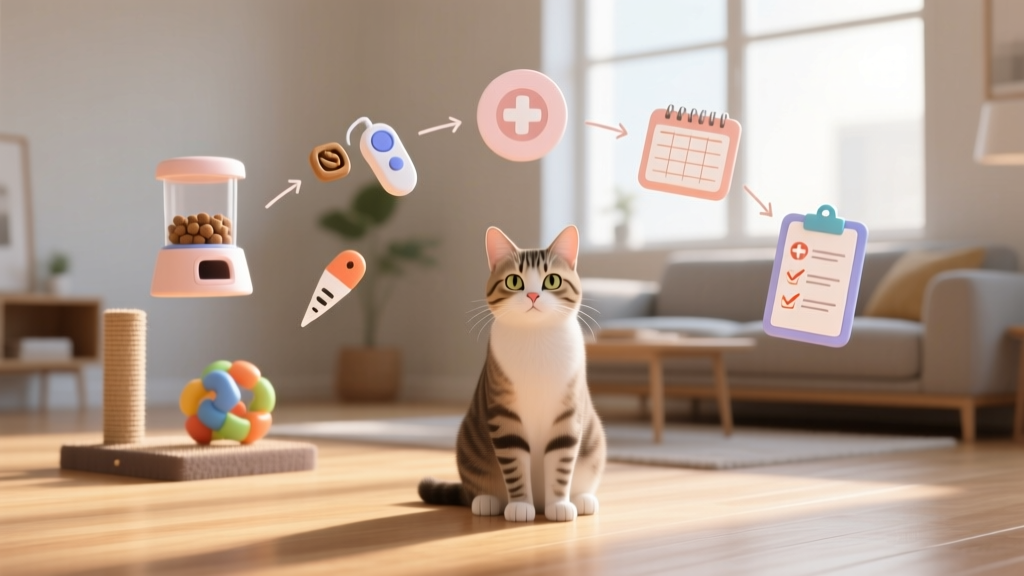
Forget ‘30-day weight loss challenges.’ Sustainable change follows a neurobehavioral timeline. Below is a realistic, vet-reviewed 12-week framework for reshaping habits—designed to align with how cats learn and retain new associations:
| Week | Primary Focus | Key Actions | Expected Shift |
|---|---|---|---|
| Weeks 1–2 | Baseline & Awareness | Complete behavior log; introduce one puzzle feeder; begin pre-meal play (even 60 sec); remove all human-food access | Reduced begging frequency by ~25%; increased alertness during play |
| Weeks 3–5 | Consistency & Replacement | Feed 100% via foraging tools; add 2x daily micro-play sessions; install automatic feeder for dawn meals | Cat initiates play without prompting 3x/week; stops vocalizing before scheduled meals |
| Weeks 6–9 | Generalization & Confidence | Introduce novel feeding locations; rotate toys weekly; add scent enrichment (catnip, silvervine); involve all household members in routine | Self-initiated exploration >2 hrs/day; reduced attention-seeking around food prep |
| Weeks 10–12 | Maintenance & Flexibility | Gradually reduce treat volume in puzzles (replace with kibble); test 1x/week ‘unstructured’ feeding window; celebrate non-food wins (e.g., purring on lap) | Stable weight loss (0.5–1% body weight/week); behavior persists during schedule changes |
Frequently Asked Questions
Can I use clicker training to fix my cat’s food obsession?
Yes—but with precision. Clicker training works best for redirecting *specific* behaviors (e.g., clicking + treating when your cat walks away from the pantry door). Avoid clicking *during* begging—it reinforces the very action you want to reduce. Instead, wait for a calm, alternate behavior (like sitting quietly on a mat), then click/treat. Start with 2–3 short sessions daily. Consistency matters more than duration: 60 seconds done daily beats 10 minutes once a week.
My cat won’t use puzzle feeders—what do I do?
Begin with zero resistance: fill a shallow dish with kibble + 2–3 treats on top. Next day, cover half the dish with tissue paper. Then use a flat, open puzzle (like a muffin tin). Never force engagement—leave it out for 30+ minutes while you ignore it. Most cats explore when curious, not coerced. If your cat has arthritis or vision issues, opt for ground-level, low-entry puzzles (e.g., Pipolino Floor). One shelter study found 92% of resistant cats engaged within 5 days when introduced this way.
Will reducing treats really help—or is it all about kibble portions?
Treats often contribute 20–40% of a cat’s daily calories—and are typically high in fat and low in satiety fiber. Cutting just 3–4 treats/day (≈ 15–25 kcal) equals ~1 lb of weight loss over 3 months. But more importantly: treats reinforce *when* and *how* your cat seeks food. Replace calorie-based treats with ‘life rewards’—5 minutes of chin scratches, opening a window perch, or letting them ‘hunt’ a stuffed mouse. These satisfy emotional needs without caloric cost.
How do I know if behavior change is working—or if my cat has an underlying health issue?
Track two key markers weekly: body condition score (BCS) using the 9-point scale (ask your vet for a quick demo), and behavior frequency (e.g., “dawn yowling episodes”). If BCS improves but begging worsens—or if lethargy, increased thirst, or coat changes appear—schedule a vet visit. Hypothyroidism is rare in cats, but diabetes, kidney disease, and arthritis can mimic or exacerbate weight-related behaviors. Always rule out medical causes before assuming it’s ‘just behavior.’
What if I have multiple cats with different weights and needs?
Multi-cat households require spatial separation during feeding. Use baby gates, closed doors, or designated rooms with RFID feeders (e.g., SureFeed Microchip Feeders) that only open for tagged cats. Never rely on ‘eating faster’ strategies—this increases stress and resource guarding. Feed overweight cats first in their own space, then remove bowls before serving leaner cats. Enrichment should also be individualized: provide vertical spaces for agile cats and ground-level tunnels for older or heavier ones.
Common Myths About Cat Behavior and Weight Loss
Myth #1: “If I ignore begging, my cat will give up.”
False. Ignoring often escalates behavior—especially in food-insecure cats. They’ll try louder, longer, or more disruptive tactics (e.g., knocking things off counters) until they get a response. Instead, teach an incompatible behavior: ask your cat to sit on a mat for 5 seconds before feeding, then reward. You’re not ignoring—you’re redirecting.
Myth #2: “Cats don’t need exercise like dogs—they’re lazy by nature.”
Biologically inaccurate. Domestic cats retain 90% of wild hunting drive. In nature, they’d spend 3–4 hours daily stalking, pouncing, and chasing. Indoor cats aren’t lazy—they’re under-stimulated. Their ‘laziness’ is often learned helplessness from unmet predatory needs.
Related Topics (Internal Link Suggestions)
- Best Puzzle Feeders for Overweight Cats — suggested anchor text: "top-rated slow-feeders for weight management"
- How to Read Your Cat’s Body Condition Score — suggested anchor text: "cat BCS chart and assessment guide"
- Feline Diabetes Prevention Through Lifestyle — suggested anchor text: "early signs and prevention strategies"
- Enrichment Ideas for Senior or Arthritic Cats — suggested anchor text: "low-impact play for aging cats"
- When to See a Veterinary Behaviorist — suggested anchor text: "signs your cat needs expert behavioral support"
Your Next Step Starts With One Tiny Change
You don’t need to overhaul your entire routine tomorrow. Pick *one* behavior from your log—the most frequent or most stressful—and apply just *one* strategy from this guide this week. Maybe it’s setting the automatic feeder 15 minutes earlier. Maybe it’s tossing one treat away from the bowl while your cat eats. Small, consistent shifts rewire neural pathways faster than dramatic restrictions ever could. And remember: this isn’t about ‘fixing’ your cat. It’s about understanding them deeply enough to meet their needs in ways that honor their nature—and protect their health. Ready to begin? Download our free 7-Day Cat Behavior Reset Checklist (with printable tracker and vet-approved scripts) at the link below—and take the first confident step toward a lighter, livelier, and more joyful life together.