Understanding Cat Food Ingredient Hierarchy by Weight
1) Why this topic matters for cat health
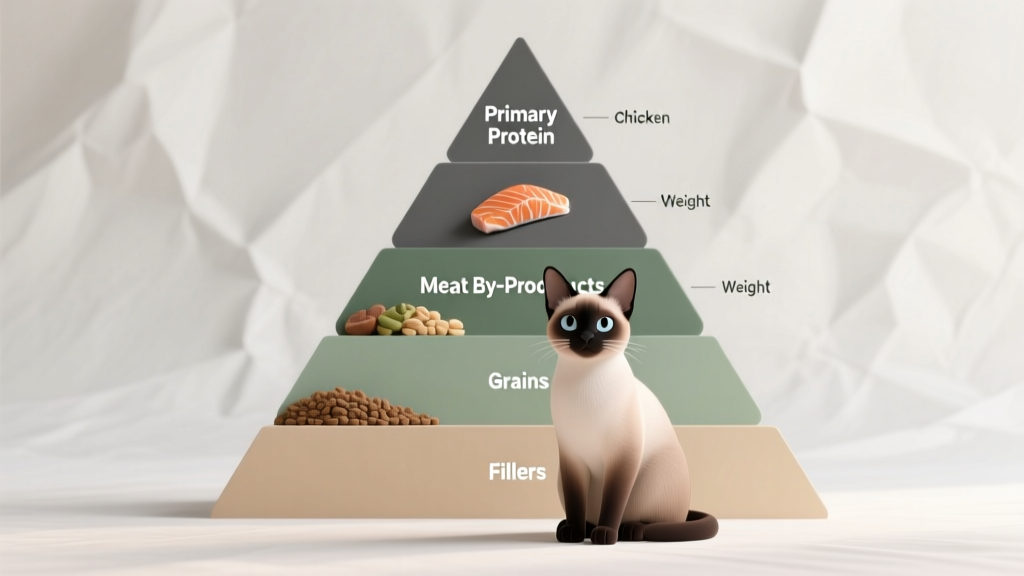
Most cat owners glance at a label, see “chicken” or “salmon” at the top, and assume they’ve found a high-quality food. Ingredient lists can be helpful, but they’re also easy to misread. Cat food ingredients are listed in descending order by weight (before cooking/processing), and that single rule can change how you interpret everything that follows.
Understanding ingredient hierarchy by weight helps you:
- Judge whether the food’s calories are likely coming from animal protein and fat (what cats are biologically designed to use) or from starches and plant proteins
- Spot “ingredient splitting” tactics that make a formula look meat-heavy when it isn’t
- Compare foods more accurately beyond marketing claims like “real meat first”
- Choose diets that support healthy body condition, digestion, skin/coat, and urinary health
Ingredient lists don’t tell the whole story, but they can prevent costly mistakes—especially for kittens, seniors, and cats with medical conditions. For any major diet change or if your cat has health concerns, consult your veterinarian (and ideally a board-certified veterinary nutritionist) for individualized guidance.
2) Scientific background: feline nutritional needs and obligate carnivore biology
Cats are obligate carnivores, meaning they have evolved to thrive on animal-based nutrients. Their metabolism and digestive physiology differ from omnivores in ways that influence what “good” ingredients look like.
Key biological realities that affect label interpretation
- High protein requirement: Cats have a high baseline protein turnover and rely heavily on amino acids for energy. They need adequate, highly digestible protein, ideally from animal sources.
- Essential nutrients found naturally in animal tissues: Cats require preformed taurine, vitamin A (retinol), and arachidonic acid, which are abundant in animal ingredients. While foods can be supplemented, the ingredient base still matters.
- Limited adaptation to high-carbohydrate loads: Cats can digest starch when it’s cooked/processed, but they generally do not require carbohydrates as an essential nutrient. Very high-carb diets may make weight management harder for some cats.
- Water needs: Cats have a naturally low thirst drive. Moist foods can support hydration, which is relevant for urinary tract health in many cats.
What nutrition science prioritizes
In veterinary nutrition, ingredient quality is only one piece. What matters most is the overall nutrient profile (protein, fat, essential fatty acids, vitamins/minerals), digestibility, manufacturing quality control, and whether the diet is complete and balanced for your cat’s life stage. Ingredient hierarchy can help you predict nutrient emphasis, but it can’t replace a full nutritional evaluation.
3) Ingredient hierarchy by weight: a detailed, evidence-based breakdown
Pet food labels list ingredients in descending order by weight as they enter the processing line. This is crucial because “weight” includes moisture. A fresh meat ingredient can weigh more than a dry ingredient simply because it contains more water—even if it contributes less protein after cooking.
Moisture changes everything: fresh meat vs. meat meal
Fresh meats (e.g., chicken, turkey, beef) often contain roughly 60–75% water. “Meal” ingredients (e.g., chicken meal) are rendered and much drier, so they can contribute more protein per pound than fresh meat.
| Ingredient type | Typical moisture | What “first on the list” might mean | Common uses |
|---|---|---|---|
| Fresh meat (e.g., chicken) | High (often 60–75%) | May drop lower after cooking; still can be excellent | Palatability, protein source |
| Meat meal (e.g., chicken meal) | Low (often <10%) | Very protein-dense; can meaningfully boost animal protein content | High-protein kibble formulas |
| By-products (e.g., poultry by-product meal) | Variable | Not automatically “bad”; nutrient-rich organs can be valuable | Cost-effective nutrition, organ nutrients |
| Plant proteins (e.g., pea protein, gluten meals) | Low | Can inflate “protein %” without providing ideal amino acid profile | Texture, cost control, protein boost |
The “top 5 ingredients” rule: useful, but limited
You’ll often hear that the first five ingredients tell you everything. They do tell you a lot about the formula’s base, but they can mislead because:
- Ingredient splitting: Manufacturers can list related carbohydrate ingredients separately (e.g., corn, corn gluten meal, ground corn) so each appears lower on the list, making meat seem more dominant.
- Water-heavy items: Fresh meat at #1 may contribute less dry-matter protein than a meal listed at #2 or #3.
- Minor ingredients can still matter: Small amounts of fish oil, taurine, or specific fiber sources can have meaningful health effects even if they appear lower on the list.
How to “read between the lines” with hierarchy by weight
Use the ingredient list with three additional tools: the guaranteed analysis, calorie statement, and feeding trial/compliance information.
Step-by-step interpretation approach
- Identify the primary protein sources: Are the first several ingredients animal-based (meat, meal, organs), or do you see multiple plant protein concentrates?
- Scan for carbohydrate load clues: Multiple grains/legumes/potatoes in the first 10 ingredients can suggest a higher-starch formula (especially in kibble).
- Check for named fats: “Chicken fat” and “salmon oil” are clearer than generic “animal fat.” Named fats can support essential fatty acid intake and typically indicate better traceability.
- Look for functional fiber sources: Beet pulp, psyllium, cellulose, pumpkin—useful in the right context (hairball control, stool quality, weight management).
- Confirm completeness: Look for an AAFCO nutritional adequacy statement indicating “complete and balanced” for a life stage, ideally supported by feeding trials.
Evidence-based perspective on controversial ingredients
- By-products: Organ meats can be excellent sources of vitamins and minerals. “By-product” isn’t synonymous with “low quality,” though quality control varies by manufacturer.
- Grain-free: Grain-free doesn’t automatically mean low-carb. Many grain-free foods use peas, lentils, chickpeas, or potatoes, which can still be carbohydrate-dense.
- “Natural” claims: “Natural” is a marketing term with limited nutritional meaning. Focus on nutrient balance, digestibility, and quality control instead.
4) Practical recommendations for cat owners
Ingredient hierarchy is most helpful when it’s used as part of a bigger decision framework.
A practical checklist for choosing a food
- Choose “complete and balanced” for your cat’s life stage (kitten, adult, senior) with an AAFCO statement
- Prioritize animal-based proteins in the early ingredient list, while recognizing that meals can be valuable
- Be cautious with multiple plant protein concentrates high on the list if you’re trying to maximize animal-derived protein
- Match moisture to your cat’s needs: many cats benefit from partial or full wet feeding for hydration
- Pick brands with strong quality control (consistent manufacturing, veterinary nutrition expertise, transparent testing)
5) Comparing options and approaches
| Approach | How ingredient hierarchy typically looks | Pros | Trade-offs |
|---|---|---|---|
| Wet/canned complete diets | Meats and broths dominate early list | Higher moisture; often lower carbs; helpful for urinary health and weight management in many cats | Higher cost per calorie; dental benefits are limited; some cats prefer crunchy textures |
| Dry kibble complete diets | Often includes starch sources early; may use meat meals | Convenient; cost-effective; easier for automatic feeders | Lower moisture; carbohydrate content can be higher; ingredient splitting more common |
| Mixed feeding (wet + dry) | Varies by products chosen | Balances hydration and convenience; can improve palatability and compliance | Requires calorie tracking to prevent weight gain |
| Therapeutic veterinary diets | Ingredients may look “less premium” but are formulated for a medical purpose | Evidence-based for specific conditions (urinary, kidney, GI, allergies) | May cost more; not all cats accept them; should be used under veterinary guidance |
6) Common mistakes and misconceptions to avoid
- Mistake: “First ingredient is meat, so it’s high-protein.”
Fresh meat is water-heavy. Check the full ingredient pattern, guaranteed analysis, and calorie density. - Mistake: “By-products are always unhealthy.”
Many organ tissues are nutrient-dense. The more relevant concern is manufacturer quality control and whether the diet is complete and balanced. - Mistake: “Grain-free equals better for cats.”
Grain-free can still be high in starch. Choose based on nutrient profile and your cat’s health needs, not buzzwords. - Mistake: “Protein percentage on the label tells me everything.”
Guaranteed analysis is on an “as-fed” basis. Wet foods look lower in protein because they contain more water. A veterinarian can help evaluate diets on a dry matter basis when needed. - Mistake: Switching foods frequently for variety without a plan.
Sudden changes can trigger vomiting/diarrhea. Cats also can become picky if constantly rotated.
7) How to implement changes safely (transition tips)
Even a better food can cause GI upset if introduced too quickly. Transition slowly, especially for cats with sensitive stomachs.
Simple transition schedule (7–10 days)
| Days | Old food | New food |
|---|---|---|
| 1–3 | 75% | 25% |
| 4–6 | 50% | 50% |
| 7–8 | 25% | 75% |
| 9–10 | 0% | 100% |
Tips for smoother transitions
- Track stool and appetite daily; slow down if stools soften or vomiting occurs
- Measure portions to avoid “bonus calories” during overlap
- Warm wet food slightly to enhance aroma (avoid hot temperatures)
- For dry-to-wet transitions: start with a teaspoon of wet alongside familiar kibble, then gradually increase
- Stop and call your vet if there’s repeated vomiting, blood in stool, lethargy, or refusal to eat for 24 hours (or sooner for kittens)
8) Special considerations: age, health conditions, activity level
Kittens
- Need higher energy density, high-quality protein, and appropriate calcium/phosphorus ratios
- Choose foods labeled for “growth” or “all life stages” and confirm the AAFCO statement
- Ingredient hierarchy: animal proteins should be prominent, but nutrient balance is the priority
Adult cats (indoor vs. active)
- Indoor cats often need calorie control; ingredient lists with lots of starch sources may make portion control harder for some cats
- Active cats may do well with higher calorie density and adequate fat
- Consider mixed feeding to increase moisture without sacrificing convenience
Seniors
- Many seniors benefit from highly digestible protein and increased moisture, but needs vary widely
- Watch for dental disease, reduced appetite, or weight loss; these warrant a veterinary visit
- Don’t restrict protein solely based on age; kidney disease decisions should be vet-guided
Common medical conditions
- Chronic kidney disease (CKD): Therapeutic kidney diets are formulated for phosphorus control and clinical outcomes; ingredient list aesthetics are less relevant than the proven nutrient profile. Always work with your vet.
- Urinary issues (crystals/FLUTD): Moisture intake and urine chemistry matter. Veterinary urinary diets can be helpful; additional water strategies may be recommended.
- Food allergies or adverse food reactions: Ingredient lists are not enough—cross-contamination is possible. Your vet may recommend a prescription hydrolyzed diet or a structured elimination trial.
- Obesity: Focus on calories, portion control, and satiety strategies (protein-forward diets, measured meals). Your vet can calculate calorie targets.
- Diabetes: Many cats do best with carefully managed calories and often lower carbohydrate intake, but treatment must be coordinated with your veterinarian, especially if insulin is used.
9) FAQ: ingredient hierarchy by weight
1) If chicken is the first ingredient, is it automatically a high-meat food?
No. Fresh chicken contains a lot of water. After cooking, the relative contribution can drop. Look at the pattern of ingredients (are there multiple animal ingredients near the top?) and consider the guaranteed analysis and calorie content. If you want a clearer sense of meat contribution in dry foods, “chicken meal” high on the list can be meaningful.
2) Are “meals” bad or lower quality?
Not inherently. Meals can be nutrient-dense and digestible when sourced and processed well. Quality depends on the manufacturer’s standards, sourcing, and testing. Named meals (e.g., “turkey meal”) are generally more transparent than generic terms.
3) What is ingredient splitting, and why does it matter?
Ingredient splitting is listing related ingredients separately (such as peas, pea protein, pea flour) so each appears lower on the list. Combined, they may represent a substantial portion of the formula. This can make a food appear more meat-forward than it truly is.
4) Does a shorter ingredient list mean a better food?
Not necessarily. Some excellent diets have longer lists due to added vitamins, minerals, and functional ingredients. Focus on whether the diet is complete and balanced, appropriate for life stage, and made by a company with strong quality control.
5) Should I choose grain-free to match a “natural” feline diet?
Not automatically. Cats don’t have a nutritional requirement for grains, but they also don’t require “grain-free” labels. Some grain-free foods are still high in starch due to legumes or potatoes. Choose based on nutrient profile, your cat’s health, and veterinary guidance.
6) What’s more important: the ingredient list or the AAFCO statement?
For safety and adequacy, the AAFCO nutritional adequacy statement is usually more important. The ingredient list helps you understand the formulation style, but the AAFCO statement tells you whether it’s intended to be complete and balanced for a life stage. For cats with health conditions, your veterinarian’s recommendations matter most.
If you’re using ingredient hierarchy to upgrade your cat’s diet, pair label-reading with a slow transition and regular weigh-ins to confirm you’re moving in the right direction. For personalized diet decisions—especially for kittens, seniors, or cats with urinary, kidney, GI, allergy, or weight issues—consult your veterinarian.
For more practical, vet-aligned label-reading and feeding guidance, explore additional nutrition guides on catloversbase.com.