Indoor Cat Calorie Needs: Feeding Guide by Life Stage
Why Indoor Cats Need Fewer Calories
Indoor cats burn 20–35% fewer calories than outdoor cats due to limited space, no hunting behaviors, and reduced thermoregulatory demands (AAFP, 2022). A typical 10-lb indoor adult cat requires only 180–220 kcal/day—compared to 240–280 kcal for free-roaming counterparts. Overfeeding is the top cause of feline obesity, affecting 61% of U.S. cats (Association for Pet Obesity Prevention, 2023).
Daily Calorie Ranges by Life Stage
Kittens (under 6 months) need 250–300 kcal/day for growth; neutered adults (1–7 years) require just 180–220 kcal; senior cats (11+ years) often need 160–200 kcal due to slower metabolism and reduced lean muscle mass. Pregnant or lactating queens may need up to 350 kcal/day during peak lactation.
Real-World Feeding Scenarios
Case 1: Luna, a 3-year-old spayed domestic shorthair (9.2 lbs), gained 1.8 lbs in 4 months after switching from measured kibble to free-fed Blue Buffalo Adult Dry (375 kcal/cup). Her vet recommended reducing intake to ⅔ cup daily—cutting her intake by 110 kcal/day—and adding two 3-minute play sessions.
Case 2: Oliver, a 12-year-old Maine Coon (14.5 lbs), developed mild azotemia. His veterinarian prescribed Hill’s Prescription Diet k/d Kidney Care (318 kcal/cup) at ½ cup twice daily—totaling 318 kcal—to support renal function while maintaining lean mass.
Homemade & Supplement Considerations
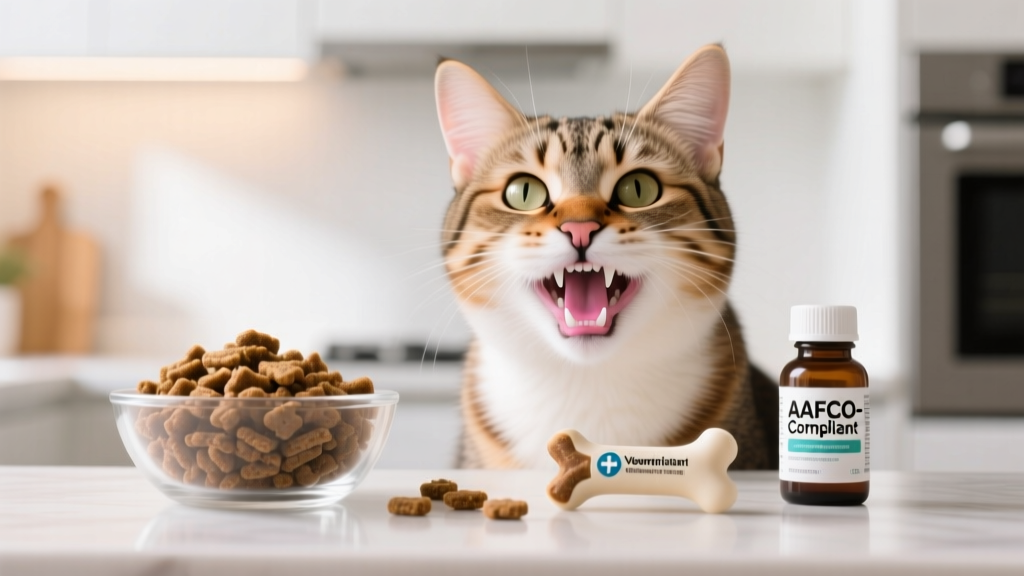
Homemade diets must include taurine (≥0.1% on dry matter basis), arachidonic acid, and vitamin A—nutrients absent in most human-grade meats. A 2021 study in JAVMA found 92% of non-veterinary-formulated homemade recipes were nutritionally incomplete (Kerr et al., 2021). If supplementing, use only AAFCO-compliant products like VetriScience Felovite II (contains B12, taurine, and L-carnitine) — never human multivitamins.
Food Reviews: Calorie-Dense vs. Lower-Calorie Options
| Food Name | kcal/cup (dry) | kcal/3 oz (wet) | Notes |
|---|---|---|---|
| Wellness CORE Natural Grain Free Dry | 450 | — | High-protein but calorie-dense; not ideal for sedentary cats |
| Royal Canin Indoor Adult Dry | 305 | — | Formulated with L-carnitine and fiber; clinically shown to reduce weight gain in 8-week trials (Royal Canin, 2020) |
| Fancy Feast Classic Pate (Turkey) | — | 70 | Low-calorie wet option; 3 oz = ~70 kcal |
| Instinct Original Grain-Free Wet | — | 110 | Higher fat content; 3 oz = ~110 kcal |
Always verify calorie counts on packaging—values vary by flavor and batch. For example, the 2024 reformulation of Purina Pro Plan LiveClear reduced kcal/cup by 8% to improve weight management.
Weight checks every 4–6 weeks are essential. A 10-lb cat should lose no more than 0.2 lbs/month safely. Rapid loss risks hepatic lipidosis.
Consult your veterinarian before switching foods or restricting calories—especially for cats with diabetes, CKD, or hyperthyroidism. Calorie needs shift dramatically with disease onset or remission.
"Energy requirements for indoor cats decline by approximately 1.5% per year after age 1, independent of body weight changes." — Small Animal Clinical Nutrition, 5th ed., p. 217 (Hand et al., 2010)