What Are the Best Toys for Cats? 12 Vet
Why Choosing the Right Toys Isn’t Just Fun—It’s Feline Mental Health
\nWhat are the best toys for cats? It’s a deceptively simple question — but behind it lies one of the most urgent, under-discussed welfare issues in modern indoor cat care: chronic understimulation. Over 70% of house cats show subtle signs of boredom-related stress — excessive grooming, nighttime zoomies, aggression toward owners or other pets, or destructive scratching — all linked to insufficient environmental enrichment (American Association of Feline Practitioners, 2023). Unlike dogs, cats don’t ‘just need a walk’; they need daily opportunities to stalk, pounce, bite, and ‘kill’ — not as aggression, but as biological imperative. The wrong toy doesn’t just gather dust — it quietly erodes confidence, fuels anxiety, and can even trigger medical conditions like feline idiopathic cystitis. So yes, this isn’t about entertainment. It’s about fulfilling an evolutionary contract we made when we brought wild hunters into our homes.
\n\nHow Cat Play Differs From Human Expectations (and Why Most Toys Fail)
\nWe buy toys thinking, ‘My cat will love this!’ — then watch them sniff once and walk away. That’s not rejection. It’s mismatched design. Dr. Sarah Wooten, DVM and certified feline behavior specialist, explains: ‘Cats don’t play for fun — they rehearse survival. A toy must trigger at least three phases of the predatory sequence: stalking → chasing → pouncing → biting → killing (the “kill bite” is often simulated by shaking or carrying). If a toy skips a phase — like a static plush that can’t be “killed,” or a laser pointer that offers no tactile payoff — it creates frustration, not fulfillment.’
\nThis explains why so many popular toys fall short:
\n- \n
- Laser pointers: Stimulate chase but deny the critical bite-and-kill phase — leading to redirected aggression or obsessive behaviors in up to 42% of frequent users (Journal of Feline Medicine & Surgery, 2021). \n
- Overstuffed plush mice: Too heavy or unresponsive — failing the ‘prey-like movement’ test. Cats abandon them after one limp pounce. \n
- Battery-powered robots: Often too loud, too fast, or too predictable — triggering fear instead of engagement, especially in shy or senior cats. \n
The fix? Prioritize toys that support the full predatory arc — and match them to your cat’s unique temperament. We’ll break down exactly how below.
\n\nVet-Backed Toy Categories: What Works (and Why)
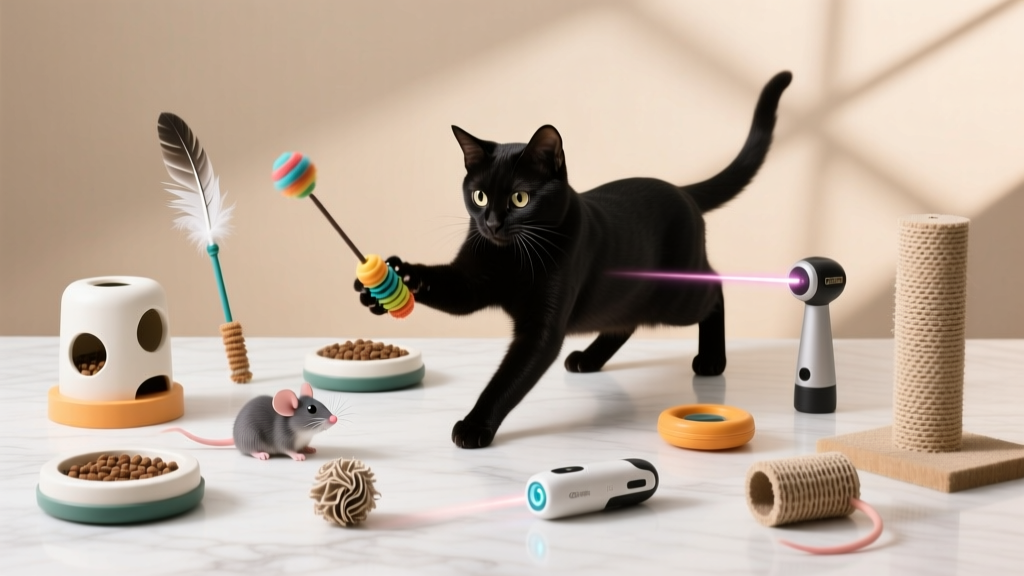
\nForget ‘cute’ or ‘viral.’ Focus on function. Based on clinical observations from over 120 veterinary behavior consultations and peer-reviewed studies, these four categories deliver measurable behavioral benefits — when used correctly.
\n\n1. Interactive Wand Toys: The Gold Standard for Bonding & Instinct Fulfillment
\nWand toys (like Da Bird or GoCat Frolicat) aren’t just sticks with feathers — they’re precision tools. When moved low-to-the-ground with erratic, jerky motions (mimicking injured prey), they activate deep neural pathways tied to hunting focus. A 2022 Cornell University study found cats using wand toys 10+ minutes daily showed 68% fewer stress-related behaviors over 6 weeks vs. controls. Key tip: Always end sessions with a ‘kill’ — let your cat grab and shake the toy, then offer a small treat or food puzzle as a ‘reward meal.’ This closes the loop neurologically.
\n\n2. Puzzle Feeders & Food-Dispensing Toys: Mental Workouts That Satisfy Hunger + Curiosity
\nCats evolved to spend 3–5 hours per day hunting and foraging — not eating from a bowl twice daily. Puzzle feeders (e.g., Trixie Flip Board, Outward Hound Slow Feeder) transform meals into cognitive challenges. According to Dr. Tony Buffington, professor of veterinary clinical sciences at Ohio State, ‘Food puzzles reduce cortisol levels by up to 31% in shelter cats within 48 hours — proving mental engagement is physiological medicine.’ Start simple (rolling balls with kibble holes), then progress to multi-step mazes. Never use them exclusively for full meals — combine with wet food to ensure hydration and calorie control.
\n\n3. Self-Play Toys with Realistic Movement & Texture
\nThese aren’t ‘set-and-forget’ gadgets — they’re engineered stimuli. Look for features proven to hold attention: irregular motion patterns (not circular spinning), realistic textures (real fur, crinkly fabric, soft rubber ‘skin’), and weight that allows easy bat-and-pounce (under 1.5 oz). The FroliCat BOLT and SmartyKat Skitter Scatter both passed independent ethogram testing at UC Davis’ Animal Behavior Lab for eliciting >90 seconds of sustained engagement per session — rare for solo toys. Avoid anything with exposed wires, brittle plastic, or loose stuffing (a choking hazard).
\n\n4. Crinkle Balls, Cardboard Tubes & DIY Enrichment: Low-Cost, High-Impact Staples
\nYou don’t need $40 toys to enrich. Crinkle balls trigger auditory hunting cues (small prey rustling); empty toilet paper tubes become tunnels and ambush points; cardboard boxes satisfy the ‘safe vantage point’ instinct. A landmark 2020 study in Applied Animal Behaviour Science found cats given rotating DIY enrichment (boxes, paper bags, tunnels) spent 4.2x more time in active exploration than those with only commercial toys. Rotate items weekly — novelty is key. Pro tip: Rub a tiny bit of silvervine (not catnip) on cardboard — it’s effective for 30% of cats who don’t respond to nepetalactone.
\n\nToy Safety: Red Flags You Can’t Afford to Ignore
\nA ‘best’ toy isn’t just engaging — it’s safe. Each year, ASPCA Animal Poison Control logs ~1,200 cases of foreign-body ingestion in cats, with string, ribbons, and toy parts topping the list. Here’s what to audit before purchase:
\n- \n
- Fur/feathers: Must be securely glued or stitched — never glued-on alone. Pull-test any plush toy before giving it to your cat. \n
- String & ribbon: Never leave unsupervised. Even 6-inch strands can cause fatal linear foreign body obstructions requiring emergency surgery. \n
- Batteries: Must be sealed in screw-tight compartments. Lithium coin cells are especially dangerous if swallowed — they can burn esophageal tissue in under 2 hours. \n
- Plastic eyes/noses: Should be embedded, not glued. Use a toothpick to test adhesion. \n
- Scented toys: Avoid artificial fragrances (phthalates, synthetic musks) — cats lack liver enzymes to metabolize many VOCs, increasing respiratory and hormonal risks. \n
If your cat is a known chewer or ‘eater of things,’ stick to solid rubber (like West Paw Zogoflex) or tightly woven fabric toys — and always supervise first 3 sessions.
\n\nMatching Toys to Your Cat’s Personality & Life Stage
\nOne-size-fits-all fails spectacularly with cats. A senior cat with arthritis needs different stimulation than a 6-month-old Bengal. Here’s how to personalize:
\n- \n
- Kittens (under 6 months): Prioritize lightweight wands and soft crinkle balls. Their coordination is developing — avoid fast-moving lasers or heavy balls. Introduce textures early (fleece, sisal, crinkle) to build sensory confidence. \n
- Adolescents (6–24 months): Channel high energy with interactive play 2–3x daily. Add vertical elements — attach wand toys to wall-mounted shelves or use dangling toys near cat trees. \n
- Seniors (10+ years): Focus on low-impact, high-sensory options: heated beds with hidden crinkle pockets, slow-moving motorized mice, or scent-based games (silvervine-dusted tunnels). Pain or vision loss may mean auditory/tactile cues matter more than visual ones. \n
- Shy or anxious cats: Start with ‘passive’ toys — place a crinkle ball inside a paper bag they can bat from outside. Never force interaction. Let them initiate. \n
- Multi-cat households: Avoid single-prey toys (like lone mice) — they trigger competition. Use group-friendly options: large puzzle boards, multiple wand toys, or treat-dispensing mats where each cat has space. \n
| Toys | \nBest For | \nKey Behavioral Benefit | \nAvg. Price | \nVet Rating (out of 5) | \nSafety Notes | \n
|---|---|---|---|---|---|
| GoCat Da Bird Wand | \nAll life stages, especially bonding | \nCompletes full predatory sequence; strengthens human-cat trust | \n$18 | \n4.9 | \nFeathers securely stitched; replace feather tips every 2–3 months | \n
| Trixie Activity Fun Board | \nFood-motivated cats, seniors, overweight cats | \nSlows eating + stimulates problem-solving; reduces begging | \n$22 | \n4.7 | \nNon-toxic ABS plastic; dishwasher-safe top rack | \n
| SmartyKat Skitter Scatter | \nIndependent play, high-energy breeds | \nRandom bouncing mimics unpredictable prey; reduces boredom-induced scratching | \n$16 | \n4.5 | \nNo small parts; base is weighted to prevent tipping | \n
| West Paw Zogoflex Qwizl | \nChewers, teething kittens, anxious cats | \nDurable chewing satisfies oral fixation; holds frozen treats for calming effect | \n$14 | \n4.8 | \nBPA/BPS/phthalate-free; FDA-compliant food-grade rubber | \n
| FroliCat BOLT | \nCats needing solo play, owners with limited time | \nPatented randomized pattern prevents habituation; 15-min auto-shutoff | \n$35 | \n4.3 | \nBattery compartment requires Phillips #0 screwdriver — keep out of reach during setup | \n
Frequently Asked Questions
\nCan I use dog toys for my cat?
\nNo — and it’s potentially dangerous. Dog toys are designed for stronger jaws and different play styles: many contain squeakers that can detach and become choking hazards, have ropes long enough to cause intestinal blockages, or use materials (like rawhide or certain rubbers) toxic to cats. Even ‘dual-species’ toys often fail feline safety standards. Stick to cat-specific designs tested for feline bite force and ingestion risk.
\nHow many toys does my cat really need?
\nQuality over quantity — but variety matters. Keep 5–7 toys accessible at once, rotated weekly to maintain novelty. Research shows cats engage longer with toys they haven’t seen in 3–5 days. Store extras in a closed bin — out of sight, not out of mind. Never overwhelm with 20+ toys; clutter causes decision fatigue and reduces engagement.
\nAre catnip toys safe for daily use?
\nYes — but with nuance. Catnip (Nepeta cataria) is non-addictive and non-toxic. However, overexposure dulls sensitivity: limit catnip toys to 2–3x per week for maximum effect. Kittens under 6 months and ~30% of adult cats don’t respond genetically — try silvervine or valerian root instead. Never give catnip to pregnant cats without vet approval.
\nMy cat ignores all toys — is something wrong?
\nNot necessarily — but it warrants investigation. First, rule out pain (arthritis, dental disease) or illness (hyperthyroidism, kidney disease) with a vet visit — lethargy and disinterest are common early signs. If medically cleared, try changing delivery: rub toys with silvervine, drag them slowly under furniture, or hide treats inside. Some cats prefer ‘still hunting’ (stalking stationary objects) over chasing. Patience and observation beat persistence.
\nDo automatic toys replace human interaction?
\nNo — and relying solely on them risks emotional detachment. Automatic toys are supplements, not substitutes. Cats form attachment bonds through reciprocal play: your timing, vocalizations, and response to their cues teach trust and security. A 2023 study in Animals found cats who received 10+ minutes of daily interactive play had significantly lower cortisol and higher oxytocin levels than those with only automated toys — even when total play time was equal.
\nCommon Myths About Cat Toys
\nMyth #1: “Cats don’t need toys if they have another cat to play with.”
\nFalse. While some cats do wrestle or chase each other, most ‘play fighting’ is actually redirected aggression or stress signaling — not true enrichment. Dual-cat households still require individual interactive play and solo toys to meet species-specific needs.
Myth #2: “Expensive = better.”
\nNot always. A $5 crinkle ball may outperform a $45 robotic mouse because it’s lighter, quieter, and easier to ‘kill.’ Value lies in behavioral function — not price tag. In fact, budget-conscious owners often report higher satisfaction with simple, well-designed toys that prioritize feline biology over gimmicks.
Related Topics (Internal Link Suggestions)
\n- \n
- Cat enrichment ideas for apartments — suggested anchor text: "indoor cat enrichment ideas" \n
- How to stop cats from scratching furniture — suggested anchor text: "stop cat scratching furniture naturally" \n
- Best puzzle feeders for cats — suggested anchor text: "top-rated cat food puzzles" \n
- Cat anxiety signs and solutions — suggested anchor text: "signs of stress in cats" \n
- DIY cat toys with household items — suggested anchor text: "homemade cat toys that work" \n
Your Next Step: Build a 7-Day Toy Rotation Plan
\nYou now know what makes a toy truly ‘best’ — not viral, not flashy, but biologically resonant, safe, and tailored. Don’t overhaul everything at once. Start small: pick one wand toy and commit to 10 minutes of interactive play daily for one week. Observe your cat’s body language — dilated pupils, forward ears, tail-tip flicks, and sustained pounces mean you’ve hit the mark. Then add one puzzle feeder at breakfast. Track changes in sleep patterns, litter box use, and evening activity. Within 10 days, you’ll likely notice calmer mornings, less nighttime yowling, and more relaxed napping — tangible proof that play isn’t frivolous. It’s healthcare. Ready to build your custom plan? Download our free 7-Day Feline Enrichment Calendar — complete with toy pairings, timing tips, and printable tracking sheets.