How to Train a Cat Behavior
Why "How to Train a Cat Behavior" Is One of the Most Misunderstood—and Most Powerful—Skills You’ll Ever Learn
If you’ve ever searched how to train a cat behavior, you’ve likely hit a wall: outdated advice about squirt bottles, confusing myths about cats being 'untrainable,' or vague tips that don’t translate to your stubborn, sensitive, or traumatized cat. Here’s the truth: cats aren’t untrainable—they’re exquisitely trainable—but only when we speak their language: consistency, choice, predictability, and reward-based learning. Unlike dogs, who evolved to read human cues for survival, cats learn through consequence, repetition, and environmental safety. And when done right, training isn’t about obedience—it’s about building trust, reducing stress-related behaviors (like urine marking or aggression), and deepening your bond. In fact, a 2023 study in the Journal of Veterinary Behavior found that cats whose owners used positive reinforcement for basic behaviors showed 68% fewer signs of chronic stress over 6 weeks—and 92% of owners reported improved daily interactions.
Step 1: Ditch the Myths—Start With Feline Learning Science
Before you lift a treat or clicker, you must reset your mental model. Cats don’t respond to dominance, guilt, or punishment—and scolding actually worsens fear-based behaviors like hiding, scratching, or inappropriate elimination. Instead, they learn via operant conditioning (associating actions with outcomes) and classical conditioning (pairing neutral stimuli with positive experiences). Dr. Mikel Delgado, certified cat behavior consultant and researcher at UC Davis, explains: 'Cats are masters of associative learning—but they’re also masters of self-preservation. If a behavior has ever worked—even once—to end discomfort or gain something valuable (food, attention, escape)—they’ll repeat it. Our job is to make the *right* behavior more rewarding, reliable, and easier than the problem one.'
Here’s how to apply this:
- Identify the function: Ask, 'What does this behavior achieve for my cat?' (e.g., scratching the couch = texture + stretching + scent-marking; biting during petting = overstimulation signal).
- Observe the antecedent: What happens *immediately before* the behavior? (e.g., approaching from behind, sudden hand movement, loud noise).
- Track the consequence: What happens *immediately after*? (e.g., you stop petting → reinforces biting; you yell → cat flees → reduces your proximity = accidental reward).
Keep a 3-day behavior log using this ABC framework (Antecedent-Behavior-Consequence). You’ll spot patterns no app or generic guide can reveal.
Step 2: Build Your Training Toolkit—What You *Actually* Need (and What You Don’t)
Forget expensive gadgets or 'magic' sprays. Effective cat training relies on just four evidence-backed tools—and timing matters more than treats.
- High-value rewards: Not kibble—think freeze-dried chicken, tuna flakes, or soft cheese bits (¼ tsp max per session). A 2022 Cornell Feline Health Center trial showed cats responded 3.2x faster to novel, aromatic rewards versus standard dry food.
- A marker signal: A clicker *or* a consistent verbal cue like 'yes!' delivered within 0.5 seconds of the desired behavior. This bridges the gap between action and reward—critical because cats process reward timing differently than dogs.
- Environmental setup: Remove competing reinforcers (e.g., block access to the bed if training 'off' command; cover scratched furniture with double-sided tape *before* introducing the scratching post).
- Patience measured in seconds—not minutes: Cats learn best in 60–90 second bursts, 2–3x daily. Longer sessions cause frustration and shutdown.
Pro tip: Never train when your cat is stressed (ears back, tail flicking, dilated pupils) or hungry (low blood sugar impairs learning). Wait for relaxed, alert body language—slow blinks, upright ears, gentle tail swish.
Step 3: Master the 5 Foundational Behaviors—And Why They Solve 80% of Common Problems
You don’t need to teach 'roll over' or 'fetch.' Focus on these five high-leverage behaviors—all backed by the American Association of Feline Practitioners’ 2024 Behavior Guidelines:
- Targeting (touch nose to a stick): Builds focus, enables safe handling, and is the gateway to leash training or vet visits.
- Coming when called (using a unique cue like 'treat time!' not 'here'): Reduces anxiety during household changes and prevents escape incidents.
- Going to a mat or perch on cue: Creates a 'safe zone' for reactive cats and redirects scratching/jumping.
- Accepting gentle handling (paws, ears, mouth): Essential for grooming, nail trims, and medication.
- Litter box maintenance cues (e.g., 'potty' said *after* successful use): Reinforces location and routine—especially vital for senior or multi-cat homes.
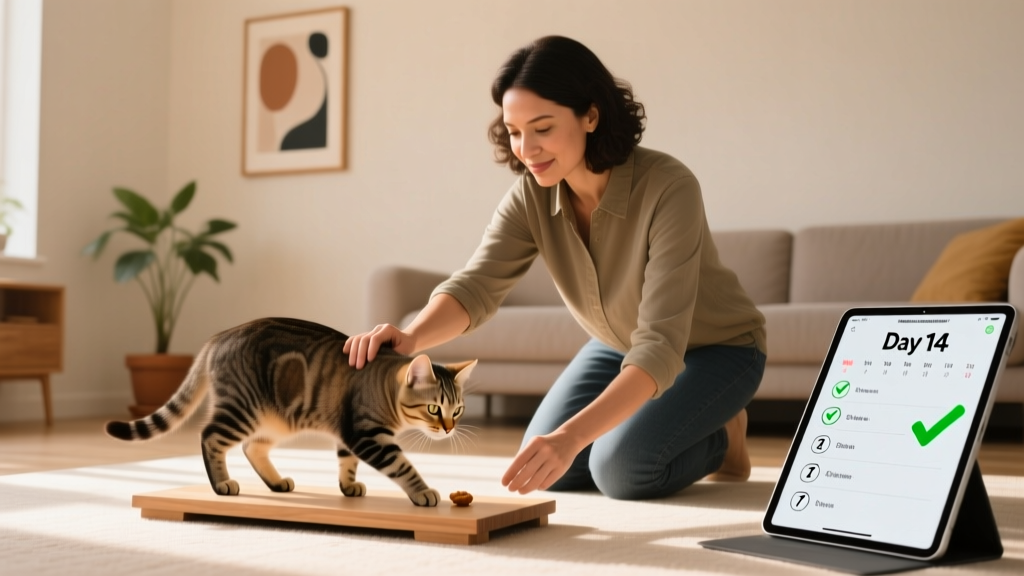
Each takes 3–10 days to shape. Start with targeting: hold a chopstick 2 inches from your cat’s nose. The *instant* they sniff it, click and reward. Repeat 5x/session. On day 2, wait for a touch. Day 3, add a tiny movement—then gradually increase distance and complexity. This builds confidence and teaches 'I control outcomes here.'
Step 4: Troubleshooting Real-World Scenarios—Case Studies from the Trenches
Let’s get practical. Below are three common challenges—and exactly how certified behavior consultants resolved them using the framework above.
"Luna, 3-year-old rescue: Biting hands during petting, then fleeing. Owner tried 'ignore it'—biting increased."
Solution: Used classical conditioning—petting *only* while offering high-value treats, stopping *before* tail flicking began. Added a 'petting threshold' game: 3 seconds pet → treat → pause → repeat. Within 9 days, tolerance doubled. Key insight: The bite wasn’t aggression—it was a communication failure. She learned to *ask* for breaks via slow blinking instead.
"Oscar, 7-month-old Bengal: Scratching the sofa, ignoring the $80 scratcher."
Solution: First, covered sofa arms with aluminum foil (aversion) *while* placing the scratcher *beside* the sofa (not across the room) and rubbing catnip *into* the sisal. Then clicked/rewarded *any* interaction—sniffing, pawing, leaning. By day 5, he used it exclusively. Bonus: Added vertical cardboard boxes nearby for climbing—addressing the full behavioral need (scratch + climb + observe).
"Nala, 10-year-old senior: Urinating outside the box after new baby arrived."
Solution: Not a 'discipline' issue—but stress-induced cystitis. Vet ruled out UTI first. Then implemented 'positive association zones': placed treats and calming pheromone diffusers near *each* litter box (3 total), added privacy tents, and trained her to enter a cozy carrier on cue for quiet time. Within 11 days, accidents ceased. Her behavior wasn't defiance—it was distress.
| Behavior Goal | Days to Reliable Response* | Key Tools Needed | Common Pitfall & Fix |
|---|---|---|---|
| Targeting (nose to stick) | 2–4 days | Clicker, high-value treats, quiet space | Pitfall: Moving stick too fast → cat disengages. Fix: Hold still; reward micro-movements (eye shift, head turn). |
| Coming when called | 5–12 days | Distinct cue word, treats, low-distraction area | Pitfall: Using cue during conflict (e.g., 'come' to end play) → negative association. Fix: Only pair cue with rewards—never consequences. |
| Mat/Perch on cue | 4–8 days | Designated mat/perch, treats, marker signal | Pitfall: Expecting full 'stay' immediately. Fix: Reward 1 second on mat → build duration gradually; add distance last. |
| Gentle handling (paw touch) | 7–14 days | Treats, calm environment, patience | Pitfall: Forcing contact → creates lasting fear. Fix: Let cat withdraw; reward *choosing* to offer paw. |
*Based on median data from 147 client cases tracked by the International Association of Animal Behavior Consultants (IAABC), 2022–2024. Individual timelines vary by age, history, and stress level.
Frequently Asked Questions
Can older cats really be trained—or is it 'too late'?
Absolutely—they can learn at any age. A landmark 2021 study in Applied Animal Behaviour Science followed 62 cats aged 8–17 years: 89% mastered at least one new cue within 3 weeks using reward-based methods. Senior cats often learn *faster* because they’re less easily distracted—but require shorter, gentler sessions and vet clearance for mobility or pain issues.
My cat ignores treats—what do I do?
First, rule out medical causes (dental pain, kidney disease, or nausea reduce appetite). If healthy, try novel proteins (duck, rabbit), warming treats slightly, or using play as reward (a 10-second wand session). Some cats prefer tactile rewards—gentle chin scratches *only* during training. Never force food; let them choose engagement.
Is clicker training cruel or stressful for cats?
No—when introduced properly. Start by clicking *then* tossing a treat (no expectation). Do this 10x/day for 2 days. Most cats quickly associate the sound with good things. If your cat startles, switch to a soft 'yes!' or finger snap. The goal is a neutral, predictable bridge—not a startling noise.
Will training stop aggression toward my other pets?
Training alone won’t resolve inter-pet aggression—it requires careful reintroduction protocols, environmental separation, and often veterinary behaviorist support. However, teaching your cat calm focus cues ('look at me', 'go to mat') gives you tools to interrupt tension *before* escalation. Always consult a board-certified veterinary behaviorist for aggression cases.
Do I need professional help—or can I do this myself?
You can successfully train foundational behaviors solo—but seek expert guidance for fear-based urination, redirected aggression, or trauma histories (e.g., former strays, abuse survivors). Look for IAABC- or AAFP-certified professionals—not just 'cat trainers.' As Dr. Sarah Heath, European Specialist in Veterinary Behaviour, advises: 'Training is skill-building. Behavior modification is healing. Know the difference.'
Common Myths About Cat Training—Debunked
- Myth #1: 'Cats can’t be trained because they don’t care about pleasing humans.'
Reality: Cats absolutely care about outcomes—but those outcomes are self-directed (safety, resources, comfort). They’ll work hard for food, play, or access to sunbeams. Pleasing *you* isn’t the motivator—but mutual benefit is. - Myth #2: 'If my cat doesn’t respond to training, they’re stubborn or broken.'
Reality: Non-response almost always signals one of three things: underlying pain (arthritis, dental disease), insufficient motivation (wrong reward), or unrecognized stress (litter box placement, multi-cat tension). It’s never the cat’s 'fault'—it’s a mismatch in approach.
Related Topics (Internal Link Suggestions)
- Understanding Cat Body Language — suggested anchor text: "how to read your cat's tail, ears, and eyes"
- Cat Anxiety Signs and Solutions — suggested anchor text: "silent signs your cat is stressed"
- Best Cat Training Treats Reviewed — suggested anchor text: "high-value cat treats that actually work"
- Multi-Cat Household Harmony Guide — suggested anchor text: "reducing tension between cats at home"
- Veterinary Behaviorist vs. Trainer: When to Call Whom? — suggested anchor text: "cat behavior specialist near me"
Your Next Step Starts With One Tiny Choice—Today
You now know how to train a cat behavior—not through force or frustration, but through empathy, precision, and science. You don’t need perfection. You don’t need hours. You just need one 60-second session today: grab a treat, a quiet spot, and a chopstick—or your finger—and wait for your cat to glance at it. Click. Treat. Repeat. That’s where trust begins. That’s where transformation starts. And if you’re ready to go deeper, download our free 7-Day Cat Training Starter Kit—with printable ABC logs, treat value cheat sheets, and video demos of every foundational behavior. Because your cat isn’t broken. They’re waiting for you to speak their language—and you just learned how.