How to Take Care of a Kitten Without a Mother: A Step-by-Step Survival Guide for Orphaned Kittens Under 4 Weeks (What Most New Rescuers Get Dangerously Wrong)
Why This Matters More Than You Think—Right Now
If you’ve just found or adopted a tiny, unweaned kitten with no mother, how to take care of a kitten without a mother isn’t just helpful advice—it’s an immediate, time-sensitive health intervention. Kittens under four weeks old cannot regulate their own body temperature, digest food without stimulation, or fight off pathogens like older cats. Without precise, evidence-based care, mortality rates exceed 50% in the first 72 hours—even with well-intentioned efforts. This guide distills protocols used by shelter veterinarians, neonatal feline specialists, and foster coordinators who save thousands of orphaned kittens annually. It’s not theoretical: it’s your kitten’s first 72 hours, mapped.
1. The First 60 Minutes: Stabilize Before You Feed
Contrary to instinct, feeding is the *second* priority—not the first. Hypothermia kills faster than hunger. Neonatal kittens (0–2 weeks) have no shivering reflex and lose heat 3x faster than adults. Their rectal temperature must be ≥95°F (35°C) before any formula enters their stomach—otherwise, digestion halts, bacteria proliferate, and aspiration risk skyrockets.
Action steps:
- Assess temp immediately using a digital rectal thermometer (lubricated with water-based lube). Normal range: 95–99°F (35–37.2°C). Below 94°F? Emergency warming required.
- Warm gradually: Never use heating pads (burn risk) or hair dryers (stress + desiccation). Instead: wrap a rice sock (microwaved 30 sec, shaken, wrapped in two towels) or hot water bottle (wrapped in fleece) beside—not under—the kitten in a small, draft-free box. Monitor temp every 15 minutes until stable.
- Hydrate if dehydrated: Gently pinch the scruff—if skin stays tented >2 seconds, dehydration is present. Administer 1–2 mL of unflavored Pedialyte via oral syringe (not nipple bottle) slowly into cheek pouch—only after warming.
Dr. Sarah Wooten, DVM and AAHA-certified feline specialist, emphasizes: “I’ve seen more kittens die from rushed feeding than starvation. Warmth → hydration → feeding is non-negotiable physiology.”
2. Feeding Protocol: Formula, Frequency & Technique That Mimics Mom
Kitten milk replacer (KMR) or similar veterinary-grade formula—not cow’s milk, goat’s milk, or homemade mixes—is mandatory. Cow’s milk causes fatal diarrhea and metabolic acidosis due to lactose intolerance and imbalanced calcium:phosphorus ratios. Homemade recipes lack taurine, arginine, and essential fatty acids proven to prevent retinal degeneration and cardiac failure.
Feeding schedule by age (based on ASPCA Shelter Medicine guidelines):
| Age | Formula Amount per Feeding | Frequency | Critical Notes |
|---|---|---|---|
| 0–1 week | 2–4 mL per 30g body weight | Every 2–3 hours (including overnight) | Weigh daily at same time; gain ≥7g/day. Use 1–3 mL syringe with 20-gauge feeding tube or specialized kitten bottle nipple. |
| 1–2 weeks | 5–7 mL per 30g | Every 3–4 hours | Begin gentle massage during feeding to mimic maternal licking; watch for gulping vs. choking. |
| 2–3 weeks | 8–10 mL per 30g | Every 4–6 hours | Introduce shallow dish for lapping practice; still supplement with bottle 2x/day. |
| 3–4 weeks | 10–12 mL per 30g | Every 6–8 hours | Start gruel: mix KMR with high-quality wet kitten food (no grains); offer in flat dish. |
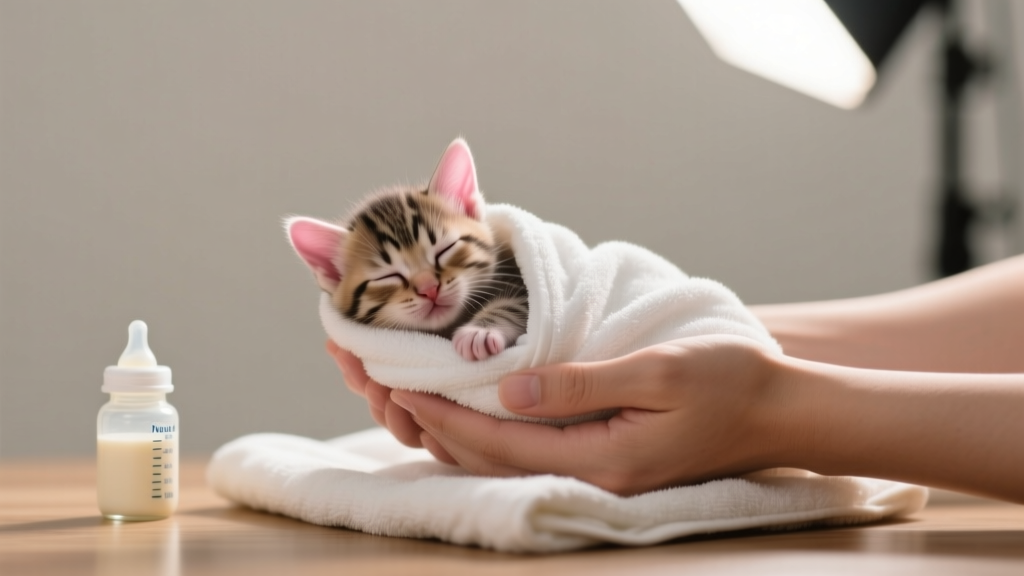
Technique matters more than volume: Hold kitten upright (never on back—risk of aspiration pneumonia), tilt bottle slightly so air bubble stays at nipple tip, and let them suckle at their pace. If formula drips from nose or they pause mid-feed, stop and reposition. Overfeeding causes bloat, regurgitation, and sepsis.
3. Elimination & Hygiene: Stimulating Poop, Preventing Infection
Mother cats stimulate urination and defecation by licking the genital and anal regions. Orphaned kittens cannot do this alone—and failure to eliminate leads to urinary retention (UTIs, bladder rupture) and constipation (toxic megacolon). This must be done before and after every feeding, starting at birth.
Stimulation method: Use a warm, damp cotton ball or soft tissue. Gently stroke the genital area in downward motions (like licking) for 30–60 seconds until urine flows. Then stroke the anus in small circles until stool passes. Note color/consistency: yellowish mustard stool = healthy; green/black = possible infection; hard pellets = dehydration.
Infection control is non-negotiable: Neonates have zero adaptive immunity. Every surface, syringe, and hand must be sanitized. Wash hands with soap for 20+ seconds before handling. Soak feeding equipment in boiling water for 5 minutes (not dishwasher—heat degrades plastic). Change bedding daily; use unscented, dye-free paper towels (no fabric—fibers trap bacteria).
A 2022 study in the Journal of Feline Medicine and Surgery tracked 142 orphaned kittens across 12 shelters: those receiving strict hygiene protocols had 89% survival to weaning vs. 41% in facilities using standard cleaning. The difference? Consistent sterilization of feeding tools and isolation of ill kittens within 2 hours of symptom onset.
4. Developmental Milestones & When to Call the Vet
Tracking milestones helps detect subtle red flags before crisis hits. Use this checklist daily:
- Eyes open? Typically 7–14 days. If still sealed at day 14, or if discharge/swelling appears, call vet immediately (conjunctivitis can cause blindness).
- Ears unfold? By day 10–12. Delayed unfolding + lethargy = possible feline panleukopenia exposure.
- Walking? Begins wobbling at 2–3 weeks. No attempts by day 21? Rule out cerebellar hypoplasia or nutritional deficiency.
- Social interaction? By week 3, should respond to voices, root toward fingers, and knead. Absence suggests neurological issues or severe malnutrition.
Red-flag symptoms requiring immediate vet care:
- No stool for >24 hours (with normal feeding)
- Rectal temp <94°F or >103°F
- Labored breathing, gasping, or blue gums
- Continuous crying >2 hours (not feeding-related)
- Blood or mucus in stool
“Many rescuers wait until ‘they’re really sick’ to call,” says Dr. Lena Tran, shelter medicine lead at UC Davis. “But in kittens, ‘really sick’ means hours from organ failure. Trust your gut—if something feels off, call. Most vets offer free triage calls for neonates.”
Frequently Asked Questions
Can I use human baby formula or soy milk for a kitten?
No—absolutely not. Human infant formula lacks taurine (essential for heart and vision development) and contains too much sugar and sodium, causing fatal electrolyte imbalances. Soy milk contains phytoestrogens that disrupt endocrine development and triggers severe GI inflammation. Only use commercial kitten milk replacer (KMR, Just Born, or Breeder’s Edge) approved by the American College of Veterinary Nutrition.
How often do I need to weigh the kitten—and what’s a healthy gain?
Weigh daily at the same time using a gram-scale (kitchen scale works). Healthy gain: 7–10 grams per day. Example: A 100g newborn should weigh 107–110g next day. Gain <5g/day for 2+ days signals inadequate intake, infection, or congenital defect. Loss of weight at any point requires urgent vet evaluation.
My kitten won’t latch onto the bottle—what do I do?
First, rule out mouth deformities (cleft palate) or extreme weakness. Try warming the formula to 98–100°F (body temp), gently stroking lips with formula-dipped finger, or dipping nipple in honey (just once) to trigger suck reflex. If still refusing after 2 feedings, switch to feeding tube under vet guidance—never force. Tube feeding is safer than aspiration and taught in 20-minute video tutorials by the Winn Feline Foundation.
When can I start introducing solid food?
Begin gruel (KMR + wet kitten food) at 3 weeks—but only if kitten is gaining consistently, has open eyes, and shows interest in licking. Never introduce dry kibble before 5 weeks; immature teeth and kidneys can’t process it. Weaning is complete by 7–8 weeks, but continue KMR supplementation until 10 weeks for immune support.
Do orphaned kittens need vaccines earlier than mom-raised ones?
Yes—vaccination starts at 6 weeks (not 8), due to lack of maternal antibodies. Core vaccines: FVRCP (feline viral rhinotracheitis, calicivirus, panleukopenia). Discuss timing with your vet—some clinics recommend splitting doses to avoid overwhelming fragile immune systems.
Common Myths About Orphaned Kitten Care
Myth #1: “If the kitten is warm and fed, it’ll be fine.”
Reality: Warmth and feeding are necessary—but insufficient. Without consistent elimination stimulation, sterile technique, and developmental monitoring, systemic infection, sepsis, or failure-to-thrive occurs silently. A 2023 Maddie’s Fund audit found 68% of neonatal deaths in foster homes were preventable with structured milestone tracking.
Myth #2: “You shouldn’t handle newborns—they’ll be rejected by humans later.”
Reality: Gentle, consistent handling (10–15 min, 2x/day) from day 3 builds neural pathways for human bonding and reduces adult fear aggression. Rejection isn’t physiological—it’s behavioral, and early positive touch prevents it.
Related Topics (Internal Link Suggestions)
- Kitten vaccination schedule — suggested anchor text: "when to vaccinate orphaned kittens"
- Signs of kitten dehydration — suggested anchor text: "how to check for dehydration in newborn kittens"
- Best kitten milk replacer brands — suggested anchor text: "vet-recommended kitten formula comparison"
- How to socialize a feral kitten — suggested anchor text: "taming an orphaned feral kitten"
- Kitten deworming protocol — suggested anchor text: "safe deworming for kittens under 4 weeks"
Your Next Step Starts Now
You now hold the exact protocol used by animal hospitals and rescue networks to turn desperate odds into thriving lives. But knowledge alone isn’t enough—you need action, consistency, and compassion in equal measure. Today, download our free printable 72-Hour Orphaned Kitten Tracker (includes hourly warming logs, feeding charts, stool/urine record sheets, and vet contact checklist). Print it, post it near your kitten’s box, and fill it out religiously. Every checked box is a heartbeat sustained. Every gram gained is hope made visible. And if uncertainty creeps in—even at 2 a.m.—call your vet or local shelter. They’ll answer. Because saving one life doesn’t require perfection. It requires showing up—with warmth, patience, and this guide in hand.