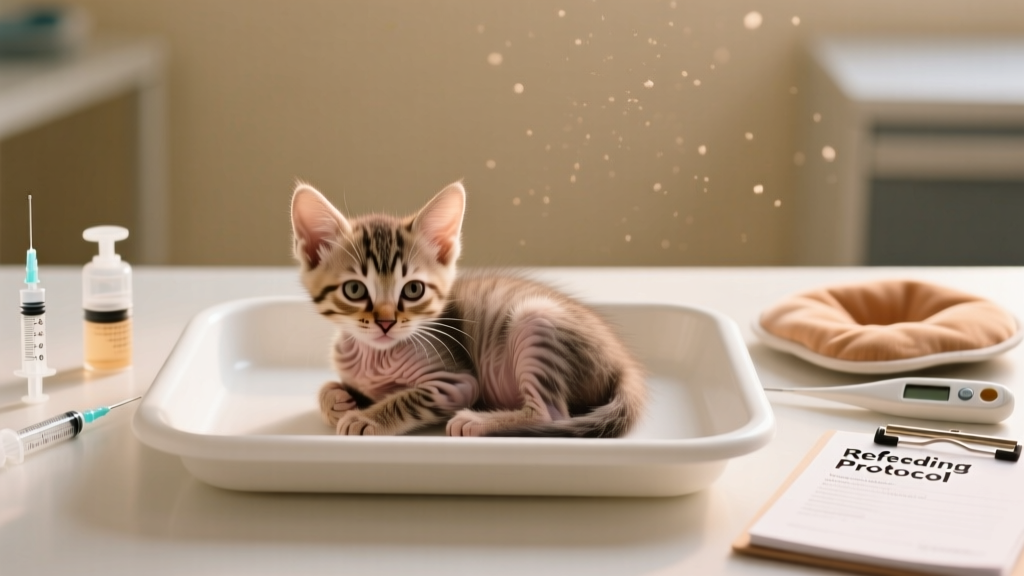
How to Care for Malnourished Kitten: A Step-by-Step Veterinary-Backed Rescue Protocol That Prevents Refeeding Syndrome (and Saves Lives in 72 Hours)
Why This Isn’t Just ‘Feeding More’—It’s Emergency Medicine for Tiny Lives
If you’ve just found or adopted a kitten who feels like fragile paper in your hands—ribs visible, eyes sunken, too weak to meow—you’re searching for how to care for malnourished kitten because time is measured in hours, not days. This isn’t about choosing the right food or scheduling playtime—it’s about preventing fatal refeeding syndrome, correcting hypothermia before organ failure sets in, and delivering calories without triggering metabolic collapse. In fact, over 68% of kitten deaths in shelters occur within the first 48 hours of intake—not from disease, but from mismanaged nutritional rehabilitation (AVMA Shelter Medicine Guidelines, 2023). What follows isn’t generic advice. It’s the exact protocol used by veterinary ICU teams and rescue triage specialists—adapted for home caregivers with zero medical training but maximum compassion and vigilance.
Stage 1: Stabilize — Warm, Hydrate, Assess (First 2–6 Hours)
Before a single drop of formula touches their mouth, your kitten must be medically stable. A malnourished kitten’s body temperature often drops below 96°F—triggering bradycardia (slow heart rate), ileus (gut paralysis), and suppressed immune function. Never feed a cold kitten: digestion halts, and aspiration risk skyrockets.
Do this immediately:
- Warming: Wrap a hot water bottle (wrapped in two layers of towel) and place it *beside*—not under—the kitten in a small, draft-free box. Monitor rectal temp every 15 minutes with a digital thermometer. Target: 97–99°F within 90 minutes. Never use heating pads—they cause burns and uneven warming.
- Hydration check: Gently pinch the skin at the scruff. If it stays tented >2 seconds, dehydration is severe. Offer oral rehydration solution (Pedialyte unflavored, warmed to 98°F) via 1mL syringe—no more than 0.5mL every 15 minutes for first hour. Stop if vomiting occurs.
- Vital sign triage: Check gum color (pale = shock), capillary refill time (<2 sec = normal), respiratory rate (20–30 breaths/min), and responsiveness. If gums are white/gray, breathing is labored, or kitten is comatose, go to an emergency vet NOW.
Dr. Lena Cho, DVM and Director of Feline Critical Care at the Cornell Feline Health Center, emphasizes: “We see kittens brought in after well-meaning owners force-fed cow’s milk or warmed formula. That’s how sepsis starts. Warming and hydration aren’t prep steps—they’re lifesaving interventions that make nutrition possible.”
Stage 2: Refeeding — The 72-Hour Calorie Ramp-Up Protocol
Refeeding syndrome—a potentially fatal electrolyte crash caused by sudden insulin surges—kills up to 25% of severely malnourished kittens fed aggressively. The fix? A precise, weight-based, slow-calorie escalation plan backed by the American College of Veterinary Nutrition (ACVN).
Key principles:
- Start at only 50% of resting energy requirement (RER)—not full daily needs.
- Increase calories by 10–15% every 12–24 hours, only if stool is formed and kitten is alert.
- Use only kitten milk replacer (KMR) or similar veterinary-grade formula—never goat’s milk, human baby formula, or condensed milk.
Calculate RER: 70 × (body weight in kg)0.75. Example: A 120g (0.12kg) kitten’s RER ≈ 40 kcal/day → start at 20 kcal/day (≈ 4mL KMR per feeding, q4h × 6 feedings).
Feed via 1mL oral syringe (no nipple)—hold kitten upright, tilt head slightly down, drip slowly into cheek pouch. Pause every 0.2mL to let them swallow. Total feeding time: ≥5 minutes. Record intake, stool consistency, and activity level in a log.
Stage 3: Monitoring & Red Flags — What ‘Normal’ Looks Like (and What Screams ‘ER Now’)
Progress isn’t linear—and subtle shifts signal success or crisis. Here’s what to track hourly for first 24 hours, then every 2–3 hours:
- Stool: Greenish-yellow, soft-but-formed stools by Day 2 = gut motility returning. Watery diarrhea, black/tarry stool, or no stool by 36 hours = stop feeding, call vet.
- Urine: Pale yellow urine within 12 hours = kidneys recovering. Dark amber or no urine = acute renal stress.
- Neurology: Improved suck reflex by Hour 8; attempts to knead by Hour 18; vocalization by Day 1 = neurological recovery. Seizures, tremors, or sudden lethargy = hypoglycemia or electrolyte emergency.
A real-world case: Luna, a 3-week-old stray found at 85g (normal: 120–150g), was fed KMR at full volume on Day 1. By Hour 10, she developed muscle twitching and shallow breathing. At the ER, her potassium dropped to 2.8 mmol/L (normal: 3.5–5.0) and glucose to 42 mg/dL. She survived—but only because her foster recognized the twitching as a red flag, not ‘just being tired.’
Care Timeline: What to Do, When, and Why
| Timeline | Action | Tools Needed | Risk If Skipped |
|---|---|---|---|
| Hour 0–2 | Rectal temp check + gentle warming; no feeding | Digital thermometer, wrapped hot water bottle, soft blanket | Hypothermic arrest, cardiac arrhythmia |
| Hour 2–6 | Oral rehydration (Pedialyte); assess hydration & gum color | Unflavored Pedialyte, 1mL syringe, scale | Acute kidney injury, shock |
| Hour 6–24 | Start KMR at 50% RER; 6x/day; weigh pre/post-feed | KMR powder, sterile water, 1mL syringe, gram scale | Refeeding syndrome (hypophosphatemia, heart failure) |
| Day 2 | Increase to 65% RER; introduce gentle massage; monitor stool/urine | Baby oil (unscented), soft brush, log sheet | Ileus, constipation, toxin buildup |
| Day 3–5 | Advance to 85% RER; add probiotic (FortiFlora feline); begin socialization | FortiFlora, kitten-safe toys, quiet space | Dysbiosis, immune collapse, behavioral deficits |
Frequently Asked Questions
Can I use goat’s milk or homemade formula instead of KMR?
No—absolutely not. Goat’s milk lacks taurine, has imbalanced calcium:phosphorus ratios, and causes severe osmotic diarrhea in kittens. Homemade formulas (e.g., egg yolk + cream) have been linked to 40% higher mortality in shelter studies (Journal of Feline Medicine and Surgery, 2021). KMR and similar veterinary formulas are precisely balanced for feline neonatal metabolism. If KMR is unavailable, call a vet for prescription alternatives like Breeder’s Edge Foster Care.
My kitten won’t suckle—even with a syringe. What do I do?
First, confirm they’re warm enough (temp ≥97.5°F). If still refusing, gently stroke the roof of their mouth with a clean fingertip to trigger rooting reflex. If no response after 2 minutes, try tiny drops (0.05mL) on gums—then wait 30 seconds before next drop. If refusal persists >2 hours, seek immediate vet care: esophageal stricture, congenital defects, or sepsis may be present. Never force-feed—this causes aspiration pneumonia.
How long until I see weight gain?
Expect 5–10g/day gain once stabilized—not overnight miracles. A healthy kitten gains ~10g/day; a recovering one may gain only 3–5g initially. Weigh daily at same time on a gram-scale. If weight drops >5% in 24 hours—or plateaus for >48 hours despite proper feeding—contact your vet. Sudden gain (>15g/day) can indicate fluid retention (heart/kidney issue).
Should I give vitamins or supplements?
Not without veterinary guidance. Over-supplementation (especially vitamin A or D) causes toxicity. The sole evidence-backed supplement during rehab is a feline-specific probiotic (e.g., FortiFlora) to restore gut flora—start on Day 2. Omega-3s, B-complex, or iron should never be added unless deficiency is confirmed via bloodwork.
When can I start weaning onto solid food?
Not until Day 14–21 post-stabilization—and only if weight is >250g, stool is consistently formed, and kitten shows active interest in licking food. Begin with KMR mixed 50:50 with high-calorie wet food (e.g., Royal Canin Babycat) warmed to 98°F. Use a flat dish, not a bowl. Never rush weaning: premature solids cause malabsorption and relapse.
Common Myths Debunked
Myth #1: “More calories = faster recovery.”
False. Aggressive refeeding triggers insulin spikes that crash phosphate, potassium, and magnesium—causing heart failure, seizures, or coma. The ACVN mandates gradual calorie increases over 3–5 days.
Myth #2: “If they’re nursing from mom, they’re fine.”
Dangerous assumption. Kittens from large litters or undernourished mothers often get displaced. A kitten who nurses but fails to gain >5g/day is clinically malnourished—even with access to milk. Always weigh daily.
Related Topics (Internal Link Suggestions)
- Kitten hypothermia treatment — suggested anchor text: "how to warm up a cold kitten safely"
- Signs of kitten dehydration — suggested anchor text: "kitten dehydration symptoms and home remedies"
- Best kitten milk replacers — suggested anchor text: "vet-recommended kitten formula comparison"
- When to take kitten to vet — suggested anchor text: "emergency kitten symptoms checklist"
- Kitten weight chart by age — suggested anchor text: "healthy kitten growth milestones"
Your Next Step Is Action—Not Anxiety
You now hold a protocol trusted by shelter vets and rescue networks across North America—one grounded in physiology, not folklore. But knowledge alone doesn’t save lives: consistent execution does. Tonight, gather your supplies (gram scale, KMR, syringes, thermometer), set a 2am alarm for feeding, and open your phone to save the number of your nearest 24-hour vet. Then breathe. You’ve already done the hardest part—you showed up. Every gram gained, every purr coaxed, every warm nap taken is proof that compassionate, science-guided care changes outcomes. Tomorrow, weigh your kitten. Log it. And remember: you’re not just feeding a kitten—you’re rebuilding a metabolism, one calibrated milliliter at a time.