Cat Vaccination Schedule 2026: Core & Non-Core Shots
Vaccinating your cat on the right timeline is one of the single most impactful decisions you can make for its long-term health. Feline vaccines protect against a range of viral and bacterial diseases that can be fatal or cause lifelong suffering. The American Association of Feline Practitioners (AAFP) updated its feline vaccination guidelines in 2020, and veterinary practices across the United States have refined their protocols based on field data collected over the past several years.
Understanding the vaccination schedule can feel overwhelming for first-time cat owners. Kittens need a series of shots during their first months of life, followed by boosters at specific intervals. Adult and senior cats follow different timelines depending on their lifestyle, health status, and geographic location. This article walks through each vaccine category, the recommended timing, and the reasoning behind every injection.
Core Vaccines Every Cat Must Receive
Core vaccines are defined as those recommended for all cats regardless of their living situation. The AAFP identifies three core vaccines: feline panleukopenia (FPV), feline herpesvirus type 1 (FHV-1), feline calicivirus (FCV), and rabies. The first three are typically combined into a single FVRCP injection, making the schedule more manageable.
Feline panleukopenia, sometimes called feline distemper, is a highly contagious parvovirus that can kill kittens within 48 hours of symptom onset. Mortality rates exceed 90% in untreated kittens under six months old, according to a 2019 epidemiological study published in the Journal of Veterinary Internal Medicine by Dr. Jane E. Sykes and colleagues at the University of California, Davis. The virus survives in the environment for up to a year, making vaccination essential even for indoor-only cats who might be exposed through contaminated shoes or clothing.
Feline herpesvirus and calicivirus together cause what veterinarians refer to as feline upper respiratory infection complex. These viruses are responsible for roughly 80% of all respiratory disease in cats. While rarely fatal in healthy adults, they can cause chronic sneezing, nasal discharge, corneal ulcers, and oral ulceration. Kittens infected during their first weeks of life often suffer permanent damage to their nasal turbinates, leading to lifelong congestion.
Rabies vaccination is required by law in most U.S. states and in many countries worldwide. The disease is nearly 100% fatal once symptoms appear, and cats are among the most frequently reported rabid domestic animals. In 2023, the CDC recorded 287 confirmed rabid cats nationwide, representing approximately 8% of all animal rabies cases reported that year.
The Kitten Vaccination Timeline
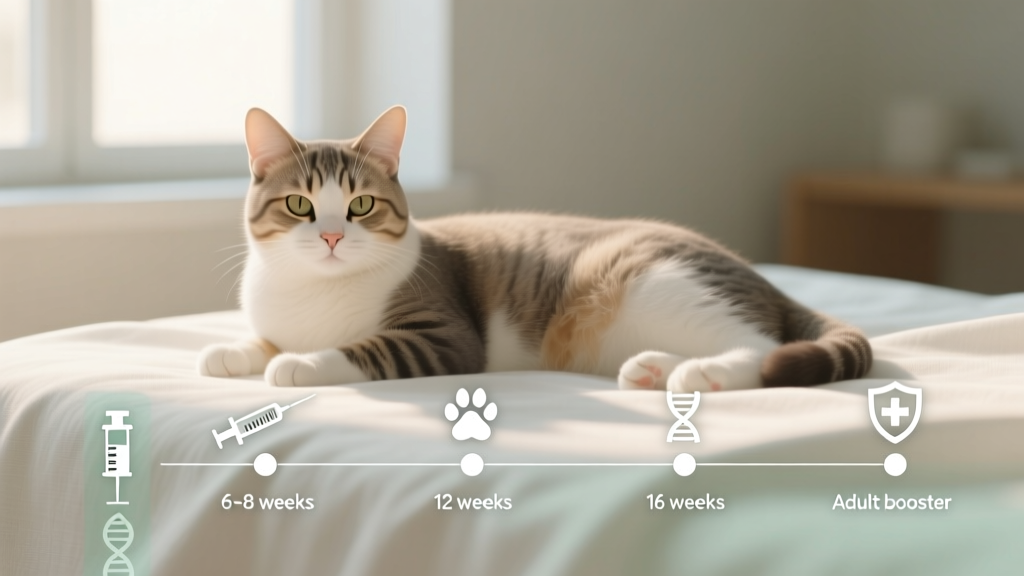
Kittens receive maternal antibodies through colostrum during their first 24 hours of life. These antibodies provide temporary protection but also interfere with vaccine effectiveness. That is why the initial vaccine series must begin at six to eight weeks of age and repeat every three to four weeks until the kitten reaches 16 weeks old.
| Age | Vaccine | Route | Notes |
|---|---|---|---|
| 6-8 weeks | FVRCP (first dose) | Subcutaneous | Earliest acceptable age; maternal antibodies may still interfere |
| 10-12 weeks | FVRCP (second dose) | Subcutaneous | Confirms seroconversion from first dose |
| 14-16 weeks | FVRCP (third dose) | Subcutaneous | Final dose in initial series; must be given at or after 16 weeks |
| 12-16 weeks | Rabies (first dose) | Subcutaneous | Single dose; 1-year or 3-year formulation depending on product |
| 16-20 weeks | FeLV (first dose, if at risk) | Subcutaneous | Recommended for kittens with outdoor access or multi-cat households |
The three-to-four-week interval between FVRCP doses is critical. Each exposure to the vaccine antigen stimulates the kitten's immune system to produce higher antibody titers. Skipping the third dose at 16 weeks is a common mistake that leaves kittens vulnerable during the period when maternal antibodies finally wane.
Why the 16-Week Final Dose Matters
Research from the Cornell University College of Veterinary Medicine demonstrates that approximately 15% of kittens still possess maternal antibodies at 14 weeks of age. These residual antibodies can neutralize the vaccine before the kitten's own immune system responds. By extending the final FVRCP dose to 16 weeks, veterinarians ensure that at least 95% of kittens will mount an adequate immune response.
Adult Cat Booster Schedule
After the initial kitten series, cats receive their first booster one year after the final kitten dose. This one-year booster is essential because it establishes long-term immunological memory. Studies have shown that cats receiving this booster develop antibody titers that persist for three years or longer for most core vaccines.
Following the one-year booster, the FVRCP vaccine can be administered every three years according to current AAFP guidelines. However, many veterinarians recommend annual titer testing as an alternative to automatic revaccination. A titer test measures the concentration of antibodies in the blood and can indicate whether a cat still has adequate protection.
"The shift from annual to triennial FVRCP boosters represents one of the most significant advances in feline preventive medicine. We now have strong evidence that properly vaccinated adult cats maintain protective immunity for at least three years, and possibly longer. This reduces unnecessary injections while maintaining protection."
— Dr. Ronald D. Schultz, Department of Pathobiological Sciences, University of Wisconsin-Madison, 2021
Rabies boosters follow a different pattern. The first rabies vaccine is valid for one year regardless of whether a one-year or three-year product is used. After that, a three-year rabies vaccine provides protection for three years, though some jurisdictions still require annual revaccination. Always check local regulations with your municipal animal control office.
Non-Core Vaccines and Risk Assessment
Non-core vaccines are recommended based on a cat's individual risk profile. The most commonly administered non-core vaccine is for feline leukemia virus (FeLV). This retrovirus causes immunosuppression, anemia, and lymphoma. Approximately 2-3% of healthy-appearing cats in the United States are persistently viremic with FeLV, according to a 2022 survey by the American Veterinary Medical Association.
Who Should Receive the FeLV Vaccine
Cats that spend any time outdoors, live with FeLV-positive cats, or reside in multi-cat households with unknown FeLV status should be vaccinated. The initial series requires two doses administered three to four weeks apart, followed by annual boosters for cats with continued exposure risk.
- Outdoor cats: Highest risk category; annual FeLV vaccination strongly recommended
- Multi-cat households with new additions: Test all cats for FeLV before introducing new members; vaccinate if status is unknown
- Indoor-only cats with no exposure risk: FeLV vaccination generally not needed after kittenhood
- Cats in FeLV-endemic regions: Some geographic areas show infection rates above 5%; consult your veterinarian about regional risk
Other non-core vaccines include those for Bordetella bronchiseptica and Chlamydia felis. These are rarely used in pet cats but may be appropriate in shelter environments or catteries where respiratory disease outbreaks are common. The intranasal Bordetella vaccine can be administered as early as four weeks of age and provides localized immunity in the respiratory tract.
Vaccine Reactions and Safety
Modern feline vaccines are remarkably safe, but adverse reactions do occur. Mild reactions include lethargy, decreased appetite, and swelling at the injection site for 24 to 48 hours. These effects are generally self-limiting and require no treatment beyond monitoring.
Serious reactions are rare. Anaphylaxis occurs in approximately 1.4 per 10,000 vaccine doses administered, based on data from a 2020 study involving over 430,000 vaccine events at Banfield Pet Hospitals. Symptoms include facial swelling, vomiting, diarrhea, and difficulty breathing within minutes to hours of vaccination. Immediate veterinary attention is required.
Vaccine-associated sarcoma (VAS) is a rare but serious concern. This aggressive tumor develops at injection sites in approximately 1 in 3,000 to 1 in 10,000 vaccinated cats. The risk appears to be associated with adjuvanted vaccines, particularly rabies and FeLV products. Current guidelines recommend administering rabies vaccines in the right rear leg, FeLV vaccines in the left rear leg, and FVRCP vaccines in the right front leg. This distal limb placement allows for surgical amputation if a sarcoma develops.
Monitoring Post-Vaccination
After any vaccination, monitor your cat closely for 48 hours. Keep them indoors during this period so you can observe for any changes in behavior, appetite, or activity level. Contact your veterinarian immediately if you notice any of the following:
- Swelling at the injection site that persists beyond three weeks
- A lump larger than 2 centimeters in diameter
- Lameness that does not resolve within 48 hours
- Vomiting or diarrhea lasting more than 24 hours
- Difficulty breathing or facial swelling (emergency)
The "3-2-1 rule" helps cat owners decide when to seek evaluation for injection-site reactions: any mass that persists for more than 3 months, is larger than 2 centimeters, or continues to grow 1 month after vaccination should be evaluated by a veterinarian for possible biopsy.
Special Considerations for Senior and Ill Cats
Cats over 10 years of age may have different vaccination needs. Geriatric cats with chronic kidney disease, hyperthyroidism, or other conditions may benefit from reduced vaccination frequency. Some veterinarians use titer testing to determine whether boosters are truly necessary in older cats with known adequate immunity.
For cats diagnosed with feline immunodeficiency virus (FIV), vaccination with modified-live products is generally contraindicated because these cats have compromised immune systems. Killed or recombinant vaccines are preferred. Your veterinarian will develop a customized protocol based on your cat's specific health status.
Pregnant cats should not receive modified-live vaccines due to the risk of fetal infection. If a cat becomes pregnant and is due for vaccination, the schedule should be adjusted to avoid the gestation period. Killed vaccines may be administered during pregnancy if the risk of disease exposure is high, though this decision should always be made in consultation with a veterinarian.
Keeping Records and Staying on Schedule
Maintaining accurate vaccination records is essential for your cat's health continuity. Most veterinary clinics keep electronic records, but having a printed copy at home ensures you never miss a booster. Many pet owners find it helpful to set calendar reminders for upcoming vaccinations, particularly for the triennial boosters that are easy to forget.
Quick tip: Many states and airlines require a current rabies certificate for travel. Keep a digital photo of your cat's rabies certificate on your phone so you can produce it quickly when needed.
When switching veterinarians, request a complete vaccination history from your previous clinic. This information helps your new veterinarian determine which vaccines are due and avoid unnecessary repeat doses. If records are unavailable, your veterinarian may recommend restarting the vaccine series or performing titer testing to assess current immunity levels.
By following the recommended vaccination schedule and working closely with your veterinarian, you give your cat the best possible protection against serious infectious diseases. The small investment of time and money in preventive vaccination pays enormous dividends in your cat's health and quality of life over the years ahead.