Dune Cat: Sand-Adapted Desert Breed Type
If you’ve ever wondered what a cat would look like if it were designed by nature to thrive in shifting dunes, scorching daytime heat, and chilly desert nights, meet the Dune Cat. This sand-adapted desert breed type is a true specialist—built for stealth, endurance, and survival in places where most animals would struggle to last a day. For cat lovers, that makes the Dune Cat endlessly fascinating: part rugged wilderness icon, part surprisingly charming little feline.
Unlike many pedigree house cats created through selective breeding, the Dune Cat is best understood as a natural desert type—a landrace-style cat shaped by environment. Think of it as a “desert model” of domestic cat, influenced by generations of life around arid regions. Some people also use “Dune Cat” as a casual nickname when discussing sand-colored desert cats (including wild species like the sand cat), so it’s worth being clear: the Dune Cat described here is a desert-adapted domestic-type cat rather than a wild species.
If you’re researching rare cat types, looking for a low-fuss coat, or you just love cats with a rugged, outdoorsy vibe, the Dune Cat is a breed-type that deserves a closer look.
Breed History and Origin
The Dune Cat isn’t a single, globally standardized pedigree with one registry “founder story.” It’s more accurate to describe it as a regional desert landrace—cats that developed in arid climates across parts of North Africa, the Middle East, and other desert-adjacent regions where human settlements and trade routes supported small populations of domestic cats.
Over many generations, these cats tended to share traits that improved survival and comfort in desert conditions:
- Light, sandy coloration for camouflage and heat management.
- Dense paw padding and strong feet for moving on hot, soft sand.
- Large ears that help dissipate heat and enhance hearing.
- Lean, athletic bodies for efficient movement and hunting.
In modern times, “Dune Cat” is often used by enthusiasts to describe this recognizable desert look and function. Some lines may be locally cherished and selectively bred, while others remain informal populations. If you see Dune Cats offered through breeders, ask for transparent lineage details and health testing—because “type” can vary widely by region and breeder ethics.
Physical Characteristics
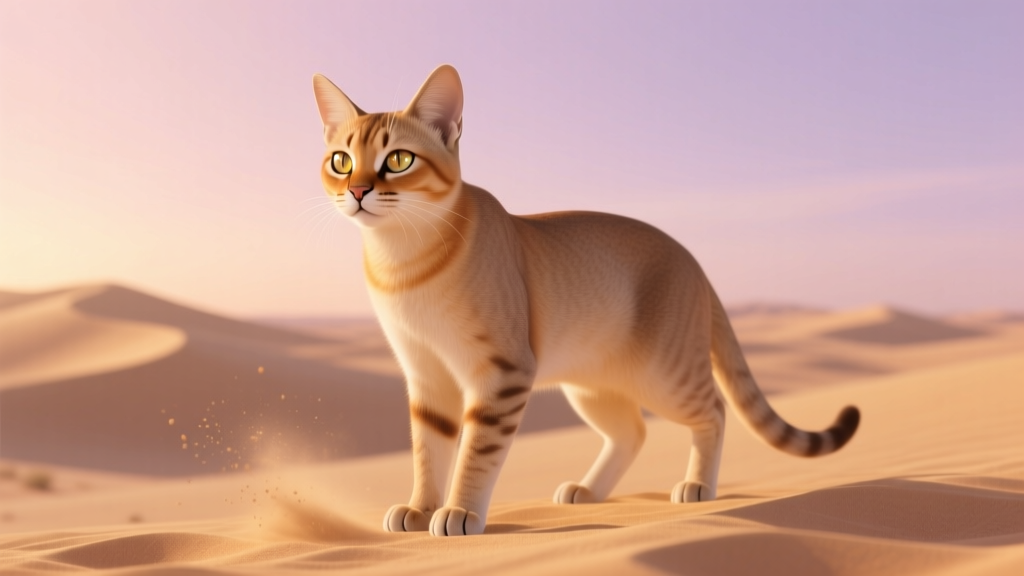
The Dune Cat has a practical, weather-wise physique. Every feature tends to feel like it has a job: keep cool, stay quiet on sand, and remain agile in open terrain.
| Feature | Typical Dune Cat Traits |
|---|---|
| Size | Medium (some lines slightly small-to-medium) |
| Weight | 7–12 lb (3.2–5.4 kg), males often heavier |
| Build | Lean, athletic, long-legged, efficient stride |
| Coat length | Short to medium-short; dense but not heavy |
| Coat texture | Silky to slightly plush; designed to insulate without overheating |
| Common colors | Sand, fawn, beige, cream, warm gray; often with subtle tabby ticking |
| Eyes | Amber, gold, green, or hazel; expressive and alert |
| Ears | Large, upright, wide-based (a “desert radar” look) |
| Distinctive features | Strong paw pads, sometimes tufts between toes; sleek face; quiet, watchful posture |
Coat Colors and Patterns
When people search for a “sand-colored cat breed,” the Dune Cat is exactly the vibe they mean. Many have:
- Warm sandy solids (fawn, buff, beige)
- Ticked or agouti-style coats that read as “dusty” and natural
- Subtle tabby markings (especially on legs and tail)
- Dark eyeliner-like markings around the eyes in some lines (a striking desert look)
Personality and Temperament Traits
Dune Cats tend to be bright, observant, and quietly confident. They’re often affectionate with their people, but not always the “pick-me-up-like-a-baby” type from day one. Many warm up through routine, gentle handling, and respectful boundaries.
Common temperament traits include:
- Highly alert and curious—they notice everything.
- Playful hunters—wand toys, chase games, and puzzle feeders are favorites.
- Independent streak—they can entertain themselves, but still enjoy companionship.
- Loyal to their chosen humans—often shadowing you from room to room.
- Moderate vocalization—more likely to chirp or “talk” than yowl, depending on the line.
If you love cats that feel a bit like a tiny wild scout—without being wild—this desert breed type is a fun match.
Health Considerations and Common Issues
Because the Dune Cat is a breed type rather than a single standardized pedigree, health risks can vary. In general, landrace-style cats may benefit from broader genetic diversity, but that doesn’t guarantee perfect health—especially if a breeder narrows a line too tightly.
Potential health considerations to discuss with a veterinarian or ethical breeder:
- Dental disease: Like many cats, they can develop tartar and gingivitis without routine care.
- Parasites: Fleas, ticks, and intestinal parasites are a risk in warm climates or for cats with outdoor access.
- Heat sensitivity: Desert-adapted cats handle warmth well, but indoor cats can still overheat in poorly ventilated homes.
- Kidney and urinary issues: Hydration matters for every cat—fresh water and wet food can help.
- Injuries from high activity: Athletic cats sometimes overdo it—provide safe climbing setups.
Look for clear, concrete health practices: vaccinations, parasite prevention, spay/neuter plans (unless part of a responsible program), and transparent vet records. If a seller can’t explain their cats’ health routines, keep shopping.
Care Requirements (Grooming, Exercise, Diet)
Grooming
One of the joys of a desert-adapted short coat is that it’s typically low-maintenance. Most Dune Cats do well with:
- Brushing once a week (rubber curry brush or soft bristle)
- Nail trims every 2–4 weeks
- Ear checks weekly (large ears can collect debris)
- Dental care: brushing when possible, plus dental treats approved by your vet
Exercise and Enrichment
Dune Cats are built to move. Without outlets, they can invent their own “desert games” (like sprinting across your sofa at 2 a.m.). Plan daily play:
- Two short play sessions a day (10–15 minutes each)
- Interactive toys: wand teasers, flutter toys, rolling treat balls
- Vertical space: cat trees, shelves, window perches
- For confident cats: harness training and supervised outdoor time
Diet
The Dune Cat’s lean body thrives on quality nutrition. Aim for a diet that supports muscle and hydration:
- High-protein wet food as a staple (great for moisture intake)
- Measured portions to maintain a trim waist
- Fresh water in multiple locations; some cats love fountains
- Treats in moderation—use them for training and enrichment
If your Dune Cat is extremely active, your vet may recommend a slightly higher calorie intake—just keep an eye on body condition rather than relying on the scale alone.
Compatibility with Families, Children, and Other Pets
With the right introductions and respectful handling, Dune Cats can be wonderful family companions. Their best matches are homes that enjoy interactive play and can provide a predictable routine.
- Families with children: Often a good fit with kids who understand gentle touch and give the cat space when needed.
- Other cats: Usually compatible, especially when introductions are gradual and there are enough resources (litter boxes, bowls, resting spots).
- Dogs: Can do well with calm, cat-savvy dogs. Early socialization helps.
- Small pets: Strong prey drive is common. Keep birds, rodents, and reptiles securely separated.
Because this is a desert breed type with a hunter’s brain, enrichment isn’t optional—it’s what keeps them sweet, relaxed, and fun to live with.
Pros and Cons of Owning a Dune Cat
| Pros | Cons |
|---|---|
| Striking desert look: sandy coat, large ears, athletic build | Can be hard to find from reputable sources due to “type” variability |
| Generally low grooming needs | Needs daily play and mental stimulation |
| Smart, curious, engaging personality | May be cautious with strangers at first |
| Often adaptable to indoor life with good enrichment | Prey drive may be challenging with small pets |
| Usually moderate shedding compared with long-haired breeds | Some lines can be very active and “busy” around the house |
FAQ: Dune Cat (Sand-Adapted Desert Breed Type)
Is the Dune Cat the same as a sand cat (Felis margarita)?
No. The sand cat is a wild feline species adapted to harsh deserts and is not a domestic pet. The Dune Cat described here is a domestic desert-adapted breed type (a landrace-style cat) that may share a similar sandy appearance but is not a wild species.
Do Dune Cats make good indoor cats?
Yes—if you provide enough stimulation. A Dune Cat can thrive indoors with climbing space, puzzle feeders, and interactive play. Without enrichment, they may become restless or destructive.
How big do Dune Cats get?
Most are medium-sized, typically around 7–12 lb as adults. Males are often larger, and highly athletic cats may look bigger than they weigh due to long legs and a lean frame.
Are Dune Cats hypoallergenic?
No cat breed is truly hypoallergenic. Many Dune Cats have short coats that are easy to maintain, but allergens come from saliva and skin proteins, not just fur. If allergies are a concern, spend time with similar short-coated cats and talk with your allergist.
Do Dune Cats like water?
Some do, especially if introduced gently. Many enjoy drinking fountains and may play with dripping taps, but it varies by individual personality.
What should I ask a breeder or seller offering a “Dune Cat”?
Ask for veterinary records, vaccination and parasite control history, details on temperament, and how kittens are socialized. Because “Dune Cat” can be used loosely, clear documentation and ethical practices matter more than a label.
Warm Final Thoughts
The Dune Cat is a gorgeous reminder of how adaptable cats can be—sleek, sandy, and alert, with a personality that blends independence and affection in a way desert-cat lovers find irresistible. If you want a companion with an athletic body, a clever mind, and a coat that looks like it was brushed with sunlit sand, this desert breed type is easy to adore.
Curious about other rare cat breeds and natural breed types? Explore more breed profiles on catloversbase.com and find the feline that fits your life perfectly.