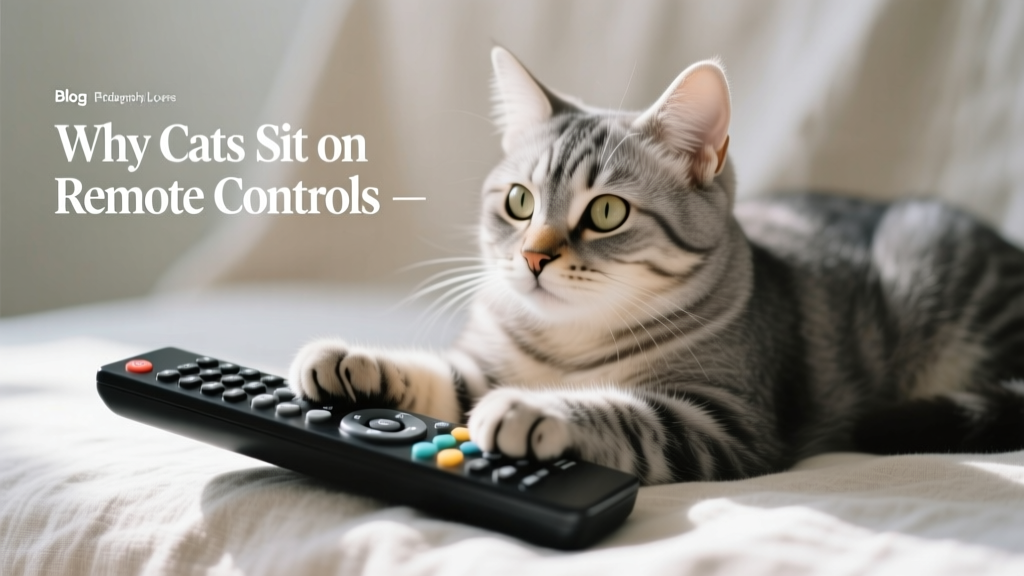
Why Cats Sit on Remote Controls
You settle in for a cozy night on the couch. Snacks? Check. Blanket? Check. The show is queued up, the remote is right where you left it… until it isn’t. Because your cat has appeared, silently and confidently, and parked their entire body on top of the remote control like it’s a heated throne.
You reach for it. Your cat tightens into a little loaf and stares at you as if you’re the one being unreasonable. You try sliding the remote out. The remote doesn’t slide. Your cat’s paw drifts down with perfect timing, pinning it in place. Then—somehow—your TV starts switching inputs, fast-forwarding, or blaring volume at a level that suggests your cat has strong opinions about audio settings.
If this sounds familiar, you’re in good company. Cats sitting on remote controls is one of those everyday mysteries that’s equal parts hilarious and baffling. The good news: it’s not random. It’s very “cat.”
The science (and evolution) behind the remote-control obsession
Cats don’t sit on remotes because they understand streaming subscriptions. They do it because remotes check a surprising number of boxes for feline instincts:
- Warmth-seeking: Cats are heat enthusiasts. Domestic cats descended from desert-dwelling ancestors, and modern cats still gravitate toward warm surfaces. Remotes often sit on laps, couches, or near electronics—spots that retain heat. Even a slightly warm object can feel inviting.
- Scent-marking and ownership: Cats communicate with scent more than we realize. They have scent glands on their cheeks, paws, and sides. When your cat rubs, steps on, or lounges on an object, they may be depositing a comforting “this is mine/this is safe” message.
- Resource control: In the animal world, controlling access to valued resources (food, resting spots, social attention) is a real strategy. In a home, the “resource” might be your hands, your attention, or the ritual of you sitting still on the couch.
- Curiosity and novelty: Remotes are handled frequently, moved around, clicked, dropped, and found again. They’re high-interest objects because they’re consistently “in the action.” Cats are drawn to the things we interact with most.
- Reinforcement history (a fancy way of saying: it worked once): If your cat sat on the remote and you laughed, talked to them, petted them, or tried to negotiate, your cat learned: “Remote + my body = instant human engagement.” Cats repeat what pays off.
So yes—your cat may be blocking the remote because it’s warm. But they may also be leaning into the fact that it reliably makes you react. Cats are excellent observers. They notice patterns in seconds that we miss for years.
Different contexts: what “remote sitting” can look like (and why)
Not all remote-sitting is the same. The surrounding context tells you a lot about the motivation.
1) The “I have chosen your lap” remote sit
Scenario: You’re holding the remote on your thigh. Your cat climbs up, circles once, and sits directly on the remote with a satisfied sigh.
What’s going on: This is often a blend of warmth, comfort, and social bonding. Your lap is prime real estate, and the remote just happens to be in the way. Some cats also like the slightly raised, firm shape under them—like a tiny seat cushion.
2) The “screen time is my time” remote sit
Scenario: The moment the TV turns on, your cat appears and wedges themselves between you and the remote, or plops down on it with theatrical confidence.
What’s going on: Your cat may be competing with whatever captures your attention. Not out of spite—cats don’t usually do “revenge”—but because your focus shifted away from them. If remote-sitting reliably gets your eyes and hands back on your cat, it becomes a smart tactic.
3) The “scent magnet” remote sit
Scenario: Your cat ignores the remote until you’ve been using it for a while. Then they rub their face on it, knead nearby, and settle on top.
What’s going on: The remote smells strongly like you. Skin oils, hand lotion, snacks, popcorn salt—cats find these scent layers meaningful. Your cat is likely drawn to the comfort of your scent and may add their own scent to blend it into the household “group smell.”
4) The “play-bite and conquer” remote sit
Scenario: Your cat bats the remote off the couch, chases it, bites the buttons, then lies next to it like they’ve defeated a tiny robot.
What’s going on: For some cats, the remote is a prey-like object: small, hand-moved, unpredictable, and occasionally makes interesting sounds. This is more common in younger cats or cats with a strong play drive.
5) The “I’m overstimulated, please don’t touch me” remote sit
Scenario: Your cat settles on the remote and gives a “do not disturb” vibe—tight loaf, half-lidded eyes, tail tucked, maybe a tiny ear flick if you reach in.
What’s going on: This can be self-soothing. Some cats choose a specific object as an “anchor” when they want to rest but still keep an eye on the environment.
What sitting on the remote can mean about your cat’s mood
Think of the remote as a stage. Your cat’s body language tells you what role they’re playing.
- Relaxed and affectionate: Soft eyes, slow blinks, loose loaf, paws tucked, gentle purring. Your cat likely wants closeness and comfort. The remote is incidental—or a convenient way to keep you nearby.
- Seeking attention: Looking at your face, head-butting your hand, standing up and sitting down repeatedly, meowing, nudging the remote. Your cat is asking for interaction.
- Playful and energized: Quick movements, tail swishing with a curve at the tip, pouncing, biting the remote, “bunny kicks.” They need play outlets.
- Guarded or easily annoyed: Ears angled sideways or back, tense loaf, tail flicking sharply, skin twitching. Your cat may be tired, overstimulated, or not in the mood to share space.
- Stressed or insecure: Hovering, scanning the room, startled at sounds, choosing the remote specifically when there’s noise or visitors. Your cat may be using your routine (TV time) as a safe predictability cue.
Remote-sitting is often a mix of “I like this spot” and “I like what you do when I do this.” Cats are masters of combining comfort with strategy.
Related behaviors you might also notice
If your cat loves sitting on the remote, you may also recognize these cousin behaviors:
- Sitting on your phone or laptop: Warmth, scent, and attention competition—plus keyboards are excellent “human-activating” devices.
- Plopping onto your book the moment you open it: Cats notice when your gaze locks onto something. They’re not offended by novels; they’re drawn to your focused attention.
- Choosing the exact spot you’re about to use: The “preemptive seat steal” is often about comfort and social proximity.
- Rubbing on the TV stand or speakers: Scent-marking communal areas and objects that carry household activity.
- Demanding pets only when you’re busy: Because busy humans are predictable. The cat learns: “When you’re settled, I get results.”
When remote-sitting is normal… and when it might be a concern
Most of the time, this behavior is completely normal—just a small daily reminder that you live with a tiny, furry decision-maker.
It’s typically normal if:
- Your cat is otherwise eating, drinking, playing, and using the litter box normally.
- The behavior happens mostly during relaxed times (evenings, couch time).
- Your cat’s body language is calm and comfortable.
It may be worth a closer look if:
- It’s a sudden new clingy behavior paired with vocalizing, restlessness, or following you constantly—this can sometimes indicate stress, pain, or a change in the household routine.
- Your cat becomes unusually irritable when you try to move the remote or touch them (hissing, swatting), especially if that’s new. Pain (like arthritis) can make cats more defensive about being handled.
- The remote becomes a chewing target and your cat is ingesting plastic or rubber buttons. That’s a safety concern (GI blockage risk) and may point to boredom, anxiety, or oral discomfort.
- The behavior looks compulsive (repetitive, hard to interrupt, paired with other compulsive actions like overgrooming). This is uncommon, but it’s worth discussing with a vet or behavior professional.
If you’re unsure, a quick vet check is never overreacting—cats are excellent at hiding discomfort, and behavior shifts are one of the earliest clues.
How to respond (without starting a remote-control war)
You have options that respect your cat’s needs and protect your ability to watch a show without accidentally ordering a movie in a language you don’t speak.
1) Offer a “better seat” next to you
Place a cozy bed, folded blanket, or small cat mat on the couch near your preferred sitting spot. Many cats will choose the comfiest, most consistent option—especially if it’s slightly elevated.
2) Make the alternative warm
A heated cat bed (on a safe, low setting) or a microwavable pet-safe warming pad near you can outcompete the remote’s appeal. Warmth is persuasive.
3) Keep a decoy remote
Some households swear by the “sacrificial remote” (an old, nonfunctional one). It’s surprisingly effective for cats that like the shape and scent but don’t need the real remote to get your attention.
4) Reinforce what you want, not what you don’t
If your cat sits on the remote and you immediately laugh, pet, and chat, you’ve rewarded the remote-sit. Try calmly relocating your cat to their designated spot and then giving affection there. The message becomes: “Couch cuddles, yes. Remote blockade, not the best route.”
5) Build a predictable attention routine
Many cats block remotes because they’ve learned it reliably starts interaction. Try giving your cat a short ritual before TV time: two minutes of play (wand toy), a small treat, then settle them on a blanket beside you. Predictability lowers the need for “attention hacks.”
6) Manage chewing and button-popping
If your cat bites remotes, store them in a drawer or a small lidded basket when not in use. Provide safe chew alternatives (vet-approved dental toys) and increase play enrichment to meet that oral/predatory need.
Fun facts and research-y nuggets (cat-nerd friendly)
- Cats are heat optimizers. Their comfort zone often runs warmer than humans prefer, which helps explain why they seek sunny patches, warm electronics, and anything you’ve just been holding.
- Scent is social glue. Cats in the same household often create a shared “group scent” by rubbing on the same objects and each other. Your remote—handled constantly—becomes a prime communal scent post.
- “Attention-seeking” is a learned strategy, not a personality flaw. When a behavior consistently produces a response, animals repeat it. Your cat isn’t being manipulative in a moral sense; they’re being effective.
- Cats pay close attention to human routines. Many cats can predict when you’re about to sit, sleep, or open a laptop based on tiny cues (time of day, where you stand, what you pick up). The remote is part of that routine pattern.
FAQ: Common questions about cats and remote controls
Do cats sit on the remote to get attention?
Often, yes—especially if it reliably makes you talk to them, pet them, or look at them. But it’s usually a combo: attention plus warmth, scent, and “prime couch real estate.”
Is my cat jealous of the TV?
Cats don’t typically experience jealousy the way humans describe it, but they do notice when your attention shifts. If the TV changes your behavior (less petting, less talking, less movement), your cat may insert themselves into the routine to regain interaction.
Why does my cat only do this at night?
Evenings are peak “everyone is home and settled” time. Your cat has learned that night = couch time = predictable access to you. Cats also tend to get a second wind in the evening, which can combine attention-seeking with playfulness.
My cat bites the remote—why?
Common reasons include boredom, teething (in kittens), a strong play/prey drive, or simply liking the texture. If your cat is chewing hard plastic or swallowing pieces, manage access and talk to your vet—especially if you notice drooling, appetite changes, or vomiting.
Should I move my cat off the remote or let them stay?
If it’s safe and you don’t mind, it’s fine to let them lounge. If you need the remote, calmly relocate your cat to a nearby comfy spot and reward them there. Avoid making it a game of tug-of-war—some cats find that incredibly entertaining.
How do I stop accidental button presses?
Use a small basket with a lid, a side-table drawer, or a remote cover with firmer buttons. A decoy remote and a cozy “approved” couch spot also reduce the odds of your cat choosing the real one.
If your cat sits on the remote, they’re not trying to ruin your show—they’re doing what cats do best: seeking comfort, claiming familiar scents, and gently rearranging your priorities.
Does your cat have a favorite “human device” to sit on—remote, laptop, phone, book, or something even stranger? Share your funniest remote-control takeovers and couch-time rituals with the Cat Lovers Base community at catloversbase.com.