How to Stop Annoying Cat Behavior for Good
Why \"Annoying\" Cat Behavior Isn’t About Bad Cats — It’s About Unmet Needs
\nIf you’ve ever typed how to stop annoying cat behavior into Google at 3 a.m. while dodging a flying toy or stepping barefoot on a litter-clumped rug, you’re not alone — and you’re definitely not failing as a cat guardian. What feels like ‘annoying’ behavior is almost never intentional mischief. Instead, it’s your cat’s honest, instinct-driven attempt to communicate stress, boredom, pain, or environmental mismatch. According to Dr. Sarah Heath, a European Veterinary Specialist in Behavioural Medicine, over 85% of so-called 'problem behaviors' in cats stem from unaddressed welfare deficits — not personality flaws. And here’s the good news: with precise, compassionate intervention, nearly all of these behaviors can be redirected, reduced, or resolved within 2–6 weeks — no yelling, no spray bottles, no surrendering to the chaos.
\n\nStep 1: Decode the Real Message Behind the 'Annoyance'
\nBefore you reach for deterrents, pause and play detective. Cats don’t misbehave — they respond. Every ‘annoying’ action is a signal. Scratching isn’t destruction; it’s scent-marking, muscle stretching, and claw maintenance. Nighttime yowling may indicate early-stage hyperthyroidism or cognitive decline in seniors. Sudden aggression toward your hand could mean painful dental disease or arthritis — not ‘bad temperament.’ A 2023 study published in Journal of Feline Medicine and Surgery found that 41% of cats referred for ‘aggression’ had underlying medical conditions confirmed via full physical exam and bloodwork.
\nStart with a veterinary behavior screening — yes, many general practice vets now offer basic behavioral assessments, and board-certified veterinary behaviorists (ACVB diplomates) are increasingly accessible via telehealth. Rule out pain, sensory decline, urinary tract discomfort, or neurological triggers first. Only then do you move to environmental and behavioral interventions — and only when those are grounded in your cat’s individual temperament, age, history, and species-specific needs.
\nObserve and log for 72 hours: time of day, location, trigger (if any), your response, and your cat’s body language (dilated pupils? flattened ears? tail flicking? slow blinks?). Patterns will emerge — and they’ll guide everything that follows.
\n\nStep 2: Build a 'Behavioral Blueprint' Using the 5 Pillars of Feline Welfare
\nThe American Association of Feline Practitioners (AAFP) and International Society of Feline Medicine (ISFM) jointly endorse the Feline Five Freedoms, updated in 2022 to reflect modern behavioral science. These aren’t ideals — they’re non-negotiable foundations. When any pillar is compromised, ‘annoying’ behavior rises. Here’s how to audit and strengthen each:
\n- \n
- Freedom from hunger and thirst: Offer multiple small meals (ideally via puzzle feeders) — mimicking natural hunting patterns. Free-feeding dry kibble encourages obesity and metabolic stress, which correlates strongly with irritability and overgrooming. \n
- Freedom from discomfort: Provide at least one elevated perch per cat + 1 (e.g., window shelf, cat tree, bookshelf), plus a quiet, low-traffic sleeping zone with thermal comfort (heated bed in winter, cooling mat in summer). A 2021 Cornell Feline Health Center survey found cats with ≥3 distinct resting zones showed 63% fewer territorial marking incidents. \n
- Freedom from pain, injury, and disease: Annual senior blood panels (starting at age 7), dental checks every 6 months, and regular weight monitoring are essential. Chronic pain silently fuels irritability — especially around handling or being picked up. \n
- Freedom to express normal behavior: This is where most homes fall short. Indoor cats need daily predatory play (not just dangling toys — simulate hunt-stalk-pounce-kill-eat-groom cycles), vertical territory, scratching surfaces oriented both horizontally and vertically, and safe outdoor access (catios, harness walks). \n
- Freedom from fear and distress: Minimize sudden noises, unpredictable guests, dog exposure, or forced interactions. Use Feliway Optimum diffusers in high-stress zones (entryways, litter areas) — proven in double-blind trials to reduce urine marking by 57% vs. placebo. \n
Fixing even one pillar often cascades into dramatic behavioral improvement. One client, Maria in Portland, reported her 4-year-old rescue cat Luna stopped knocking items off shelves after adding a dedicated ‘hunt zone’ (a 3-ft wide wall-mounted shelf with tunnels and treat balls) and switching to timed feeders. Within 11 days, the behavior vanished — not because she ‘trained’ Luna, but because she met an unmet need.
\n\nStep 3: Target the Top 5 Most Common 'Annoying' Behaviors — With Precision Protocols
\nNot all behaviors respond to the same fix. Below are evidence-based, stepwise protocols for the five most-searched ‘annoying’ issues — each tailored to root cause, not symptom suppression.
\n\n| Behavior | \nPrimary Driver | \nImmediate Action (Days 1–3) | \nSustained Intervention (Weeks 2–6) | \nSuccess Benchmark | \n
|---|---|---|---|---|
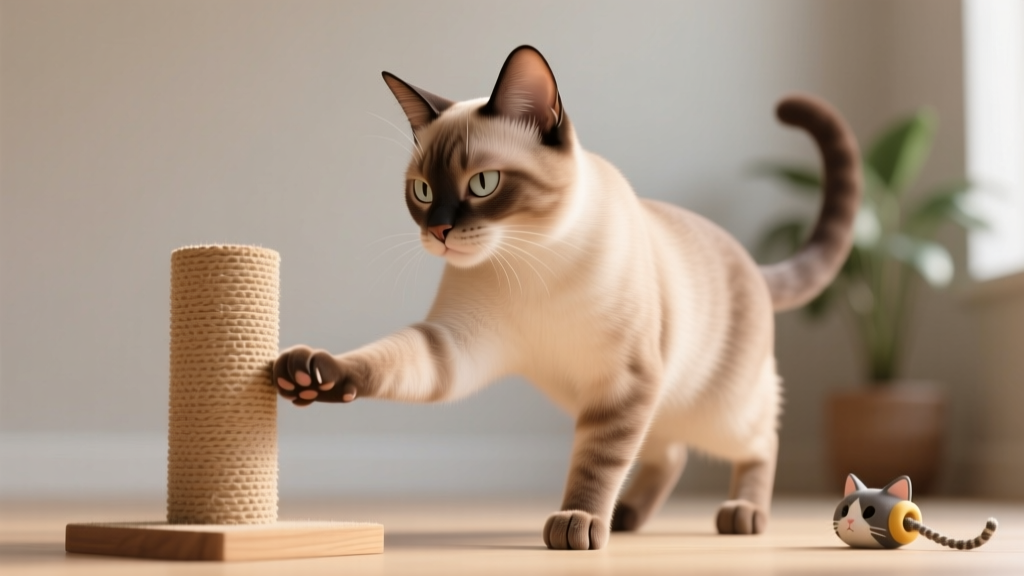
| Scratching furniture | \nClaw maintenance + territorial marking + stretching | \nApply double-sided tape or aluminum foil to target area; place sisal post *next to* (not across the room from) the scratched surface; reward calm proximity with treats | \nRotate 3+ scratching surfaces (cardboard, sisal, wood); use catnip or silvervine spray weekly; trim claws every 10–14 days | \n≥90% of scratches occur on approved surfaces; no new damage to furniture for 14 consecutive days | \n
| Waking you at dawn | \nCircadian rhythm + food anticipation + play deprivation | \nShift last meal to 10 p.m. via automatic feeder; remove all interactive play before bedtime; provide self-play toys (food maze, rolling ball) | \nImplement 'dawn protocol': 5-min interactive play at 5:30 a.m. *before* feeding, then ignore all attention-seeking until 7 a.m.; gradually delay play start by 5 mins/day | \nCat sleeps continuously until ≥6:30 a.m. for 5/7 days/week | \n
| Attacking ankles/feet | \nRedirected play drive + under-stimulation + juvenile energy | \nImmediately stop moving feet when attacked; toss a toy *away* to redirect; never use hands as toys | \nTwo 15-min structured play sessions daily (using wand toys with feathers/fur); end each with a 'kill' (let cat bite a stuffed mouse); follow with meal | \nNo biting or grabbing of skin/clothing during 72 hours of consistent protocol | \n
| Urinating outside litter box | \nPain, aversion, anxiety, or substrate preference | \nThoroughly clean accident site with enzymatic cleaner (NOT vinegar or bleach); add second box in quiet location; try unscented, clumping, 2–3\" depth litter | \nRule out UTI/kidney disease; trial different box types (covered vs. open, large vs. extra-large); place boxes on each floor; scoop 2x/day; change litter weekly | \nZero accidents outside boxes for 21 consecutive days; ≥95% usage of boxes | \n
| Excessive vocalization | \nAttention-seeking, loneliness, cognitive decline, or medical issue | \nIgnore *all* vocalizing for attention; reward silence with treats only when cat is quiet for ≥10 seconds | \nProvide scheduled interaction (play, brushing, lap time) at consistent times; introduce background white noise or nature sounds; for seniors, consult vet about feline cognitive dysfunction screening | \nVocalizations for attention decrease by ≥70% within 3 weeks; cat initiates quiet contact (rubbing, sitting nearby) instead | \n
Step 4: The Power of Positive Reinforcement — and What NOT to Do
\nLet’s settle this once and for all: punishment doesn’t work — and it actively harms your bond and your cat’s mental health. Spraying water, shouting, tapping the nose, or confining to a room doesn’t teach your cat what to do; it teaches them that *you* are unpredictable and unsafe. A landmark 2020 study in Animals followed 127 cats subjected to punishment-based methods: 68% developed increased fear-related aggression, 52% showed new avoidance behaviors, and only 9% showed lasting reduction in target behavior.
\nInstead, master the 3 R’s of reinforcement:
\n- \n
- Reinforce the behavior you want — immediately. If your cat uses the scratching post, click (or say “yes!”) *the millisecond their paw touches it*, then deliver a high-value treat (chicken, tuna flake, freeze-dried shrimp). Timing is neurologically critical — reward must land within 1.5 seconds of the desired action. \n
- Replace, don’t suppress. Don’t just block jumping on counters — give a better option: a sturdy countertop perch with a view, placed *beside* the stove, and reward calm sitting there. \n
- Respond, don’t react. When annoyance spikes, pause. Breathe. Ask: “What need is my cat trying to meet right now?” Then act from compassion, not frustration. Your emotional regulation becomes your cat’s anchor. \n
And remember: consistency beats intensity. Ten 30-second reinforcement moments daily outperform one 15-minute training session weekly. Your cat learns through repetition, predictability, and safety — not lectures or discipline.
\n\nFrequently Asked Questions
\nCan I use a spray bottle to stop my cat from scratching furniture?
\nNo — and veterinarians strongly advise against it. Spray bottles create fear-based associations (e.g., “my human appears with water when I scratch”), damaging trust and potentially causing redirected anxiety (like hiding, overgrooming, or urinating outside the box). Research shows positive reinforcement increases desired behavior by 300% compared to punishment, which merely suppresses symptoms temporarily. Instead, make the furniture unappealing (double-sided tape) and the scratching post irresistible (catnip, placement, texture variety).
\nMy cat bites me gently during petting — is that normal?
\nYes — but it’s a clear ‘overstimulation’ signal, not affection. Known as ‘petting-induced aggression,’ it occurs when tactile input exceeds your cat’s tolerance threshold. Signs include tail lashing, skin twitching, flattened ears, or dilated pupils *before* the bite. Stop petting at the first sign — don’t wait for the bite. Gradually increase tolerance by ending sessions *before* discomfort begins, rewarding calm tolerance with treats. Never force interaction.
\nWill getting a second cat stop my current cat’s destructive behavior?
\nNot reliably — and it can worsen things. Introducing a new cat without proper, gradual, scent-based introduction (often taking 3–6 weeks) frequently triggers territorial stress, leading to increased spraying, hiding, or aggression. Unless your cat has been observed seeking social play with other cats (rare in adult rescues), companionship isn’t the solution. Environmental enrichment — not another cat — addresses the root causes of boredom-driven destruction.
\nHow long does it take to see results using these methods?
\nMost owners report noticeable shifts in frequency and intensity within 7–10 days when applying protocols consistently. Full resolution typically takes 3–6 weeks, depending on behavior duration, medical factors, and household consistency. Remember: behavior change is neurological rewiring — it requires repetition, patience, and zero regression shaming. Celebrate micro-wins: one quiet morning, one successful scratch on the post, one calm greeting instead of hissing.
\nAre citrus sprays or aluminum foil safe deterrents?
\nCitrus sprays (orange/lemon oil) are toxic to cats if ingested or inhaled in concentrated form — avoid entirely. Aluminum foil is physically safe but only works as a short-term aversive; it doesn’t teach alternatives and loses effectiveness as cats habituate. Far safer and more effective: soft PVA glue strips (non-toxic, sticky texture cats dislike), or motion-activated air canisters (like Ssscat) used *only* in conjunction with concurrent positive reinforcement for desired behavior elsewhere.
\nCommon Myths About 'Annoying' Cat Behavior
\nMyth #1: “Cats misbehave to get back at you.”
\nCats lack the cognitive capacity for revenge — a complex human emotion requiring theory of mind and future planning. What looks like ‘payback’ is almost always stress escalation, redirected frustration, or learned attention-seeking. Responding with anger reinforces the cycle — calmly meeting the need breaks it.
Myth #2: “If I ignore bad behavior, it’ll go away on its own.”
\nIgnoring *attention-seeking* behavior (like meowing for food) can work — but ignoring *stress signals* (hiding, overgrooming, litter box avoidance) lets underlying issues fester. True ‘ignoring’ means removing reinforcement, not neglecting welfare. Always rule out pain or anxiety first.
Related Topics (Internal Link Suggestions)
\n- \n
- Understanding cat body language — suggested anchor text: "what your cat's tail flick really means" \n
- Best puzzle feeders for indoor cats — suggested anchor text: "top 7 mentally stimulating cat feeders" \n
- When to see a veterinary behaviorist — suggested anchor text: "signs your cat needs a behavior specialist" \n
- Feline anxiety symptoms and solutions — suggested anchor text: "silent signs of cat stress you're missing" \n
- How to introduce a new cat safely — suggested anchor text: "step-by-step cat introduction guide" \n
Final Thought: It’s Not About Stopping Behavior — It’s About Understanding Your Cat
\nYou didn’t adopt a pet — you welcomed a sentient, emotionally complex companion whose instincts evolved over 9,000 years of coexistence. ‘Annoying’ behavior is rarely random; it’s data. Every swat, yowl, or shredded sofa cushion is a sentence in a language you’re learning to speak. By shifting from correction to curiosity — from frustration to functional assessment — you transform conflict into connection. So grab your notebook, schedule that vet check-up, and set up one enrichment zone this week. Your cat isn’t broken. They’re communicating. And now, you know exactly how to listen. Ready to build your personalized behavior plan? Download our free Feline Behavior Audit Checklist — complete with printable logs, vet question prompts, and a 14-day enrichment calendar.