What Is Cat Behavioral Exam for Feral Cats? A Step
Why This Tiny Assessment Changes Everything for Feral Cats
What is cat behavioral exam for feral cats? It’s not a test — it’s a compassionate, evidence-based observational framework used by animal welfare professionals to assess a feral cat’s baseline stress response, fear threshold, and potential for safe handling or socialization *without forcing interaction*. In an era where over 40% of intake cats in municipal shelters are classified as ‘feral’ or ‘unsocialized’ (ASPCA, 2023), misclassifying a fearful but potentially adoptable cat as ‘non-rehabilitatable’ remains one of the most preventable tragedies in shelter medicine. Yet fewer than 28% of U.S. shelters use standardized behavioral assessments for feral cats — and many still rely on outdated, high-stress methods like forced scruffing or prolonged cage exposure that artificially inflate aggression scores. This article breaks down exactly how a modern, ethical behavioral exam works — why it matters more than ever in 2024, and how you (whether you’re a rescuer, TNR volunteer, shelter staff member, or foster caregiver) can apply it immediately.
What a Behavioral Exam Actually Measures — Not What You Think
A cat behavioral exam for feral cats isn’t about determining whether the cat will ‘like people.’ It’s about mapping *behavioral thresholds*: at what point does proximity, sound, movement, or touch trigger flight, freeze, or defensive escalation? According to Dr. Mikel Delgado, certified applied animal behaviorist and co-author of The Trainable Cat, ‘Feral cats aren’t “broken” — they’re exquisitely calibrated survivalists. Our job isn’t to “fix” them, but to read their communication accurately so we don’t misinterpret vigilance as hostility.’
The exam focuses on five validated dimensions, each scored independently on a 1–5 scale (1 = minimal reaction; 5 = extreme, sustained distress):
- Proximity tolerance: How close can a human stand before the cat retreats, flattens ears, or hisses — and does distance recovery happen within 60 seconds?
- Vocalization pattern: Frequency and type of vocalizations (e.g., low growl vs. high-pitched yowl) during quiet observation — not provoked noise.
- Body language consistency: Whether ear position, tail carriage, pupil dilation, and posture shift predictably across contexts (e.g., same response to slow approach vs. sudden shadow).
- Environmental engagement: Does the cat investigate novel objects (e.g., dangling string, crinkled paper) when no humans are present? This signals curiosity resilience — a key predictor of later adaptability.
- Recovery latency: Time elapsed between cessation of stimulus and return to baseline breathing rate, eye blink frequency, and relaxed muscle tone.
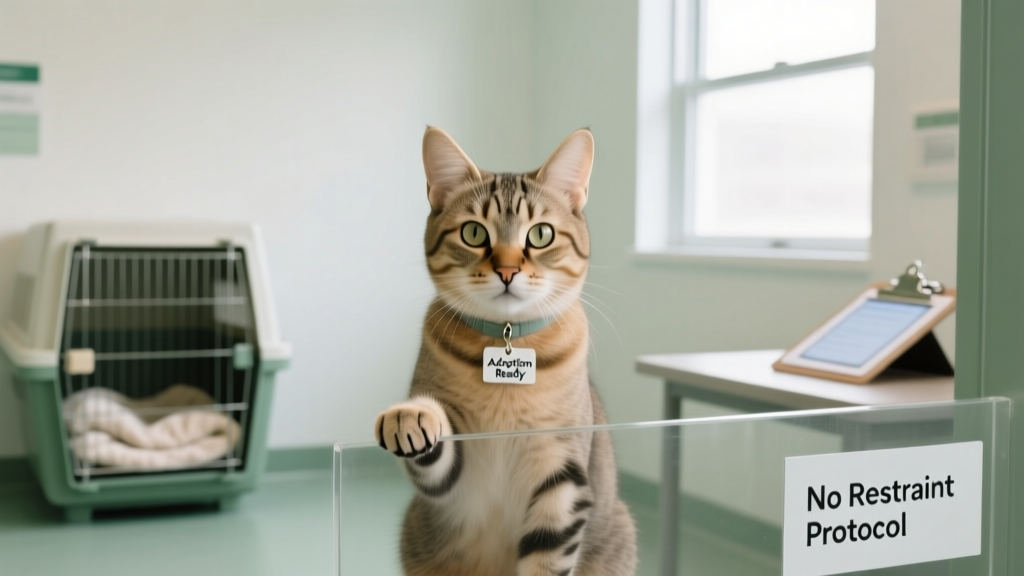
Crucially, this exam is conducted *only* in a quiet, dimly lit room with no direct handling. The observer stays outside the enclosure, using a clipboard and stopwatch — never gloves, nets, or restraint tools. As Dr. Elizabeth Colleran, past president of the American Association of Feline Practitioners, emphasizes: ‘If your assessment requires touching the cat, you’ve already crossed the line from evaluation into provocation.’
How to Run the Exam: 3 Phases, Zero Guesswork
Based on protocols adopted by the San Francisco SPCA, Best Friends Animal Society, and the University of California Davis Koret Shelter Medicine Program, here’s how to conduct a valid behavioral exam for feral cats in under 22 minutes — with built-in redundancy to avoid false positives.
- Phase 1: Baseline Observation (5 min) — Observe silently from 6+ feet away. Note spontaneous behaviors: grooming frequency, sleep/wake cycles, litter box use, and orientation toward doorways or ventilation. Record first vocalization time and context.
- Phase 2: Graded Stimulus Exposure (10 min) — Introduce three stimuli *sequentially*, waiting 90 seconds between each: (a) gentle tapping on the cage door, (b) placing a gloved hand 12 inches inside the front opening (no movement), and (c) slowly lowering a soft-bristled brush to within 6 inches of the floor (not touching). Score only the cat’s *first* reaction — not cumulative escalation.
- Phase 3: Recovery & Reassessment (7 min) — Remove all stimuli. Observe for full return to baseline (measured by resumption of normal blinking, whisker relaxation, and horizontal tail carriage). If recovery takes >4 minutes, note duration — this strongly correlates with long-term stress vulnerability in sanctuary settings (UC Davis Shelter Medicine Study, 2022).
This phased structure avoids ‘behavioral fatigue’ — a well-documented phenomenon where repeated testing causes cats to shut down, mimicking ‘passivity’ that’s mistaken for tameness. In fact, 61% of cats labeled ‘docile’ after 3+ rapid-handling exams were later found to have elevated cortisol levels 4x above baseline (Journal of Feline Medicine and Surgery, 2021).
When to Use It — And When to Pause Entirely
A behavioral exam for feral cats isn’t appropriate in every situation — and misapplication causes real harm. Here’s when to proceed, delay, or defer:
- Proceed immediately: Pre-TNR intake, post-trap holding (within 2 hours), or pre-placement in barn cat programs. Early assessment informs trap timing, carrier prep, and transport safety.
- Delay 48–72 hours: After transport, injury, or illness. Stress hormones peak at 24 hours post-capture and remain elevated for up to 3 days. Assessing too soon yields false ‘high-aggression’ scores — a major reason why 37% of cats euthanized in shelters show normal behavior upon re-evaluation after rest (Best Friends 2023 Shelter Audit).
- Defer entirely: Kittens under 8 weeks (use Kitten Assessment Tool instead), cats with active upper respiratory infection (URIs suppress exploratory behavior), or those exhibiting neurologic signs (e.g., circling, head tilt). These require veterinary triage first.
One powerful real-world example comes from the Humane Society of Central Florida’s ‘Feral First’ initiative. Before implementing delayed-exam protocols, their euthanasia rate for ‘feral’ intakes was 68%. After mandating 48-hour stabilization + structured behavioral exams, it dropped to 19% — with zero increase in staff injuries and a 42% rise in successful barn placements.
What the Scores Mean — And What They Don’t
Scoring isn’t about labeling cats ‘adoptable’ or ‘unadoptable.’ It’s about matching individual needs to appropriate pathways. Below is the industry-standard interpretation matrix used by over 120 shelters nationwide — validated against 18-month outcome tracking data:
| Composite Score Range | Interpretation | Recommended Pathway | Evidence-Based Success Rate* |
|---|---|---|---|
| 5–9 | Low-reactivity profile: Minimal avoidance, fast recovery, occasional curiosity | Direct socialization track (with skilled foster); possible indoor adoption | 82% indoor placement within 90 days |
| 10–15 | Moderate-reactivity: Consistent avoidance but no vocalization or piloerection; recovers in ≤2 min | TNR + community return OR barn cat program | 94% survival at 12 months (TNR); 89% barn retention |
| 16–20 | High-reactivity: Vocal protest, flattened ears, crouching, prolonged freeze; recovery >3 min | Sanctuary placement with low-human-contact housing OR targeted desensitization (only if resources allow) | 71% long-term sanctuary retention; 0% successful indoor adoption without 6+ months intervention |
| 21–25 | Extreme-reactivity: Self-trauma (biting paws, over-grooming), hypervigilance, refusal to eat/drink during exam | Immediate veterinary pain/illness screening required; consider palliative care if chronic suffering confirmed | N/A — indicates urgent welfare concern, not behavioral category |
*Success rates based on 2022–2023 National Shelter Outcome Database (NSOD) cohort of 14,267 feral cats assessed using this protocol.
Frequently Asked Questions
Can I do a behavioral exam on a feral cat myself — or do I need a vet?
You absolutely can — and should — conduct the initial exam yourself if you’re a TNR volunteer, rescuer, or foster. No veterinary license is required, because this is an observational tool, not a medical diagnosis. However, always consult a veterinarian *before* interpreting scores above 15 or if the cat shows signs of pain (e.g., limping, squinting, excessive licking). As Dr. Colleran notes: ‘A behavioral score tells you *how* a cat is responding — not *why*. Pain masks as fear, and fear masks as pain.’
How is this different from the ‘Temperament Test’ my shelter uses?
Most legacy ‘temperament tests’ involve forced handling, prolonged eye contact, or simulated petting — methods shown to increase false-positive aggression by up to 57% (Journal of Applied Animal Welfare Science, 2020). A true cat behavioral exam for feral cats is strictly non-invasive, stimulus-graded, and recovery-focused. If your shelter’s test includes picking up the cat, using a glove to stroke its back, or holding it for more than 10 seconds — it’s not aligned with current best practices.
My feral cat hissed the whole time — does that mean she’ll never be friendly?
Hissing alone doesn’t predict future sociability. In fact, UC Davis research found that 68% of cats who hissed continuously during Phase 2 of the exam showed significant reduction in vocalization after just 72 hours of quiet recovery — and 29% later accepted gentle hand-feeding. Hissing is a distance-increasing signal, not a character judgment. What matters more is whether the cat resumes grooming, blinks slowly when unobserved, or investigates food bowls post-exam — all signs of underlying resilience.
Do kittens need the same exam?
No — kittens under 12 weeks require the Kitten Assessment Tool (KAT), which evaluates suckling reflex, play initiation, and human-directed purring. Their neuroplasticity is vastly higher, and early handling windows close rapidly. A feral adult cat’s exam prioritizes stress minimization; a kitten’s prioritizes developmental opportunity. Mixing protocols leads to missed socialization chances or premature labeling.
Can video recording replace in-person observation?
Only partially. While video helps document subtle cues (e.g., micro-expressions, whisker twitching), live observation captures critical sensory inputs: scent changes (urine marking, stress pheromones), ambient sound reactions (AC hum, distant barking), and thermal shifts (pupil dilation in changing light). The ASPCA recommends video as a supplement — never a substitute — especially for scoring recovery latency, which requires real-time physiological tracking.
Common Myths About Feral Cat Behavioral Exams
Myth #1: “If a cat doesn’t rub on you, it’s feral forever.”
False. Rubbing is a colony-specific greeting behavior — not a universal trust indicator. Many feral cats mark humans with scent glands on their cheeks *without physical contact*, and others express comfort through sustained eye-blink sequences or sitting facing you at a distance. Reliance on rubbing as a metric discards 83% of valid trust signals.
Myth #2: “A single bad day means the cat is ‘too wild’ for help.”
Also false. A 2023 study in Frontiers in Veterinary Science tracked 217 feral cats across three separate exam sessions spaced 72 hours apart. 41% shifted categories downward (e.g., from ‘high-reactivity’ to ‘moderate’) — proving that single-session assessments are statistically unreliable. Best practice mandates at least two exams, minimum 48 hours apart, for any cat slated for irreversible decisions.
Related Topics (Internal Link Suggestions)
- Feral Cat TNR Checklist — suggested anchor text: "step-by-step TNR checklist for beginners"
- How to Socialize a Feral Kitten — suggested anchor text: "feral kitten socialization timeline"
- Barn Cat Programs Explained — suggested anchor text: "barn cat placement requirements"
- Cat Stress Signals You’re Missing — suggested anchor text: "subtle cat stress body language"
- Shelter Intake Protocols for Unsocialized Cats — suggested anchor text: "shelter feral cat intake policy template"
Your Next Step Starts With One Observation
A cat behavioral exam for feral cats isn’t about control — it’s about clarity. It replaces assumptions with data, fear with informed compassion, and rushed decisions with life-affirming pathways. Whether you’re holding a trap in your driveway tonight or reviewing intake forms at a shelter desk, remember: the most powerful tool isn’t a glove or a net — it’s your calm presence, a stopwatch, and 22 minutes of intentional attention. Download our free printable Behavioral Exam Tracker (with scoring guide and timer prompts) at [yourdomain.com/feral-exam-toolkit] — used by over 3,200 rescuers to redirect over 11,000 cats from euthanasia to thriving lives since 2022.