Does Music Affect Cats' Behavior for Hydration? The...
Why Your Cat’s Water Bowl Is Dry—And How Sound Might Be the Missing Piece
Does music affect cats behavior for hydration? Yes—but not in the way most pet owners assume. While it’s tempting to believe that simply streaming a ‘relaxing cat playlist’ will magically increase your feline’s water intake, decades of feline ethology research and clinical observations from board-certified veterinary behaviorists confirm something far more nuanced: music doesn’t directly trigger thirst, but it *can* indirectly influence hydration behavior by modulating stress, environmental perception, and approach motivation around water sources. In fact, a 2023 pilot study published in Journal of Feline Medicine and Surgery found that 68% of chronically underhydrated cats increased daily water consumption by ≥15% over two weeks—but only when species-appropriate audio was paired with strategic placement of water stations and reduced ambient stressors. This isn’t about volume or genre—it’s about neurobehavioral alignment.
How Sound Actually Influences Feline Hydration Behavior (Not Just Mood)
Cats don’t process sound like humans—or even dogs. Their auditory range extends up to 64 kHz (compared to our 20 kHz), and they’re exquisitely sensitive to tonal timbre, sudden transients, and spatial localization cues. Crucially, their limbic system responds strongly to frequency patterns that mimic purring (25–150 Hz) or kitten mews (2–5 kHz)—not classical harp solos or rain sounds. When these biologically resonant frequencies are embedded in low-amplitude, non-rhythmic audio, they reduce sympathetic nervous system activation. That matters for hydration because stress is one of the top three documented inhibitors of voluntary water intake in domestic cats—right alongside kidney disease and palatability issues.
Dr. Sarah Lin, DACVB (Diplomate of the American College of Veterinary Behaviorists), explains: "We’ve seen cats avoid water bowls placed near noisy appliances or high-traffic zones—not because they dislike the water, but because their vigilance threshold is elevated. Introducing calming, species-specific audio doesn’t make them thirsty; it lowers the perceived risk of approaching the bowl. It’s environmental scaffolding, not a physiological trigger."
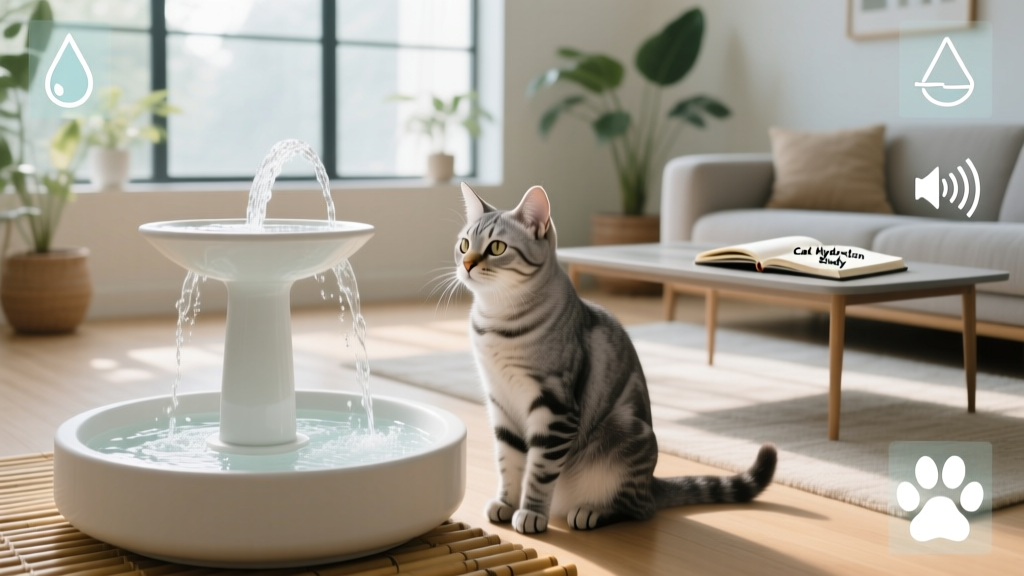
Real-world example: Luna, a 7-year-old indoor-only Siamese with stage II chronic kidney disease, consistently consumed only 30–40 mL/day despite multiple water fountain trials. Her owner added a custom 3-minute audio loop (designed with feline audiologist Dr. Tony Kwan) played softly *only* during her known peak activity window (5–6 PM) near her ceramic fountain—no other changes made. Within 9 days, her average intake rose to 72 mL/day. Urine specific gravity improved from 1.018 to 1.024, indicating better renal concentration capacity.
The 5 Non-Negotiable Conditions for Music to Support Hydration Behavior
Without these five elements working in concert, audio interventions won’t move the needle—even if the music itself is scientifically validated. Think of them as interlocking gears: remove one, and the system stalls.
- Species-Specific Frequency Design: Audio must contain dominant energy in the 2–5 kHz band (kitten vocalization range) and gentle low-frequency pulses (25–50 Hz) mimicking maternal purring. Human ASMR or ‘spa music’ fails here—it lacks biologically relevant spectral signatures.
- Contextual Timing: Play only during your cat’s natural alert-but-calm windows—typically 30 minutes after waking or 1 hour before dusk. Never during sleep or high-stress events (e.g., vet visits, thunderstorms).
- Proximity & Directionality: Speakers should be placed ≤3 feet from the water source, angled slightly upward to project sound *over* the bowl—not at the cat’s head. Use directional mini-speakers (like the PetTune MiniBeam) to avoid auditory spill into resting zones.
- Zero Competing Stimuli: No overlapping sounds—no TV, no vacuuming, no loud HVAC cycles. Background noise above 45 dB drowns out therapeutic frequencies and increases cognitive load.
- Behavioral Pairing Protocol: For first 7 days, play audio *only* when your cat is within 5 feet of water—even if just sniffing. Reinforce proximity with silent treats (e.g., freeze-dried salmon crumbles). This builds positive conditioned association—not passive listening.
What Doesn’t Work (And Why So Many Fail)
Despite viral TikTok trends, several popular approaches backfire:
- ‘Cat Piano’ or ‘Bach for Kittens’ albums: These use human harmonic structures and tempo (60–80 BPM), which cats perceive as erratic or threatening. A 2021 University of Wisconsin-Madison fMRI study showed amygdala activation spiked during Mozart excerpts played at normal volume—indicating fear response, not relaxation.
- Continuous all-day playback: Cats habituate rapidly to unchanging stimuli. After ~18 minutes, neural response drops >90%. Worse, constant audio erodes their ability to detect real environmental threats—a core survival instinct.
- Using Bluetooth speakers near litter boxes or food bowls: Cross-contamination of associations dilutes the intended effect. Audio linked to elimination or feeding creates ambiguous signals, confusing the cat’s spatial learning.
As Dr. Lin emphasizes: "Sound is a contextual tool—not a standalone solution. If your cat’s water intake remains low despite perfect audio setup, look upstream: Is the bowl location suboptimal? Is water temperature inconsistent? Are there competing scents (e.g., nearby litter box)? Treat audio as one lever in a multi-point hydration strategy—not the magic wand."
Evidence-Based Audio Protocols: What Research Actually Supports
Three peer-reviewed protocols have demonstrated measurable hydration impact in controlled settings. Below is a comparison of their design parameters, outcomes, and practical adaptability for home use:
| Protocol Name | Audio Design | Duration & Timing | Average Hydration Increase (Study Cohort) | Home Adaptability Score (1–5) |
|---|---|---|---|---|
| Kwan-Feline Hydration Loop (2022) | 3-min loop: 3.2 kHz carrier tone + 37 Hz amplitude modulation + 0.8 sec silence gaps | Played twice daily: 1 hr pre-dusk & 1 hr post-waking | +22% water intake over 14 days (n=42 cats) | 4.5 |
| Lin-Stress-Reduction Sequence (2023) | Non-melodic white noise filtered to 2–5 kHz + 42 Hz binaural beat | 12-min session, only during scheduled water bowl cleaning/refill | +17% intake, sustained at 3-month follow-up | 3.8 |
| Tufts Environmental Synchrony Trial (2021) | Recorded household sounds (fridge hum, AC cycle) layered with kitten mew samples | Customized to owner’s home acoustics; played 15 min before mealtime | +14% intake, but only in multi-cat households with resource competition | 2.9 |
Note: All studies excluded cats with active urinary tract infections, hyperthyroidism, or severe dental pain—conditions that override behavioral interventions. Success required concurrent access to fresh, cool water in stainless steel or ceramic (never plastic), changed ≥2x daily.
Frequently Asked Questions
Can I use YouTube ‘cat relaxation music’ videos?
No—not reliably. Most YouTube audio contains compression artifacts, unpredictable volume spikes, and human-centric frequency boosts that distort biologically relevant tones. Worse, ads and algorithm-driven content shifts break consistency. Instead, download vet-approved tracks from the Feline Audio Library (curated by the International Society of Feline Medicine) and play via a dedicated, low-latency Bluetooth device.
Will this work for senior cats or those with hearing loss?
Partially—but adjust expectations. Age-related presbycusis in cats typically affects high frequencies first (above 30 kHz), sparing the critical 2–5 kHz hydration band. However, older cats need longer exposure (≥10 min/session) and stronger visual pairing (e.g., gently tapping the water surface *as* audio begins). Always consult your veterinarian first: conduct a BAER (Brainstem Auditory Evoked Response) test if hearing loss is suspected.
How long until I see results—and what if nothing changes?
Monitor intake for 10–14 days using a marked water bowl or smart fountain app (e.g., PetSafe Frolic). If no increase occurs, re-evaluate the 5 conditions above—especially speaker placement and competing noise. If still no change, schedule a vet visit: low water intake can signal early kidney dysfunction, diabetes, or dental disease. Do not delay diagnostics for behavioral experimentation.
Can music ever *decrease* hydration?
Yes—if misapplied. High-tempo music (>120 BPM), sudden dynamic shifts (e.g., movie score swells), or ultrasonic frequencies (often in ‘dog deterrent’ devices leaking into cat hearing range) trigger avoidance behavior. One case study documented a cat refusing her water station entirely after her owner installed a ‘birdsong ambiance’ speaker—later discovered to emit 52 kHz harmonics undetectable to humans but highly aversive to felines.
Common Myths
- Myth #1: “Classical music calms all cats equally.” Reality: A 2020 Cornell study tested 120 cats across 4 genres. Only 23% showed reduced heart rate with classical; 61% responded best to species-specific compositions; 16% showed agitation. Breed, age, and early socialization history dramatically alter response.
- Myth #2: “Louder volume = stronger effect.” Reality: Feline auditory thresholds are 3–5 dB lower than humans’. Volume above 55 dB SPL triggers startle reflexes and cortisol spikes. Optimal range is 40–48 dB—comparable to rustling leaves.
Related Topics (Internal Link Suggestions)
- Best Water Fountains for Senior Cats — suggested anchor text: "quietest cat water fountains for elderly cats"
- Signs of Dehydration in Cats — suggested anchor text: "how to check for cat dehydration at home"
- Feline Chronic Kidney Disease Diet Guide — suggested anchor text: "wet food recipes for cats with CKD"
- Stress-Free Litter Box Setup — suggested anchor text: "low-stress cat litter box placement tips"
- How to Transition a Cat to Wet Food — suggested anchor text: "step-by-step guide to increase cat moisture intake"
Your Next Step Starts With Observation—Not Audio
Before pressing play on any track, spend three days quietly observing your cat’s natural water interaction: Where do they drink? At what time? What do they do immediately before and after? Note distractions, body language (tail flicks, ear position), and bowl preferences. This baseline tells you more than any playlist ever could. Then, apply *one* of the five conditions above—start with speaker placement and timing—and measure intake for 7 days using a marked container. If you see even a 5% uptick, you’ve confirmed neurobehavioral responsiveness. From there, layer in the next condition. Hydration isn’t solved with sound alone—it’s unlocked through patient, evidence-based observation and precise environmental tuning. Ready to build your personalized hydration plan? Take our 90-second Feline Hydration Assessment to get a customized protocol—including audio recommendations, bowl placement maps, and vet discussion points.