What Is Cat Nesting Behavior for Sleeping? Why Your Cat...
Why Your Cat’s Midnight Nesting Isn’t Just ‘Cute’ — It’s a Window Into Their Well-Being
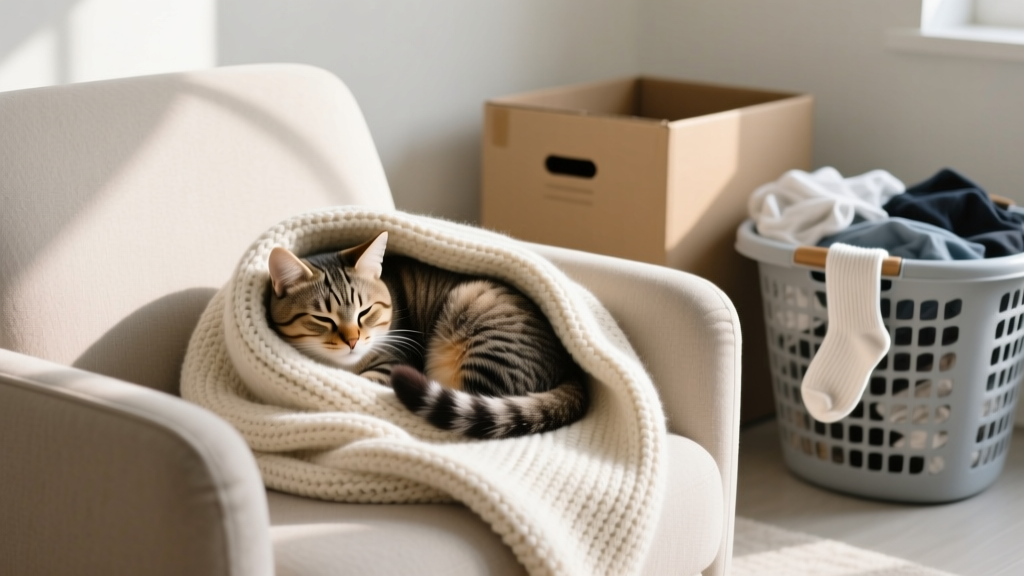
\nWhat is cat nesting behavior for sleeping? It’s the instinctive act of seeking out, shaping, and settling into enclosed, soft, or warm spaces — like burrowing under blankets, kneading inside laundry baskets, or curling tightly in cardboard boxes — before drifting off. Far more than a quirky habit, this behavior traces back to wild ancestors who needed concealed, thermally stable dens to rest safely while conserving energy and staying hidden from predators. Today, over 87% of domestic cats exhibit nesting behaviors daily, according to a 2023 observational study published in Applied Animal Behaviour Science, yet many owners misread its meaning — mistaking anxiety-driven nesting for contentment, or dismissing genuine discomfort as ‘just being a cat.’ Understanding the nuance isn’t optional; it’s one of the most accessible, real-time indicators of your cat’s emotional and physical state — especially since cats rarely vocalize distress until it’s advanced.
\n\nThe Evolutionary Blueprint: Why Nesting Is Hardwired, Not Learned
\nCats are obligate carnivores with a prey-animal nervous system — even when well-fed and loved. In the wild, unguarded sleep is dangerous. Nesting behavior for sleeping evolved as a survival strategy: creating micro-environments that regulate body temperature (critical for conserving calories), block visual stimuli (reducing sensory overload), and provide tactile pressure that triggers parasympathetic nervous system activation — essentially flipping the ‘rest-and-digest’ switch. Dr. Lena Torres, a feline behavior specialist and certified veterinary technician with over 18 years of clinical experience, explains: ‘When a cat circles, kneads, and then tucks herself into a tight ball inside a hoodie or under a throw pillow, she’s not just getting comfortable — she’s replicating the denning behavior of her Felis silvestris lybica ancestors. That compression against her sides signals safety to her brainstem. Interrupt that process too often — say, by pulling her out of a nest mid-settle — and you’re inadvertently spiking cortisol.’
\nThis instinct remains potent across all life stages. Kittens begin nesting as early as 3 weeks old, using littermates as ‘living pillows’ to maintain warmth. Senior cats intensify nesting as thermoregulation declines with age — a 2022 Cornell Feline Health Center survey found that 64% of cats over age 12 slept in insulated nests (under quilts, inside heated beds, or wedged between couch cushions) at least 5x/week, compared to just 31% of cats aged 2–6.
\n\nDecoding the Nest: 4 Key Variations & What They Reveal
\nNot all nesting looks the same — and each variation communicates something distinct about your cat’s current needs. Here’s how to read the signals:
\n- \n
- The Burrower: Digs deep under comforters, pulls blankets over head, or vanishes beneath duvets. Often indicates high sensitivity to environmental stimuli — think loud HVAC systems, sudden noises, or household changes (new pet, baby, renovation). This is typically low-risk *if* the cat emerges relaxed and engages normally afterward. \n
- The Box Architect: Obsessively repositions cardboard boxes, flips them, tears flaps, or carries them to preferred spots before entering. Signals strong territorial reinforcement — especially common after moving homes or introducing new furniture. A 2021 University of Utrecht ethology study observed that cats given identical boxes but different scents (their own vs. unfamiliar cat) spent 3.2x longer nesting in boxes bearing their own scent, confirming nesting as a scent-marking + security ritual. \n
- The Kneader-Nester: Vigorously kneads fabric (your sweater, a fleece blanket, a cat bed) before settling in. This neonatal carryover behavior stimulates milk flow in kittens — so when adults do it during nesting, it’s a powerful sign of deep trust and emotional safety. As Dr. Torres notes: ‘If your cat kneads *and* purrs while nesting on your lap, that’s the feline equivalent of saying, “I feel utterly safe with you.” Don’t disturb it.’ \n
- The Relocator: Moves bedding — toys, socks, paper scraps — into a chosen nest site before lying down. Often seen in multi-cat households and strongly linked to resource guarding. This isn’t hoarding; it’s olfactory anchoring. By layering familiar scents, the cat creates a ‘safe zone buffer’ against perceived competition. \n
When Nesting Crosses the Line: 5 Subtle Warning Signs
\nHealthy nesting is voluntary, reversible, and paired with normal appetite, play, and litter box use. But when nesting becomes compulsive, defensive, or isolating, it may signal underlying issues. Veterinarians emphasize watching for these five red flags — especially when appearing *together*:
\n- \n
- Persistent nesting in dark, inaccessible places (e.g., inside closets with closed doors, behind appliances, under beds with no easy exit) — suggests avoidance behavior or pain-related withdrawal. \n
- Nesting accompanied by excessive grooming (especially focused on one area like the belly or hindquarters) — may indicate dermatological irritation, arthritis discomfort, or anxiety-induced overgrooming. \n
- Refusal to leave the nest for >24 hours without eating, drinking, or using the litter box — a medical emergency requiring immediate vet evaluation (possible urinary obstruction, pancreatitis, or neurological issue). \n
- New-onset nesting in previously non-nesting cats over age 7 — warrants senior wellness screening for hyperthyroidism, kidney disease, or cognitive dysfunction (feline dementia), all of which can increase anxiety and need for containment. \n
- Aggression when approached near the nest — unlike typical ‘don’t bother me’ body language (slow blink, tail flick), true nest-guarding includes flattened ears, hissing, or swatting *before* being touched. This reflects acute fear or pain. \n
If you observe two or more of these signs, schedule a vet visit within 48 hours — and record a 30-second video of the behavior to share. As Dr. Arjun Patel, internal medicine veterinarian and co-author of Feline Behavioral Medicine, advises: ‘Cats don’t “act out” — they express physiology. Nesting shifts are among the earliest, most reliable behavioral biomarkers we have for systemic illness.’
\n\nVet-Approved Nest Optimization: Build Safer, Smarter Sleep Spaces
\nYou can’t stop nesting — nor should you — but you *can* guide it toward safer, more supportive outcomes. Based on guidelines from the American Association of Feline Practitioners (AAFP) and the International Society of Feline Medicine (ISFM), here’s how to optimize nesting environments:
\n- \n
- Temperature control: Maintain ambient room temps between 75–80°F (24–27°C) for seniors and kittens; use radiant heat pads (NOT electric blankets) under 1–2 layers of breathable fabric. \n
- Enclosure design: Offer 3–4 nest options per cat: one fully enclosed (like a cave bed), one semi-enclosed (hooded donut bed), one open but elevated (window perch with fleece pad), and one shared (family sofa corner with designated blanket). Rotate weekly to prevent over-familiarity. \n
- Scent enrichment: Rub used t-shirts or socks on new beds *before* introducing them — never use synthetic pheromones *inside* nests (they disrupt natural scent mapping). Instead, diffuse Feliway Classic 3 ft away from sleeping zones. \n
- Texture layering: Combine materials: a firm base (memory foam), middle cushion (shredded memory foam or kapok), and top cover (brushed cotton or bamboo jersey). Avoid plush polyester — traps heat and sheds microfibers cats ingest while grooming. \n
| Step | \nAction | \nTools/Materials Needed | \nExpected Outcome (Within 72 Hours) | \n
|---|---|---|---|
| 1 | \nBaseline observation: Log nesting location, duration, time of day, and pre-nest behavior (kneading? vocalizing? pacing?) for 3 days | \nPrintable log sheet or Notes app template | \nClear pattern emerges (e.g., “Nests only post-vacuuming,” “Always in closet after dog barks”) | \n
| 2 | \nIntroduce one enriched nest option matching dominant nesting type (Burrower → weighted blanket nest; Box Architect → corrugated cardboard fort) | \nWeighted blanket (5–8% of cat’s body weight), recycled cardboard, non-toxic glue | \n≥50% reduction in “problem nesting” (e.g., under kitchen cabinets, inside laundry hampers) | \n
| 3 | \nRemove access to unsafe nests (plastic bags, dryer vents, behind refrigerators) using childproof latches or motion-activated deterrents | \nAdhesive cabinet locks, battery-operated ultrasonic deterrent (set to ‘low frequency only’) | \nZero incidents of entrapment or ingestion of hazardous materials | \n
| 4 | \nPair nest entry with positive reinforcement: Offer high-value treat (freeze-dried chicken) *only* when cat enters new nest voluntarily | \nSmall treats, clicker (optional) | \nCat chooses new nest over old spot ≥3x/day without prompting | \n
| 5 | \nWeekly nest rotation + scent refresh: Swap bedding fabrics and gently rub with cat’s cheek gland secretions (using clean finger) | \nClean cotton cloths, gentle hand-washing routine | \nSustained interest in all nest options; no obsessive focus on single location | \n
Frequently Asked Questions
\nIs nesting behavior for sleeping a sign my cat is pregnant?
\nWhile nesting *can* occur in late-stage pregnancy (typically 24–48 hours before labor), it’s not a reliable standalone indicator. Pregnant cats often combine nesting with other clear signs: mammary gland enlargement (pink, swollen nipples), increased vocalization, restlessness, and refusal of food 12+ hours pre-labor. However, non-pregnant cats — especially unspayed females experiencing false pregnancy or seasonal hormonal shifts — may also nest intensely. If your cat is intact and nesting suddenly, consult your vet for ultrasound or palpation — but remember: most nesting has zero reproductive link.
\nWhy does my cat nest on my chest or head while I sleep?
\nThis is high-trust nesting — your body heat, rhythmic breathing, and scent create an ideal thermal and olfactory nest. The chest offers steady vibration (like a mother cat’s purr), while the head provides elevated vantage point + warmth from scalp circulation. It’s rarely about dominance; it’s about co-regulation. That said, if it disrupts your sleep or causes breathing difficulty for your cat (e.g., flat-faced breeds like Persians), gently redirect to a heated cat bed placed *beside* your pillow — never punish or push away, as this erodes security.
\nCan stress cause excessive nesting — and how do I fix it?
\nAbsolutely. Stress-induced nesting is often frantic, repetitive, and occurs in inappropriate locations (e.g., inside empty drawers, under sinks). Common triggers include moving, construction noise, new pets, or even changing your work schedule. Fix it by first identifying the trigger (use your 3-day log), then implementing environmental buffers: vertical space (cat trees near windows), consistent feeding/play routines, and pheromone diffusers placed *away* from nests. Crucially: never force interaction during nesting — instead, sit quietly nearby reading aloud (calm human voice = reassurance). Most cats self-correct within 10–14 days once stressors are mitigated.
\nDo all cats nest — or is it breed-specific?
\nAll domestic cats possess the nesting instinct, but expression varies widely. Breeds with higher baseline anxiety (e.g., Siamese, Oriental Shorthair) tend toward more frequent, intense nesting. Conversely, confident, exploratory breeds (Maine Coon, Abyssinian) may nest less visibly — but still seek micro-enclaves (e.g., curling inside large plant pots, under desk chairs). Even outdoor cats nest — in dense shrubbery, hollow logs, or abandoned vehicles. The instinct is universal; the visibility depends on environment and individual temperament.
\nShould I stop my cat from nesting in my clothes or shoes?
\nNot unless it poses risk (e.g., chewing laces, inhaling fabric softener residue, or blocking ventilation in shoes). Clothing retains your scent — the ultimate security signal. Instead of stopping it, *leverage* it: place a worn t-shirt in a new cat bed to accelerate adoption. If nesting in dirty laundry is problematic, keep hampers lidded and provide a dedicated ‘scent basket’ filled with folded, unwashed shirts — making the behavior both acceptable and directed.
\nCommon Myths About Cat Nesting Behavior
\n- \n
- Myth #1: “Nesting means my cat is cold.” While thermoregulation is a factor, nesting persists even in 80°F rooms. Cats nest for psychological containment as much as warmth — studies show nesting frequency correlates more strongly with household noise levels than ambient temperature. \n
- Myth #2: “If my cat nests a lot, she’s depressed.” Depression in cats manifests as *reduced* activity, appetite loss, and hiding — not purposeful nest-building. Healthy nesting is active, engaged, and followed by relaxed sleep. True depression rarely involves kneading or purring. \n
Related Topics (Internal Link Suggestions)
\n- \n
- Understanding Cat Body Language Cues — suggested anchor text: "what your cat's tail flick really means" \n
- Feline Anxiety Signs and Natural Remedies — suggested anchor text: "silent signs of cat stress you're missing" \n
- Best Heated Cat Beds for Senior Cats — suggested anchor text: "vet-recommended warming beds for older cats" \n
- Kneading Behavior in Cats: Why They Do It — suggested anchor text: "why does my cat knead me like dough?" \n
- Cat Sleep Patterns: How Much Is Normal? — suggested anchor text: "is it normal for cats to sleep 18 hours a day?" \n
Conclusion & Next Step
\nWhat is cat nesting behavior for sleeping? It’s a profound, biologically rooted act of self-preservation and emotional regulation — not a quirk to be indulged or ignored. By learning to decode its variations, recognizing its boundaries, and thoughtfully enriching your cat’s nesting ecology, you transform everyday moments into meaningful opportunities for connection and care. Don’t wait for a crisis to pay attention to where — and how — your cat chooses to rest. Your next step? Grab your phone right now and film 60 seconds of your cat’s *most typical* nesting sequence — then compare it against the warning signs and table guidelines above. Within 48 hours, choose *one* optimization step from the table (start with Step 1: the 3-day log) and implement it. Small observations, consistently applied, build extraordinary insight — and that’s how truly attuned cat guardianship begins.