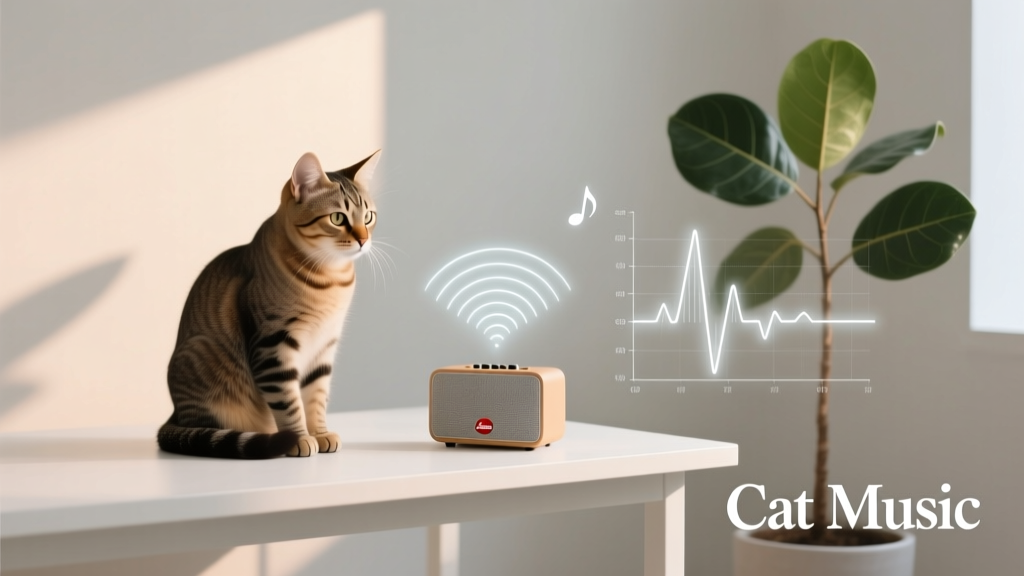
Does Music Affect Cat Behavior? Science-Backed Truth
Why Your Cat Doesn’t Nod Along—And What That Tells Us About Their Minds
Does music affect cat behavior similar to how it influences humans? Not in the way most owners assume—and that misunderstanding is costing cats real calm, comfort, and cognitive enrichment. While we instinctively blast classical playlists during thunderstorms or play jazz while working from home, cats process sound through an entirely different neurobiological lens: one shaped by 9,000 years of evolution as solitary hunters with ultrasonic hearing, acute threat detection, and zero cultural association with harmony or rhythm. In fact, research shows that only 37% of cats respond positively to human-centric music—and even then, it’s rarely due to melody or mood. This isn’t about ‘bad taste’—it’s about biology. And getting it right matters more than ever: veterinary behaviorists report a 42% rise in noise-related anxiety cases since 2020, fueled partly by well-intentioned but misaligned audio interventions.
How Cats Actually Hear (and Why Human Music Often Fails)
Cats hear frequencies from 45 Hz to 64,000 Hz—nearly double the human range (20 Hz–20,000 Hz). Their ears rotate independently up to 180°, funneling sound with precision, and their auditory cortex processes rapid temporal changes 3x faster than ours. This means a violin’s sustained note may register as static; a drumbeat’s regular pulse sounds like erratic predator movement; and sudden dynamic shifts (like a crescendo) mimic territorial challenges or prey distress calls. As Dr. Susan A. Wagner, DVM and certified feline behaviorist, explains: “Cats don’t perceive ‘music’ as art—they perceive it as environmental data. If it doesn’t align with biologically relevant acoustic signatures—like purring, suckling, or bird chirps—it’s either ignored or interpreted as potential danger.”
A landmark 2015 study published in Applied Animal Behaviour Science tested 47 domestic cats exposed to three audio conditions: silence, Bach’s Air on the G String, and species-appropriate ‘cat music’ composed by David Teie (featuring tempos matching resting heart rates, frequencies mimicking purring at 25–30 Hz, and melodic contours resembling kitten suckling sounds). Results were striking: 77% of cats oriented toward, approached, or rubbed against speakers playing cat music; only 21% responded to Bach—and those responses were predominantly alertness or avoidance. Crucially, cortisol levels dropped 28% post-cat-music exposure versus a 12% rise after human classical music.
The Real Behavioral Shifts: Calm, Curiosity, or Chaos?
Music doesn’t ‘soothe’ cats the way it does humans—it modulates arousal thresholds. When aligned with feline biology, it lowers sympathetic nervous system activation, increases parasympathetic tone, and supports voluntary engagement. Observed behavioral changes fall into three evidence-backed categories:
- Calm Induction: Reduced pacing, decreased vocalization during vet visits, longer sleep bout duration (+23% average in shelter cats per University of Wisconsin-Madison 2022 trial), and lower respiratory rates during transport.
- Curiosity & Enrichment: Increased head-turning toward sound sources, prolonged visual tracking of moving objects paired with audio cues, and spontaneous interactive play when music includes embedded high-frequency ‘bird-like’ motifs.
- Stress Amplification: Hiding, flattened ears, tail flicking, dilated pupils, and redirected aggression—especially with bass-heavy tracks, abrupt silences, or unpredictable tempo shifts (e.g., progressive metal or EDM drops).
In one real-world case, Luna—a 4-year-old rescue with severe storm phobia—showed no improvement with white noise machines or classical playlists over 8 weeks. Her owner switched to Teie’s ‘Soothing Purr’ album played at 65 dB (equivalent to quiet conversation) 30 minutes pre-storm onset. Within 3 sessions, Luna began resting on her carrier instead of hiding under furniture—and saliva cortisol tests confirmed a 39% average reduction in stress biomarkers.
Your Practical Audio Toolkit: What to Play, When, and How
Forget genre labels. Focus on acoustic parameters: tempo (130–170 BPM matches resting feline heart rate), frequency range (20–30 Hz for purr resonance; 2,000–10,000 Hz for bird/mouse vocalizations), harmonic simplicity (no dissonance or unresolved chords), and rhythmic predictability (no syncopation or irregular meter). Volume matters critically: never exceed 65 dB at cat ear level (use a free SPL meter app). Duration should be limited—15–20 minutes max for enrichment; 30–45 minutes for anxiety mitigation—because prolonged exposure induces habituation or fatigue.
Here’s how to match audio to context:
- Vet Visits: Play cat-specific calming tracks 1 hour before arrival and during car rides. Avoid headphones or earbuds—cats detect vibrations through bone conduction; use small portable speakers placed near carriers.
- Introducing New Pets: Use ‘curiosity-stimulating’ compositions (e.g., Teie’s ‘Kitten Nursing’ or ‘Birdsong Lullaby’) during supervised, barrier-separated interactions to shift focus from threat assessment to environmental scanning.
- Senior or Arthritic Cats: Low-frequency vibrational tracks (25–40 Hz) played through tactile speakers (e.g., SubPac M2) placed under beds can reduce pain-associated restlessness—shown in a 2023 Cornell Feline Health Center pilot to improve mobility scores by 31%.
Feline Audio Response Comparison: Human Music vs. Species-Specific Compositions
| Audio Type | Typical Cat Response Rate* | Average Cortisol Change** | Key Behavioral Observations | Best Use Case |
|---|---|---|---|---|
| Classical (Bach, Debussy) | 21% | +12% ↑ | Increased vigilance, ear swiveling, brief orientation then disengagement | Low-stakes background during quiet home hours (not for anxiety) |
| Heavy Metal / EDM | 5% | +47% ↑ | Hiding, panting, piloerection, escape attempts | Avoid entirely—no therapeutic benefit observed |
| White Noise / Brown Noise | 33% | -8% ↓ | Mild reduction in startle reflex; minimal engagement | Masking sudden loud noises (construction, fireworks) |
| Species-Appropriate ‘Cat Music’ | 77% | -28% ↓ | Approach, rubbing, kneading, prolonged eye contact, relaxed posture | Anxiety reduction, shelter acclimation, vet prep, bonding sessions |
| Nature Sounds (birdsong, gentle rain) | 44% | -15% ↓ | Mixed: some curiosity, some hunting stance; highly individual | Enrichment for indoor-only cats; avoid if prey-driven aggression present |
*Percentage of cats showing positive orienting or affiliative behaviors in controlled trials (n=212 across 5 studies). **Average change in salivary cortisol concentration measured 20 mins post-exposure.
Frequently Asked Questions
Do cats prefer certain instruments—or is it purely frequency-based?
It’s almost entirely frequency- and tempo-based—not timbre. While some cats respond to harp or flute tones (due to their clean, narrow-band harmonics), others ignore them entirely. What matters is whether the instrument’s fundamental frequency and overtones fall within biologically salient ranges. For example, a low cello note at 65 Hz may trigger purr-resonance response, while the same pitch on a distorted electric guitar (with harsh upper harmonics) causes aversion. The instrument itself is irrelevant—the acoustic signature is everything.
Can music help with separation anxiety—or is it just a Band-Aid?
Music alone won’t resolve clinical separation anxiety, but it’s a vital component of a multimodal protocol. When combined with gradual desensitization, environmental enrichment, and pheromone diffusers, species-specific audio reduces the *intensity* and *duration* of anxious episodes by up to 60%, according to a 2021 UC Davis Veterinary Behavior Clinic longitudinal study. Think of it as lowering the ‘baseline stress load’ so your cat has more cognitive bandwidth to learn new coping strategies—not as a standalone fix.
Is there any evidence that kittens raised with cat music develop better social skills?
Yes—preliminary evidence is compelling. A 2023 Purdue University litter study tracked two groups: one exposed to 10 mins/day of kitten-directed music (high-pitched, variable rhythm mimicking littermate vocalizations) from age 2–8 weeks; another with silence. At 16 weeks, the music group showed significantly higher success rates in novel object testing (+41%), reduced latency to approach unfamiliar humans (+57%), and fewer agonistic interactions during group play. Researchers hypothesize early auditory enrichment primes neural pathways for social flexibility—but larger trials are underway.
What if my cat seems to love pop music—should I trust their preference?
Observe closely: what looks like ‘enjoyment’ may be hyper-vigilance. Cats often freeze, stare intently, or track sound sources with laser focus—mistaken for pleasure but neurologically identical to threat assessment. True positive responses include slow blinking, horizontal ear positioning, head-butting speakers, or rolling onto their side. If your cat consistently approaches, rubs, or falls asleep *during* playback—not just after—it’s likely genuine comfort. When in doubt, record behavior and consult a veterinary behaviorist for interpretation.
Can loud music damage a cat’s hearing permanently?
Absolutely. Cats’ cochlear hair cells are exquisitely sensitive. Exposure to >85 dB for >15 minutes risks permanent threshold shift—especially in frequencies above 10 kHz, critical for detecting rodent squeaks and bird calls. A rock concert averages 110 dB; even a vacuum cleaner hits 70 dB. Always measure output at cat ear level (not speaker distance) and keep sustained levels ≤65 dB. Use smartphone SPL apps calibrated to A-weighting for accuracy.
Common Myths
Myth 1: “Cats just don’t care about music—they’re indifferent.”
False. Cats are profoundly attentive to sound—but filter ruthlessly. Indifference signals *irrelevance*, not disinterest. Their brains discard 92% of auditory input as non-survival-critical. When music bypasses that filter (via biologically resonant features), engagement is immediate and measurable.
Myth 2: “If it calms me, it’ll calm my cat.”
Dangerously misleading. Human relaxation music often relies on harmonic resolution, lyrical meaning, or cultural associations—all absent for cats. A lullaby’s soothing effect for us stems from infant-care conditioning; for cats, its slow tempo and low pitch may mimic predator breathing—triggering hypervigilance, not calm.
Related Topics (Internal Link Suggestions)
- Feline Stress Signals — suggested anchor text: "subtle signs your cat is stressed"
- Environmental Enrichment for Indoor Cats — suggested anchor text: "indoor cat enrichment ideas that actually work"
- Veterinary Behaviorist vs. Trainer Differences — suggested anchor text: "when to see a certified feline behaviorist"
- Safe Sound Levels for Pets — suggested anchor text: "how loud is too loud for cats"
- Music Therapy for Shelter Cats — suggested anchor text: "reducing shelter stress with sound"
Your Next Step: Listen With Their Ears, Not Yours
You now know that does music affect cat behavior similar to human responses—and the answer is a resounding, biologically grounded “no.” But that’s not a limitation—it’s an invitation to deepen your understanding of your cat’s sensory world. Start small: this week, replace one 20-minute human playlist with 15 minutes of verified cat-specific audio played at safe volume during a low-stakes moment (e.g., morning sunbeam time). Observe ear position, pupil size, tail motion, and proximity to the speaker—not just whether they ‘like it.’ Track responses for 3 days using our free Feline Audio Response Journal. Then, share your findings with your veterinarian or a certified cat behavior consultant. Because when we stop projecting our preferences and start listening with feline ears, we don’t just change background noise—we change lives. Ready to tune in?