Why Cats Sit on Paper and Documents
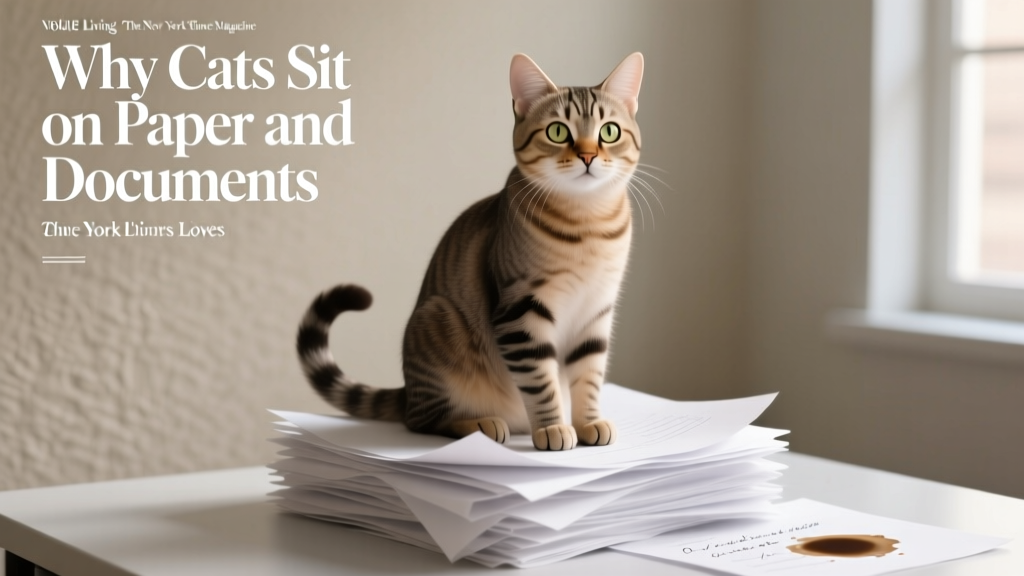
You sit down with a fresh stack of papers—tax forms, a work report, the instruction manual you swore you’d read this time. You’re focused. Responsible. Adulting. And then… a soft thud. Your cat strolls over like they own the place (because, honestly, they do), circles once, and lowers themselves onto the exact page you needed. If you slide the paper away, they follow it. If you add more papers, they pick the most important one like they can read your deadlines.
It’s funny, it’s maddening, and it’s one of the most common “Why does my cat do this?” questions. The good news: your cat isn’t trying to sabotage your productivity. The better news: this behavior tells you a lot about how cats think, what they value, and how they communicate with the humans they love.
1) The scientific (and evolutionary) reasons cats love sitting on paper
Cats aren’t obsessed with paper because of paperwork. They’re responding to what paper represents in their world: warmth, comfort, territory, attention, and predictable “cat-friendly” body positioning.
Warmth and energy efficiency
Cats are heat seekers. Their comfort zone tends to be warmer than ours, and they’re biologically wired to conserve energy. A sheet of paper isn’t a heater, but it can feel slightly warmer than a bare desk—especially if it’s been under your hands or near a laptop. Paper also reduces the “cold desk” sensation. It’s a tiny upgrade in comfort, and cats notice tiny upgrades.
A safe “sit spot” with clear boundaries
Many cats adore boxes, baskets, and any defined space. Paper provides a visual and tactile boundary: “Here is the spot.” Even one sheet makes a clear target for a cat who likes predictable, contained resting places. This is related to why cats loaf on bath mats, rugs, and even a single hoodie on the floor.
Scent and social bonding
Your papers smell like you—hands, lotion, soap, the oils from your skin. Cats rely heavily on scent to understand their environment and relationships. Sitting on your papers can be a form of “scent mixing”: your scent plus their scent becomes a shared family marker. It’s one way cats create a group identity in the home.
Attention economics: the paper is where the action is
From your cat’s perspective, paper is a magical object that makes humans intensely focused. When the paper appears, your posture changes, your gaze locks in, and your hands move in interesting ways. If your cat wants closeness or interaction, planting themselves on the “attention hotspot” is simply smart strategy.
Territorial messaging (gentle version)
Cats are subtle about claiming important resources. Your documents and notebooks are valuable to you, and cats pay attention to what you value. Sitting on them can be a quiet territorial behavior: “This important thing exists in my territory, and I am part of it.”
2) A detailed breakdown: different contexts, different motivations
The “cat on paper” behavior isn’t one-size-fits-all. The context often reveals what your cat is after.
When you’re working: “I want access to you.”
You open your laptop, spread papers out, and suddenly your cat becomes a tiny supervisor. In this situation, paper sitting is usually about social contact. Your cat is choosing the spot that guarantees proximity to your hands, your face, and your attention. Some cats will even look up and blink slowly as if to say, “This meeting could have been an email. Pet me instead.”
When you’re reading in bed: “I want shared calm time.”
Many cats don’t want high-energy play—they want quiet companionship. If you’re reading, journaling, or doing a crossword, your cat may settle on the page as a way to “join” your activity. It’s not always demand-y; it can be affiliative, like choosing to sit next to you on the couch.
When it’s mail or new documents: “New smell, new object.”
Mail is fresh from the outside world: different paper type, different inks, different scents. Cats investigate novelty. Sitting on new papers can come after sniffing and rubbing, as if the cat is processing the information: “This came from Outside. I will neutralize it with my presence.”
When it’s craft paper, tissue paper, or wrapping paper: “Texture and sound play.”
Not all paper is equal. Tissue paper crinkles, wrapping paper slides, and craft paper can be fun to dig at. In these contexts, sitting can be part of play—pounce, scrunch, pause, sit, repeat.
When it’s on the floor: “It’s a target.”
Put a random sheet of paper on the floor and many cats will walk over and sit. This is partly the boundary effect (a defined “spot”), partly curiosity, and partly a cat’s love of claiming new little territories. It’s also why people joke that cats are liquid—if there’s a space that looks like it could be a bed, they’ll test it.
3) What it says about your cat’s mood and feelings
Paper-sitting can be a surprisingly good emotional barometer. Look at the rest of the body language to interpret the message.
- Relaxed loaf, half-closed eyes: Content and secure. Your cat feels safe near you and is settling into a cozy routine.
- Tail wrapped, slow blinks, gentle purring: Affection and bonding. This is “I like being with you” behavior, not a power move.
- Staring at you, pawing the page, chirping or meowing: Requesting interaction. Often means “Break time, please.”
- Restless shifting, ears swiveling, quick head turns: Mildly conflicted—wants to be close but is also alert. Sometimes happens in busy households or if there are other pets nearby.
- Body tense, ears back, guarding the paper: Less common, but can signal resource guarding or stress. This is where context matters (more on that below).
Most of the time, the emotion behind the behavior is positive: closeness, comfort, and a desire to share space.
4) Related behaviors you might also notice
If your cat sits on paperwork, you’ll probably recognize a few cousins of the behavior:
- Keyboard sitting: The premium version—warm, central, and guaranteed to produce a human reaction.
- Sleeping on your clothes: Same scent-bonding idea, plus soft texture.
- Box obsession: Defined boundaries and perceived safety.
- Sitting on your book the moment you open it: Attention hotspot plus “shared activity.”
- Rubbing cheeks on corners of notebooks or books: Facial pheromones marking familiar territory.
5) When it’s normal… and when it might be a concern
For most cats, sitting on paper is harmless and adorable. Still, it’s worth watching for patterns that suggest stress or unmet needs.
Normal and healthy
- Your cat does it occasionally or as part of a routine.
- Body language is loose and relaxed.
- The cat can be redirected without getting upset.
- They still play, eat, and rest normally.
Potentially concerning
- Compulsive behavior: If your cat constantly seeks paper, chews it obsessively, or seems unable to settle without it.
- Sudden clinginess: If paper-sitting ramps up alongside other signs of anxiety (hiding, overgrooming, startling easily), consider recent changes—new pet, move, schedule shift.
- Paper chewing/eating: Some cats chew paper as a soothing behavior or out of boredom. Eating paper repeatedly can be risky and may warrant a vet check, especially if paired with vomiting, appetite changes, or lethargy.
- Aggression when moved: If your cat growls, swats, or guards paperwork, look for stressors and consider professional behavior guidance.
If you’re seeing dramatic changes or any signs of illness, a vet visit is a smart first step. Pain and discomfort can make cats more clingy or more controlling about “safe spots.”
6) How to respond (without declaring war on your paperwork)
You don’t have to choose between a functional desk and a fulfilled cat. The goal is to meet the need behind the behavior—warmth, proximity, and a defined resting spot.
Create a “yes spot” near your work
Place a small cat bed, folded blanket, or even a shallow box beside your papers. For many cats, the magic is simply having a designated landing zone near you. If your cat loves the boundary of paper, try putting a single sheet or a placemat on top of their bed to make it extra appealing.
Use decoy paper (seriously)
If your cat is determined, give them their own “important documents.” A blank sheet or old notebook placed next to your workspace can satisfy the urge. Cats often pick the closest available “paper spot.”
Reward the behavior you like
When your cat chooses the bed instead of your tax return, reinforce it: a treat, a gentle pet, or a calm “good cat” voice. Cats repeat what works.
Schedule micro-interactions
Many paper-sitters are asking for connection. Try a 2-minute play session before you start working, and brief “attention breaks” every so often: a few chin scratches or tossing a toy mouse. It can reduce the need for theatrical desk takeovers.
Make the desk less inviting (kindly)
- Keep papers in a tray or folder when possible.
- Use a desk mat your cat doesn’t love as much as paper.
- Offer warmth elsewhere (a heated cat pad on a safe, low setting can be irresistible).
Avoid punishment
Yelling or spraying water can backfire by making your workspace feel unpredictable, which can increase clinginess or stress. Calm redirection works better: lift your cat gently, place them on the “yes spot,” reward, repeat.
7) Fun facts and research-flavored insights
- Cats love defined spaces. Studies on stress in cats have found that access to hiding spots and predictable “safe zones” can reduce stress-related behaviors. A sheet of paper isn’t a cave, but it does create a small, predictable “zone” on an open surface.
- Scent is social glue. Cats use scent marking (especially facial pheromones) to make environments feel familiar and safe. Hanging around objects that smell like you—and adding their own scent by sitting and rubbing—is part of how they maintain a calm home base.
- Your attention has gravity. From a cat’s point of view, whatever consistently captures your eyes and hands is valuable. Paper, books, and laptops all qualify.
8) FAQ: Cats sitting on paper and documents
Why does my cat sit on the exact paper I’m using?
Because it’s where your attention is strongest. Cats are excellent at tracking what matters to you, and they often choose the “center of the action” to be close, get petted, or simply be included.
Is my cat jealous of my work or my book?
Not jealousy in the human sense, but cats can compete for access to your attention and proximity. If work reliably reduces interaction, your cat may interrupt to restore closeness.
How do I stop my cat from sitting on important documents?
Offer an equally attractive alternative right next to you (bed, box, folded blanket), add a decoy paper, and reward your cat for choosing the alternative. Also store truly important papers in a tray or folder to remove temptation.
Why does my cat chew paper?
Paper chewing can be boredom, stress relief, attention-seeking, or a texture preference. If your cat is actually ingesting paper or doing it frequently, it’s worth discussing with your vet to rule out medical issues and to create a safe behavior plan.
Do some cats do this more than others?
Yes. Cats who are more social, more curious, or more routine-oriented often do it more. Kittens may treat paper as a toy, while adult cats may treat it as a comfort spot.
Should I let my cat sit on my papers?
If it’s safe and you don’t mind, it’s usually fine—and can be a sweet bonding ritual. If you do mind, redirect without scolding. The goal is to keep your cat’s need for closeness met while keeping your paperwork intact.
Cats sitting on paper is one of those small, silly habits that actually reveals something big: cats are relationship-driven, comfort-driven creatures who pay close attention to what we do and where we focus. With a simple “yes spot,” a little redirection, and a sense of humor, you can protect your documents and still make your cat feel included in your world.
Does your cat have a favorite paper to claim—mail, sketchbooks, homework, or the one form you can’t replace? Share your funniest “cat vs. paperwork” story with the Cat Lovers Base community at catloversbase.com.