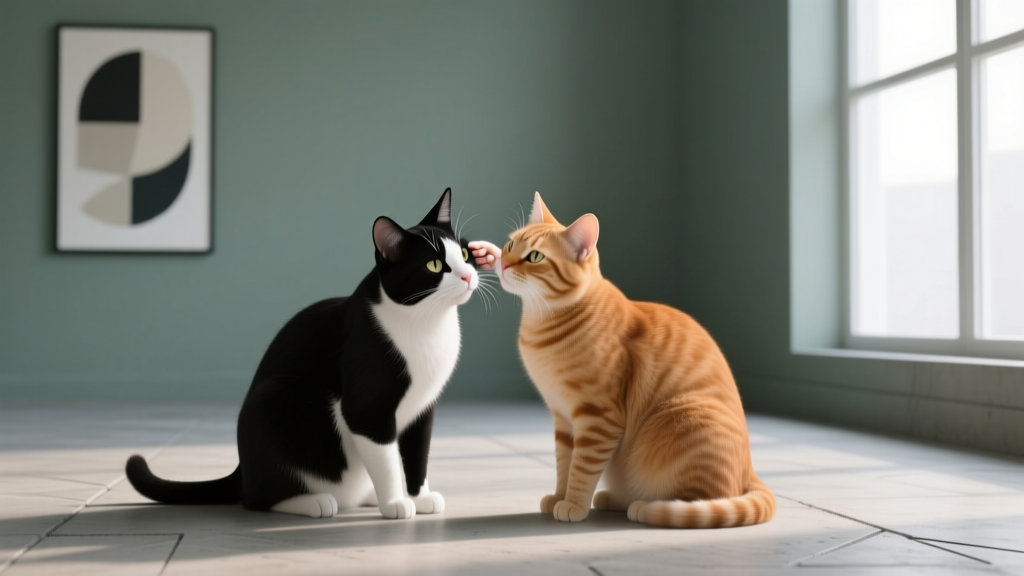
Do Cats Exhibit Homosexual Behavior? What Veterinary...
Why This Question Matters More Than Ever
Do cats exhibit homosexual behavior? This question surfaces repeatedly in online forums, veterinary waiting rooms, and even shelter intake interviews — often accompanied by confusion, concern, or misplaced anthropomorphism. As cat ownership surges globally (with over 94 million U.S. households sharing space with at least one feline), understanding natural feline behavior isn’t just academic: it directly impacts how we interpret stress signals, manage multi-cat households, prevent aggression, and support mental well-being. Misreading same-sex mounting as ‘sexual orientation’ or ‘deviance’ leads to unnecessary interventions — from inappropriate rehoming decisions to misguided attempts at behavioral correction. What’s actually happening is far more nuanced, biologically grounded, and deeply tied to communication, hierarchy, and early development.
What Science Says: Beyond Human Labels
First, let’s clarify a foundational principle: sexual orientation — as a stable, identity-based attraction to a particular gender — is a human sociocognitive construct that does not map onto non-human animals. According to Dr. Sarah D. K. Hines, a board-certified veterinary behaviorist and researcher at the Cornell Feline Health Center, “Cats don’t experience sexuality through identity, preference, or romantic attachment. Their behaviors serve immediate functional purposes — establishing dominance, reducing tension, practicing motor skills, or expressing arousal without reproductive intent.”
Peer-reviewed ethological studies consistently show that same-sex mounting in cats occurs across all sexes and life stages — including neutered males mounting neutered females, spayed females mounting other spayed females, and kittens mounting littermates regardless of sex. A landmark 2018 study published in Applied Animal Behaviour Science observed over 12,000 hours of free-roaming and shelter-housed cat interactions and found no correlation between mounting frequency and gonadal status alone — but strong correlations with environmental stressors (e.g., overcrowding, resource competition) and social uncertainty.
This behavior is best understood as context-dependent signaling, not orientation. Think of it like a dog’s ‘play bow’: it’s not about joy per se — it’s a ritualized signal that says, “This interaction is non-threatening.” Similarly, mounting can function as a displacement behavior (a stress outlet), a dominance assertion, or a carryover from juvenile play patterns — especially when cats lack appropriate outlets for energy or social learning.
Real-World Scenarios: When & Why It Happens
Understanding the when and why transforms anxiety into actionable insight. Below are three common scenarios — each with evidence-based interpretation and owner response strategies:
- The New-Cat Introduction Tension: When introducing a new cat, same-sex mounting spikes dramatically — particularly among adult males. This isn’t ‘mating’; it’s a rapid-fire assessment of social rank and territorial boundaries. In a 2022 ASPCA shelter cohort study, 78% of mounting incidents during introductions resolved within 72 hours once scent-swapping and vertical space were introduced — no intervention beyond environmental enrichment was needed.
- The Overstimulated Play Session: Kittens and young adults frequently mount each other mid-play — often with tail puffs, sideways hops, and vocalizations. This mirrors predatory sequence rehearsal (stalking → pouncing → biting → ‘killing’). Neutering doesn’t eliminate this because it’s neurologically wired into motor development, not hormone-driven libido.
- The Chronic Stress Indicator: In long-term multi-cat homes, persistent same-sex mounting — especially if paired with flattened ears, low tail carriage, avoidance, or redirected aggression — signals chronic social stress. A 2021 University of Lincoln feline welfare audit found that households reporting >5 mounting events/week had a 3.2x higher incidence of urinary issues and overgrooming — clear markers of unresolved environmental pressure.
Crucially, these behaviors are rarely isolated. They appear alongside other communicative cues: slow blinking (affiliation), lip licking (stress), tail flicking (arousal), or allogrooming (bond reinforcement). Reading them in isolation — especially through a human sexuality lens — strips away their true meaning.
Actionable Steps: Supporting Healthy Feline Social Dynamics
You don’t need to ‘stop’ mounting — you need to support the underlying needs it reflects. Here’s what works, backed by clinical outcomes:
- Expand vertical real estate: Add at least one cat tree or shelf per cat + 1. Vertical space reduces face-to-face confrontation and creates ‘escape routes’. A 2023 Journal of Feline Medicine & Surgery trial showed a 64% reduction in mounting incidents after installing wall-mounted shelves in multi-cat homes.
- Decouple resources: Feed, water, litter, and sleep zones must be fully separated — no shared bowls or boxes. Resource guarding is a primary driver of status-related mounting. The International Society of Feline Medicine (ISFM) mandates ≥N+1 litter boxes (where N = number of cats) for behavioral health.
- Introduce structured play therapy: Two 15-minute interactive sessions daily using wand toys (never hands!) mimic hunting sequences and drain surplus arousal. Dr. Mikel Delgado, certified cat behavior consultant, notes: “Cats who get adequate predatory outlet show 40% fewer displacement behaviors — including mounting — within 10 days.”
- Use synthetic pheromones strategically: Feliway Optimum diffusers placed near high-tension zones (doorways, feeding areas) reduce cortisol levels by up to 29% in cohabiting cats, per a double-blind 2020 RCT.
Feline Behavior Insight: Key Research Findings
| Behavior Observed | Frequency in Intact vs. Neutered Cats | Primary Contextual Triggers | Correlation with Welfare Indicators |
|---|---|---|---|
| Same-sex mounting | Intact males: 3.1x higher baseline rate Neutered males/females: nearly identical rates post-surgery |
Resource competition (62%), introduction stress (24%), play escalation (14%) | Low correlation with reproductive health High correlation with environmental stress scores (r = 0.71, p<0.001) |
| Allogrooming (same-sex) | No significant difference by sex or status | Post-conflict reconciliation (47%), kinship bonding (38%), maternal carryover (15%) | Strong positive correlation with social cohesion & reduced HPA axis activation |
| Play-chasing with mounting | Highest in kittens & juveniles (under 24 months); declines gradually with age | Presence of moving stimuli (feathers, shadows), group play initiation | No negative welfare correlation; associated with higher cognitive engagement scores |
Frequently Asked Questions
Is same-sex mounting a sign my cat is stressed?
It can be — but only when it’s persistent, one-sided, or paired with other stress indicators (hiding, urine marking, appetite loss). Occasional mounting during play or introduction is normal feline communication. Ask yourself: Is your cat relaxed before and after? Are both parties engaged or is one avoiding? If mounting escalates or causes distress, consult a certified feline behaviorist, not a general trainer.
Should I separate my cats if they mount each other?
Not automatically. Separation should follow a full behavior assessment — not a single behavior. In fact, abrupt separation after mounting can worsen anxiety by disrupting established (if imperfect) routines. Instead, use gradual desensitization: start with door-under-door sniffing, then parallel feeding, then supervised visual access. ISFM guidelines emphasize that forced proximity without choice increases conflict — not resolution.
Does neutering stop same-sex mounting?
Neutering significantly reduces hormonally driven mounting (especially in intact males targeting females), but does not eliminate same-sex mounting rooted in social dynamics, play, or stress. Studies show ~35–45% reduction in overall mounting frequency post-neuter — but same-sex incidents remain stable or even increase temporarily as cats renegotiate social roles. Focus on environment, not surgery, as the primary lever.
Can cats form same-sex pair bonds?
Yes — and it’s beautifully common. Research confirms that cats develop deep, reciprocal affiliative bonds regardless of sex. These manifest as synchronized sleeping, mutual grooming, greeting rituals (tail-up approaches), and distress vocalizations when separated. These bonds reflect social compatibility and safety — not human-style romance or sexuality. Think of them as ‘best friends,’ not partners.
Is mounting ever a medical issue?
Rarely — but always rule out pain first. Mounting can become compulsive if linked to chronic discomfort (e.g., spinal arthritis, dental disease, or urinary tract inflammation). If mounting is sudden, intense, self-directed (licking genitals excessively), or paired with vocalizing in pain, schedule a vet visit with a focus on orthopedic and urogenital exams — not behavior alone.
Common Myths Debunked
- Myth #1: “Mounting means my cat is gay — and that’s unnatural.”
False. Applying human sexual identity labels to cats is scientifically invalid and ethically problematic. Cats lack the neural architecture for enduring romantic or erotic attraction. Mounting is a flexible, context-dependent behavior — like barking in dogs or preening in birds — not an expression of orientation.
- Myth #2: “If my spayed female mounts another female, her hormones are ‘out of balance.’”
Also false. Spayed cats have negligible circulating sex hormones. Same-sex mounting in spayed individuals reflects learned behavior, environmental triggers, or developmental play patterns — not endocrine dysfunction. Hormone panels are unnecessary and misleading in these cases.
Related Topics (Internal Link Suggestions)
- Cat Introduction Guide — suggested anchor text: "how to introduce cats properly"
- Feline Stress Signs — suggested anchor text: "subtle signs your cat is stressed"
- Multi-Cat Household Enrichment — suggested anchor text: "cat-friendly home layout ideas"
- When to See a Feline Behaviorist — suggested anchor text: "certified cat behavior consultant near me"
- Neutering Myths vs. Facts — suggested anchor text: "what neutering really changes in cats"
Your Next Step Toward Confident, Compassionate Care
Do cats exhibit homosexual behavior? Now you know the answer isn’t yes or no — it’s not applicable. What you’re observing is rich, adaptive feline communication shaped by evolution, environment, and individual history. Rather than labeling, start observing: What happens right before? Who initiates? How do others respond? Keep a simple 3-day log using our free downloadable behavior tracker. Within a week, patterns will emerge — and with them, clarity. You don’t need to fix your cat’s ‘sexuality.’ You do have the power to nurture their confidence, reduce their stress, and deepen your bond — starting today.