How to Correct My Cat’s Behavior
Why \"How to Correct My Cat’s Behavior\" Is the Wrong Question—And What to Ask Instead
\nIf you’ve ever typed how to correct my cats behavior into a search bar while staring at shredded couch cushions, a litter box full of pee outside the box, or your third pair of bitten ankles this week—you’re not failing. Your cat isn’t ‘bad.’ They’re communicating unmet needs in the only language they know: behavior. And the truth is, most so-called ‘correction’ methods—yelling, clapping, spray bottles, or worse, physical punishment—don’t fix anything. They erode trust, spike cortisol levels, and often escalate the very issues you’re trying to solve. In fact, a 2023 study published in Journal of Veterinary Behavior found that punitive techniques increased aggression in 68% of cats within 10 days. So before we dive into solutions, let’s reframe: it’s not about correcting behavior—it’s about understanding the why, meeting the need, and reshaping the context. That’s where lasting change begins.
\n\nStep 1: Rule Out Medical Causes—Because Pain Masquerades as ‘Misbehavior’
\nBefore any training plan, rule out hidden illness. Cats are masters of masking discomfort—and what looks like ‘acting out’ is often a cry for help. Urinating outside the litter box? Could be interstitial cystitis, urinary crystals, or arthritis making squatting painful. Sudden aggression? Dental disease, hyperthyroidism, or even brain tumors (rare but documented) can trigger irritability. According to Dr. Sarah Wooten, DVM, CVJ, a certified veterinary journalist and feline behavior consultant, ‘At least 30% of behavior cases referred to veterinary behaviorists have an underlying medical component—and half go undiagnosed without full diagnostics.’
\nWhat to do: Schedule a comprehensive exam including bloodwork (CBC, chemistry panel, T4), urinalysis, and a thorough orthopedic and dental check. If cost is a barrier, ask your vet about tiered testing—start with urine culture and senior panel if your cat is over 7. Document behavior patterns first: when does it happen? Where? With whom? Any triggers? Keep a 7-day log (we’ll provide a printable version in our free resource library). This data transforms vague complaints into clinical clues.
\n\nStep 2: Decode the Function—Every Behavior Has a Job
\nBehavior isn’t random. It serves one (or more) of four core functions: to get something (attention, food, access), to avoid something (a person, noise, vet visit), to relieve stress/anxiety, or to fulfill a biological need (scratching, hunting, territory marking). Misreading the function leads to counterproductive responses.
\nTake nighttime zoomies: many owners assume it’s ‘energy,’ but research from the Cornell Feline Health Center shows it’s often displaced hunting behavior—your cat’s natural crepuscular rhythm colliding with human schedules. Punishing it (shouting, shutting doors) increases anxiety and may shift the behavior to more destructive outlets.
\nHere’s how to diagnose function:
\n- \n
- Antecedent-Behavior-Consequence (ABC) Tracking: For 3–5 incidents, write down: What happened right before? (A) What did the cat do? (B) What happened right after? (C). Example: A = You sit on couch → B = Cat bites ankle → C = You laugh and pet them. The consequence (attention) reinforces the bite—even if it feels negative to you. \n
- Environmental Audit: Walk through each room asking: Is there enough vertical space? Are litter boxes placed near loud appliances or in corners with no escape route? Is food delivered in ways that mimic hunting (e.g., puzzle feeders vs. bowls)? \n
- Stress Scorecard: Use the validated Feline Stress Score (FSS) scale (0–5 per category: activity, posture, eyes, ears, vocalization, interaction). A score ≥3 in ≥2 categories signals chronic stress—a major driver of ‘problem’ behaviors. \n
Step 3: Build the 5-Pillar Behavior Plan—No Treats Required (But They Help)
\nForget ‘training’ in the dog sense. Cats respond to consistency, predictability, and choice—not commands. Our evidence-based 5-pillar framework—developed in collaboration with Dr. Marci Koski, Certified Cat Behavior Consultant (IAABC)—creates sustainable change:
\n- \n
- Enrichment First: Provide daily ‘hunting sequences’: 3x15-min interactive play sessions with wand toys (mimicking prey movement—jerk, pause, dart), followed by a meal or treat. This fulfills predatory drive and drops cortisol by up to 40% (per 2022 UC Davis feline enrichment trial). \n
- Safe Spaces Everywhere: Cats need 3+ elevated, enclosed, quiet zones per floor—think covered cat beds, shelves with tunnels, or repurposed bookcases with soft blankets. One client, Maya in Portland, reduced her rescue cat’s growling by 90% in 12 days after installing two ‘fortress shelves’ away from the front door and baby’s nursery. \n
- Litter Box Optimization: Follow the ‘N+1’ rule (N = number of cats + 1 box), all scooped daily, unscented clumping litter, boxes >1.5x cat’s length, and placement in low-traffic, well-lit (not dark corners), easily accessible locations—never next to washing machines or litter deodorizers. \n
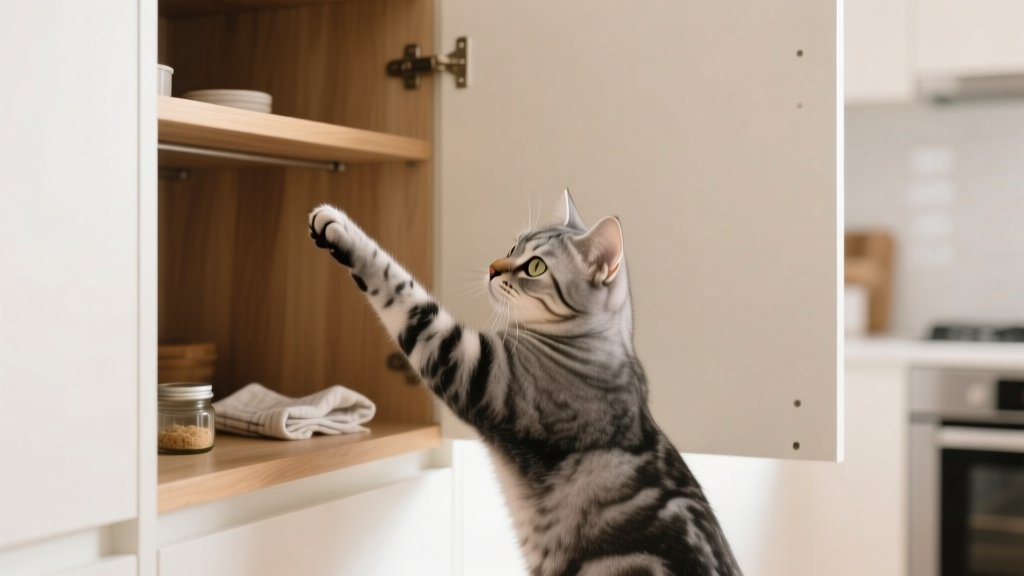
- Positive Interrupters: Replace punishment with redirection. When scratching furniture: calmly say ‘oops,’ offer a nearby sisal post *while gently guiding paw*, then reward with a lick of tuna water. When biting during petting: stop before overstimulation (watch for tail flicks, skin twitching), then toss a treat 3 feet away to reset. \n
- Consistency Across Humans: All household members must use the same cues, rewards, and boundaries. A single person using spray bottles while others cuddle the ‘aggressive’ cat creates massive confusion—and doubles anxiety. \n
Step 4: When to Call in Reinforcements—And Which Professionals to Trust
\nSome situations require expert support—and not all ‘cat behaviorists’ are equal. Here’s how to vet help:
\n- \n
- Veterinary Behaviorist (Dip ACVB): A veterinarian with 3+ years specialty training and board certification. They can prescribe medication (e.g., gabapentin for anxiety, fluoxetine for OCD-like overgrooming) and rule out neurologic causes. Find one via dacvb.org. \n
- Certified Applied Animal Behaviorist (CAAB): PhD-level scientists trained in learning theory and ethology. Best for complex cases like multi-cat aggression or trauma recovery. \n
- IAABC-Certified Cat Behavior Consultant: Rigorous 6-month program with mentorship, video case reviews, and ethics oversight. Look for ‘CCBC’ or ‘CCBT’ credentials. Avoid anyone promising ‘guaranteed results in 1 session’ or using prong collars, shock devices, or dominance theory. \n
Real-world example: Leo, a 4-year-old Maine Coon in Austin, began urine-marking doorframes after his owner adopted a second cat. His vet ruled out UTI. An IAABC consultant observed that Leo was guarding entryways due to insecurity—not dominance. Within 6 weeks of gradual introductions, scent-swapping (using shared towels), and installing ‘neutral territory’ feeding stations, marking stopped completely. No drugs. No punishment. Just patience and precision.
\n\n| Step | \nAction | \nTools/Supplies Needed | \nExpected Timeline for Noticeable Change | \n
|---|---|---|---|
| 1. Medical Workup | \nSchedule full exam + diagnostics; share ABC logs with vet | \nVet visit, printed behavior log, urine sample kit (if requested) | \nDiagnosis: 1–3 days. Treatment effects: 3–14 days (e.g., antibiotics for UTI) | \n
| 2. Environmental Reset | \nAdd 2 safe spaces, 1 new litter box, 1 puzzle feeder; begin daily play | \nCardboard boxes, fleece blankets, unscented litter, Frolicat Bolt or Da Bird wand | \nReduced hiding/stress signs: 3–7 days. Fewer accidents: 10–21 days | \n
| 3. Positive Redirection | \nUse ‘oops + redirect + reward’ for top 2 behaviors daily | \nTuna water, small treats (<1 kcal each), sisal post or cardboard scratcher | \nDecreased frequency of target behavior: 5–12 days. Consistent alternative behavior: 14–28 days | \n
| 4. Consistency Audit | \nHold family meeting; assign roles (who scoops, who plays, who monitors stress signs) | \nShared digital calendar (Google Sheets), printed ‘Cat Care Cheat Sheet’ | \nImproved household alignment: immediate. Reduced confusion-related incidents: 7–10 days | \n
Frequently Asked Questions
\nCan I use a spray bottle to stop my cat from jumping on counters?
\nNo—and here’s why it backfires. Spray bottles create fear-based associations: your cat doesn’t link the water to the counter; they link it to you. This damages your bond and often shifts the behavior to sneakier, more stressful alternatives (e.g., jumping only when you’re not home, or developing redirected aggression). Far more effective: make counters unappealing (double-sided tape, aluminum foil) AND make the adjacent cat tree irresistible (place treats, rotate toys, add a heated pad). Enrichment + choice > punishment every time.
\nMy cat bites me when I pet them—does that mean they don’t love me?
\nAbsolutely not. This is almost always ‘overstimulation biting’—a hard-wired response triggered by repetitive petting that activates nerve endings. Signs include tail lashing, skin twitching, flattened ears, or sudden stillness. Stop petting before these appear (often after just 3–5 strokes). Reward calm tolerance with treats—but never force interaction. As Dr. Kristyn Vitale, feline behavior researcher at Oregon State University, says: ‘Cats don’t owe us affection on demand. Respecting their autonomy builds deeper trust than any amount of forced cuddling.’
\nWill getting another cat fix my lonely, destructive cat?
\nRarely—and often makes things worse. Introducing a second cat without careful, slow protocols (6–12 weeks minimum) frequently triggers territorial stress, resource guarding, and redirected aggression. In a 2021 study of 200 multi-cat households, 61% reported increased conflict after adding a new cat, especially if the original cat was older or had existing anxiety. Instead, invest in solo enrichment: window perches with bird feeders, automated laser toys on timers, and scheduled interactive play. If companionship is truly needed, adopt a young, neutered, easygoing cat—and work with a certified consultant for introduction.
\nIs clicker training effective for cats?
\nYes—when done correctly. Clicker training uses operant conditioning to mark desired behaviors precisely. But cats require higher-value rewards (chicken broth ice cubes, bonito flakes) and shorter sessions (2–3 minutes, 2x/day). Start with targeting (touch nose to stick), then shape simple behaviors like ‘sit’ or ‘touch.’ Avoid using it for fear-based issues (e.g., nail trims)—desensitization and counterconditioning are safer first steps. Pro tip: Pair the click with a treat every single time—no exceptions—or the marker loses meaning.
\nMy cat suddenly started peeing on my bed—what’s the emergency signal here?
\nThis is a red-flag behavior requiring immediate vet attention. While stress can contribute, sudden substrate preference changes (especially soft fabrics) strongly correlate with urinary tract pain, bladder stones, or kidney disease. Don’t assume it’s ‘revenge’ or ‘attention-seeking.’ Clean the area thoroughly with enzymatic cleaner (not vinegar or bleach), block access temporarily, and call your vet today—even if other symptoms seem mild. Early intervention prevents life-threatening blockages, especially in males.
\nCommon Myths About Correcting Cat Behavior
\nMyth #1: “Cats can’t be trained—they’re too independent.”
\nReality: Cats learn constantly—but on their terms. They excel at operant and classical conditioning. The issue isn’t ability; it’s that traditional dog-style obedience training ignores feline motivation (curiosity, control, safety). With high-value reinforcers and short, fun sessions, cats readily learn recall, ‘leave it,’ and even complex tricks.
Myth #2: “Rubbing a cat’s nose in their accident teaches them the litter box.”
\nReality: This causes terror and confusion. Cats don’t associate the smell of urine on their face with the location of elimination. Instead, they associate the litter box with fear or punishment—and avoid it entirely. It’s the #1 cause of chronic litter aversion.
Related Topics (Internal Link Suggestions)
\n- \n
- Understanding Cat Body Language — suggested anchor text: "what your cat's tail flick really means" \n
- Best Litter Boxes for Multi-Cat Households — suggested anchor text: "litter box solutions that actually work" \n
- Feline Anxiety Signs and Natural Remedies — suggested anchor text: "calming aids vet-approved for cats" \n
- How to Introduce a New Cat Without Fighting — suggested anchor text: "stress-free multi-cat introductions" \n
- DIY Cat Enrichment Ideas on a Budget — suggested anchor text: "free and cheap cat toys that reduce boredom" \n
Your Next Step Starts Today—Not Tomorrow
\nYou now know that how to correct my cats behavior isn’t about control—it’s about compassion, curiosity, and consistency. The most powerful tool you own isn’t a spray bottle or a treat pouch. It’s your observation skills, your willingness to adjust the environment, and your commitment to seeing your cat as a sentient individual with needs, fears, and preferences. Pick one pillar from Step 3 to implement this week—just one. Add a safe shelf. Swap one litter box location. Do one 15-minute play session with intention. Track what happens. Notice the subtle shifts: longer naps, slower blinks, a head-butt against your hand. Those are your wins. And when you’re ready for deeper support, download our free ABC Behavior Tracker & Enrichment Calendar—plus a vet-approved checklist for finding a qualified behavior professional. Because your cat isn’t broken. And neither are you.