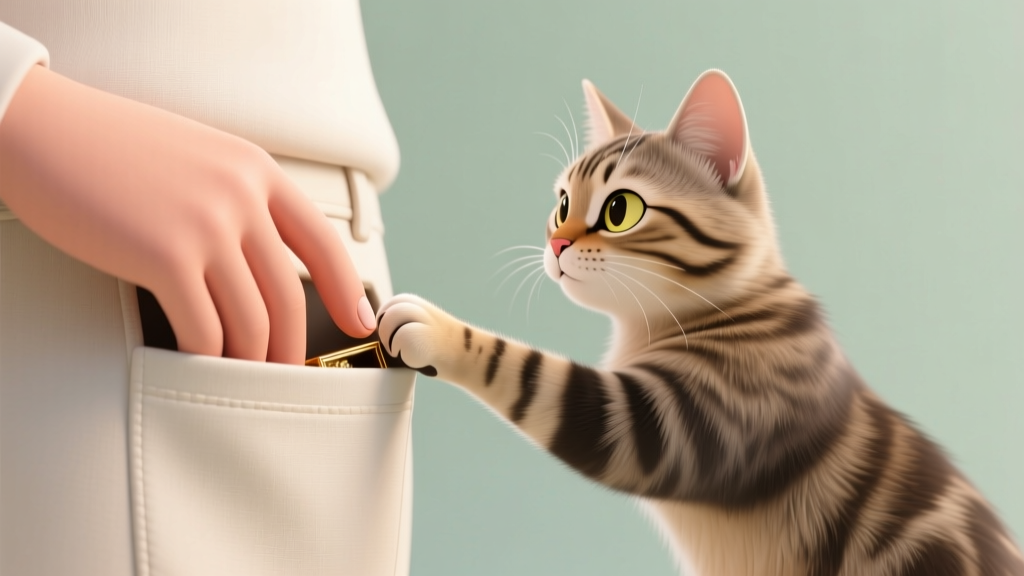
Cat Paw Reaching Into Your Pocket: Exploration Drive
1) That “Excuse Me, Is There Something In There?” Moment
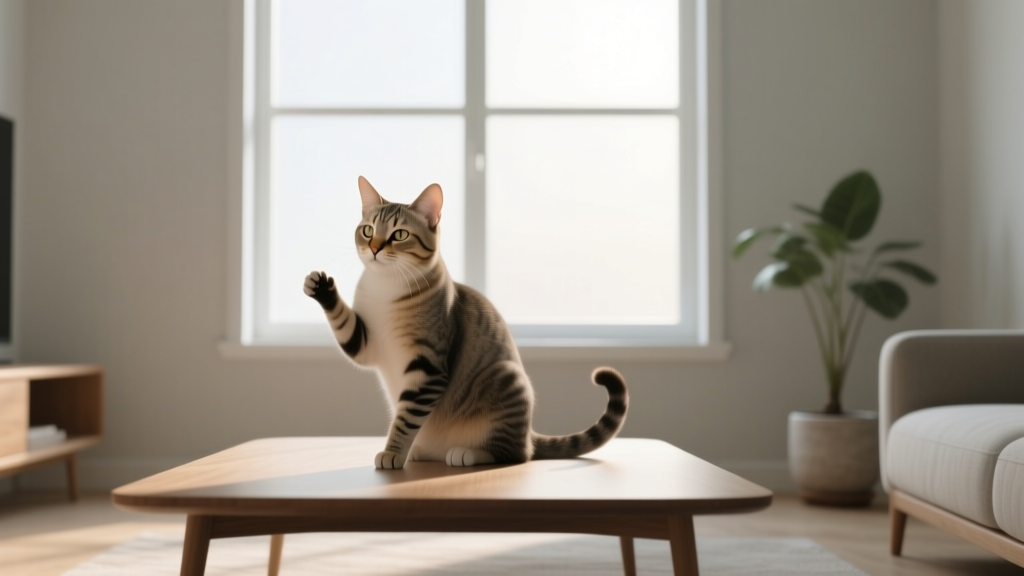
You’re standing in the kitchen, keys in one pocket, a crinkly treat bag in the other. Your cat brushes past your leg like a friendly little commuter, then—very casually—slides a paw into your pocket. Not a swipe. Not a grab-and-run. Just a slow, confident reach, like they’re checking for loose change… or secrets.
Some cats go further: they hook a claw gently on the pocket edge, lean in, sniff, and “fish” around with surprising precision. If you’ve ever laughed and said, “Are you pickpocketing me?” you’re not alone. This quirky behavior is common, and it’s often a perfect window into your cat’s strongest inner engine: the exploration drive.
2) The Science & Evolution: Why Pockets Are Cat Magnets
Cats are built to investigate. In the wild, their survival depends on noticing tiny changes in the environment—an unfamiliar scent, a rustle in the grass, a new object that could be prey… or danger. Your pocket is basically a portable mystery box that moves around the house. It’s warm, it smells like you, and it often contains interesting objects that carry “outside” scents.
From a feline psychology perspective, a pocket checks several boxes:
- Scent hotspot: Pockets hold concentrated smells—your skin oils, your hand scent, food traces, outdoor odors, and the signature scent of whatever you’ve carried (treats, catnip, tissues, receipts, gloves).
- Small-space appeal: Cats love enclosed, tight spaces. A pocket is a mini “den” opening—small, dark, and intriguing.
- Foraging instinct: Hunting is only part of the picture. Cats also have a natural “forage and manipulate” style of problem-solving: reach, hook, pull, inspect. That paw is an all-purpose tool.
- Learning history: If a pocket has ever produced something rewarding (a treat, a toy, a string, a crinkly wrapper), the behavior gets reinforced quickly.
In short: your cat isn’t being weird. They’re being exquisitely cat.
3) A Detailed Breakdown: Different Pocket-Reaching Contexts
Not all pocket-reaching is the same. The context tells you what your cat is after—information, food, play, reassurance, or attention.
The “Treat Pocket” Investigation
This is the classic. Your cat smells yesterday’s treats or hears a faint crinkle when you shift. They approach with focused body language: head forward, whiskers slightly pushed ahead, eyes bright. The paw reaches in with purpose, sometimes followed by a determined sniff directly into the pocket opening.
What’s happening: scent-driven seeking + learned association. To your cat, that pocket is a vending machine that occasionally pays out.
The “Outside Smell” Pocket Check
You come home and your cat greets you intensely—sniffing your shoes, your bag, your hands. Then the pocket paw appears. This often happens after you’ve been around other animals, visited a new place, or handled food.
What’s happening: information gathering. Cats “read” scent the way we read headlines. Your pocket may contain the strongest story.
The “Wiggly Toy” Retrieval Attempt
You have a string, a feather, or a wand attachment in your pocket. Your cat saw it go in, or they can hear it shift. They may chirp, do a quick head tilt, then reach in like a tiny crane operator.
What’s happening: prey-play activation. That paw is acting like a hooking forelimb to “capture” prey.
The “Comfort & Bonding” Pocket Paw
Some cats reach into a hoodie pocket while you’re sitting on the couch, purring. The paw is slow and gentle, and sometimes they knead or rest their toes against the fabric. They may not even be trying to grab anything.
What’s happening: social contact + soothing. Your pocket smells strongly like you, and the enclosed space can feel secure.
The “Attention, Please” Pocket Tap
You’re on your phone. Your cat wants engagement. They walk up, touch your pocket with a paw, then look up at your face like, “Hello? I’m right here.”
What’s happening: communication. Cats learn that paws are effective tools for making humans react.
4) What This Says About Your Cat’s Mood & Feelings
Think of pocket-reaching as a blend of curiosity and confidence. Here’s what it can signal emotionally:
- Curious and engaged: A relaxed body, soft tail, and exploratory paw usually means your cat is mentally “on” and enjoying investigating their world.
- Trusting: Reaching into your clothing means your cat feels safe getting close to you. That’s a social green light.
- Expectant (possibly hungry): If your cat stares at you, meows, then paws the pocket, they may be requesting a known reward.
- Excited/playful: Quick pawing, bright eyes, a little bounce, or a “mrrp” vocalization often means they’re ready for action.
- Slightly anxious or uncertain: If the pawing comes with tense shoulders, dilated pupils, or frantic sniffing after you come home, your cat may be trying to assess unfamiliar scents (like another cat on you) and re-establish security.
One of the most charming parts of this behavior is how “personal” it feels. Your cat is investigating you as part of their environment—because to them, you are.
5) Related Behaviors You Might Also Notice
Once you spot pocket-reaching, you’ll likely recognize its cousins:
- Bag and purse inspections: Cats love exploring containers that carry outside scents.
- Sniffing your hands intensely: Especially after cooking, petting another animal, or using lotion.
- “Helping” with groceries: Sitting in bags, pawing at items, checking every new smell.
- Fishing under doors or furniture: The same paw-based problem-solving used to retrieve hidden “prey.”
- Kneading your hoodie or blanket: Comfort behavior that sometimes overlaps with pocket exploration.
- Gentle paw taps to your arm/face: Social attention-seeking and communication.
6) Normal vs. Concerning: When to Pay Closer Attention
Most of the time, pocket-reaching is perfectly normal enrichment in action. It can even be a sign of a confident, curious cat. Still, a few scenarios deserve a second look.
Usually Normal
- Occasional pocket investigating, especially when you’ve carried treats or new scents
- Gentle pawing with relaxed posture and no escalation
- Playful behavior that stops easily when redirected
Potential Concerns
- Compulsive or frantic behavior: If your cat repeatedly paws pockets/clothing obsessively, can’t disengage, or seems distressed, consider stress, under-stimulation, or anxiety.
- Aggressive grabbing or biting: If the behavior escalates into swatting, biting, or attacking pockets, it may be frustration, overstimulation, or learned rough play.
- Pica or dangerous chewing: If your cat is trying to eat strings, plastic, tissues, rubber bands, or medication packaging, it’s a safety and veterinary concern.
- Sudden new intensity: A big change in behavior can sometimes relate to hunger changes, medical issues, or stress in the home.
If you’re seeing distress, aggression, or ingestion attempts, loop in your veterinarian and consider a behavior consult. It’s easier to reshape patterns early than after they become deeply ingrained.
7) How to Respond (and How to Encourage It the Smart Way)
You don’t need to shut down curiosity—you just want to guide it toward safe, satisfying outlets.
Do: Reward Calm, Gentle Investigating
If your cat politely sniffs and gently paws, you can calmly praise them, offer a treat from your hand (not directly from the pocket every time), or initiate a short play session. This keeps the behavior friendly and controlled.
Don’t: Accidentally Train Pocket Mugging
If every pocket paw results in immediate treats, many cats will increase the intensity: harder pawing, persistence, maybe claws. Mix it up. Sometimes reward with attention or play instead of food. Sometimes ask for an easy behavior first (like “sit” or “touch”) if your cat knows it.
Create a “Legal Pocket” Alternative
- Snuffle mat or treat ball: Channels the foraging instinct.
- Crinkle toys and small kickers: Mimic the pocket’s sensory appeal.
- A paper bag or box “inspection station”: Let your cat explore a designated item after you return home (remove handles/strings for safety).
If Claws Are Involved
Stay neutral and still. Pulling away quickly can turn it into a chase game or trigger grabbing. Gently redirect with a toy. Keep nails trimmed and provide scratchers to help your cat maintain claw health naturally.
Safety Checklist
- Keep medications, gum, nicotine products, and hair ties out of pockets within your cat’s reach.
- Watch for strings or earbuds that could be swallowed.
- If your cat is a chewer, choose chew-safe toys and talk to your vet about pica risks.
8) Fun Facts & Research-Flavored Nuggets
- Cats use scent like a personal news feed. Their world is layered in odor information, and your clothing holds a concentrated summary of where you’ve been.
- The paw is a precision instrument. Cats can manipulate objects with surprising dexterity, using toes and claws like tiny hooks—especially when they’re motivated by food or novelty.
- “Contrafreeloading” shows up in cats, too. Many animals will choose to work for food sometimes, even when free food exists. Offering food puzzles can satisfy the same drive that makes your pocket so irresistible.
- Curiosity is a wellbeing indicator. In many cats, healthy exploration—balanced with relaxation—can be a sign of a stimulating environment and a secure bond.
9) FAQ: Pocket-Paw Edition
Why does my cat paw my pocket specifically, not my shirt or sleeves?
Pockets trap scent and create a small “cave” opening, which is extra appealing. They also often carry the most interesting items—treats, tissues, toys—so they become a reliable target.
Is my cat trying to steal from me?
In a way, yes—stealing your attention, your scent, and possibly your snacks. But it’s not spite or mischief. It’s curiosity + learned reward.
My cat only does this when I come home. What does that mean?
Homecomings are scent events. Your cat is gathering information: where you were, whether you encountered other animals, what you ate, and what’s new in the environment. It can also be a bonding ritual.
How do I stop my cat from using claws when reaching into my pocket?
Avoid yanking away (that can trigger grabbing). Redirect to a toy immediately, reward gentle paws, keep nails trimmed, and don’t store irresistible crinkly treats in the same pocket you present to your cat every day.
Could this mean my cat is bored?
Sometimes. A cat who constantly seeks novelty—pockets, drawers, cabinets, anything—may benefit from more enrichment: short daily play sessions, food puzzles, new toys rotated weekly, and climbing/perching options.
Is pocket pawing a sign my cat loves me?
It can be. Getting close enough to reach into your clothing is a sign of comfort and trust. Even when they’re hunting for treats, they’re choosing to engage with you—one of the best compliments a cat can give.
If your cat has a signature “pocket move” (the gentle pat, the deep-pocket spelunk, the treat-check, or the full-on hoodie-pocket snuggle), share your story with other cat people on catloversbase.com. The world needs more tales of tiny, whiskered pickpockets.