How to Encourage Playful Behavior in Cats
Why Ignoring This One Habit Is Costing Your Cat Joy (and Your Sanity)
\nIf you've ever watched your cat stare blankly at the wall, nap 18 hours straight, or bat half-heartedly at a feather wand before walking away, you're not alone—and you're likely missing a critical piece of their well-being. How to encourage playful behavior in cats isn’t just about fun; it’s foundational to their neurological development, stress regulation, and even urinary tract health. According to Dr. Sarah H. Johnson, a board-certified veterinary behaviorist with over 15 years of clinical experience, 'Play is not optional enrichment—it’s non-negotiable neurobiological maintenance. A chronically under-stimulated cat isn’t lazy; they’re quietly accumulating cortisol, which directly correlates with idiopathic cystitis, aggression, and overgrooming.' In fact, a 2023 University of Lincoln study tracking 217 indoor cats found that those engaging in ≥15 minutes of interactive play per day had 63% lower rates of anxiety-related behaviors—and their owners reported 41% higher relationship satisfaction. So if your cat seems 'too old,' 'too shy,' or 'just not into it,' the problem isn’t them. It’s almost always setup, timing, or mismatched expectations.
\n\nThe 3 Hidden Barriers Killing Your Cat’s Play Drive (And How to Remove Them)
\nMost cat guardians unknowingly sabotage play before it begins—not out of neglect, but because common assumptions override biological reality. Let’s dismantle the big three:
\n\n- \n
- Barrier #1: The 'Toy Dump' Fallacy — Leaving 20+ toys scattered across the floor doesn’t stimulate curiosity; it triggers sensory overload and habituation. Cats evolved to hunt *one* prey item at a time. When every object looks equally unremarkable, none triggers the predatory sequence (stare → stalk → pounce → bite → kill). As Dr. John Bradshaw, anthrozoologist and author of Cat Sense, explains: 'A cat’s brain filters novelty through scarcity. If everything is available all the time, nothing feels urgent.' \n
- Barrier #2: Human-Centered Timing — We schedule play when we’re home and energetic (e.g., 7 p.m. after work), but cats are crepuscular: biologically wired for peak activity at dawn and dusk. Forcing play at 9 p.m. is like asking a night owl to run a marathon at 6 a.m.—physiologically misaligned. \n
- Barrier #3: The 'No Kill' Taboo — Many owners instinctively pull toys away before the cat ‘kills’ them (i.e., bites, shakes, or flips the toy), thinking it’s safer or more 'gentle.' But interrupting the full predatory sequence leaves cats frustrated and unsatisfied. Without closure, the brain doesn’t release endorphins—and the urge resurfaces as redirected scratching, chewing, or aggression. \n
Your Cat’s Play Personality: Match Strategy to Temperament (Not Breed)
\nForget stereotypes ('Siamese = hyper, Persians = couch potatoes'). Research from the ASPCA’s Feline Behavior Center shows temperament varies more within breeds than between them. What matters is observing your cat’s individual pattern. Here’s how to decode it—and respond:
\n\n- \n
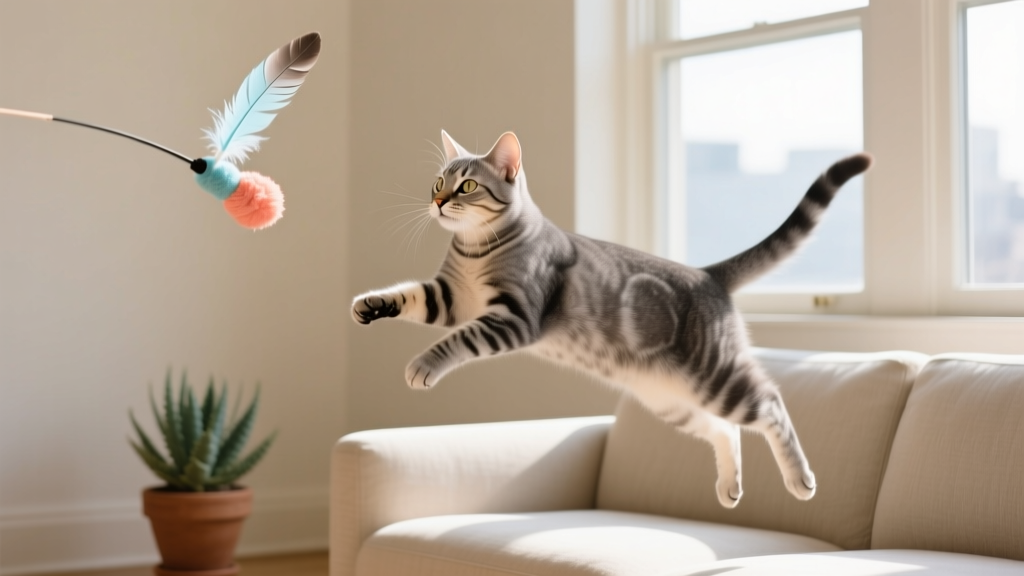
- The Stalker: Watches intently, freezes, then launches. Respond with slow-drag lures (feather on string, rolled paper ball) that mimic injured prey. Pause mid-drag to trigger the 'freeze-and-assess' instinct. Never chase *toward* them—drag *away* to ignite pursuit. \n
- The Ambusher: Lies in wait near doorways or under furniture. Set up 'prey zones'—place crinkle balls or battery-free motorized mice (like FroliCat BOLT) in high-traffic areas *before* you leave. Trigger motion only when they’re nearby—timing matters more than tech. \n
- The Tactile Explorer: Prefers batting, pawing, or carrying objects. Offer textured items: faux-fur mice with rattles inside, cork balls, or knotted rope toys soaked in catnip (not sprayed—volatile oils degrade fast). Rotate weekly to preserve novelty. \n
- The Senior or Recovering Cat: May have arthritis, vision loss, or thyroid issues dampening drive. Prioritize low-impact, high-reward options: warm (not hot) rice socks dragged slowly, laser pointers *only* paired with a tangible finisher (e.g., shine on a treat or soft toy they can 'catch'), or scent-based games using silver vine or valerian root. \n
Pro tip: Track play sessions for one week using a simple log (time, duration, toy used, your cat’s response). You’ll spot patterns faster than any quiz. One client, Maya (owner of 11-year-old rescue tabby Leo), discovered his 'low energy' was actually pain-avoidance—he’d only engage with vertical wand toys held at chest height, reducing shoulder strain. After switching to a lightweight, extendable pole, his play time tripled in 10 days.
\n\nThe 5-Minute Daily Ritual That Builds Lifelong Engagement
\nYou don’t need marathon sessions. Consistency beats duration. The gold standard? Two 5–7 minute interactive sessions per day—ideally at dawn and dusk—using the 'Rule of Three': three minutes of active play, one minute of rest, three minutes of reward-based conclusion.
\n\nHere’s exactly how to execute it:
\n- \n
- Prep (30 sec): Choose ONE toy. Hide others. Fill treat pouch with 5–7 high-value morsels (freeze-dried chicken, tuna flakes). \n
- Stimulate (3 min): Mimic prey movement—erratic, stop-start, low-to-the-ground. Vary speed: quick darts followed by stillness. Let your cat lead pace; follow their cues, not your agenda. \n
- Pause & Observe (1 min): Stop moving. Watch. Does your cat reposition? Stare? Take a breath? This pause builds anticipation and teaches impulse control. \n
- Complete & Reward (3 min): Let them 'kill' the toy—allow biting, shaking, dragging. Then immediately offer treats *on the spot*, praising softly. This closes the loop neurologically and reinforces play as safe, rewarding, and controllable. \n
This ritual works because it mirrors evolutionary hunting cycles while respecting feline autonomy. No coercion. No chasing. Just invitation, participation, and respectful closure.
\n\nWhat to Use (and What to Avoid): A Vet-Reviewed Toy & Tool Comparison
\nNot all 'cat toys' support healthy play. Some trigger frustration, injury risk, or learned helplessness. Below is a comparison of 6 common categories, evaluated by Dr. Lisa M. Rieger (DVM, Certified Feline Practitioner) and the International Cat Care (ICC) guidelines:
\n\n| Toy Type | \nPros | \nCons | \nVet Recommendation | \n
|---|---|---|---|
| Wand Toys (with replaceable attachments) | \nEnables full predatory sequence; builds human-cat bond; highly customizable | \nRisk of entanglement if string left unattended; attachment wear causes choking hazard | \n✅ STRONGLY RECOMMENDED — Use 12–18\" poles, detachable feathers/fur, and store safely. Replace attachments monthly. | \n
| Laser Pointers | \nHighly stimulating for visual hunters; great for reluctant players | \nNo tactile payoff; can cause obsessive behavior or frustration if never 'caught'; potential eye risk | \n⚠️ CONDITIONAL USE ONLY — Always end session by shining laser on a treat or physical toy they can bite. Limit to 90 seconds. | \n
| Motorized Toys (e.g., FroliCat, PetSafe Frolicat) | \nAutonomous stimulation; good for solo play; timers prevent overuse | \nCan desensitize cats to real-world movement; some models emit high-frequency noise cats hear | \n🟡 MODERATE USE — Choose quiet models (<25 dB); use only 1x/day for ≤10 mins; pair with human-led play. | \n
| Plastic Balls with Bells | \nInexpensive; easy to find; encourages chasing | \nBell noise stresses sensitive cats; hard plastic damages teeth/jaws; no 'kill' option | \n❌ AVOID — Replace with felt balls, cork, or crinkle fabric spheres. | \n
| Cardboard Boxes & Paper Bags | \nZero cost; excellent for ambush play; satisfies nesting/scratching instincts | \nPaper bags pose suffocation risk if handles are present; staples/glue may be toxic | \n✅ RECOMMENDED WITH SAFETY CHECKS — Remove handles, staples, and glossy coatings. Supervise first 3 uses. | \n
| Cat TV (digital screens) | \nNovel stimulus; useful for visually oriented cats | \nNo physical exertion; no scent/tactile input; zero predatory completion | \n⛔ NOT RECOMMENDED AS PRIMARY STIMULATION — Max 5 mins, 2x/week. Never substitute for interactive play. | \n
Frequently Asked Questions
\nMy cat only plays with me at 3 a.m. Is this normal—and how do I shift it?
\nYes—it’s biologically normal. Cats are naturally most active during twilight hours, and indoor cats often compress that into early morning due to household silence and your sleeping body heat. To gently shift the rhythm: start a 5-minute interactive session at 5:30 a.m. *before* they wake you. Use a quiet wand toy and end with treats. Gradually move the session 15 minutes earlier every 3 days until hitting 6:30 a.m. Simultaneously, add a timed feeder with breakfast at 6:45 a.m. This teaches their internal clock that food—and therefore activity—happens earlier. Within 2–3 weeks, most cats adjust without protest.
\nMy senior cat barely moves anymore. Is play still possible—or even safe?
\nAbsolutely—and critically important. Arthritis, hyperthyroidism, or dental pain often masquerade as 'laziness.' First, rule out medical causes with a vet exam (including bloodwork and orthopedic check). Then adapt: try warm (not hot) rice socks dragged slowly across floors, gentle air puffs with a straw, or placing treats inside puzzle feeders at ground level. A 2022 study in the Journal of Feline Medicine and Surgery found that cats with osteoarthritis who engaged in 3 minutes of daily targeted play showed measurable improvement in joint mobility and reduced pain biomarkers within 4 weeks. Key: prioritize comfort over intensity. If they blink slowly and stay near you during the session, you’ve succeeded.
\nMy kitten chews everything—including my hands! How do I redirect without discouraging play?
\nThis is normal teething + predatory instinct—but biting humans is unsafe and must be redirected *immediately*. Never punish. Instead: when they bite, freeze (no jerking away—that mimics prey), say 'Ouch!' calmly, and instantly offer an approved chew toy (e.g., frozen washcloth, rubber teether, or cat-safe rope). Praise heavily when they switch. Crucially: ensure they get 4–5 short play sessions daily *before* naps—kittens who miss play windows become overtired and bite more. And yes—wear long sleeves during early training. Consistency for 7–10 days rewires the association.
\nDo indoor cats really need play if they seem 'happy'?
\n'Happy' is often misread. Indoor cats rarely show overt distress—they hide illness and stress. What looks like contentment (long naps, calm demeanor) can mask chronic boredom-induced stereotypies: excessive licking, pacing, or vocalizing at night. The American Association of Feline Practitioners states unequivocally: 'Lack of species-appropriate play is a welfare violation, not a lifestyle choice.' Even 'chill' cats benefit from 5 minutes of daily engagement—it reduces cortisol, prevents obesity, and strengthens your bond at a neurological level. Think of it like brushing teeth: you don’t wait for cavities to start.
\nCommon Myths About Cat Play—Debunked
\n- \n
- Myth #1: “Cats play to burn energy.” — False. Wild cats spend ~80% of waking hours resting—not because they’re lazy, but because hunting is metabolically expensive. Domestic cats play primarily to practice skills, reduce stress, and satisfy innate drives—not to 'get tired.' Over-exertion can actually increase anxiety. \n
- Myth #2: “If my cat doesn’t play with toys, they’re broken or depressed.” — False. Some cats prefer environmental interaction (bird-watching, exploring boxes) or social play (gentle wrestling with trusted humans). Others have neurodivergent traits (e.g., high sensitivity to sound/light) making traditional toys aversive. Play is personal—not a pass/fail test. \n
Related Topics (Internal Link Suggestions)
\n- \n
- Understanding cat body language — suggested anchor text: "what your cat's tail flick really means" \n
- Best interactive toys for indoor cats — suggested anchor text: "top 7 vet-approved wand toys" \n
- How to stop cats from biting during play — suggested anchor text: "gentle bite redirection techniques" \n
- Cat enrichment ideas for small apartments — suggested anchor text: "space-smart play setups" \n
- Signs of stress in cats — suggested anchor text: "subtle stress signals you're missing" \n
Ready to Reignite the Spark—Starting Today
\nYou now hold the keys—not gimmicks, not gear, but science-backed understanding of *why* play matters and *how* to invite it with respect and precision. Remember: you’re not training your cat to perform. You’re honoring their biology, rebuilding trust, and co-creating moments of pure, shared presence. Pick *one* strategy from this article—maybe the dawn/dusk 5-minute ritual, or swapping out that bell ball for a crinkle sphere—and commit to it for just 7 days. Track what shifts: a longer stretch of eye contact, a purr during petting, less nighttime yowling, or simply the quiet pride of watching your cat fully inhabit their wild, joyful self. Then come back—and let us know what worked. Because the best part of cat care isn’t perfection. It’s showing up, again and again, with curiosity instead of expectation.