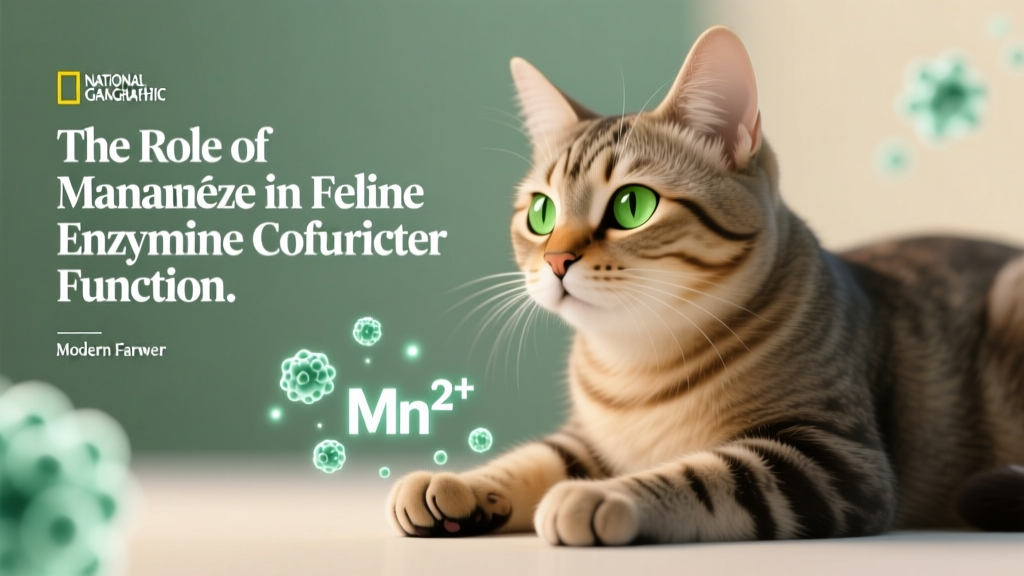
The Role of Manganese in Feline Enzyme Cofactor Function
1) Why this topic matters for cat health
Manganese is a trace mineral—needed in very small amounts—but it supports big, day-to-day processes in a cat’s body. Its most important job is acting as a cofactor, meaning it “switches on” or assists specific enzymes so they can do their work. Without the right cofactors, enzymes can’t run efficiently, and metabolism becomes less smooth.
For cat owners aiming to feed the best diet, manganese is worth understanding because:
- It supports connective tissue and cartilage maintenance (important for mobility and joint comfort).
- It participates in antioxidant defense, helping protect cells from oxidative damage.
- It plays roles in metabolism of carbohydrates, amino acids, and lipids.
- Deficiency is uncommon in properly formulated foods, but risk can rise with unbalanced homemade diets, poorly designed raw recipes, or unusual feeding patterns.
Manganese is not a “more is better” nutrient. Cats need enough for enzyme function, but excess minerals can also create problems. The goal is balance, ideally through a complete and balanced diet. For any major diet change—especially homemade or therapeutic diets—consult your veterinarian or a board-certified veterinary nutritionist.
2) Scientific background: feline nutritional needs and obligate carnivore biology
Cats are obligate carnivores, adapted to thrive on animal-based diets with high protein and specific nutrients that are limited in plant foods. This doesn’t mean cats cannot use minerals from plants, but it does affect how owners should think about diet construction:
- Higher protein requirement: Cats use amino acids as a major metabolic fuel and need steady dietary protein.
- Micronutrient precision matters: Because cats are small and their nutrient requirements are concentrated, small formulation errors can have outsized effects.
- Trace minerals must be present consistently: Minerals like manganese are required in tiny amounts; “variety over time” is not a reliable substitute for daily completeness.
Commercial foods labeled “complete and balanced” are formulated to meet established nutrient profiles (commonly AAFCO in the US; FEDIAF in Europe). These profiles include trace minerals such as manganese to support normal metabolism and health across life stages. Homemade and raw diets can meet needs too, but only when properly formulated and supplemented.
3) Detailed analysis: manganese as an enzyme cofactor in cats
Manganese (Mn) functions primarily by binding to enzymes and enabling chemical reactions that would otherwise run slowly or not at all. While much of the research on manganese biochemistry comes from multiple species, the core enzyme pathways are conserved and relevant to cats.
Key manganese-dependent enzymes and what they do
| Enzyme (manganese-supported) | Main role | Why cat owners should care |
|---|---|---|
| Manganese superoxide dismutase (MnSOD) | Major mitochondrial antioxidant enzyme; helps neutralize superoxide radicals | Supports cellular resilience, especially in high-energy tissues; contributes to healthy aging and stress response |
| Arginase | Involved in the urea cycle (nitrogen metabolism) | Cats have high protein turnover; efficient nitrogen handling matters for metabolic balance |
| Glycosyltransferases (multiple enzymes) | Build proteoglycans and other compounds in cartilage and connective tissue | Connective tissue support can influence mobility, joint health, and tissue repair |
| Pyruvate carboxylase (manganese can support activity) | Metabolic pathway support for energy balance | Helps maintain smooth metabolic function; relevant in overall energy metabolism |
What happens with too little manganese?
True manganese deficiency is rare in cats fed complete and balanced commercial diets. When deficiency does occur, it’s typically associated with long-term feeding of unbalanced homemade diets, poorly designed raw diets, or “meat-only” feeding patterns.
Deficiency signs are not always specific, but may relate to manganese’s roles in connective tissue, growth, and metabolism. Potential concerns can include:
- Skeletal and cartilage issues in growing animals (kittens are more vulnerable to imbalances).
- Poor growth or impaired development (again, most relevant to kittens).
- Reduced antioxidant capacity at the cellular level.
Because these signs overlap with many other nutritional problems (calcium/phosphorus imbalance, vitamin D issues, protein-energy malnutrition), manganese deficiency should not be self-diagnosed. Veterinary evaluation and diet assessment are essential.
Can a cat get too much manganese?
Excess manganese from standard commercial diets is uncommon. Risk increases when owners add multiple supplements “just in case,” use human multivitamins, or layer a vitamin/mineral powder on top of an already complete diet.
Minerals can interact. High levels of certain minerals may affect absorption or balance of others. Over-supplementation can also create gastrointestinal upset and, in extreme or chronic cases, contribute to systemic issues. If you are considering mineral supplementation, do it only with veterinary guidance and a clear rationale.
Bioavailability: not all manganese sources act the same
Manganese can be provided through ingredients naturally containing manganese or via supplemental forms included in pet food premixes. Bioavailability can vary based on:
- Chemical form: Common forms include manganese sulfate, manganese oxide, and chelated/organic forms (e.g., manganese amino acid chelates).
- Diet composition: Certain fibers or compounds in plant ingredients can bind minerals; processing and formulation help ensure adequate available manganese.
- Overall mineral balance: Mineral interactions can influence uptake.
From an owner standpoint, the most reliable approach is choosing foods formulated to meet recognized standards and made by companies with strong quality control.
4) Practical recommendations for cat owners
- Choose “complete and balanced” foods appropriate for your cat’s life stage (kitten, adult maintenance, growth/reproduction, senior where applicable).
- Avoid “meat-only” diets (plain chicken, turkey, beef, fish) as a long-term plan. Muscle meat alone is not nutritionally complete and can be low in key micronutrients, including trace minerals.
- Be cautious with homemade/raw: use a recipe formulated by a board-certified veterinary nutritionist (DACVIM-Nutrition or ECVCN) or a veterinary-approved formulation service. Trace minerals are easy to miss.
- Limit supplements unless medically indicated. If your cat eats a complete diet, adding a multivitamin/mineral can push intake out of balance.
- Use treats strategically: keep treats to ~10% or less of daily calories to avoid diluting micronutrient intake.
5) Comparing options and approaches
| Approach | Manganese reliability | Pros | Cons / risks | Best for |
|---|---|---|---|---|
| Commercial complete & balanced (wet or dry) | High | Formulated to nutrient profiles; consistent trace mineral coverage | Must choose reputable brands; some cats need therapeutic diets | Most households; easiest way to meet trace mineral needs |
| Therapeutic veterinary diets | High (formulated for specific conditions) | Targets medical needs while meeting micronutrients | Should be used under veterinary guidance; may be costlier | Cats with kidney disease, urinary issues, GI disease, allergies, obesity, etc. |
| Homemade cooked (properly formulated) | Variable (can be high if formulated well) | Ingredient control; can help with select sensitivities | Requires supplementation, precision, and regular review; easy to underdose trace minerals | Owners willing to measure accurately and work with a veterinary nutritionist |
| Raw / BARF-style feeding | Often variable | Some cats prefer texture; owner preference | Food safety risks; nutritional imbalance common without expert formulation; trace mineral gaps possible | Only with strict hygiene and veterinary nutrition oversight |
| “Topper-heavy” feeding (lots of meat/fish toppers) | Lower (dilutes balanced base diet) | Improves palatability short-term | Can unbalance minerals and vitamins; may increase picky eating | Occasional use only, within calorie limits |
6) Common mistakes and misconceptions to avoid
- Myth: “If my cat eats meat, they’ll naturally get all minerals.”
Reality: Muscle meat alone is not a complete diet. Wild prey includes bones, organs, and gut contents, creating a broader micronutrient profile than grocery-store meat. - Myth: “Trace minerals don’t matter because they’re tiny.”
Reality: Enzymes depend on trace minerals. Small deficiencies can affect metabolism over time, especially in kittens or cats with chronic illness. - Mistake: Adding a multivitamin/mineral to a complete diet “for insurance.”
This can oversupply certain nutrients and disrupt balance. Use supplements only when a vet recommends them. - Mistake: Relying on unverified online recipes.
Many homemade recipes are incomplete or have incorrect calcium:phosphorus ratios and missing trace minerals like manganese, iodine, copper, or zinc. - Mistake: Excessive fish-based feeding.
Fish-heavy diets can create other nutritional issues (not specifically manganese) and may increase the risk of imbalances if used as a primary food outside of a complete formula.
7) How to implement changes safely (transition tips)
If you’re moving from an unbalanced diet to a complete and balanced food—or changing brands or formats—do it in a way that protects digestion and appetite:
- Transition gradually over 7–10 days (longer for sensitive cats):
- Days 1–3: 75% old, 25% new
- Days 4–6: 50% old, 50% new
- Days 7–9: 25% old, 75% new
- Day 10: 100% new
- Monitor stool and appetite: mild soft stool can happen during transitions; persistent diarrhea, vomiting, or refusal to eat warrants a vet call.
- Protect hepatic health: cats should not go without food. If your cat refuses food for ~24 hours (or less for kittens), contact your veterinarian promptly.
- Be consistent: rotating too many foods rapidly can worsen pickiness and GI upset.
8) Special considerations (age, health conditions, activity level)
- Kittens (growth stage): Nutrient density and correct mineral balance are critical. Kittens are more susceptible to skeletal issues from imbalanced diets. Feed a diet labeled for growth/all life stages and avoid homemade feeding unless professionally formulated.
- Senior cats: Seniors may have lower appetite, dental issues, or chronic disease. The priority is a diet that supports lean mass and is easy to eat, while remaining complete and balanced. Discuss screening for kidney and thyroid disease with your vet; diet choices may change based on results.
- Kidney disease (CKD): Management focuses on phosphorus control, protein strategy, hydration, and overall nutrient profile. Do not add mineral supplements unless directed—trace mineral changes should be part of a vet-guided plan.
- GI disease or malabsorption: Cats with chronic enteropathy may have altered nutrient absorption. Work with your vet to select a highly digestible diet and monitor body weight, stool quality, and labwork as recommended.
- High activity vs. indoor lifestyle: Activity changes calorie needs more than micronutrient ratios. Avoid diluting micronutrients by overfeeding treats or toppers; keep the base diet complete.
9) FAQ: common questions about manganese in cat nutrition
1) Should I give my cat a manganese supplement for joint health?
Usually no. If your cat eats a complete and balanced diet, manganese needs are typically already met. Joint support is more often addressed with veterinary-directed weight management, appropriate exercise, pain control, and sometimes supplements like omega-3 fatty acids or specific joint nutraceuticals. Ask your veterinarian before adding any supplement.
2) Can a homemade diet provide enough manganese?
Yes, but only if it’s properly formulated and includes the correct vitamin-mineral premix or targeted supplementation. Many homemade recipes are missing trace minerals. If you want to feed homemade, consult a veterinarian or a board-certified veterinary nutritionist for a recipe tailored to your cat.
3) Is manganese the same as magnesium?
No. They are different minerals with different functions. Magnesium is involved in muscle and nerve function and is often discussed in urinary health contexts. Manganese is mainly known for enzyme cofactor roles (including antioxidant enzymes and connective tissue-related enzymes).
4) Does wet food or dry food have more manganese?
It depends on formulation, not moisture level. Both wet and dry foods can be complete and balanced and can meet manganese requirements. Choose based on your cat’s preferences, hydration strategy, medical needs, and your veterinarian’s guidance.
5) My cat eats mostly cooked chicken. What’s the risk?
Cooked chicken alone is not a complete diet and can lead to multiple deficiencies and imbalances over time (not just manganese). If you use chicken as a topper, keep it to a small portion of calories. If it’s the main diet, work with your vet to transition to a balanced food.
6) Are “natural” diets automatically better for trace minerals?
No. “Natural” is a marketing term and doesn’t guarantee nutritional completeness or correct mineral levels. Nutrient adequacy comes from formulation, testing, quality control, and appropriate supplementation—not from the label style.
Best next step: If you’re unsure whether your cat’s diet is meeting trace mineral needs like manganese, bring the food label (or full recipe and supplements) to your veterinarian for a nutrition review. For more practical, science-based feeding guidance, explore the cat nutrition guides and ingredient deep-dives on catloversbase.com.