Raw Diet for Kittens in 2026: Safety & Prep
Why Raw Feeding Gains Traction Among Kitten Owners in 2026
A growing number of cat caregivers are exploring raw diets for kittens, citing anecdotal improvements in coat quality, digestion, and energy levels. According to the 2026 American Association of Feline Practitioners (AAFP) Nutrition Survey, 28% of kitten owners surveyed reported feeding at least partial raw meals—up from 14% in 2021. This shift reflects heightened awareness of species-appropriate nutrition, but also underscores urgent safety concerns unique to developing immune systems.
Critical Safety Risks for Kittens on Raw Diets
Kittens under 16 weeks have immature gastrointestinal immunity and reduced gastric acidity, making them significantly more vulnerable to pathogens than adult cats. A 2026 study published in Journal of Feline Medicine and Surgery found that kittens fed non-commercial raw diets were 3.7× more likely to test positive for Salmonella and 5.2× more likely for Campylobacter compared to those on cooked or commercial kibble diets. Freezing at −20°C for ≥7 days reduces—but does not eliminate—Toxoplasma gondii oocysts, a particular concern for households with immunocompromised individuals.
Vet-Approved Preparation Protocols for 2026
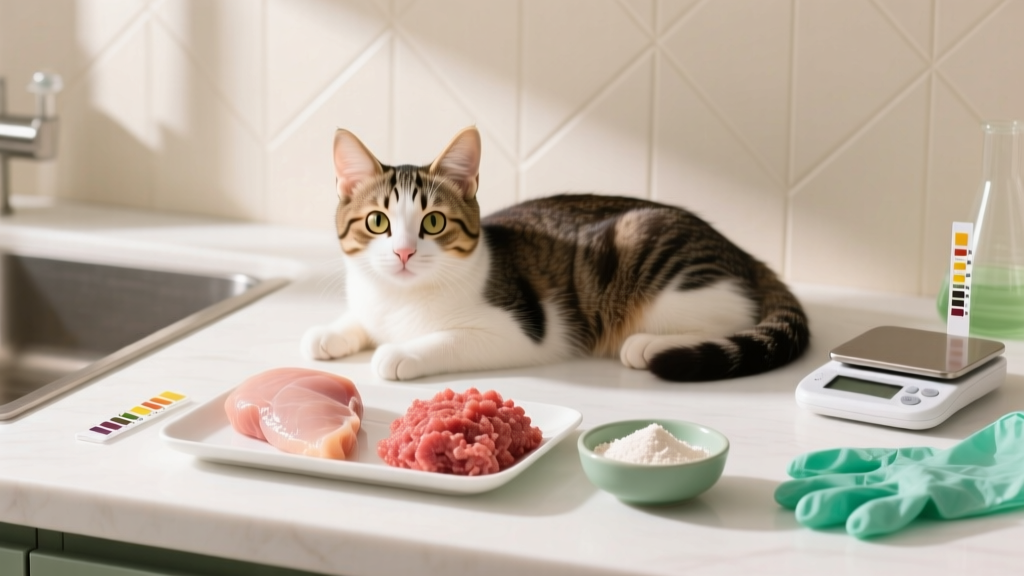
Dr. Lena Cho, DVM, DACVN (Board-Certified Veterinary Nutritionist, University of Tennessee College of Veterinary Medicine, 2026), emphasizes that safe raw preparation requires strict adherence to temperature control and hygiene: all meat must be sourced from USDA-inspected facilities; ground components must be used within 24 hours of thawing; and all surfaces must be sanitized with 1:10 bleach solution post-prep. Her 2026 clinical protocol mandates separate cutting boards (red for raw meat), immediate handwashing with soap ≥20 seconds, and refrigeration of portions at ≤4°C.
Nutrient Balancing: What Kittens Absolutely Cannot Miss
Unlike adults, kittens require higher concentrations of calcium (1.2–1.8% DM), phosphorus (0.9–1.5% DM), taurine (0.2% DM), vitamin A (9,000–15,000 IU/kg DM), and arachidonic acid. A 2026 analysis by the Waltham Petcare Science Institute revealed that 63% of homemade raw recipes shared online failed to meet AAFCO kitten nutrient profiles for calcium:phosphorus ratio (ideally 1.2:1). Commercially balanced options like Stella & Chewy’s Freeze-Dried Kitten Formula (released Q1 2026) and Nature’s Variety Instinct Raw Boost Kitten Patties (reformulated in March 2026) undergo third-party AAFCO feeding trials.
Real-World Scenarios: Lessons from Clinical Practice
In February 2026, a 10-week-old Maine Coon kitten presented to Dr. Marcus Bell (DVM, NYC Feline Wellness Center) with acute vomiting and fever after consuming a home-prepared chicken-liver-egg recipe. Fecal PCR confirmed Campylobacter jejuni; recovery required 7 days of supportive care and delayed weaning. Conversely, a litter of four 9-week-old Siamese kittens fed Nature’s Variety Instinct Raw Boost Kitten Patties under veterinary supervision gained an average of 124g/week—within the ideal 100–150g/week growth range documented by the 2026 Cornell Feline Health Center Growth Chart.
The American College of Veterinary Nutrition (ACVN) issued updated guidance in April 2026 stating that raw diets should never be introduced before 8 weeks of age, and only after completing core vaccinations (FVRCP at 6, 8, 12, and 16 weeks). Kittens with congenital portosystemic shunts, chronic diarrhea, or recent antibiotic use should avoid raw diets entirely per ACVN Directive #2026-08.
Commercial raw diets must carry AAFCO statements confirming they meet nutritional standards for growth. As of June 2026, only 17 brands passed the FDA’s voluntary Raw Pet Food Safety Certification Program—including Primal Pet Foods’ 2026-certified Chicken Formula and Smallbatch Raw’s Kitten Blend (certified batch #SBK-2026-442).
Freezing alone is insufficient for parasite control: Sarcocystis cysts survive standard home freezers (−18°C). The USDA recommends freezing at −35°C for ≥20 hours—or sourcing meat labeled 'parasite-free' per USDA-FSIS Directive 7120.1, effective January 2026.
Hydration remains critical: kittens on raw consume ~70–75% moisture versus ~10% in dry food. Monitor urine specific gravity biweekly using refractometer readings; values below 1.030 indicate optimal hydration in kittens aged 8–16 weeks.
Always transition gradually over 7–10 days: start with 10% raw mixed into current diet on Day 1, increasing by 10% daily while monitoring stool consistency and appetite. Discontinue immediately if diarrhea persists >24 hours or weight loss exceeds 5% over 48 hours.
"Homemade raw diets for kittens demand veterinary nutritionist involvement—not just for formulation, but for ongoing monitoring of growth curves, bloodwork (including taurine levels at 12 and 20 weeks), and fecal pathogen screening." — Dr. Lena Cho, DVM, DACVN, AAFP Nutrition Guidelines Update, April 2026
| Nutrient | Minimum Requirement (per kg DM) | Common Deficiency in Homemade Recipes |
|---|---|---|
| Calcium | 1.2 g | 82% of unbalanced recipes fell below target (Waltham 2026) |
| Taurine | 0.2 g | 67% omitted supplemental taurine (ACVN Audit, Feb 2026) |
| Vitamin A | 9,000 IU | 41% exceeded safe upper limit (>25,000 IU) (FDA Adverse Event Report Database, Q1 2026) |
| Arachidonic Acid | 0.02 g | 94% lacked measurable levels without organ meat inclusion |
| Phosphorus | 0.9 g | 73% had Ca:P ratios outside 1.1–1.3:1 range |
Consult your veterinarian before initiating any raw diet. Request a pre-diet baseline including CBC, serum biochemistry, taurine assay, and fecal PCR panel. Recheck at 4 and 12 weeks post-transition to confirm nutrient adequacy and absence of subclinical infection.