How to Take Care and Feed an Orphaned Kitten
Why This Matters More Than You Think — Right Now
If you’ve just found or been handed a shivering, mewing newborn kitten with no mother in sight, how to take care and feed an orphaned kitten isn’t just helpful advice — it’s urgent, life-or-death knowledge. Neonatal kittens under 4 weeks old have zero ability to regulate body temperature, digest food independently, or eliminate waste without help. Without precise intervention within the first 6–12 hours, dehydration, hypothermia, or sepsis can set in silently — and mortality rates exceed 50% in unguided home attempts (per ASPCA Shelter Medicine Guidelines, 2023). This isn’t about ‘doing your best’ — it’s about applying proven, veterinary-standard protocols that mirror what top-tier kitten nurseries use daily. In this guide, you’ll get the exact steps, timing windows, formula specs, and warning signs that separate thriving kittens from heartbreaking losses.
Step 1: Stabilize Before You Feed — Warmth Is Non-Negotiable
Feeding a cold kitten is dangerous — and potentially fatal. A kitten’s normal rectal temperature should be 95–99°F (35–37.2°C) at birth, rising to 100–102°F (37.8–38.9°C) by week 2. Below 94°F? They’re in crisis. Hypothermia slows gut motility, halts digestion, and suppresses immune response — meaning even perfect formula won’t absorb, and bacteria multiply unchecked.
Never place a chilled kitten directly on a heating pad or near a space heater. Instead, use a safe, gradual rewarming method:
- Wrap the kitten loosely in a soft, dry towel (no terry cloth — fibers snag delicate skin).
- Hold them against your chest (skin-to-skin under clothing) for 10–15 minutes — human body heat is gentle and controllable.
- Supplement with a rice sock: Fill a clean sock ¾ full with raw white rice, microwave for 45 seconds, shake well, wrap in two layers of thin cloth, and place *beside* (not under or on) the kitten in its box.
- Monitor every 10 minutes with a digital rectal thermometer (lubricated with water-based lube). Stop warming once temp reaches 97°F — over-warming causes stress and dehydration.
Only after stable warmth (≥97°F for 20+ minutes) should you proceed to feeding. As Dr. Sarah Lin, DVM and Director of Neonatal Care at the San Francisco SPCA, emphasizes: “Warming isn’t step one — it’s the foundation. Everything else fails without it.”
Step 2: Choose & Prepare Formula Like a Pro — Not Just ‘Baby Bottle’
Human baby formula, cow’s milk, goat’s milk, almond milk, or homemade recipes are all dangerous. Kittens lack lactase persistence and the amino acid profile needed to process non-feline milk — leading to severe diarrhea, bloat, metabolic acidosis, and death within 24–48 hours.
The only safe option is a commercial kitten milk replacer (KMR) or similar veterinary-grade formula like Breeder’s Edge Foster Care or PetAg KMR Liquid. Powdered versions offer better shelf life and cost efficiency; liquid is convenient but must be refrigerated and used within 24 hours of opening.
Preparation protocol:
- Wash hands and sterilize bottles/nipples with boiling water for 5 minutes.
- Mix powder with warm (not hot) distilled or filtered water — follow package ratios *exactly*. Over-dilution causes malnutrition; over-concentration leads to constipation and kidney strain.
- Warm formula to 98–100°F (36.7–37.8°C) — test on your inner wrist. It should feel neutral, not warm.
- Draw into bottle, expel air bubbles, and attach nipple. Snip the tip just enough for a steady drip when inverted — too large = aspiration risk; too small = exhaustion.
Feed volume depends on age and weight — never force-feed. Use this rule of thumb: 2–4 mL per ounce of body weight per feeding, every 2–4 hours depending on age (see timeline table below).
Step 3: Bottle-Feed With Precision — Position, Pace & Patience
Improper feeding technique causes aspiration pneumonia — the #1 preventable cause of death in hand-reared kittens. Here’s how to avoid it:
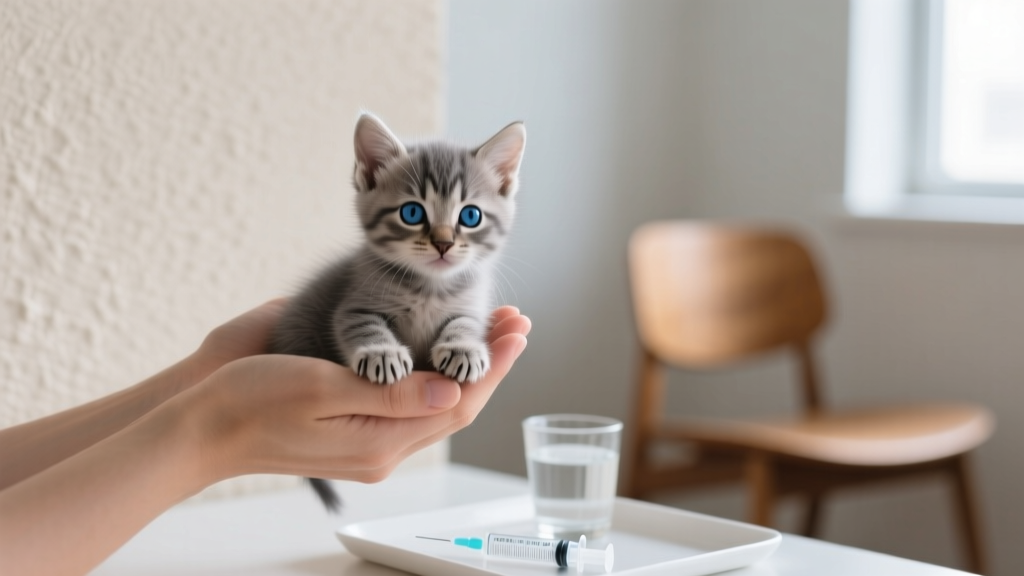
- Position: Hold kitten upright or slightly reclined — never on its back. Cradle its chest and front paws gently against your palm, head slightly elevated (like nursing on mom). Never squeeze the bottle — let the kitten suckle at its own pace.
- Pace: Pause every 10–15 seconds to burp (gently pat back/shoulders). Watch for swallowing cues — rhythmic jaw movement, relaxed ears, steady breathing. If they push away, stop — overfeeding triggers regurgitation and aspiration.
- Duration: Newborns typically nurse 15–25 minutes per session. If feeding takes <10 min, the nipple hole may be too large; if >35 min, it’s likely too small or kitten is weak.
After each feeding, stimulate elimination — yes, every time. Use a warm, damp cotton ball or soft tissue to gently stroke the genital and anal area in circular motions for 30–60 seconds until urine and/or stool appears. Kittens cannot urinate or defecate without this stimulation until ~3 weeks old. Missing even one session risks urinary retention and toxic buildup.
Step 4: Monitor, Track & Triage — Your Daily Vital Signs Checklist
Orphaned kittens don’t just need feeding — they need vigilant biometric tracking. Keep a simple log (paper or app) with these 5 non-negotiable metrics after every feeding:
- Weight: Weigh daily on a gram-scale (kitchen scale works). Expect 7–10g gain per day. No gain for 24 hrs? Red flag. Loss >5% body weight? Contact a vet immediately.
- Hydration: Pinch the scruff — it should snap back instantly. Dry gums or sunken eyes = dehydration.
- Bowel movements: Must pass stool at least once every 24 hrs. Yellow-mustard color and soft texture = healthy. White, gray, or watery = bacterial imbalance or formula intolerance.
- Activity level: By day 3–5, kittens should root, knead, and vocalize when hungry. Lethargy, weak cries, or inability to lift head = urgent concern.
- Temperature: Check twice daily until week 3. Fluctuations >2°F indicate infection or failure to thermoregulate.
At 2 weeks, introduce gentle socialization: short (2–3 min), calm handling sessions while awake. At 3 weeks, add soft toys and shallow litter boxes with non-clumping paper pellets. At 4 weeks, begin gruel transition (see table).
| Age Range | Key Developmental Milestones | Critical Care Actions | Feeding Schedule & Volume | Red Flags Requiring Vet Visit |
|---|---|---|---|---|
| 0–7 days | Eyes closed; ears folded; no teeth; entirely dependent | Warmth stabilization; strict feeding/stimulation every 2 hrs; weigh AM/PM | 2–4 mL per oz, every 2 hrs (12x/day); room-temp formula only | No stool in 24 hrs; weight loss >5%; rectal temp <96°F; blue/pale gums |
| 8–14 days | Eyes beginning to open; ear flaps unfolding; starts crawling | Continue stimulation; introduce gentle handling; monitor eye discharge | 3–5 mL per oz, every 3 hrs (8x/day); warm formula (99°F) | Green/yellow eye discharge; persistent crying; refusal to suckle for >2 feeds |
| 15–21 days | Eyes fully open; ears upright; starts walking wobbly; incisors emerging | Introduce low-sided litter box; start socialization; check for upper respiratory signs | 4–6 mL per oz, every 4 hrs (6x/day); add probiotic paste (FortiFlora) per vet guidance | Sneezing + nasal discharge; labored breathing; diarrhea lasting >12 hrs |
| 22–28 days | Walking confidently; playing; grooming self; deciduous teeth visible | Begin gruel transition; introduce shallow water dish; increase playtime | 5–7 mL per oz, every 4–5 hrs (5x/day); mix KMR with wet kitten food (3:1 ratio) | Constipation >48 hrs; blood in stool; sudden lethargy or collapse |
Frequently Asked Questions
Can I use cow’s milk or soy milk if I can’t get KMR right away?
No — absolutely not. Cow’s milk contains lactose and casein proteins kittens cannot digest, causing explosive diarrhea, dehydration, and electrolyte imbalances within hours. Soy milk lacks essential taurine and arginine and disrupts gut pH. In true emergencies (e.g., middle of night, no pet store open), a temporary emergency formula can be made: 1 cup whole goat’s milk (pasteurized), 1 egg yolk, 1 tsp corn syrup, and 1 drop pediatric multivitamin — but this is only for one feeding while you source proper KMR. Do not repeat. Contact your local shelter or vet clinic — many keep emergency KMR on hand for exactly this scenario.
My kitten hasn’t pooped in over 24 hours — what do I do?
First, double-check stimulation technique: Use warm, damp cotton ball; stroke firmly but gently in circles over anus for 60+ seconds. Try after every feeding — not just once per day. If still no stool after 2 stimulations, add 1–2 drops of mineral oil orally (use a 1mL syringe, no needle) and massage abdomen clockwise for 1 minute. If no result in 12 more hours, or if kitten shows bloating, vomiting, or lethargy, seek immediate vet care — constipation can lead to megacolon or sepsis in neonates.
How do I know if my kitten has fading kitten syndrome?
Fading Kitten Syndrome (FKS) isn’t a disease — it’s a cluster of symptoms signaling systemic collapse. Key signs include: persistent low body temperature (<97°F), refusal to nurse, weak or absent suck reflex, high-pitched or silent crying, extreme lethargy, slow capillary refill time (>2 sec), and pale or blue-tinged gums. FKS progresses rapidly — onset to death can occur in under 24 hours. If you observe ≥3 of these signs, contact a veterinarian immediately. Early IV fluids, dextrose, and antibiotics can reverse it — but only if started within the first few hours.
When can I start weaning onto solid food?
Weaning begins at 3.5–4 weeks, but it’s gradual. Start with ‘gruel’: mix high-quality wet kitten food (no onions/garlic) with warm KMR to the consistency of thin oatmeal. Offer in a shallow dish; dab a bit on their lips to encourage licking. Don’t force — let them explore. By week 5, reduce KMR volume by 20% weekly while increasing gruel thickness. Full weaning is typically complete by 7–8 weeks. Never switch to adult food before 12 weeks — kittens need triple the protein and specific nutrients (like DHA) for brain and retinal development.
Do orphaned kittens need vaccines earlier than mom-raised ones?
Yes — and this is often overlooked. Orphaned kittens miss maternal antibodies via colostrum, leaving them immunologically naïve. Core vaccines (FVRCP) should begin at 6 weeks — not the standard 8 weeks — with boosters every 3–4 weeks until 16 weeks. Rabies is given at 12–16 weeks depending on local law. Discuss a tailored plan with your vet, and request titer testing at 16 weeks to confirm immunity. According to the 2023 AAHA Feline Vaccination Guidelines, early-start protocols significantly reduce shelter outbreak risk in hand-reared kittens.
Common Myths About Orphaned Kitten Care
Myth #1: “If the kitten is warm and eating, it’s fine.”
Reality: Many fatal conditions — like neonatal sepsis, congenital heart defects, or feline panleukopenia — present subtly. A kitten can eat vigorously for 24–48 hours then crash without warning. Daily weight tracking and stool observation are non-negotiable diagnostics — not optional extras.
Myth #2: “Stimulating with a Q-tip is safer than a cotton ball.”
Reality: Q-tips pose serious risks: cotton swab tips can detach and be ingested, and the rigid stem increases pressure injury risk to delicate tissues. Veterinary neonatal units exclusively use soft, lint-free cotton balls or gauze pads — always moistened with warm water, never alcohol or wipes.
Related Topics (Internal Link Suggestions)
- Kitten Weaning Timeline Guide — suggested anchor text: "step-by-step kitten weaning schedule"
- Best Kitten Milk Replacers Ranked by Vets — suggested anchor text: "top vet-approved kitten formulas"
- Signs of Fading Kitten Syndrome — suggested anchor text: "fading kitten syndrome symptoms and treatment"
- How to Socialize Orphaned Kittens Properly — suggested anchor text: "orphaned kitten socialization checklist"
- When to Take a Kitten to the Vet for the First Time — suggested anchor text: "first vet visit for orphaned kitten"
Your Next Step — Because Waiting Costs Lives
You now hold actionable, vet-validated knowledge — but knowledge only saves lives when applied. If you’re currently caring for an orphaned kitten, grab a gram scale and weigh them right now. Then check their temperature. Then review today’s feeding log — did they gain at least 7g? If anything feels off — hesitation, uncertainty, or a tiny voice saying “this doesn’t seem right” — call your nearest 24-hour vet or shelter nursery before symptoms escalate. Thousands of kittens survive each year because someone acted fast, asked questions, and refused to guess. You’re not just feeding a kitten — you’re holding a life in your hands. Trust your instincts, use this protocol, and reach out. Compassion + precision = survival. And that changes everything.