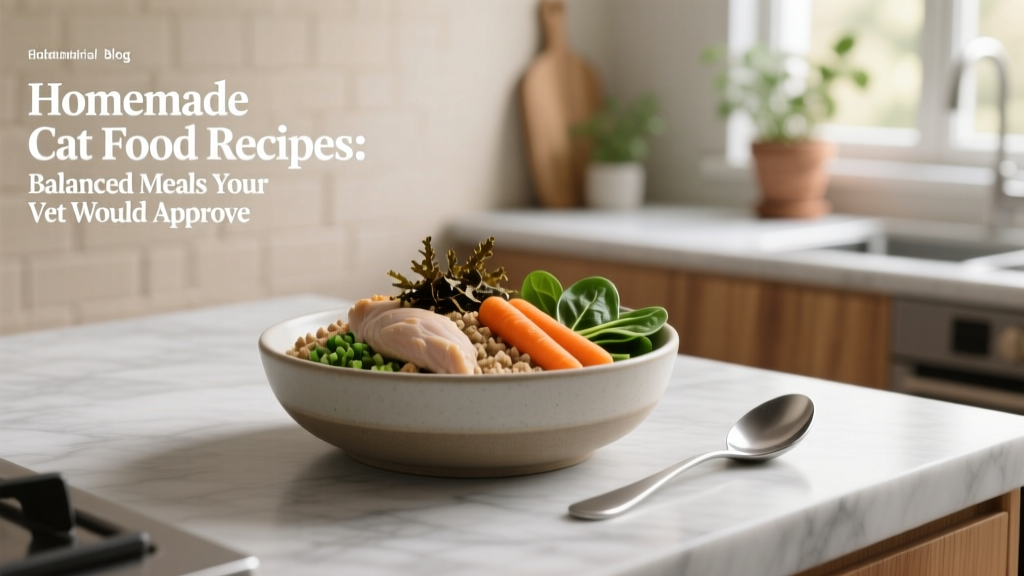
Homemade Cat Food Recipes: Balanced Meals Your Vet Would Approve
When Rachel's 11-year-old Siamese, Jasmine, was diagnosed with hyperthyroidism and chronic kidney disease, her veterinarian recommended a home-cooked diet. Commercial renal diets were too high in phosphorus for Jasmine's stage 2 kidney disease, and the prescribed prescription food cost $180 per month — money Rachel, a single-income parent, didn't have. Over the next six months, working with a board-certified veterinary nutritionist, Rachel developed a home-cooked recipe that stabilized Jasmine's phosphorus at 4.2 mg/dL (down from 6.1) and kept her thyroid levels within range for the remaining two years of her life.
Stories like Jasmine's are why homemade cat food deserves serious attention. But the gap between a well-formulated home diet and a dangerously deficient one is narrow, and most recipes circulating online fall squarely on the wrong side. A 2024 analysis published in the Journal of the American Veterinary Medical Association examined 200 homemade cat food recipes from popular websites and books. Only 9 of the 200 — that's 4.5% — met all AAFCO nutrient profiles for adult maintenance.
The Non-Negotiables Before You Start Cooking
Every complete homemade cat food must supply 11 essential amino acids, 2 essential fatty acids, 12 vitamins, and 11 minerals in the correct proportions. Missing or underdosing even one of these for a period of months produces measurable health consequences.
The three nutrients most commonly deficient in internet-sourced recipes are taurine, calcium, and vitamin E. A recipe calling for "chicken and rice" without a specified calcium source is guaranteed to produce a calcium-phosphorus ratio well below the safe range of 1:1 to 2:1. Raw chicken contains approximately 0.01% calcium and 0.9% phosphorus — a ratio of roughly 1:90. Feeding this without calcium supplementation produces severe secondary hyperparathyroidism within weeks, as the body leaches calcium from bones to maintain blood levels.
The Supplement Stack Every Recipe Needs
Regardless of which protein source you choose, the following supplements are required in virtually every homemade cat food formulation:
- Taurine — 250 mg per 1,000 kcal of food (minimum). This is non-negotiable for reasons covered extensively in the taurine article on this site.
- Calcium carbonate or bone meal — Approximately 1.5 teaspoons (6 grams) of food-grade calcium carbonate per pound of meat. This brings the calcium-phosphorus ratio into the 1.1-1.4:1 range.
- Vitamin E — 30-50 IU per 1,000 kcal. Natural alpha-tocopherol is preferred over synthetic dl-alpha-tocopherol due to approximately 36% higher bioavailability in cats.
- Zinc — 75-100 mg per kg of dry matter. Zinc proteinate or zinc gluconate are the preferred forms.
- B-complex vitamins — Thiamine is particularly critical because cooking destroys 30-50% of the thiamine in raw meat. A B-complex supplement at 50-75% of the daily requirement per 1,000 kcal covers the gap.
- Iodized salt or potassium iodide — To meet the iodine requirement of 0.35 mg per 1,000 kcal. Iodine deficiency produces goiter and hypothyroidism.
- Fish oil — 1,000 mg per 1,000 kcal, providing approximately 180 mg EPA and 120 mg DHA.
"The single most common mistake I see in homemade cat food formulations is under-supplementation of calcium and taurine. Both deficiencies are silent for months — no visible symptoms until organ damage is already underway. If you're going to home-cook, get the supplement amounts right from day one." — Dr. Cailin Heinze, VMD, MS, DACVIM (Nutrition), Cummings School of Veterinary Medicine at Tufts University (2024)
Recipe 1: Balanced Chicken-Based Adult Maintenance Diet
This recipe meets AAFCO nutrient profiles for adult maintenance and is suitable for cats aged 1-7 years without known health conditions. It yields approximately 1,200 grams of food, providing roughly 1,400 kcal — about 5-6 days of food for a 10-pound adult cat at maintenance.
Ingredients
| Ingredient | Amount | Purpose |
|---|---|---|
| Chicken thighs (boneless, skin-on) | 500 g | Primary protein and fat source |
| Chicken liver | 50 g | Vitamin A, B vitamins, iron |
| Chicken hearts | 75 g | Taurine, B vitamins, CoQ10 |
| Salmon oil | 3 g (approx. 3 ml) | Omega-3 fatty acids (EPA/DHA) |
| Calcium carbonate powder | 6 g (approx. 1.5 tsp) | Calcium supplementation |
| Taurine powder | 500 mg | Essential amino acid |
| Vitamin E (natural alpha-tocopherol, 400 IU) | 1 capsule (400 IU) | Antioxidant |
| B-complex vitamin tablet | 1 tablet (human-grade) | B-vitamin coverage including thiamine |
| Iodized salt | 0.5 g (pinch) | Iodine source |
| Egg (large, cooked) | 1 whole egg | Additional protein, choline, biotin |
Preparation Steps
- Cook the chicken thighs, liver, hearts, and egg together by baking at 350°F (177°C) for 25 minutes until internal temperature reaches 165°F. Do not boil — boiling leaches water-soluble vitamins and taurine into the cooking liquid.
- Reserve all cooking juices. Allow the meat to cool to room temperature.
- Grind or finely chop the cooked meat, liver, hearts, and egg. A food processor works well for this step.
- Add the calcium carbonate, taurine powder, vitamin E (squeeze the capsule contents), crushed B-complex tablet, iodized salt, and salmon oil to the meat mixture.
- Stir thoroughly for at least 2 minutes to ensure even distribution of supplements. Uneven mixing means some meals will be over-supplemented and others under-supplemented.
- Divide into 200-gram portions (approximately 230 kcal each) and freeze. Thaw individual portions in the refrigerator 12 hours before feeding.
- Serve at room temperature. Add 1-2 tablespoons of warm water to increase moisture content and improve palatability.
Nutritional Analysis (Per 1,000 kcal)
This recipe delivers approximately 42% protein, 35% fat, 3% fiber, 12% carbohydrate (from the egg and trace glycogen in muscle), and 8% ash on a dry-matter basis. Crude protein meets and exceeds the AAFCO minimum of 26%. Taurine content is approximately 180 mg per 1,000 kcal, well above the 50 mg minimum. The calcium-phosphorus ratio is 1.3:1, within the recommended range.
Recipe 2: Fish-Based Formula for Cats with Poultry Allergies
Food allergies in cats are real and increasingly common. The 2025 report from the American College of Veterinary Dermatology found that chicken protein accounts for 42% of confirmed feline food allergy cases, making it the single most common allergen. For cats that react to poultry, a fish-based alternative is often the best first-choice novel protein.
Ingredients
- Sardines (canned in water, no salt added): 400 g — provides protein, omega-3 fatty acids, and naturally occurring taurine
- White fish fillet (cod or pollock): 200 g — lean protein source
- Beef liver: 50 g — vitamin A, B12, and iron (use beef rather than chicken liver to avoid poultry cross-reactivity)
- Calcium carbonate: 6 g
- Taurine powder: 500 mg
- Vitamin E (400 IU): 1 capsule
- Zinc gluconate: 50 mg
- B-complex tablet: 1 tablet
- Iodized salt: 0.5 g
- Pumpkin puree (plain, no spices): 50 g — fiber source for digestive health
Preparation follows the same method as Recipe 1: cook the sardines, white fish, and beef liver, reserve juices, grind, mix in supplements, portion, and freeze. The pumpkin puree should be added after cooking, as it requires no heat treatment.
Important Note on Fish-Based Diets
Fish should not comprise more than 15-20% of a cat's total diet long-term due to thiaminase activity — an enzyme in raw fish that destroys thiamine (vitamin B1). Cooking denatures thiaminase, so the fish in this recipe must be fully cooked to an internal temperature of 145°F. Canned sardines are already cooked during the canning process, making them safe from a thiaminase perspective.
Recipe 3: Senior Cat Formula (7+ Years)
Cats over age 7 have shifting nutritional priorities. Protein requirements actually increase with age — a 12-year-old cat needs approximately 25% more protein than a 3-year-old cat to maintain lean muscle mass, according to research from Nestle Purina's Research Center (Dr. Gregory Aldrich, 2023). At the same time, phosphorus intake should be moderated to support kidney health, and joint-supporting nutrients become valuable additions.
Ingredients
- Turkey thighs (boneless, skin-on): 450 g — highly digestible protein with moderate fat
- Turkey heart: 75 g — taurine and CoQ10 for cardiac support
- Turkey liver: 40 g — vitamins and minerals
- Egg (large, cooked): 1 whole egg
- Glucosamine HCl powder: 500 mg — joint support (target dose: 20-30 mg per kg body weight daily)
- Calcium carbonate: 5.5 g — slightly reduced from the adult recipe to moderate phosphorus load
- Taurine powder: 500 mg
- Vitamin E (400 IU): 1 capsule
- Fish oil: 3 ml — anti-inflammatory omega-3 support
- B-complex tablet: 1 tablet
- Iodized salt: 0.5 g
Preparation is identical to the previous recipes. The glucosamine powder should be mixed in with the other supplements after cooking. For senior cats with confirmed kidney disease, consult a veterinary nutritionist before using this recipe — stage 3-4 CKD cats require further phosphorus restriction that home cooking alone may not achieve safely.
Storage, Rotation, and Long-Term Feeding
Homemade cat food should be portioned and frozen immediately after preparation. Thawed portions keep in the refrigerator for a maximum of 3 days. Do not refreeze thawed food — bacterial growth accelerates rapidly in meat-based diets, and cats are particularly sensitive to foodborne pathogens like Salmonella and Campylobacter.
For long-term feeding, rotate between at least two different protein sources every 3-4 months. This practice, called protein rotation, helps prevent the development of food sensitivities and ensures a broader micronutrient profile. A cat that eats only chicken-based food for two years has a higher risk of developing a chicken protein allergy than a cat that rotates between chicken, fish, and rabbit-based formulations.
Have your cat's blood chemistry panel checked every 6 months when feeding a homemade diet. Key markers to monitor include: total protein and albumin (protein adequacy), blood urea nitrogen and creatinine (kidney function), calcium and phosphorus (mineral balance), and whole blood taurine concentration. A blood taurine level below 200 nmol/mL indicates the need to increase supplementation by 25-50%.
When to Work With a Veterinary Nutritionist
These recipes are appropriate for healthy cats in specific life stages. If your cat has any of the following conditions, a custom-formulated recipe from a board-certified veterinary nutritionist (DACVIM-Nutrition or ECVCN) is essential:
- Chronic kidney disease (stages 2-4)
- Diabetes mellitus
- Hyperthyroidism (especially if managed with methimazole)
- Inflammatory bowel disease or food allergy
- Heart disease (HCM, DCM, or valvular disease)
- Pregnancy or nursing
- Growth (kittens under 12 months)
A consultation with a board-certified veterinary nutritionist typically costs $200-400 and results in a custom recipe tailored to your cat's specific condition, weight, age, and laboratory values. Board-certified specialists can be found through the American College of Veterinary Internal Medicine directory at acvim.org or through veterinary teaching hospitals at universities like UC Davis, Cornell, and Tufts.
Rachel kept Jasmine on the homemade renal diet for two years. The weekly food prep took about 90 minutes — comparable to the time most people spend on meal planning for themselves. The monthly ingredient cost averaged $65, compared to $180 for the prescription diet. And Jasmine maintained a body condition score of 5 throughout, with stable bloodwork at every six-month checkup. The investment in getting the recipe right from the beginning is what made that outcome possible.