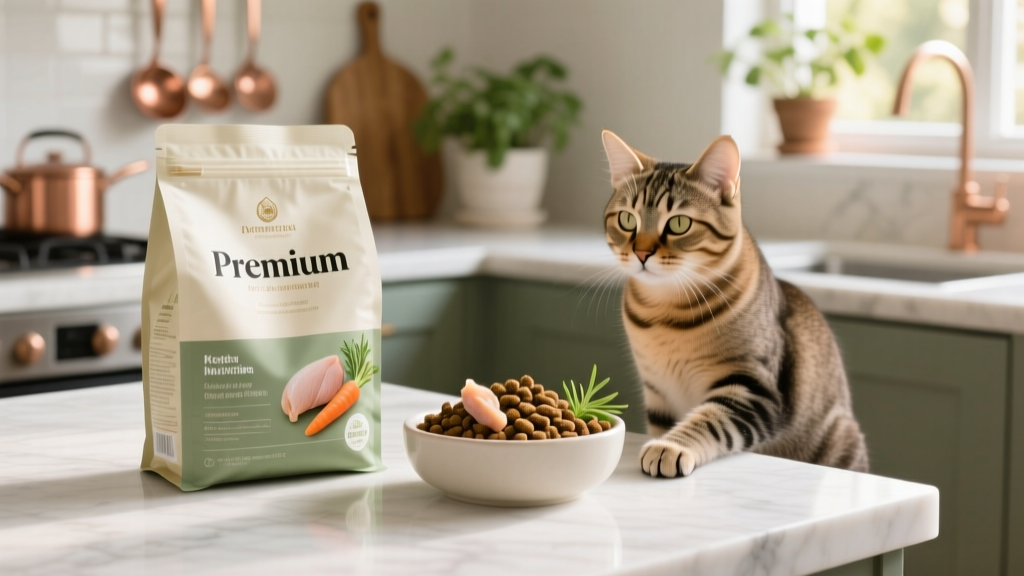
Cat Food Marketing vs Science: Holistic and Premium Labels
1. Why this topic matters for cat health
Cat food bags and cans are designed to sell a feeling: “premium,” “holistic,” “natural,” “ancestral,” “human-grade,” “gently cooked,” “grain-free.” Many of these words sound like they automatically equal better health. Sometimes they do correlate with solid nutrition and quality control. Often they don’t.
For cats, diet isn’t just about shiny coats and “energy.” Nutrition influences urinary tract health, kidney workload, body weight, diabetes risk, gut function, dental comfort, and even how well older cats maintain muscle. Marketing terms can distract from what actually matters: whether the food is complete and balanced for your cat’s life stage, whether it matches your cat’s medical needs, and whether the manufacturer consistently produces safe, nutrient-accurate diets.
This guide breaks down “holistic” and “premium” labels using current veterinary nutrition science, so you can choose foods based on evidence rather than buzzwords. For any major dietary change—especially for kittens, seniors, or cats with medical conditions—work with your veterinarian (and ideally a board-certified veterinary nutritionist).
2. Scientific background: feline nutritional needs (obligate carnivore basics)
Cats are obligate carnivores. That doesn’t mean they can only eat meat, but it does mean their physiology is adapted to derive essential nutrients from animal tissues and high-protein diets. Key points that shape food choice:
- High protein requirement: Cats use amino acids for energy more than many species and have limited ability to downshift protein metabolism when protein intake drops.
- Essential nutrients tied to animal ingredients: Cats require preformed taurine, vitamin A (retinol), and arachidonic acid, which are naturally abundant in animal tissues. Plant sources alone can be insufficient without correct supplementation.
- Low carbohydrate requirement: Cats can digest carbs, but there is no dietary requirement for carbohydrate. Excess calories from any source can promote weight gain.
- Water intake matters: Cats have a naturally low thirst drive. Many cats do better with higher-moisture diets, especially those prone to urinary issues.
“Complete and balanced” is not a marketing flourish; it is a nutritional claim. In the U.S., it generally means the product meets AAFCO nutrient profiles (formulated to meet levels) or passes feeding trials. In other regions, standards may reference FEDIAF or local regulatory bodies. Adequacy is the baseline for health; “premium” is optional.
3. Marketing vs science: what “holistic” and “premium” really mean
Do “holistic” and “premium” have legal definitions?
In most pet food markets, terms like holistic and premium are not strictly defined by regulators. Brands can use them as broad positioning statements. The result: two “premium holistic” foods can differ dramatically in nutrient profile, digestibility, calorie density, and quality control.
| Term on label | What it often implies | What science says to verify |
|---|---|---|
| Holistic | Whole-body wellness, “natural” ingredients, fewer additives | Check for complete & balanced claim, life stage, feeding trial vs formulated, nutrient analysis, company quality control |
| Premium/Super-premium | Higher quality ingredients, better digestibility, safer sourcing | Look for transparent manufacturing, consistent nutrient targets, veterinary nutrition expertise, and evidence of safety testing |
| Natural | No artificial flavors/colors/preservatives | “Natural” does not guarantee nutritional adequacy; antioxidants and vitamins can still be “natural” or synthetic |
| Human-grade | Same standards as human food | Only meaningful if the entire process is certified human-edible; still must be complete & balanced for cats |
| Grain-free | Lower carb, fewer allergies | Grains are not a common cat allergen; grain-free may replace grains with peas/potatoes and can be similarly high-carb |
Ingredient lists: useful, but easy to misunderstand
Marketing leans heavily on ingredient lists (“real chicken first,” “no by-products”). Ingredient lists are ordered by weight before cooking, so water-heavy ingredients (like fresh meat) can appear higher than they contribute after processing. More importantly, the list does not tell you:
- Whether amino acids (especially taurine) meet targets after processing and storage
- Whether minerals are balanced in a way that supports urinary and kidney health
- Calorie density (critical for weight control)
- Digestibility and stool quality outcomes in real cats
- Quality assurance measures (testing, recalls, batch consistency)
“No by-products” is not automatically better
“By-products” is one of the most misunderstood terms. In regulated pet food definitions, it typically refers to organ meats and other parts of the animal not sold as human muscle meat (for example: liver, heart). These can be nutrient-dense and biologically appropriate for cats. What matters is sourcing, handling, and formulation—not whether the ingredient name sounds appetizing to humans.
“Fillers” and the fear of carbohydrates
Some cats do best on lower-carbohydrate diets, particularly those with obesity or diabetes risk. But labeling an ingredient as a “filler” is a marketing tactic. Small amounts of certain fibers can support stool quality, microbiome health, and hairball management. The science-based question is: does the diet provide appropriate calories, adequate protein, and balanced nutrients for your cat?
“Holistic” does not equal “therapeutic”
A diet designed for a medical condition (urinary crystals, kidney disease, food allergies, diabetes) requires precise nutrient and mineral control. Over-the-counter “holistic urinary support” claims are not the same as a veterinary therapeutic diet. If your cat has a diagnosed condition, ask your vet which diet characteristics matter (for example, urine pH targets, controlled phosphorus, sodium levels, calorie density).
Evidence that matters more than labels
When evaluating a food, prioritize:
- Nutritional adequacy statement: “Complete and balanced” for the appropriate life stage
- Life stage fit: Kitten vs adult vs senior; reproduction/growth needs are very different
- Manufacturer expertise: Are veterinary nutritionists involved? Does the company do feeding trials or publish digestibility data?
- Quality control: Own manufacturing vs co-packing, batch testing, contaminant screening, nutrient verification
- Transparent calorie info: kcal per can/cup/pouch and a clear feeding guide
- Your cat’s outcomes: Body condition score, muscle condition, coat, stool quality, hydration, and veterinary lab trends
4. Practical recommendations for cat owners
Use a science-first checklist
- Choose foods labeled complete and balanced for your cat’s life stage.
- Prefer brands that can answer: Who formulates the diet? What quality testing is performed? Where is it manufactured?
- Prioritize adequate protein and appropriate calories over trendy claims.
- Support hydration when needed: incorporate wet food, add water to meals if your cat accepts it, provide multiple water stations or a fountain.
- Track your cat’s body condition score and weight monthly (more often during weight loss).
Look beyond the front-of-bag claims
Front labels sell. Side panels inform. Spend 60 seconds checking:
- AAFCO/FEDIAF adequacy statement and life stage
- Guaranteed analysis (as a starting point, not the whole story)
- Calories (kcal) per unit
- Feeding directions and whether they align with your cat’s ideal weight
5. Comparison of approaches: “premium” vs truly well-formulated
| Approach | Potential benefits | Potential downsides | Best fit for |
|---|---|---|---|
| Budget complete & balanced (wet or dry) | Meets nutrient standards; often widely tested; consistent availability | May be higher carb (some dry foods), palatability varies | Most healthy cats when matched to calories and preferences |
| “Premium/holistic” retail diets | Sometimes higher meat inclusion, appealing ingredient choices, diverse textures | Labels can be vague; quality control varies by company; may be calorie-dense | Cats with strong preferences; owners who verify adequacy and manufacturer standards |
| Veterinary therapeutic diets | Condition-specific nutrient control; strong clinical rationale; often tested | Cost; limited flavors; not for healthy cats unless advised | UTD, CKD, GI disorders, allergies, obesity management (vet-directed) |
| Home-cooked (vet-formulated) | Ingredient control; can be tailored for medical needs | High risk of deficiency if not properly formulated; time and cost | Cats needing custom nutrition under veterinary nutritionist guidance |
| Raw (commercial or homemade) | High palatability for some cats | Pathogen risk to cats and humans; nutrient imbalance risk; not ideal for immunocompromised households | Requires careful risk assessment with your veterinarian |
6. Common mistakes and misconceptions to avoid
- Myth: “Holistic means healthier.”
Reality: Without verified nutritional adequacy and strong manufacturing controls, “holistic” is a vibe, not a guarantee. - Myth: “Grain-free is best for cats.”
Reality: True grain allergies are uncommon. The bigger issue is overall nutrient balance and calorie control, not the presence of rice or oats. - Mistake: Picking food based on the first ingredient alone.
Reality: Ingredient order is influenced by moisture. A diet’s full nutrient profile and quality control matter more. - Mistake: Overfeeding “premium” food.
Reality: Many premium diets are calorie-dense. Even high-quality calories cause weight gain when portions are too large. - Myth: “No by-products” equals higher quality.
Reality: Organ meats can be excellent for cats; the formulation and safety testing are what count. - Mistake: Switching diets rapidly because of marketing fear.
Reality: Frequent abrupt changes can trigger GI upset and food aversions.
7. How to implement changes safely (transition tips)
Cats are sensitive to sudden diet changes. A slow transition protects the gut and helps prevent refusal.
| Day | Old food | New food |
|---|---|---|
| 1–2 | 75% | 25% |
| 3–4 | 50% | 50% |
| 5–6 | 25% | 75% |
| 7+ | 0% | 100% |
- If your cat has a sensitive stomach, extend the transition to 10–14 days.
- Measure portions with a scale when possible; cups are imprecise.
- Watch for vomiting, diarrhea, constipation, itchy skin, or appetite changes. If signs persist beyond 24–48 hours, contact your veterinarian.
- Never “wait it out” with fasting. Cats can develop hepatic lipidosis (fatty liver) if they stop eating, especially overweight cats. If your cat refuses food for 24 hours (or less for kittens), call your vet.
8. Special considerations: age, health conditions, activity level
Kittens (growth)
- Feed a diet labeled for growth or all life stages.
- Growth requires higher energy density and precise mineral balance (including calcium and phosphorus).
- A “premium adult” diet can be inappropriate for kittens even if the ingredients sound excellent.
Adult indoor cats
- Focus on calorie control and satiety.
- Consider mixed feeding (wet + dry) to support hydration while maintaining convenience.
- Monitor body condition score; many indoor cats gain weight gradually over years.
Seniors
- Older cats are prone to muscle loss and may benefit from highly digestible protein and adequate calories.
- Dental disease, arthritis, and reduced smell can affect appetite; texture and aroma may matter more than “premium” claims.
- If kidney disease is diagnosed, do not self-prescribe low-protein diets; kidney nutrition is nuanced (often focusing on phosphorus control, omega-3s, and maintaining calories). Work with your vet.
Urinary tract issues (FLUTD, crystals)
- Hydration and mineral balance are central; wet food often helps increase water intake.
- Therapeutic urinary diets are formulated to target urine pH and relative supersaturation; “holistic urinary support” is not equivalent.
- Always involve your vet—urinary blockage is an emergency, especially in male cats.
Food allergies or chronic GI disease
- Most suspected “food allergies” are not caused by grains; common triggers include certain proteins.
- Your vet may recommend a hydrolyzed or novel protein diet trial with strict rules (no flavored meds, treats, or table scraps).
Highly active cats vs low-activity cats
- Active cats may do well with higher calorie allowances and more frequent meals.
- Low-activity cats need portion control; the “best” food is the one that keeps lean body condition without hunger stress.
9. FAQ: common questions cat owners ask
Is “holistic” cat food better than regular cat food?
Not automatically. “Holistic” is usually a marketing term. A better test is whether the food is complete and balanced for your cat’s life stage and whether the manufacturer has strong quality control and nutritional expertise. Your veterinarian can help you select an appropriate diet for your cat’s health profile.
Does “premium” mean higher meat and better nutrition?
Sometimes, but not reliably. Some premium foods are excellent; others are simply more expensive with trendier ingredients. Evaluate the adequacy statement, calories, and the company’s testing standards rather than assuming price equals quality.
Should I choose wet or dry food?
Both can be complete and balanced. Wet food increases water intake and can be helpful for urinary health and weight management in many cats. Dry food is convenient and can work well when portions are controlled. Many cats do well on a mixed approach. If your cat has medical issues (urinary disease, kidney disease, obesity, diabetes), ask your vet which format best supports their treatment plan.
Are grains bad for cats?
Grains are not inherently “bad,” and true grain allergies are uncommon. Cats don’t need grains, but they can digest cooked grains. The more relevant factors are total calories, protein adequacy, mineral balance, and how your individual cat responds.
How can I tell if a food is truly “high quality”?
Look for: complete and balanced claim for the correct life stage, clear calorie labeling, a company that employs qualified nutrition experts, and evidence of consistent manufacturing and batch testing. Then judge results in your cat: stable healthy weight, good stool quality, healthy coat, and favorable vet checkups.
Is homemade food healthier than store-bought?
Homemade diets can be excellent when formulated by a veterinary nutritionist and followed precisely, including supplements. Many homemade recipes found online are nutritionally incomplete for cats. If you want to home-cook, ask your veterinarian for a referral to a board-certified veterinary nutritionist.
Choosing the “best” diet is less about chasing premium labels and more about matching a complete and balanced food to your cat’s biology, life stage, and health needs—then feeding the right amount consistently. If you’re unsure which direction to take, bring the label (or a photo of it) to your veterinary appointment and ask for a nutrition review.
For more science-based feeding help, explore the nutrition guides and product-decoding articles on catloversbase.com.