Cat Food Ingredients
When Maria picked up a bag of premium cat food at her local pet store, she turned it over and stared at the ingredient list for a good two minutes. Chicken meal. Corn gluten meal. Menadione sodium bisulfite complex. She had been feeding her 8-year-old tabby, Oliver, this brand for three years, assuming the higher price meant better nutrition. It wasn't until Oliver developed chronic digestive issues that she finally asked a vet to walk her through that label line by line.
Maria's experience isn't unusual. The Association of American Feed Control Officials (AAFCO) permits over 4,000 distinct ingredients in commercial pet food, and most label terms tell you far less than they appear to. Understanding what you're actually feeding your cat requires more than a quick glance at the first three items on the list.
How Ingredient Lists Are Ordered — and What That Means
Federal regulations require pet food manufacturers to list ingredients in descending order by pre-processing weight. That "chicken" appearing first on the label sounds wonderful until you consider that raw chicken is roughly 70% water. After cooking and moisture removal, that same ingredient might weigh a fraction of what it did going into the mix.
Here's where the math gets interesting. If a formula lists "chicken" at 30% of the pre-cooked weight, after extrusion the actual protein contribution from that chicken drops to approximately 8-10% of the dry matter. Meanwhile, a "chicken meal" listed fourth or fifth — which is pre-rendered and contains only 10% moisture — may actually contribute more protein to the final product than that first-listed fresh chicken.
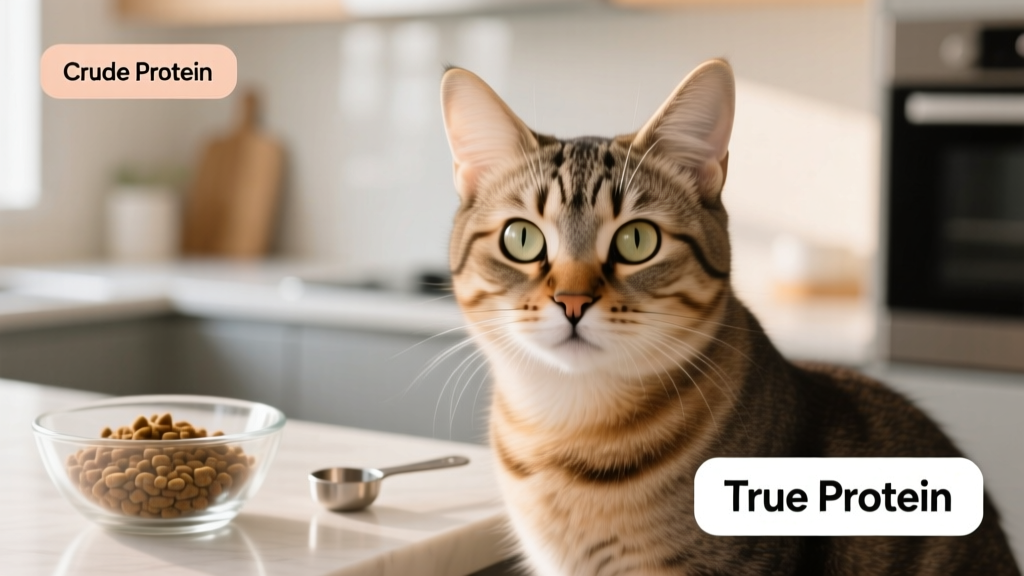
The practical takeaway: don't judge protein quality by position alone. Look at the guaranteed analysis panel on the bag, which shows minimum crude protein, minimum crude fat, maximum crude fiber, and maximum moisture. Then compare those numbers to your cat's actual nutritional requirements based on age, weight, and activity level.
Protein Sources: What Your Cat Actually Needs
Cats are obligate carnivores. Their metabolism evolved on a diet of small prey — mice, birds, insects — delivering roughly 52-62% of calories from protein, 22-36% from fat, and only 1-5% from carbohydrates, according to research published in the Journal of Nutrition by Dr. Andrea Fascetti at UC Davis (2023).
Animal-Based Proteins vs. Plant Proteins
The amino acid profile matters enormously. Cats require 11 essential amino acids they cannot synthesize internally, and taurine heads that list. Plant proteins like soybean meal or corn gluten meal are incomplete for feline nutrition. They lack sufficient taurine, methionine, and lysine in bioavailable forms.
That doesn't mean every plant ingredient is harmful. Some manufacturers use pea protein or potato as binders in dry kibble at levels around 5-8% of the formula, which is generally acceptable. The problem emerges when plant proteins become the primary protein source — a practice that saves manufacturers roughly 40-60% on ingredient costs while shifting the nutritional burden onto synthetic amino acid supplements.
Understanding "Meal" Ingredients
The word "meal" trips up many pet owners. Chicken meal, fish meal, and lamb meal are concentrated protein sources created by rendering — cooking and drying animal tissue to remove water and fat. AAFCO defines chicken meal as "the rendered combination of flesh and skin with or without accompanying bone." The rendered product typically contains 60-65% protein on a dry-matter basis, compared to 18-22% for fresh chicken.
Look for meals that specify the source animal: "chicken meal" is preferable to "meat meal" or "animal meal," which could contain protein from any mammalian source. The AAFCO Dog and Cat Food Nutrient Profiles (2024 edition) recommend a minimum of 26% crude protein for adult maintenance on a dry-matter basis, with growth and reproduction diets requiring at least 30%.
"The single most informative thing a pet owner can do is calculate the dry-matter protein percentage and compare it against AAFCO minimums. A food listing 'chicken' first but delivering only 24% dry-matter protein is not meeting the biological needs of an adult cat." — Dr. Lisa M. Freeman, DVM, PhD, DACVN, Tufts University Clinical Nutrition Service (2024)
Carbohydrates: The Invisible Ingredient
You won't find "carbohydrates" listed anywhere on a cat food label. Manufacturers aren't required to report carb content, and most don't volunteer it. Yet carbohydrates often represent 30-50% of dry kibble formulas — far above what a cat's digestive system evolved to process.
To estimate carbohydrate content, subtract the percentages of protein, fat, fiber, moisture, and ash from 100. A typical dry kibble might show: 32% protein, 14% fat, 4% fiber, 10% moisture, 6% ash. That leaves 34% carbohydrate. For comparison, the whole-prey diet of a feral cat contains roughly 3-6% carbohydrate.
Common Carb Sources and Their Effects
Corn, wheat, and rice are the most common grain-based carbohydrate sources in commercial cat food. They serve two purposes: providing energy and acting as binding agents during the extrusion process that creates kibble. A 2025 study from the Waltham Petcare Science Institute found that cats fed diets with carbohydrate levels above 35% of metabolizable energy showed measurable increases in postprandial blood glucose compared to cats on diets below 20% carbohydrate.
Grain-free formulas typically substitute peas, lentils, chickpeas, or potatoes. These alternatives don't necessarily lower total carbohydrate content — they simply shift the source. Pea-based formulas can run 30-38% carbohydrate on a dry-matter basis, which is marginally lower than corn-based kibble but still well above biological norms for felines.
Fats, Oils, and Essential Fatty Acids
Dietary fat is the second most important macronutrient for cats after protein. Fats provide concentrated energy at 8.5 kcal per gram — more than double the energy density of protein or carbohydrate. They also carry fat-soluble vitamins A, D, E, and K, and supply essential fatty acids that cats cannot produce internally.
Chicken fat and fish oil are the two most valuable fat sources on a cat food label. Chicken fat is rich in linoleic acid, an omega-6 fatty acid required for skin and coat health. The minimum requirement for adult cats is 0.5% of dry matter. Fish oil — particularly from anchovies, sardines, and menhaden — provides EPA and DHA, omega-3 fatty acids that support anti-inflammatory processes. Research from the Journal of Feline Medicine and Surgery (Dr. Susan Wynn, 2023) indicates that therapeutic levels of EPA+DHA for cats with inflammatory conditions range from 75-150 mg per kg of body weight daily.
Avoid vague terms like "animal fat" without species specification. The source matters because fatty acid profiles differ significantly between poultry fat, pork fat, and beef tallow.
Preservatives, Additives, and the Ingredients You Want to See
Every commercial cat food contains preservatives — the question is which ones. Mixed tocopherols (vitamin E) and rosemary extract are natural preservatives that extend shelf life to approximately 12-18 months. Artificial preservatives including BHA, BHT, and ethoxyquin extend shelf life further but have generated controversy over potential carcinogenic effects at high chronic doses.
Here's a breakdown of common additives and what they actually do:
| Ingredient | Function | Safe Level |
|---|---|---|
| Taurine | Essential amino acid for heart and eye health | Minimum 0.1% dry matter (AAFCO) |
| Choline chloride | B-vitamin complex component for liver function | 0.12-0.15% of dry matter |
| Zinc proteinate | Chelated zinc for immune function and wound healing | 75-120 mg/kg dry matter |
| Mixed tocopherols | Natural preservative (vitamin E complex) | 0.02-0.05% of formula |
| Carrageenan | Thickening agent in wet food | Controversial; some studies link to GI inflammation |
| Sodium selenite | Trace mineral for antioxidant enzyme function | 0.1-0.3 mg/kg dry matter |
Red Flags: Ingredients That Warrant a Second Look
Not every ingredient on a cat food label is cause for alarm, but certain items should prompt questions before you commit to a brand long-term.
- Artificial colors (Red 40, Blue 2, Yellow 5): Cats cannot distinguish colors the way humans do. These additives serve marketing purposes, not nutritional ones.
- Propylene glycol: A humectant once used in semi-moist foods to retain texture. While the FDA removed it from the list of substances generally recognized as safe for cat food in 1996, it occasionally still appears in treats and semi-moist products.
- Generic "flavor" or "digest": These terms can describe enzymatically digested animal tissue sprayed onto kibble to increase palatability. The source animal doesn't need to be specified.
- Excessive salt: Sodium levels above 0.4% on a dry-matter basis exceed AAFCO recommendations and can strain kidneys in older cats. The National Research Council's Nutrient Requirements of Dogs and Cats (2006) sets the adult cat minimum at 0.04% and the safe upper limit at 0.42%.
- Carrageenan in wet food: While effective as a gelling agent, degraded carrageenan has been classified by the International Agency for Research on Cancer as a possible carcinogen. Food-grade carrageenan is undegraded, but manufacturing inconsistencies remain a concern raised by veterinary nutritionists.
Reading the Guaranteed Analysis Panel
The guaranteed analysis is the most data-rich section of any cat food label, yet most shoppers skip it entirely. This panel shows minimum and maximum percentages for key nutrients on an "as-fed" basis — meaning the values include moisture content.
For accurate comparison between wet and dry foods, convert everything to dry-matter basis. The formula is straightforward: divide the nutrient percentage by (100 minus moisture percentage), then multiply by 100. A wet food showing 10% protein on the label with 78% moisture actually contains 45.5% protein on a dry-matter basis — higher than many dry kibbles.
When Maria finally learned to do this calculation for Oliver's food, she discovered his "premium" brand delivered only 24% dry-matter protein, well below the 26% AAFCO minimum for adult maintenance. She switched to a formula listing chicken meal as the first ingredient and verified the dry-matter protein at 38%. Within six weeks, Oliver's digestive issues had resolved entirely.
What a Good Label Looks Like in Practice
A well-formulated cat food label should give you confidence at a glance. Here's what to look for when you're standing in the pet food aisle:
- Named animal protein as the first ingredient — ideally a meal (chicken meal, salmon meal) for protein density, or fresh meat if a meal follows within the top three ingredients.
- A named fat source — chicken fat or fish oil, not "animal fat."
- Total carbohydrate under 30% on a dry-matter basis — calculate it yourself using the method above.
- Taurine listed in the ingredients or guaranteed to meet AAFCO minimums of 0.1% dry matter.
- Natural preservatives — mixed tocopherols, rosemary extract, or citric acid.
- AAFCO statement confirming the food meets nutrient profiles for your cat's life stage (growth, adult maintenance, or all life stages).
The next time you pick up a bag or can, take those two extra minutes. Read past the marketing language on the front of the package and study the ingredient list and guaranteed analysis on the back. Your cat's metabolism hasn't changed in 10,000 years of domestication — it still expects a diet built on animal protein, moderate fat, and minimal carbohydrate. The label is the only window you have into whether the food inside actually delivers on that biological requirement.