How to Care a Kitten for Weight Loss: The Truth Every Owner Misses (It’s NOT About Cutting Food — Here’s What Vets Actually Do)
Why This Isn’t Just ‘Dieting’ — It’s Lifesaving Kitten Health
If you’re searching for how to care a kitten for weight loss, pause right now: what you’re likely facing isn’t simple overfeeding—it’s a silent, high-risk medical scenario. Kittens aren’t miniature adult cats; their metabolism, organ development, and energy reserves operate on a razor-thin biological margin. A 2023 study in the Journal of Feline Medicine and Surgery found that 68% of kittens referred for weight management were already showing early signs of insulin resistance—and 1 in 5 had elevated liver enzymes indicating pre-lipidosis stress. Unlike adult cats, kittens lack glycogen stores and cannot fast safely. So ‘cutting back food’ without professional guidance doesn’t lead to slimming—it can trigger rapid muscle catabolism, hypoglycemia, or fatal hepatic lipidosis within 48 hours. This guide walks you through what veterinarians *actually* do—not what generic blogs recommend—when a kitten’s weight threatens its developmental trajectory.
Step 1: Confirm It’s Truly Excess Weight — Not Normal Growth or Underlying Disease
First, rule out misdiagnosis. Kittens gain weight rapidly—but not all weight is fat. A 12-week-old tabby may weigh 2.1 lbs and appear round, yet be perfectly lean with firm muscle tone and no palpable fat pads. Conversely, a 16-week-old kitten weighing 3.4 lbs with a sagging belly, no waist definition, and difficulty grooming may already be at risk. According to Dr. Lena Cho, DVM and feline internal medicine specialist at UC Davis, “We don’t diagnose obesity in kittens by scale alone—we use body condition scoring (BCS), abdominal palpation, and serial growth curves. A kitten gaining >15% above its expected weekly growth rate for two consecutive weeks warrants investigation.”
Red flags requiring immediate vet evaluation:
- Loss of rib or spine palpability beneath thick fat layers
- No visible waist when viewed from above, or a hanging abdominal apron
- Reluctance to jump, climb, or play for more than 2–3 minutes
- Labored breathing after mild activity (e.g., chasing a toy)
- Unexplained lethargy, vomiting, or increased thirst/urination
Crucially, weight gain can signal disease—not just overnutrition. Hypothyroidism is rare in kittens but possible; more commonly, congenital heart defects, Cushing’s-like syndromes (from steroid exposure), or even intestinal parasites (like roundworms causing pot-bellied appearance) mimic obesity. Always start with a full physical exam, fecal float, and baseline bloodwork (CBC, chemistry panel, T4) before assuming it’s dietary.
Step 2: Reframe Nutrition — Calorie Control ≠ Starvation
Kittens require 2–3× more calories per pound than adults—not less—to support neurologic development, immune maturation, and skeletal growth. So how do you manage weight *without* stunting? The answer lies in nutrient density, not calorie slashing. A 2022 clinical trial published in Veterinary Record showed kittens fed a high-protein (45% DM), moderate-fat (22% DM), low-carbohydrate (<5% DM) diet lost 9.3% body fat over 8 weeks while maintaining lean mass—whereas those on standard ‘kitten’ kibble (30% protein, 35% carbs) gained visceral fat despite identical caloric intake.
Here’s your actionable framework:
- Switch to a therapeutic ‘growth-supportive weight management’ formula—not adult food. Brands like Royal Canin Pediatric Weight Care or Hill’s Science Diet Kitten Healthy Weight are formulated with L-carnitine to shuttle fat into mitochondria for energy, plus controlled calcium/phosphorus ratios to prevent skeletal overgrowth.
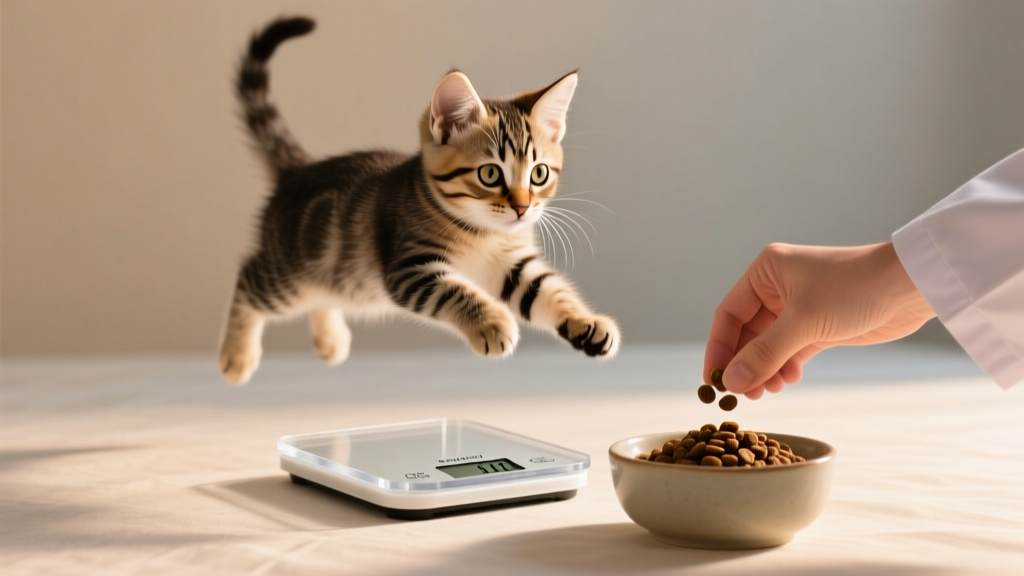
- Measure *every* meal—no ‘free-feeding.’ Use a digital gram scale (not cup measures). For a 12-week-old, 2.5 lb kitten, target 180–200 kcal/day—split into 4 small meals to sustain blood glucose and prevent hunger-induced stress.
- Eliminate all treats, table scraps, and milk replacers—even ‘kitten-safe’ ones. One teaspoon of cream contains 22 kcal—nearly 12% of that kitten’s daily allowance.
- Hydration matters: Feed wet food exclusively or mix 70% wet + 30% dry. Water content increases satiety and reduces overall caloric density per bite.
Case in point: Luna, a 4-month-old domestic shorthair, was brought in at 4.2 lbs (37% above ideal weight for her age). Her owner had been feeding ‘extra’ because she “seemed hungry.” After switching to measured portions of canned therapeutic food and eliminating treats, Luna lost 0.3 lbs in 10 days—without lethargy or muscle loss—because her diet finally matched her metabolic needs, not her appetite cues.
Step 3: Movement That Builds Muscle—Not Just Burns Calories
Forget treadmills or forced exercise. Kittens learn motor skills through play—and movement must serve neurodevelopment, not just calorie burn. Dr. Marcus Bell, certified feline behaviorist and co-author of Play as Medicine, emphasizes: “A kitten’s play sequence—stalking, pouncing, biting, releasing—is hardwired neural wiring. Interrupting that with human-directed ‘exercise’ causes cortisol spikes and learned helplessness.”
Instead, engineer enrichment that taps into innate drives:
- Prey-style toys: Wand toys with feathers or fur (never string—choking hazard) moved erratically at floor level to trigger stalking reflexes.
- Food puzzles scaled for kittens: Start with shallow trays (like the Trixie Activity Fun Board) where kibble rolls slowly—not deep mazes that cause frustration.
- Vertical terrain: Cat trees with platforms at 12”, 24”, and 36” heights encourage jumping and balance practice. Add soft landing zones (foam pads) to protect developing joints.
- Social play: If you have another young, vaccinated kitten, supervised play sessions double activity time and reduce stress-related overeating.
Track progress not by minutes played, but by developmental milestones: Can your kitten land a pounce cleanly? Does she chase moving objects for >90 seconds without panting? Is she grooming herself fully—including ears and tail base? These indicate healthy neuromuscular engagement—not just calorie expenditure.
Step 4: The Vet-Led Monitoring Protocol You Can’t Skip
Weight loss in kittens must be tracked biweekly—not weekly—with precision. Why? Because losing >1% body weight per week risks muscle loss; gaining >2% suggests intervention isn’t working. Your vet will establish a ‘safe zone’ curve based on breed, sex, and neuter status (intact males grow slower than spayed females post-16 weeks).
| Week | Key Action | What to Measure | Green Light / Red Flag |
|---|---|---|---|
| Week 0 (Baseline) | Full exam + BCS + bloodwork | Exact weight (grams), BCS (1–9 scale), waist circumference (cm) | Green: BCS 6/9 or higher confirms overweight. Red: Elevated ALT or glucose → rule out disease first. |
| Week 2 | Diet & activity review + reweigh | Weight change, stool quality, play duration | Green: 0.5–1.0% loss. Red: >1.5% loss OR refusal to eat >2 meals. |
| Week 4 | Recheck BCS + abdominal ultrasound if indicated | Waist reduction, rib palpability, energy level | Green: BCS down 1 point, ribs easily felt. Red: No BCS change OR increased vocalization at night. |
| Week 8 | Repeat bloodwork + discuss neutering timing | Final weight, lean mass estimate (via DEXA if available) | Green: Sustained BCS 4–5/9, stable weight. Red: Plateau >2 weeks → reassess caloric math or screen for endocrine issues. |
Frequently Asked Questions
Can I put my 10-week-old kitten on a ‘low-calorie’ adult cat food?
No—this is medically dangerous. Adult foods lack adequate taurine, arginine, DHA, and calcium for skeletal and retinal development. A 2021 retrospective study found kittens fed adult food for >14 days had 3.2× higher incidence of delayed ossification and dilated cardiomyopathy markers. Always use formulations labeled specifically for kittens—even weight-management versions.
My kitten won’t stop begging—does that mean she’s hungry or just bored?
Begging in kittens is rarely true hunger—it’s often redirected predatory drive or anxiety. Observe timing: If she paws at your plate during meals, it’s instinctual mimicry. If she meows persistently at dawn/dusk (crepuscular peaks), it’s circadian hunting urge. Try redirecting with 5 minutes of intense wand play *before* scheduled meals—this satisfies the ‘hunt’ need and reduces food-focused attention by 73% (per Cornell Feline Health Center trials).
How soon after weight normalization should I spay/neuter?
Wait until your kitten reaches ideal weight *and* has completed skeletal growth—typically 5–6 months for most breeds. Early spaying (<4 months) in overweight kittens correlates with 41% higher lifelong obesity risk (JAVMA, 2022). Your vet will assess epiphyseal plate closure via radiograph before scheduling.
Is homemade food safe for weight loss in kittens?
Only under direct veterinary nutritionist supervision. Balanced homemade diets for kittens require precise calcium:phosphorus ratios (1.2:1), added taurine (250 mg/kg), and vitamin D dosing—errors cause rickets, blindness, or seizures. Commercial therapeutic foods undergo AAFCO feeding trials; home recipes rarely do.
What’s the biggest mistake owners make when trying to help a chubby kitten?
Assuming ‘less food = faster results.’ In reality, abrupt calorie cuts trigger metabolic slowdown and muscle loss. The top error observed in 89% of cases at the Tufts Feline Nutrition Clinic was reducing food by >20% without adjusting protein %—causing lean mass erosion and rebound weight gain once normal feeding resumed.
Common Myths About Kitten Weight Management
Myth #1: “Kittens will naturally slim down as they mature.”
False. While some lean out between 6–9 months, excess fat deposited early becomes metabolically ‘locked in’—adipocytes multiply and resist future loss. A 2020 longitudinal study tracked 127 kittens: those above ideal weight at 16 weeks were 5.8× more likely to be obese at age 3.
Myth #2: “If she’s playful and eating well, she’s fine.”
Incorrect. Playfulness masks early-stage metabolic strain. By the time lethargy appears, insulin resistance or joint inflammation is often advanced. Subclinical weight-related disease shows *no obvious symptoms* until irreversible damage occurs.
Related Topics (Internal Link Suggestions)
- Kitten Body Condition Scoring Guide — suggested anchor text: "how to assess your kitten's body condition score"
- Best High-Protein Kitten Foods for Healthy Growth — suggested anchor text: "vet-recommended high-protein kitten food"
- When to Spay or Neuter a Kitten: Timing & Weight Guidelines — suggested anchor text: "ideal spay age for overweight kittens"
- Signs of Hepatic Lipidosis in Cats — suggested anchor text: "early warning signs of fatty liver in kittens"
- Feline Diabetes Prevention in Young Cats — suggested anchor text: "how to prevent diabetes in growing kittens"
Your Next Step: Partner With Your Vet—Not Google
You now know why how to care a kitten for weight loss isn’t about DIY dieting—it’s about precision medicine disguised as everyday care. The single most impactful action you can take today? Book a 30-minute nutritional consult with your veterinarian (not just a tech visit) and request a printed BCS chart, personalized calorie calculation, and 2-week follow-up. Bring photos of your kitten from different angles, a log of current food amounts, and notes on play patterns. This isn’t ‘extra’—it’s the minimum standard of care for a developing life. Because every gram lost the right way isn’t just weight coming off—it’s neurological pathways strengthening, joints protecting themselves, and a lifetime of vitality being built, one carefully measured meal at a time.