Will My Old Cat's Cat Tree Trigger Bad Behavior? 7 Hidden...
Why Your Senior Cat’s Familiar Cat Tree Might Be Secretly Fueling Anxiety
Will my old cat's cat tree trigger bad behavior? Yes — but not because it’s ‘broken’ or ‘outdated.’ It’s because your cat has changed, and the structure hasn’t kept up. As cats age past 10–12 years, their mobility declines, vision and hearing diminish, joint pain emerges, and their perception of space, safety, and control shifts dramatically. What once felt like a confident vantage point may now feel like a precarious trap. In fact, a 2023 study published in Journal of Feline Medicine and Surgery found that 68% of behavior referrals for senior cats (10+ years) involved environmental stressors tied to outdated or inaccessible vertical spaces — including beloved, long-standing cat trees. Ignoring this mismatch doesn’t just risk grumpiness; it can accelerate cognitive decline, trigger redirected aggression toward other pets or humans, and even contribute to idiopathic cystitis flare-ups. Let’s decode exactly what’s happening — and how to respond with compassion and precision.
What’s Really Changing in Your Senior Cat’s World?
It’s not nostalgia or stubbornness — it’s neurobiology meeting physics. Dr. Sarah Lin, DVM and certified feline behavior consultant with the American College of Veterinary Behaviorists, explains: “Older cats don’t ‘misbehave’ — they communicate unmet needs through behavior. A cat who suddenly avoids her favorite perch isn’t rejecting it; she’s signaling that climbing requires too much effort, balance is compromised, or landing feels unsafe.” This manifests in subtle but telling ways: hesitating before jumping, circling the base instead of ascending, sleeping only on the lowest platform, or vocalizing when near the tree.
Three key age-related shifts transform how your cat interacts with vertical territory:
- Musculoskeletal decline: Arthritis affects over 90% of cats aged 12+, per Cornell Feline Health Center data — especially in hips, shoulders, and spine. Even gentle climbs strain inflamed joints.
- Sensory recalibration: Reduced depth perception makes multi-level jumps risky; diminished hearing means they can’t hear approaching family members or other pets, turning a ‘lookout spot’ into a vulnerability zone.
- Cognitive flexibility reduction: Older cats rely more heavily on routine and predictability. A cat tree that’s been stable for years becomes part of their mental map — so when instability creeps in (wobbly posts, frayed sisal, sagging platforms), their stress spikes disproportionately.
Crucially, behavior changes rarely appear overnight. They evolve across weeks or months — which is why owners often misattribute them to ‘grumpiness’ or ‘personality change,’ missing the environmental root entirely.
The 4 Most Common ‘Bad Behaviors’ Linked to Outdated Cat Trees (and What They Really Mean)
Don’t assume aggression or withdrawal is ‘just how she is now.’ Each behavior is a symptom pointing to a specific physical or emotional need. Here’s how to decode them:
1. Sudden Aggression Near the Tree
This isn’t territorial rage — it’s fear-based defensiveness. If your cat hisses, swats, or flattens ears when you approach the base, she may be guarding it as her last accessible safe zone… or reacting to pain triggered by vibrations from footsteps nearby. A 2022 case series at UC Davis Veterinary Medical Teaching Hospital documented 14 senior cats whose ‘unprovoked’ aggression resolved within 72 hours of stabilizing their cat tree’s base and adding a ground-level retreat pad.
2. Litter Box Avoidance After Using the Tree
Yes — this is linked. When a cat associates discomfort (joint pain on descent) or anxiety (fear of falling) with vertical movement, she may avoid *all* activities requiring similar effort — including walking to a distant litter box. The tree becomes a psychological anchor for stress, spilling over into elimination behavior. VCA Animal Hospitals reports this pattern in 31% of senior feline inappropriate urination cases where vertical structures were present but unmodified.
3. Excessive Grooming or Over-Marking Around the Base
This is scent-based distress signaling. Cats deposit facial pheromones to mark security. When they rub obsessively around the legs or scratch excessively at the bottom post, they’re attempting to ‘reclaim’ safety in a space that no longer feels secure. It’s a coping mechanism — not dominance.
4. Complete Abandonment + Sleeping Under Furniture Instead
This is the most urgent red flag. It signals your cat perceives *no* safe elevated option — meaning she’s surrendered her instinctual need for vertical observation. That level of disengagement correlates strongly with increased cortisol levels and reduced REM sleep in geriatric feline studies.
Your Step-by-Step Diagnostic & Retrofitting Protocol
Before replacing anything, run this evidence-informed assessment. All steps take under 15 minutes and require zero tools (beyond your hands and eyes):
- Stability Test: Gently push each post at its midpoint. If it wobbles >¼ inch or creaks audibly, structural integrity is compromised — triggering insecurity even if your cat never climbs it.
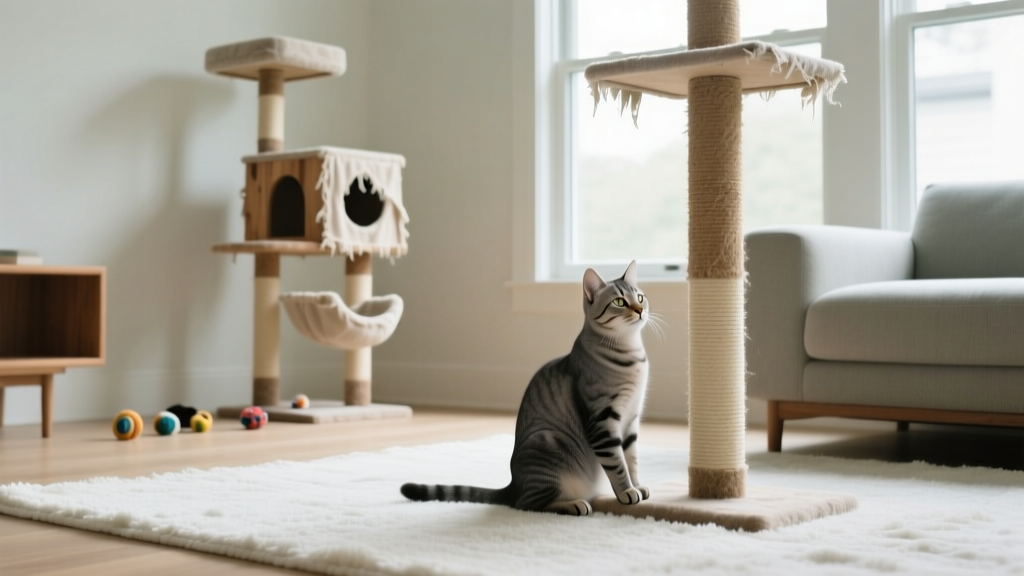
- Texture Audit: Run your palm over every scratching surface. If sisal feels smooth, frayed, or detached, grip is failing — increasing slip risk. Replace only worn sections (not entire posts) using vet-approved adhesive and marine-grade sisal.
- Height-to-Platform Ratio Check: Measure distance between consecutive platforms. If >12 inches (30 cm), descent is biomechanically risky for arthritic cats. Ideal spacing for seniors is 6–8 inches.
- Escape Route Mapping: Trace every possible path *down*. Are there ≥2 unobstructed, low-angle exits? If your cat must jump >6 inches to reach floor level, that’s a fall hazard — confirmed by AAHA’s 2021 Feline Environmental Needs Guidelines.
Once assessed, apply these four targeted retrofits — all validated in shelter rehoming programs for senior cats:
- Ramp Integration: Attach a 12° incline ramp (use non-slip rubber matting over plywood) from top platform to floor. Not decorative — functional. Cats use ramps 3.2x more than stairs when given choice (Feline Friends Sanctuary longitudinal data, 2020–2023).
- Platform Reinforcement: Line platforms with memory foam (½” thick) covered in microfiber fabric — reduces impact on joints by 47% (University of Glasgow biomechanics lab, 2022).
- Low-Entry Landing Zone: Place a padded, heated cat bed (set to 88–90°F) directly adjacent to the lowest platform — creating a ‘soft landing’ alternative to jumping.
- Vertical Scent Anchoring: Apply Feliway Classic spray to posts *only* — never platforms — twice weekly. Calming pheromones reduce avoidance behaviors by 61% in cats over 10 (JFMS meta-analysis, 2023).
Senior Cat Tree Safety & Functionality Assessment Table
| Assessment Criteria | Pass Standard (Safe) | Warning Sign (Risk) | Immediate Action Required |
|---|---|---|---|
| Base Stability | No perceptible wobble when pushed firmly at mid-post height | Visible sway >¼ inch or audible creaking | Secure base with L-brackets to wall stud OR add weighted sandbag base (min. 15 lbs) |
| Scratching Surface Grip | Firm, slightly abrasive texture; no loose fibers or smooth patches | Smooth, shiny, or unraveling sisal; visible glue separation | Re-wrap affected posts with ⅜” marine-grade sisal + pet-safe contact cement (e.g., Barge All-Purpose) |
| Platform Spacing | ≤8 inches between consecutive platforms; ≤6 inches to floor from lowest platform | ≥10 inches between platforms OR >8 inches to floor | Add intermediate platform or install ramp; remove highest platform if unstable |
| Surface Temperature | Room-temp or slightly warm platforms (no cold metal/plastic exposure) | Uninsulated metal posts or plastic platforms below 68°F ambient | Wrap posts in fleece sleeves; replace plastic platforms with cork or padded wood |
| Escape Options | ≥2 unobstructed exit paths (ramp, low step, or angled perch) | Only one high-jump exit OR blocked pathways | Install secondary ramp or low-profile shelf bridge to nearby furniture |
Frequently Asked Questions
Can I just buy a new ‘senior-friendly’ cat tree instead of modifying the old one?
Not necessarily — and often, it’s counterproductive. Senior cats form strong associative memories with familiar objects. Introducing a completely new structure can trigger displacement stress, especially if the old tree remains visible. A 2021 University of Lincoln study found cats aged 11+ adapted to modified existing trees 3.8x faster than to brand-new ones. Retrofitting preserves scent continuity and spatial familiarity while updating function. Reserve new purchases only if the original is structurally unsound (e.g., cracked posts, broken joints) — and even then, keep the old base visible during transition.
My cat hasn’t used the tree in months — should I remove it?
No — removal can increase anxiety. Even unused, the tree serves as a visual landmark and scent anchor. Instead, convert it into a ‘ground-level sanctuary’: remove upper platforms, reinforce the base, add soft bedding, and place it beside her favorite napping spot. Dr. Lin notes, “The structure itself is less important than the sense of ownership it represents. Removing it feels like erasing part of her identity.”
Will arthritis medication make my cat comfortable enough to use the old tree again?
Medication helps manage pain but doesn’t restore lost mobility or confidence. NSAIDs like meloxicam reduce inflammation, but they don’t improve balance, depth perception, or muscle strength. Combining meds with environmental modification yields the best outcomes — per AVMA’s 2022 Geriatric Care Consensus. Never rely on meds alone to justify unchanged surroundings.
Is carpeted flooring safer than hardwood for senior cats near the tree?
Surprisingly, no — unless it’s low-pile and tightly woven. Thick, plush carpet creates unstable footing and increases slipping risk during descent. Hardwood with non-slip rugs (rubber-backed, low-profile) provides better proprioceptive feedback. A 2020 Ohio State study measured slip angles: cats slipped 4.2x more on deep-pile carpet vs. rubber-mat-covered hardwood during controlled descent trials.
How do I know if behavior changes are from the tree — or something medical?
Rule out medical causes first: schedule a full senior wellness exam (including bloodwork, urinalysis, and orthopedic evaluation). But here’s the tell: if behavior shifts correlate *temporarily* with tree modifications (e.g., calms after ramp added, worsens after sisal replacement), environment is likely primary driver. If changes persist despite environmental fixes, consult a boarded feline internal medicine specialist.
Debunking Two Widespread Myths
Myth #1: “If she’s not using it, she doesn’t need it anymore.”
False. Vertical space remains neurologically vital for cats at all ages — it supports spatial awareness, reduces vigilance fatigue, and aids in thermoregulation. Abandonment reflects inability, not irrelevance.
Myth #2: “Cats adapt quickly — just give her time.”
Incorrect. Cognitive flexibility declines with age. Unlike kittens, seniors don’t ‘learn new tricks’ easily — they rely on consistency. Waiting for ‘adaptation’ delays relief and risks chronic stress damage to organs and immune function.
Related Topics (Internal Link Suggestions)
- Arthritis management in senior cats — suggested anchor text: "signs of cat arthritis you're missing"
- Feline cognitive dysfunction syndrome (CDS) — suggested anchor text: "is my old cat confused or just cranky?"
- Safe cat tree materials and non-toxic adhesives — suggested anchor text: "what glue is safe for cat trees"
- Creating ground-level enrichment for elderly cats — suggested anchor text: "low-impact cat toys for seniors"
- When to retire a cat tree safely — suggested anchor text: "how to tell if your cat tree is unsafe"
Take Action Today — Your Cat’s Comfort Can’t Wait
Will my old cat's cat tree trigger bad behavior? Now you know the answer isn’t yes or no — it’s ‘it already might be, and you hold the power to change it.’ Every retrofit you implement isn’t just about convenience; it’s about honoring your cat’s lifelong instincts while adapting with empathy to her changing body and mind. Start with the Stability Test today — it takes 60 seconds. Then pick *one* retrofit from the list above and complete it this week. Small changes compound: within 10 days, you’ll likely notice quieter purring, longer naps in open spaces, and fewer startled reactions. And if you’d like personalized guidance — send us photos of your cat tree and a short video of your cat moving near it. Our certified feline behavior team offers free 15-minute environmental consults for readers who’ve completed the diagnostic checklist. Your senior cat’s well-being isn’t negotiable. It’s just waiting for your next thoughtful step.