Why Cats Sit on Your Desk During Meetings
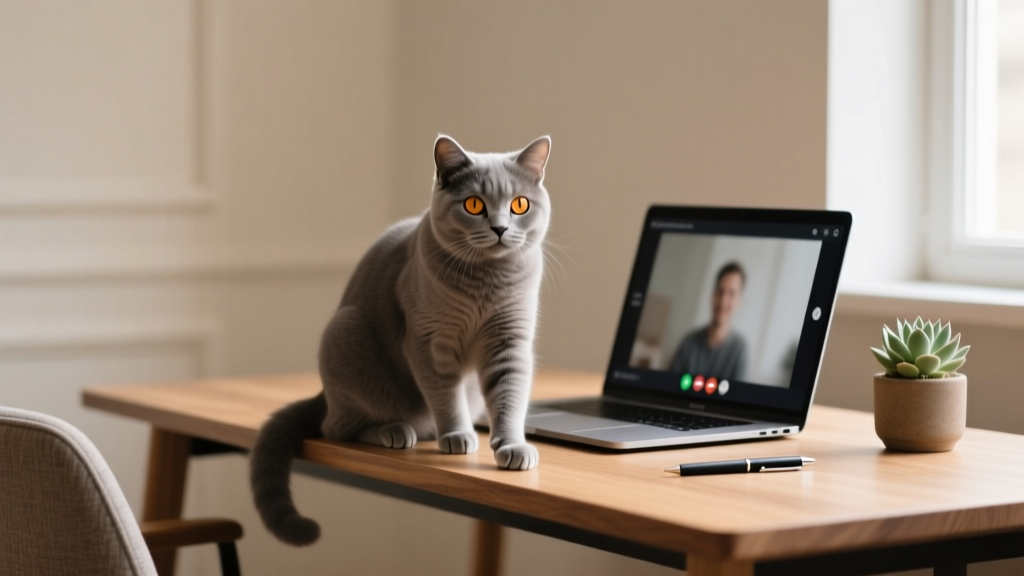
You’re in the middle of a meeting, trying to look focused and professional. Your camera is on. Your boss is talking. You’re nodding at exactly the right moments. And then—soft, silent footsteps. A tail rises like a question mark. Your cat hops onto the desk and parks directly between you and your keyboard, as if to say, “Yes, hello. I’ll be leading this call.”
If you’ve ever negotiated a spreadsheet around a loafed-up cat—or watched your cat slowly lower their body onto your notes with the confidence of a creature who pays rent in vibes—you’re not alone. Desk-sitting is one of the most common “work from home” cat behaviors, and it’s surprisingly rich in meaning. It’s not just clinginess or mischief (although sometimes it’s a little bit of both). It’s also cat psychology, habit, and a dash of evolutionary common sense.
1) The Scientific (and Evolutionary) Reasons Cats Do This
Cats are small predators who evolved to be both hunters and, at times, hunted. That combination shaped a mind that’s always scanning for vantage points, warmth, safety, and social information.
- Height and access: Even a desk counts as “high ground” in a home environment. Elevated surfaces provide better sightlines and a sense of control. Your cat can monitor you, the room, and the door—all at once.
- Warmth: Laptops, monitors, and even the sun patch that hits your desk in the afternoon are cozy magnets. Cats are heat-seekers by design; conserving energy is part of their survival strategy.
- Scent mixing and territory: Cats navigate their world through scent. Your desk smells like your hands, your devices, your daily routines—aka “you.” When your cat sits there, they’re adding their scent to the communal family zone. It’s social bonding in cat language.
- Predictable routines: Cats love patterns. If your meetings happen at the same time every day, your cat learns, “When human sits here and talks to the glowing rectangle, attention becomes… available.” Even if you’re not paying attention, you’re anchored in one place—very convenient.
- Social learning: Cats notice what you focus on. You’re staring at the desk, typing, touching things. Your cat concludes: “Clearly, this surface is important. I will also participate.”
2) A Detailed Breakdown: Different Desk-Sitting Contexts (and What They Usually Mean)
Not all desk-sits are created equal. The context—timing, body language, and what exactly they do once they’re there—tells you a lot.
The “Keyboard Pancake”
Your cat climbs up and settles directly on the keyboard, preferably while you’re mid-sentence in a chat. This is often attention-seeking, but not always in a needy way. It can be a simple strategy: “If I sit where your hands go, you will inevitably touch me.” Cats are excellent behavioral economists.
Common in: social cats, cats with high play needs, cats who have learned this gets a reaction (even a laugh counts as reinforcement).
The “Notebook Sitter”
They choose your paper, planner, or open book instead of the keyboard. This can be about scent and comfort: paper holds subtle scents, has a satisfying texture, and is usually placed in the “prime” zone right in front of you.
Common in: cats who prefer gentle contact and proximity rather than direct demand.
The “Laptop Heater Hug”
Your cat isn’t trying to interrupt; they’re trying to absorb. They drape over the warmest part of the setup like a fluffy heat sink.
Common in: cats who run chilly, older cats, short-haired cats, or any cat who has discovered that technology makes excellent sun substitutes.
The “Monitor Blockade”
They sit upright between you and the screen, sometimes staring directly into the camera like they’re the team lead. This is often about proximity and social contact. Your face is near the screen; your cat wants to be near your face. Cats use proximity the way humans use small talk.
Common in: affectionate cats, cats who head-bunt and cheek-rub often, cats who like to be “in the mix.”
The “Desk Edge Perch”
They pick the corner or edge, tail dangling, watching quietly. This is typically a monitoring behavior—calm curiosity, a desire to be near you without being handled.
Common in: slightly cautious cats, cats who enjoy togetherness without direct contact, multi-cat homes where your cat is tracking household movement.
The “Sudden Meeting Ambush”
Your cat ignores you all morning, then the moment your voice changes (meeting voice!) they appear. Many cats are drawn to shifts in your tone and energy. Talking to people through a device can sound unusual; your cat might come investigate, or they may interpret it as you “socializing” and want to join.
3) What This Behavior Says About Your Cat’s Mood and Feelings
Desk-sitting is often a compliment. But like most cat behavior, it can mean several things depending on the details.
- Affiliation (friendly bonding): Loose posture, slow blinks, a relaxed tail, kneading, gentle purring. Your cat is choosing closeness and sharing space.
- Comfort-seeking: Curling up tightly, tucking paws, choosing warm spots, dozing. They feel safe with you nearby.
- Attention request: Paw taps, nudging your hand, meowing, pushing objects, escalating interruptions. Your cat wants interaction—play, petting, or food.
- FOMO and social curiosity: Alert ears, watching your face, looking at the screen, tracking your voice. They’re trying to understand the “invisible people.”
- Mild stress or insecurity: If paired with restless pacing, excessive vocalizing, or clinginess that’s new, desk-sitting can be a self-soothing strategy. Your presence becomes an anchor.
A helpful rule: Relaxed body = relaxed meaning. Tense body + clingy intensity = investigate what’s changed.
4) Related Behaviors You Might Also Notice
If your cat is a dedicated desk companion, you may also see:
- Rubbing cheeks on your laptop or monitor: Scent-marking with facial glands. It’s their way of labeling your workspace as part of the shared territory.
- Kneading on your mouse pad or sweater: A comfort behavior linked to kittenhood; often shows contentment.
- Sitting on whatever you’re holding: Book, tablet, newspaper—if it has your attention, it becomes the hottest property in the house.
- “Helping” with calls: Meowing when you speak, chirping at certain voices, or head-butting the microphone at the exact wrong moment.
- Desk object testing: Pushing pens, tapping sticky notes, swatting cables—part play, part curiosity, part “does this get you to look at me?”
5) When Desk-Sitting Is Normal (and When It Might Be a Concern)
Most of the time, your cat on your desk is perfectly normal—just a cat being a cat in a human-designed environment.
Usually normal if:
- Your cat’s posture is relaxed and they can settle.
- They still eat, play, and use the litter box normally.
- The behavior is consistent with their personality (they’ve always been a “near you” cat).
Worth a closer look if:
- It’s sudden and intense: A previously independent cat becomes glued to you and panics when you move.
- There are stress signs: Hiding, overgrooming, inappropriate urination, aggression, loss of appetite.
- Your cat seems uncomfortable physically: Reluctance to jump down, stiffness, unusual irritability when touched. (Older cats may seek warmth and proximity more when sore.)
- The desk-sitting is paired with nighttime yowling or clinginess: This can sometimes indicate anxiety, cognitive changes, or medical discomfort.
If you’re seeing big behavior shifts, a vet check is a smart first step, then consider environmental stressors (new schedule, new pet, construction noise, travel, changes in household tension).
6) Tips for Responding (Without Encouraging Chaos)
You don’t have to choose between “cat banishment” and “accepting a cat-shaped paperweight on your keyboard forever.” The goal is to meet your cat’s needs while protecting your workflow.
Create an approved “desk buddy” spot
Place a small cat bed, folded blanket, or non-slip mat on one corner of the desk or on a nearby shelf. Cats love defined zones. If the spot is cozy and consistent, many cats will choose it.
Make the approved spot better than the keyboard
- Add warmth (a microwavable pet-safe heat disc under a blanket, or place the bed near a warm—safe—area).
- Sprinkle a little catnip or use a calming pheromone spray on the bed (if your cat responds well).
- Offer occasional treats when your cat settles in the designated spot.
Give an attention budget before meetings
Many desk invasions are “attention withdrawals.” Try a 5–10 minute play session before your call: wand toy, chase, pounce, then a small snack. That hunt-eat-groom-sleep sequence is feline relaxation magic.
Use gentle redirection, not dramatic reactions
If your cat learns that sitting on the keyboard makes you laugh, talk, and wave your hands, congratulations: you’ve trained a keyboard cat. Calmly lift them to their spot, reward when they stay, and keep your response low-key.
Offer vertical alternatives nearby
A cat tree or wall shelf near your desk can satisfy the “be close and see everything” need without turning your workspace into a runway.
If you want to encourage desk time (the polite version)
Some people love the company. If that’s you, teach a cue like “mat” or “place.” Put the bed down, lure your cat onto it with a treat, reward, repeat. Over time, your cat learns where to park their fluff during Zoom.
7) Fun Facts and Research-Style Findings (Cat Edition)
- Cats are crepuscular-ish: Many cats are most active around dawn and dusk, but they also adapt to your schedule. If your workday has predictable “busy times,” your cat may time their social bids to match.
- Social bonding doesn’t always look like cuddling: In cat relationships, simply choosing to rest near someone is a big deal. Your desk is a prime “close but not too close” location.
- Your voice changes during meetings: Cats are sensitive to tone and rhythm. The meeting voice—brighter, more repetitive, more animated—can be inherently attention-grabbing.
- Warmth is a biological priority: Cats prefer warmer resting spots than humans typically do. Your electronics and sunlit desk areas are basically premium real estate.
8) FAQ: Common Questions About Cats on Desks
Why does my cat only sit on my desk when I’m busy?
Because “busy” often means “still.” When you’re cooking or walking around, you’re harder to pin down. When you’re seated, your cat can reliably get proximity, warmth, and sometimes attention. Also, your focus is intense—cats notice that and want in on the action.
Is my cat jealous of my laptop or work?
Not jealous in the human sense, but your cat is competing with whatever has your attention. To a cat, attention is a resource. If the laptop consistently “wins,” your cat may increase behaviors that successfully reclaim your focus.
Should I let my cat sit on my desk during calls?
If you enjoy it and it’s safe (no hot drinks, no chewing wires, no risk of knocking equipment), it can be a lovely bonding ritual. If it disrupts work, set up an approved nearby perch and reward your cat for using it.
How do I stop the keyboard-sitting specifically?
Give your cat a designated spot on the desk or next to it, reward that spot heavily, and keep keyboard access boring. Consider a keyboard cover, closing the laptop when you step away, and a pre-meeting play session to reduce attention urgency.
My cat meows loudly during meetings—what does that mean?
Often it’s attention-seeking or confusion about why you’re talking to invisible people. It can also be frustration (“You’re talking, but not to me”). Try a short play session before calls, provide a chew-safe toy or food puzzle nearby, and reward quiet settling.
Why does my cat paw at the screen or camera?
The moving faces, voices, and your focused gaze create a mini mystery. Some cats treat screens like windows; others are reacting to your attention and want to insert themselves into the social moment—literally between you and the “other cats/people.”
Closing Thoughts
When your cat hops onto your desk mid-meeting, they’re not trying to sabotage your career (even if the timing is impressively dramatic). They’re seeking warmth, closeness, and a front-row seat to the most important thing in the room: you. With a little environmental setup and a bit of pre-meeting enrichment, you can turn desk-sitting into a behavior that feels flattering instead of frustrating—and maybe even makes your workday better.
Does your cat become an instant coworker the moment you open your laptop? Share your funniest (or most chaotic) desk-meeting stories with the Cat Lovers Base community at catloversbase.com—we’d love to hear how your cat “helps” you get things done.