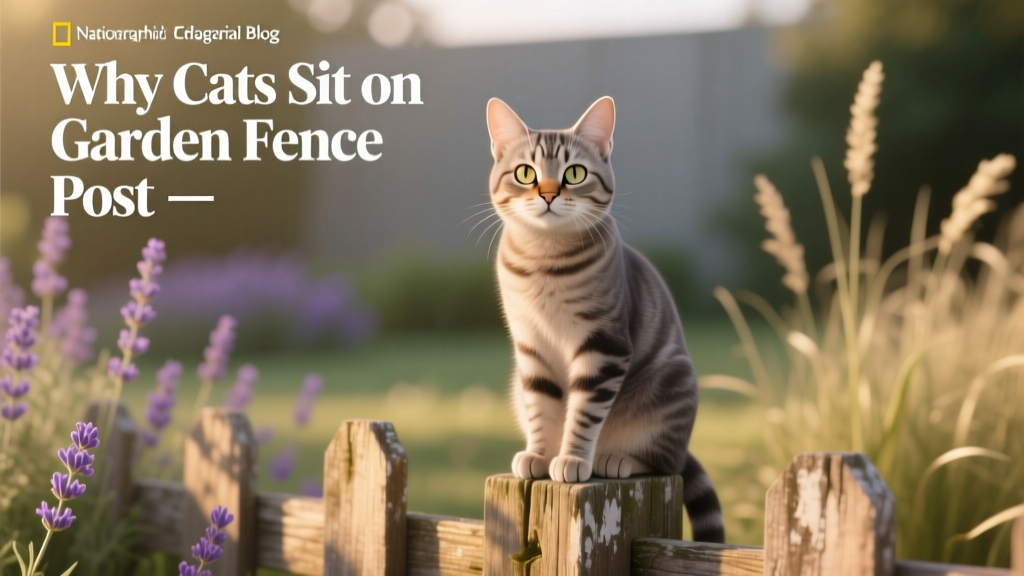
Why Cats Sit on the Garden Fence Post
You’re rinsing a watering can, half-watching the birds hop through the flowerbeds, when you notice your cat has climbed up onto the garden fence post like they own the neighborhood. Tail curled neatly around their paws, ears swiveling like tiny radar dishes, they look down at you with that calm, mildly smug expression that says, “Yes, human, I am supervising.”
If you’ve ever wondered why cats choose that spot—perched like a miniature panther on a wooden pillar—there’s a lot going on behind the cute silhouette. Fence-post sitting is one of those everyday behaviors that’s equal parts instinct, strategy, and feline opinion.
1) The scientific (and slightly wild) reason cats love high perches
Cats are both predators and, depending on the neighborhood, potential prey. That double identity shaped their brains over thousands of years. A fence post is basically a perfect feline “observation deck.” From up high, a cat can:
- Spot prey (insects, mice, lizards, birds) more easily.
- Notice threats early (dogs, unfamiliar cats, loud humans, the dreaded wheelie bin).
- Control access to territory—watching who comes and goes.
- Feel safer because fewer things can sneak up behind them.
In the wild, small cats and wildcat ancestors used elevated points—rocks, fallen logs, low branches—to scan for movement. Your backyard fence post is the modern equivalent. It’s not “weird”; it’s ancient feline logic operating in a suburban setting.
There’s also a body-language component: height can signal confidence. Cats communicate a lot through spatial positioning. Being higher isn’t just practical—it can be social information to other animals, too.
2) A detailed breakdown: what “fence-post sitting” can mean in different contexts
Not every fence-post sit is the same. The meaning shifts depending on what happens before, during, and after the perch.
They’re monitoring their territory
If your cat sits on the post at the same times each day—often at dawn or dusk—they may be doing a routine “patrol.” Cats are creatures of habit, and many do regular perimeter checks. You might notice them staring at a particular corner of the yard, sniffing the air, then settling in as if clocking in for a shift.
What you might see: slow head turns, ears flicking toward distant sounds, tail still or gently swishing, occasional chirps at birds.
They’re watching neighborhood cat politics
Outdoor and indoor-outdoor cats often have a mental map of who lives where. The fence is a boundary line, and the post is a prime seat for “reading the room.” If another cat appears, your cat may freeze, stare, and hold their position like a tiny bouncer at a velvet rope.
What you might see: stiff body, direct stare, tail twitching at the tip, possibly a low growl or silent, unblinking “standoff.”
They’re enjoying the sensory buffet
Some cats sit up high because it’s stimulating in a pleasant way. Wind carries smells. Birds create sound layers. Leaves move like toy targets. A fence post can be the feline version of sitting on a porch with a cup of tea.
What you might see: soft eyes, relaxed paws, slow blinks in your direction, calm breathing, a loose posture.
They’re avoiding something on the ground
Sometimes the fence post is not about what’s up there—it’s about what’s down here. If the yard has a noisy sprinkler, a new dog next door, or a toddler with enthusiastic “petting,” a cat may choose elevation to feel out of reach and in control.
What you might see: quick climb, crouched posture, eyes wide, ears angled sideways (airplane ears), staying put until the “problem” passes.
They’re practicing athletic skills
Balancing on a narrow post uses core muscles, coordination, and paw precision. For some cats, it’s a confidence-building routine: jump up, balance, look impressive, jump down. Cats don’t need a gym membership; they invent one.
What you might see: purposeful hopping, careful paw placement, tail used like a counterbalance, repeated jumps like a mini obstacle course.
3) What it says about your cat’s mood and feelings
Your cat’s body language on the post is your best clue. Here are common “fence-post emotions,” translated into human-friendly terms:
- Relaxed and content: body loose, paws tucked or comfortably placed, tail resting, slow blinking, ears forward but not rigid.
- Curious and engaged: alert posture, ears swiveling, focused gaze that tracks movement, maybe a little chirp or chatter.
- Confident and in charge: upright posture, steady gaze, minimal fidgeting, tail held neutrally or gently draped.
- Worried or uncertain: crouched low, weight shifted as if ready to flee, eyes wide, ears sideways, quick scanning.
- Annoyed or overstimulated: tail flicking sharply, tense shoulders, pinned ears, quick head turns—especially if another animal is nearby.
Think of the fence post as a “mood amplifier.” Because your cat feels exposed up there, their body language often becomes extra clear—like watching a silent movie with the subtitles turned on.
4) Related behaviors you might also notice
If your cat loves fence posts, you may see other perch- and boundary-related habits:
- Loafing on the top of the sofa like a fuzzy gargoyle.
- Sitting on windowsills to monitor bird activity and passing cars.
- Perching on the back of garden chairs for a slightly lower “watchtower.”
- Walking the fence line with careful, high-wire-cat focus.
- Rubbing cheeks on fence boards to leave friendly facial pheromones (the cat version of “this is mine”).
- Pausing at thresholds (doorways, gates) to assess before entering a space.
These behaviors all share a theme: cats like to control their perspective and manage their environment. Elevation and edges help them do that.
5) When fence-post sitting is normal… and when it might be a concern
Most of the time, sitting on a fence post is perfectly normal, healthy cat behavior. It’s enrichment, exercise, and environmental awareness rolled into one.
It may be worth paying closer attention if:
- Your cat suddenly starts doing it obsessively and seems unable to relax indoors (possible stress, outdoor conflict, or a new threat they’re monitoring).
- They’re guarding the fence and reacting strongly to other cats—hissing, yowling, lunging, or returning inside keyed up (possible territorial anxiety).
- They’re unsteady, hesitant, or falling when jumping up or down (possible pain, arthritis, injury, vestibular issues, or vision changes).
- They’re spending much longer outside than usual and seem avoidant or restless (could be stress indoors, conflict with another pet, or environmental change).
- You notice limping, vocalizing, or sensitivity after perching (could indicate soreness or a sprain).
If your cat is older, stiff, or has a history of joint issues, a narrow fence post may be a risky balance beam. A vet check is wise if you see changes in jumping ability, posture, or confidence.
6) Tips for responding to (and safely encouraging) the behavior
You don’t need to stop your cat from being a tiny backyard lookout—just help them do it safely and with less stress.
Offer alternative “lookout spots”
If your cat loves height, give them safer options: a sturdy outdoor cat shelf (in a catio), a stable bench, or an indoor window perch. Many cats will happily choose the spot that offers the best view with the least wobble.
Reduce neighborhood-cat stress
If the fence post is a stage for territorial drama, focus on lowering tension:
- Use frosted window film or strategic barriers if visual triggers are intense.
- Consider motion-activated sprinklers (aimed away from your own cat’s routes) to discourage other cats entering your yard.
- Keep a predictable feeding schedule and provide indoor enrichment so your cat doesn’t feel they must “guard” outside.
Don’t punish the perch
If you shout or chase them down, you can accidentally teach your cat that being outdoors is dangerous—or that you’re part of the threat. Instead, call them calmly, offer a treat indoors, or redirect with a toy.
Think about safety and boundaries
Fence posts can be close to roads, dogs, or unfriendly animals. If your cat goes outside, consider:
- Supervised outdoor time (especially at peak activity times like dawn and dusk).
- A catio for safe fresh air and elevated views.
- Harness training if your cat enjoys exploring but needs limits.
Reward calm observation
If your cat comes inside relaxed after a perch session, reinforce that. Offer a quiet treat, gentle praise, or a cozy nap spot. You’re helping them learn that “I checked the yard; now I can settle.”
7) Fun facts and research-flavored tidbits
- Cats use their tails like tightrope tools. When balancing on narrow surfaces, the tail acts as a counterweight, helping stabilize tiny shifts in posture.
- Height changes how safe a cat feels. Many behaviorists consider vertical space a core environmental need—especially in multi-pet homes—because it reduces conflict and gives cats choice.
- Outdoor sitting is partly “information gathering.” Cats take in scent, sound, and motion. A fence post concentrates all three: breezes carry smells, sounds travel, and movement is easier to spot from above.
- The “post pose” is a communication billboard. A confident, upright cat on a boundary can signal to other cats, “This space is occupied,” without having to fight.
8) FAQ: Common questions about cats and fence posts
Is my cat trying to escape when they sit on the fence post?
Not necessarily. Many cats sit on fence posts as a lookout rather than an exit strategy. If your cat regularly crosses the fence and disappears for long periods, that’s more about roaming. If they simply perch, watch, and hop back down, it’s often surveillance and enrichment.
Why does my cat sit on the fence post and stare at one spot for a long time?
Cats are tuned to tiny movements and faint sounds. They may be tracking a rustle in the hedge, a hidden insect, or a distant cat they can hear but not see. Long stares are often “auditing the environment,” not boredom.
My cat chatters on the fence post—what does that mean?
That rapid little jaw chatter is commonly linked to excitement and frustration, especially when watching birds or squirrels. It’s like your cat’s hunting system revving while the prey remains out of reach.
Should I stop my cat from sitting on the fence post?
If it’s safe and your cat is relaxed, it’s a healthy, natural behavior. You might want to discourage it if the fence borders a busy road, if other animals are a threat, or if your cat is getting into fights. In those cases, offering a safer alternative perch (like a catio or indoor window seat) helps a lot.
Why does my cat choose the same fence post every time?
Cats love predictable “anchor points.” That post may have the best view, the most stable footing, a familiar scent, or a strategic line of sight to a rival cat’s route. It’s the VIP seat in your cat’s backyard theater.
My older cat used to sit on the fence but doesn’t anymore—should I worry?
A change in jumping or climbing can be a sign of arthritis or pain, especially in senior cats. If you also notice stiffness, reluctance to jump onto furniture, or changes in grooming, a vet visit is a good idea. You can still support the instinct by adding lower, wider perches.
Ending thought: your cat’s tiny watchtower has a big story
When your cat sits on the garden fence post, they’re not just being quirky. They’re being a cat—managing safety, surveying territory, tracking movement, and enjoying a moment of control in a busy world. If you learn to read the posture, tail, and timing, that little perch becomes a window into your cat’s feelings.
Does your cat have a favorite fence post, wall, or “royal lookout” spot? Share your stories (and the funniest things your cat supervises) with the Cat Lovers Base community at catloversbase.com.