Why Cats Sit on the Coat Rack Base
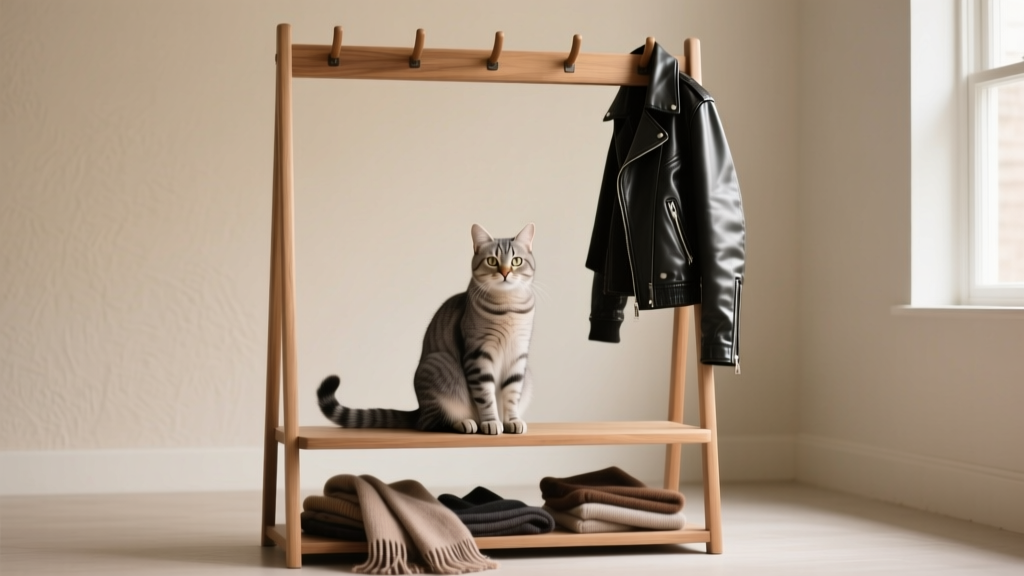
You walk in the door with your arms full—keys, mail, maybe a grocery bag—and there it is: your cat, perched like a tiny, confident statue… on the base of the coat rack. Not the cozy cat bed you bought. Not the sunny windowsill. Not even the couch. The coat rack base. A spot that seems, to human logic, oddly flat, slightly dusty, and about as exciting as a lamp stand.
If you’ve ever paused mid-shoe removal and wondered, “Why that spot?” you’re in good company. Cats have a talent for turning everyday household objects into “important places.” The coat rack base is a surprisingly perfect example of how cat brains work—part jungle survivor, part interior designer, part comedian.
The scientific (and evolutionary) reason this spot is irresistible
To understand the coat rack base, it helps to remember what domestic cats are at heart: small predators who survived by controlling space. Cats evolved to pay close attention to vantage points, traffic patterns, scents, and safety zones. Even though your cat now lives in a climate-controlled home with a full food bowl, the instincts are still there—just applied to modern furniture instead of shrubs and rocks.
The base of a coat rack often checks several instinctive boxes:
- It’s a “hub” location. Coat racks usually live near entryways or busy transitions between rooms. Cats love to monitor movement because movement predicts interesting things (people arrive, bags open, food appears, doors lead to mysterious outdoors).
- It’s a defined boundary. Many coat racks have a circular or cross-shaped base that creates a clear “platform.” Cats feel secure on spots that are physically outlined—think boxes, baskets, laundry piles, or anything that frames their body.
- It carries social scent. Coats and bags bring in a whole world of smells—outside air, other people, other animals, restaurants, grocery stores. For a scent-driven species, that’s basically the news of the day.
- It’s strategically sheltered. Depending on the rack, coats may drape down and create a curtain-like effect. Cats adore semi-hidden spaces where they can watch without being fully exposed.
So while it looks random, it’s often a smart choice from a cat’s perspective: “I can see what’s happening, smell what’s new, and sit in a spot that feels like mine.”
A detailed breakdown: different “coat rack base” scenarios
Not every cat sits on the coat rack base for the same reason. Context matters, and once you start noticing the pattern, you’ll learn a lot about how your cat experiences your home.
1) The “welcome committee” perch
Your cat positions themselves there right before you get home (or as soon as they hear keys). This is classic anticipation + routine. Cats are excellent at predicting sequences: car sound, footsteps, door, human appears.
What it looks like: upright posture, relaxed tail, slow blinks, maybe a meow that says, “You’re late.”
Why that base: it’s the closest “approved” spot to the action that still feels safe and controlled.
2) The “guarding the doorway” strategy
Some cats sit there as if they’re on security duty. This can happen in multi-pet homes or in homes with lots of comings and goings.
What it looks like: alert ears, scanning eyes, tail tucked around paws, quick head turns when someone passes.
Why that base: doorways are key resources—routes to other rooms, access points for strangers, the place where unfamiliar scents enter.
3) The “new smell investigation station”
When you hang a coat or bring in a bag, your cat’s nose lights up. Sitting at the base can be the “control tower” for scent processing.
What it looks like: sniffing the air, rubbing cheeks on the base, chin marking, rolling a shoulder against the pole, then settling down like they’ve claimed the area.
Why that base: scent gathers there—fabric drips scent molecules down like invisible breadcrumbs.
4) The “I want attention, but on my terms” move
The coat rack base is often just close enough to people to be noticed, but not so close that the cat feels crowded.
What it looks like: sitting quietly, watching you, slow blinking, possibly moving away if you approach too directly.
Why that base: it offers social proximity without forced interaction.
5) The “cool surface” or “comfy angle” preference
Sometimes the answer is beautifully simple: the base is cool, stable, and the right size for a loaf position.
What it looks like: full loaf, paws tucked, half-closed eyes, minimal interest in anything else.
Why that base: cats optimize comfort like tiny engineers. A firm surface can feel secure, especially for cats who don’t like sinking into plush beds.
What this behavior says about your cat’s mood and feelings
The coat rack base can function like a mood ring—if you pay attention to body language.
- Relaxed and content: loafed posture, slow blinks, ears neutral, tail still or gently wrapped. Your cat feels safe and is simply enjoying their “spot.”
- Curious and socially engaged: upright sit, forward ears, gentle meows, approaching when you speak. They’re interested in you and the activity around the entryway.
- Slightly wary or cautious: crouched body, ears swiveling, tail close to body, wide eyes when someone passes. They may be monitoring potential “threats” like visitors or another pet.
- Possessive/territorial: blocking the path, intense staring at other pets, repeated cheek rubbing, or swatting if another cat approaches. They may be claiming the entry zone as a resource.
- Stressed: tense posture, flattened ears, twitching tail tip, hiding under coats, quick startle responses. In this case, the base may be a security station because your cat doesn’t fully relax elsewhere.
A key takeaway: sitting there isn’t automatically “good” or “bad.” It’s your cat choosing a location that matches their internal state—comfort, curiosity, vigilance, or a mix of all three.
Related quirky behaviors you might also notice
If your cat is a coat rack base enthusiast, you’ll probably recognize these cousins of the same instinct:
- Sitting in doorways (especially bathrooms—because privacy is a myth in cat households).
- Sleeping on shoes, bags, or freshly worn clothing for maximum “you” scent.
- Rubbing cheeks on corners and furniture legs to deposit friendly territorial scent markers.
- Choosing the “wrong” bed (the cardboard box it came in, the laundry basket, the laptop keyboard).
- Perching near high-traffic zones like hallways, stair landings, and kitchen thresholds.
These are all variations of: “I want to be where information flows—movement, smells, social interaction—while still feeling safe.”
When sitting on the coat rack base is normal… and when it might be a concern
Usually normal:
- Your cat sits there briefly, especially around arrivals/departures.
- They’re relaxed, responsive, and show normal eating, drinking, and litter box habits.
- They also use other rest spots around the home.
Potential concern:
- Obsessive guarding: your cat blocks the entryway, attacks other pets, or seems unable to settle elsewhere.
- Hiding more than usual: if they spend hours under hanging coats or seem reluctant to enter other rooms.
- Sudden change: a cat who never cared about the coat rack suddenly camps there constantly—especially if paired with clinginess, vocalizing, or avoidance.
- Signs of stress or anxiety: overgrooming, reduced appetite, litter box accidents, pacing, or increased startle responses.
- Physical discomfort: if they choose hard surfaces and avoid jumping/climbing, or if they seem stiff when getting up. This can sometimes hint at pain (like arthritis), especially in older cats.
If you’re seeing stress signals or a dramatic behavior shift, it’s worth checking in with a veterinarian first to rule out medical issues, then considering environmental stressors (new pet, new baby, construction noise, neighborhood cats outside the door).
How to respond (and how to encourage it in a healthy way)
If your cat loves that coat rack base, you don’t have to “fix” it. You can work with it—make the spot safer, more appropriate, and more informative for your cat in a way that fits your home.
Make it safe
- Stabilize the rack. If it wobbles, cats can get startled, and a scare at the entryway can create long-term anxiety. Consider a heavier base or wall anchoring.
- Remove dangling hazards. Strings, long scarf fringes, or bag straps can tempt play that becomes risky when you’re not watching.
- Keep breakables away. If the base is near a console table, reduce clutter so curiosity doesn’t turn into chaos.
Offer a “legal” alternative nearby
- Add a small mat or low cat bed beside the base (not across the room). Many cats will choose the comfier option if it’s in the same strategic location.
- Try a scratcher near the entryway. Marking with claws is another way to say, “This area is part of my safe territory.”
- Create vertical options. A nearby cat tree or wall shelf gives your cat a higher vantage point, which often reduces doorway guarding and startle responses.
Support their scent needs
- Let them sniff new items first. If your cat is social and curious, give them a moment to investigate bags and coats before you tuck everything away.
- Use scent soothers if needed. In stressy households, a feline pheromone diffuser near the entry can help some cats feel more secure (results vary, but many owners find it useful).
Reinforce calm behavior
If your cat sits there politely, reward that calm: a soft greeting, a slow blink, a gentle treat tossed away from the doorway (to prevent them from learning to block traffic for snacks). You’re teaching: “Entryway calmness earns good things.”
Fun facts and research-friendly nuggets
- Cats map your home like a 3D territory. We think in rooms; cats often think in routes, perches, and “control points.” Entryways are major control points.
- Scent is a social language. Cheek rubbing deposits pheromones from facial glands, which function like a friendly “This is safe/familiar” label—especially important in high-traffic zones.
- Defined edges increase comfort. Studies on animal resting behavior across species show many animals prefer resting sites with boundaries or cover. Your cat’s love of boxes has a very real behavioral logic, and a circular coat rack base can mimic that “contained” feeling.
- Routine is emotional regulation for cats. Predictable arrival/departure patterns help cats feel secure. A coat rack base can become part of that routine—like your cat’s personal “front desk.”
FAQ: Common questions about cats and coat rack bases
1) Is my cat trying to stop me from leaving?
Sometimes. More often, they’re responding to the pattern of you leaving: shoes, coat, keys, door. Sitting there can be curiosity, mild protest, or simply wanting a final interaction. If your cat becomes frantic (yowling, scratching the door, pacing), they may have separation-related stress and could benefit from enrichment and a behavior plan.
2) Why does my cat sit there but ignore their cat bed?
Cat beds are usually placed where humans think a cat should rest—quiet corners—while cats choose spots where they can gather information and feel in control. Try moving the bed closer to the entryway or adding a bed with higher sides for that “contained” feeling.
3) My cat sits on the base and swats when people walk by. What’s going on?
This can be play ambush behavior or low-level resource guarding. Watch body language: playful cats often have a loose body and may chase; stressed/guarding cats look tense and may block access. Offer an alternative perch, increase play sessions, and avoid stepping over or crowding them.
4) Is it safe for cats to sit there?
Usually, yes—if the coat rack is stable and there aren’t straps or sharp bits. The bigger risk is the rack tipping if your cat climbs it or if a heavy coat shifts suddenly. Stability is the safety upgrade that matters most.
5) Why does my cat rub their face on the coat rack pole?
That’s friendly scent marking. Your cat is labeling the entryway as familiar and safe—and mixing their scent with yours (since coats carry your smell). It’s one of the most affectionate “home-making” behaviors cats do.
6) My cat suddenly started doing this. Should I worry?
Sudden changes deserve curiosity. It could be harmless (new coat smell, new routine), or it could reflect stress (new neighbor cat outside) or discomfort (avoiding jumping). If the change is paired with appetite, litter, grooming, or mobility changes, schedule a vet visit.
The coat rack base might not look like much to us, but to a cat it can be a scent-rich observation deck, a boundary-defined resting spot, and a front-row seat to the most important daily event: you coming and going. Once you see it through feline eyes, it starts to feel less like a weird quirk and more like a tiny, practical choice—made by a creature who’s been optimizing territory for thousands of years.
If your cat has a favorite “why would you sit there?” spot, share the story with fellow cat people on catloversbase.com. The stranger the location, the better—we all learn from each other’s delightful little mysteries.