Cat Paw Resting on Your Arm: Ownership Behavior
You’re on the couch, one hand on your phone, the other absentmindedly scratching your cat behind the ears. Everything is peaceful… until you realize your cat has placed a single paw on your forearm like they’re filing a tiny, fluffy claim. Not kneading. Not grabbing. Just a calm, deliberate “I’m here, and you’re staying.” If you’ve ever wondered whether that paw is affection, possession, or a subtle form of feline mind control, you’re not alone.
That gentle paw-rest is one of those classic cat-owner moments: small, quiet, and surprisingly loaded with meaning. It can be a sign of bonding, a request for stability, a social “bookmark,” or yes—sometimes a hint of ownership behavior. The good news is that most of the time it’s normal, sweet, and a sign your cat feels safe enough to reach out and connect.
Why Cats Do This: The Scientific and Evolutionary Roots
Cats are both predators and, in some contexts, prey. That combination shapes nearly everything they do—especially how they manage safety and social contact. While cats aren’t pack animals like dogs, they do form social bonds and maintain “friendly group” relationships (usually with related cats, and very often with their favorite humans).
Touch is a big part of that. Cats use physical contact to:
- Maintain social bonds (similar to allogrooming—mutual grooming among friendly cats)
- Exchange scent (cats have scent glands around the face and also leave scent via skin oils and contact)
- Regulate distance (cats are masters of “close, but not too close”)
- Monitor movement (a paw on you gives instant feedback if you shift or try to leave)
In the wild or in multi-cat environments, social cats often sleep near each other, touch tails, or rest paws against a companion. It’s a low-risk way of saying, “We’re together,” while still maintaining the option to spring away if needed. Your arm just happens to be the warm, convenient version of that companion.
What “Paw on Your Arm” Looks Like in Different Contexts
Not all paw-rests are created equal. The meaning depends on what comes before, what comes after, and what the rest of your cat’s body is “saying.” Here are common scenarios you’ll recognize.
1) The Couch Claim: “Don’t Move—This Is the Good Part”
You’re petting your cat and they gently place a paw on your arm, then half-close their eyes. Their body melts into the cushion. This is often relaxed affiliation: your cat is enjoying the interaction and wants it to continue. The paw is a soft “hold that thought” signal.
2) The Stop Sign Paw: “That Spot Is Questionable”
You’re scratching a little too close to the belly or the lower back, and suddenly there’s a paw on your wrist. Sometimes it’s gentle, sometimes firm. Your cat might be politely redirecting you: “No thank you, not there.” If you ignore it, it may escalate to a grab, a bunny-kick attempt, or a quick nip.
3) The Attention Anchor: “I Need Something”
Your cat places a paw on your arm and looks at you, then at the treat cabinet, then back at you. This is purposeful communication. Cats learn that touching humans works. It’s tactile pointing—feline style.
4) The Security Paw: “You’re My Safe Place”
This happens during thunderstorms, when guests are over, or when a new pet is in the home. Your cat settles near you and keeps a paw in contact. Physical touch can be grounding. In cat terms, your steady presence helps them feel less vulnerable.
5) The Resource Guard-ish Paw: “This Human Is Mine”
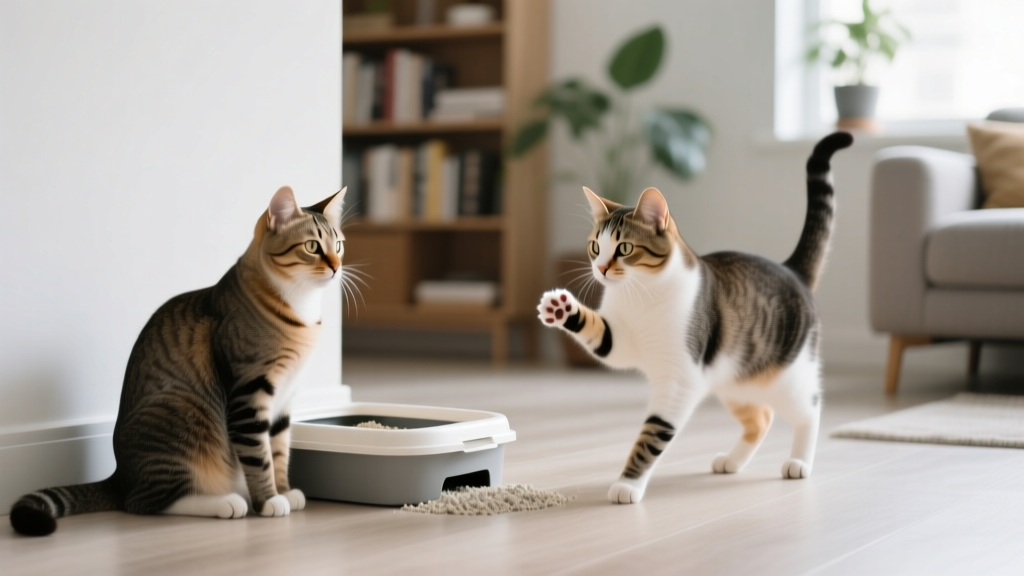
Your cat is on your lap, paw on your arm, and another pet approaches. Your cat’s body stiffens; ears rotate sideways; tail may flick. The paw can become a “reservation marker.” It’s not always aggression, but it can be a sign your cat is feeling possessive or socially tense.
What It Means About Your Cat’s Mood and Feelings
Think of the paw-rest as a sentence with multiple possible translations. Your cat’s full body language provides the punctuation.
- Content and bonded: Soft eyes, slow blinking, relaxed whiskers, loose body, gentle paw pressure.
- Seeking reassurance: Paw stays put, cat presses closer, may purr but look slightly vigilant (ears rotating, scanning the room).
- Requesting more interaction: Paw taps or kneads once or twice, cat head-butts, rolls slightly toward your hand.
- Setting a boundary: Paw becomes firm, cat’s skin ripples, tail flicks, ears angle back—petting tolerance may be reached.
- Possessive/guarding: Paw “holds” you while the cat watches others, body stiff, blocking posture, low growl or quick swat possible if challenged.
In many homes, the most common meaning is simply: “I like you, and I like this.” The “ownership” vibe comes from the fact that cats use contact to manage access—access to you, to space, and to predictable comfort.
Related Behaviors You Might Also Notice
If your cat does the paw-on-arm move, you’ll often see these companion behaviors too:
- Gentle paw taps on your face at 5 a.m. (a classic “feed me” strategy)
- Placing a paw on your hand while you type (your keyboard is competing for affection)
- Wrapping a tail around your wrist while sitting beside you—another friendly contact signal
- Head-butting (bunting) to deposit scent and reinforce social connection
- Following you and “checking in” from room to room, often with brief touches
- Blocking behaviors like sitting on your book, your laptop, or directly on your chest (cats are efficient communicators)
When Paw Resting Is Normal vs. When to Be Concerned
Most paw-resting is perfectly normal. It becomes worth a closer look when the behavior shifts suddenly or comes with signs of stress, pain, or escalating aggression.
Normal and healthy
- Gentle touch paired with relaxed posture
- Occurs during calm bonding times (couch cuddles, bedtime)
- Your cat can be redirected easily without irritation
Potential concern
- Sudden clinginess or constant contact in a cat who was previously independent (could indicate anxiety, environmental stress, or illness)
- Increased irritability—paw-holding becomes grabbing, swatting, or biting
- Signs of pain (hiding, reduced appetite, hunched posture, sensitivity to touch)
- Guarding you from other pets with growling, stalking, blocking, or attacks
If you’re seeing major behavior changes, persistent aggression, or any hint your cat is painful, a veterinary check is a smart first step. Cats are masters of subtle symptoms, and “behavior problem” is sometimes “medical problem” in disguise.
How to Respond (and How to Encourage the Sweet Version)
You don’t need to “correct” a gentle paw-rest. But you can respond in ways that support trust and reduce any possessive edge.
If it seems affectionate and relaxed
- Pause and savor it. Slow blink back if your cat’s eyes are soft.
- Offer steady, predictable petting. Many cats prefer consistent pressure rather than fast switching between spots.
- Respect the contact. If you need to move, gently lift their paw and give a brief stroke elsewhere to “close the interaction” kindly.
If it seems like a boundary signal
- Stop and reassess. Your cat may be saying “enough” or “not there.”
- Watch for tail flicks and skin ripples. These often show up before a nip.
- Switch to lower-intensity affection. Try cheek rubs or a short pause instead of continuing full petting.
If it seems possessive around other pets
- Avoid forcing proximity. Don’t make the other pet “prove” they can handle it.
- Increase resources. More resting spots, more vertical space, more litter boxes, more feeding stations—less competition.
- Reward calm sharing. Treats when pets are relaxed in the same room (at a comfortable distance) can reshape the emotional response.
- Consider a behavior consult if guarding escalates to attacks.
Fun Facts and Research-Adjacent Nuggets
- Cats use touch as “social glue.” Friendly cats often sleep in contact and groom one another. Your arm can become part of that trusted social circle.
- Contact helps cats control uncertainty. A paw resting on you gives instant information about movement—useful for a creature that likes predictable outcomes.
- Purring isn’t always “happy.” Some cats purr when soothed, stressed, or seeking comfort. Look at the whole body, not just the soundtrack.
- Many cats prefer consent-based affection. A paw on your arm can be your cat’s way of negotiating touch: “This is okay; keep it here; not too much.”
FAQ: Cat Paw Resting on Your Arm
Is my cat being possessive when they put a paw on me?
Sometimes, but not always. Most paw-resting is affectionate or comforting. It’s more likely to be possessive if your cat stiffens, watches others closely, or reacts negatively when another pet approaches.
Why does my cat put a paw on my arm and then bite?
Often that’s petting overstimulation or a boundary issue. The paw can be a “stop” cue. Watch for tail flicking, ear flattening, or a tense body. Try shorter petting sessions and focus on head/cheek areas many cats tolerate best.
Does this mean my cat trusts me?
In most cases, yes. Choosing to rest a paw on you is a small vulnerability—your cat is making contact and assuming you’ll respond predictably. It’s a strong sign of comfort and social bonding.
My cat only does this with me, not other family members. Why?
Cats form individual relationships. You may be the person who respects their boundaries best, offers the most consistent routines, or has the calm energy your cat prefers. It can also be about association—your lap might be the “treat lap” or the “quiet lap.”
Should I pet my cat when they do it, or leave them alone?
Follow their lead. If your cat is relaxed and leaning in, gentle petting is usually welcome. If they look alert, twitchy, or they place the paw with firm pressure, pause and see if they settle or move away.
What if my cat’s paw feels tense or they’re gripping my arm?
That can signal overstimulation, anxiety, or escalating possessiveness. Calmly stop petting, slowly disengage, and give your cat space. If gripping is frequent or paired with aggression, consider a vet check and a behavior plan.
That one quiet paw on your arm can be a whole conversation: affection, reassurance, a boundary, or a gentle “you’re my person” stamp. Pay attention to the body language around it, and you’ll get better and better at understanding what your cat is really asking for in the moment.
Seen a particularly funny or heart-melting version of the paw-rest—like the dramatic full-arm drape, the single-claw “bookmark,” or the paw that appears the second you stop petting? Share your cat’s story with fellow cat people over at catloversbase.com.