Why Cats Sit on the Bathroom Counter Mirror
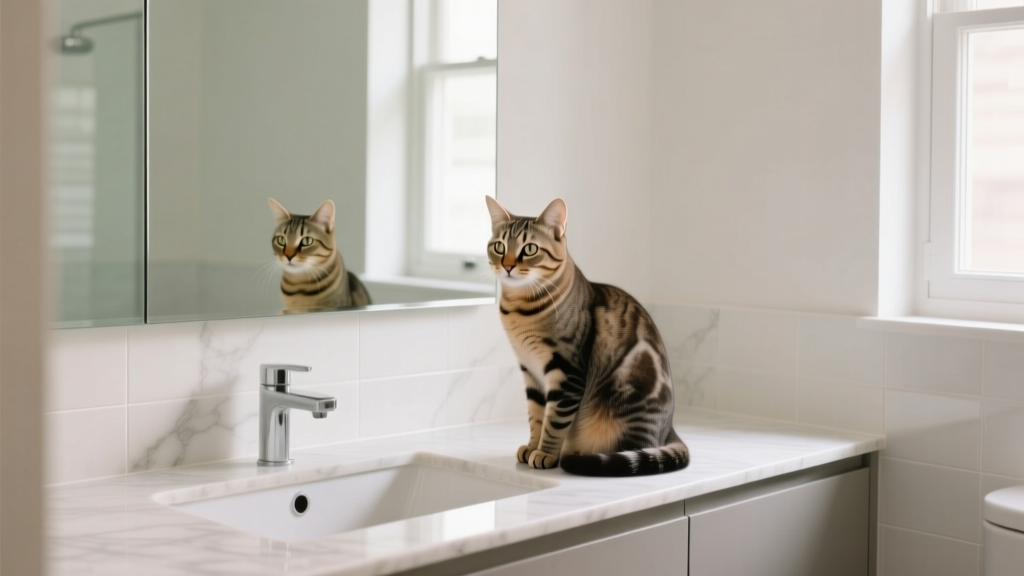
You’re brushing your teeth, half-awake, when you catch a familiar movement in the corner of your eye. Your cat—who has perfectly good couches, window perches, and a whole house to explore—hops up onto the bathroom counter. Then, with absolute confidence, they squeeze behind the faucet, pivot, and settle… right in front of (or practically on top of) the mirror. Sometimes they stare at their reflection like it owes them money. Sometimes they watch you like you’re the entertainment. Sometimes they purr and loaf as if the bathroom counter mirror is the finest throne in the kingdom.
If you’ve ever wondered, “Why this spot? Why now? And why the mirror?” you’re not alone. Cats do this for a surprisingly logical mix of instinct, comfort, curiosity, and social strategy—wrapped in the delightful weirdness that makes them cats.
1) The scientific (and evolutionary) reasons cats love mirror-side counter spots
Cats are small predators. Even the most pampered indoor cat carries an ancient set of priorities: find safe vantage points, control the environment, and conserve energy. The bathroom counter mirror area checks a lot of those boxes.
- Height equals safety. Elevated surfaces help cats feel secure. A counter is a mini lookout tower where they can monitor what’s happening without being in the middle of it.
- Edges and corners feel defensible. The mirror creates a “wall” at their back. Many cats prefer resting spots where at least one side is protected—fewer directions to watch means less stress.
- Warmth and scent concentration. Bathrooms trap warmth and humidity. Countertops often hold human scents (soap, toothpaste, skincare) and cat scent (from prior visits). A familiar scent landscape is emotionally soothing for cats.
- Routine and predictability. Cats thrive on patterns. If you appear at the mirror morning and night, that location becomes a reliable “event zone.” Cats love to be where the action reliably happens.
- Reflections create movement. From a cat’s perspective, reflections can look like another cat, a moving shape, or a controllable visual stimulus. Movement is attention-grabbing for predators—even when they’re not hunting.
In short: bathroom counters offer security, information, and often a guaranteed audience (you). The mirror adds visual novelty—sometimes fascinating, sometimes confusing, occasionally irresistible.
2) A detailed breakdown: what’s going on in different contexts
Not all “cat on the bathroom counter mirror” moments mean the same thing. Here are the most common versions I see—and what they usually suggest.
The “Supervisor Loaf” (you’re brushing your teeth)
Your cat hops up, settles into a loaf, and watches your routine with slow blinks or a mildly judgmental stare. This is classic companion behavior. You’re stationary, predictable, and available. Many cats enjoy simply being near their person, and bathroom routines are one of the few times humans stand still long enough to be observed.
The “Reflection Investigator” (nose to mirror, paw taps)
Some cats sniff the mirror edge, touch the surface, or tilt their head as if trying to decode physics. Kittens and young cats are especially likely to test reflections. Many eventually learn that “mirror-cat” is not accessible, but they still check occasionally—because it’s interesting and changes with lighting.
The “High Ground Claim” (you walk in and they beat you to it)
Your cat may run ahead to the bathroom, jump up, and plant themselves by the mirror before you even start. This is often about territory and routine. “My person comes here; therefore, this is my station.” It can also be about controlling access to a desirable interaction (petting, attention, water from the tap).
The “Water Negotiator” (staring at the faucet)
If your cat positions themselves between the mirror and faucet, they may be hoping for running water. Cats are naturally drawn to fresh moving water (it’s often safer in the wild than stagnant water). The mirror area is where they’ve learned the “water machine” is activated.
The “Comfort Camper” (post-shower humidity fan)
After a shower, the bathroom becomes warm and humid, and the counter may hold residual warmth from lights. Some cats love this microclimate. It’s basically a tiny spa with you included.
The “Attention Magnet” (you try to leave, they block the sink)
Cats quickly learn that being in your way works. If your cat consistently chooses the mirror-side spot when you’re busiest—makeup, shaving, skincare—they may have discovered a reliable method for getting interaction. Not “manipulation” in a villainous sense—more like smart social learning.
3) What this behavior says about your cat’s mood and feelings
Look at the whole cat: posture, tail, ears, and what they do when you approach. Here are common emotional states behind the mirror-counter hangout.
- Affectionate and socially engaged: relaxed loaf, soft eyes, slow blinks, gentle head bumps on your hand or the mirror edge.
- Curious and mentally stimulated: sniffing, pawing the mirror, head tilts, scanning the room, investigating items on the counter.
- Comfort-seeking: kneading a towel, settling near your scent, choosing the same spot repeatedly, purring when you talk to them.
- On alert (but not necessarily scared): upright posture, ears swiveling, tail still or tucked close, intense scanning. Bathrooms echo sounds; a cat may be monitoring unusual noises (pipes, fans, neighbors).
- Possessive or mildly conflicted: blocking your access, swatting at your hand (without claws) when you move items, tense shoulders. This can be a sign they’re over-invested in the spot or overstimulated.
For most cats, “mirror sitting” is neutral-to-positive. It’s a blend of bonding, observation, and environmental control.
4) Related behaviors you might also notice
If your cat loves the bathroom mirror zone, you might see a whole constellation of bathroom-themed quirks:
- Following you into the bathroom and meowing as if you invited them to a meeting.
- Rolling on bath mats (they’re textured, scent-holding, and often warm).
- Drinking from the faucet or pawing at water droplets in the sink.
- Inspecting the tub after you shower—new smells, moisture, and interesting residue patterns.
- Sitting on clean laundry or towels stored in the bathroom (soft, elevated, and smells like you).
- Staring into the mirror at night when reflections are darker and movement looks more mysterious.
5) When it’s normal… and when it might be a concern
Most of the time, this is perfectly normal cat behavior. Still, a few red flags are worth noting.
Usually normal if:
- Your cat is relaxed, playful, or calmly curious.
- They eat, drink, and use the litter box normally.
- They can be redirected without getting upset.
- It’s part of a stable routine (morning/evening bathroom visits).
Potentially concerning if:
- Sudden obsession with the mirror/counter appears out of nowhere, especially in an older cat.
- Compulsive behavior shows up: frantic mirror-fighting, repeated pacing, or inability to disengage.
- Aggression toward the reflection escalates (hissing, growling, attacking the mirror repeatedly).
- Signs of stress accompany it: hiding more, over-grooming, litter box changes, appetite changes.
- They’re seeking water urgently (constant faucet begging, drinking much more than usual), which can signal medical issues like kidney disease or diabetes—time to call your vet.
Also consider practical hazards: medications, essential oils, razors, hair ties, and small objects can be dangerous. Sometimes the real problem isn’t the cat’s motivation—it’s what’s within reach.
6) Tips for responding (and safely encouraging the behavior)
If you enjoy the company, you can absolutely make this a safe, sweet ritual. If you’d rather not share counter space with a furry bathroom supervisor, you can redirect without turning it into a daily argument.
If you want to allow it
- Create a designated “cat zone” on the counter. A small washable mat or towel gives your cat a clear target and helps keep them from stepping in toothpaste residue or water.
- Secure the environment. Put away floss, razors, pills, cotton swabs, hair ties, and anything stringy. Close the toilet lid. Cats explore with mouths and paws.
- Offer attention on your terms. A few head scratches or slow blinks can satisfy the social need without reinforcing counter-blocking.
- Provide an alternative water option. If faucet fascination is part of the routine, a cat fountain nearby can meet the same desire in a safer, more consistent way.
If you want to discourage it
- Add an appealing alternative nearby. A cat tree outside the bathroom door, a window perch, or a stool with a soft pad can replace the counter as the “best seat in the house.”
- Keep it boring, not dramatic. Quietly lift your cat down and reward them when they choose the alternative spot. Big reactions can make the counter more exciting.
- Use management tools. Close the bathroom door during busy times, or use baby gates if appropriate. Consistency matters more than intensity.
- Avoid punishment or scare tactics. They can increase anxiety and make the bathroom feel unsafe, which often creates new behavioral issues.
The relationship takeaway: your cat isn’t trying to “be naughty.” They’re choosing a place that meets needs—security, closeness, stimulation. If you address the need, the behavior becomes easier to guide.
7) Fun facts and research-flavored insights
- Many cats don’t recognize themselves in mirrors. Self-recognition is rare in animals; cats typically interpret reflections as another cat, a moving object, or just “visual noise” they learn to ignore.
- Cats are masters of associative learning. If “cat on counter” reliably leads to you talking, petting, turning on water, or even just making eye contact, the behavior gets reinforced—often without you realizing it.
- They prefer predictable observation posts. In multi-cat homes, cats often choose “stations” that give them information and a sense of control. The bathroom counter can become a prime station because you show up there consistently.
- Your scent is a big deal. Cats navigate social comfort through scent. Areas where you spend time—especially where your hands are near your face (and then touch surfaces)—can become high-value comfort zones.
FAQ: Cats and the bathroom counter mirror
1) Does my cat think the mirror is another cat?
Sometimes, especially if they’re young or haven’t encountered mirrors much. You’ll usually see investigating, cautious approaches, or playful pawing. Most cats learn quickly that the reflection doesn’t smell like a real cat and doesn’t respond normally.
2) Why does my cat stare at me through the mirror?
Cats gather information by watching. The mirror gives them a wider “view,” and some cats seem to enjoy tracking your movements indirectly. It can also be a bonding moment: you’re close, you’re still, and your cat is simply keeping you company.
3) My cat attacks the mirror. Should I stop it?
If it’s occasional playful swatting, it’s usually harmless. If your cat is repeatedly aggressive—hissing, growling, or unable to disengage—cover the mirror temporarily, redirect with a toy, and consider a chat with your vet or a behavior professional to rule out stress or compulsive patterns.
4) Is it unsanitary to let my cat sit on the bathroom counter?
It can be, depending on your household. If you allow it, clean the surface regularly, keep personal care items in drawers, and give your cat a washable mat to sit on. If you prefer “no cats on counters,” focus on providing a nearby alternative perch and consistent redirection.
5) Why does my cat only do this when I’m in the bathroom?
Because you’re the main event. Cats are social in their own way, and many enjoy predictable together-time. The bathroom routine is structured, repeated daily, and full of interesting smells and sounds—cat heaven, basically.
6) Why does my cat meow nonstop on the counter while I get ready?
Usually it’s attention-seeking or anticipation (food, play, or water). If the meowing is new, intense, or paired with other changes (appetite, litter box habits), consider a vet check to rule out medical causes like pain or increased thirst.
If your cat has claimed the bathroom counter mirror as their personal perch, you’re in good company—many cats adore a front-row seat to human rituals. Notice the context, read the body language, and decide whether you want to channel the behavior or redirect it. Either way, your cat is telling you something simple and very cat-like: “This spot feels good, and you’re interesting to watch.”
Seen your cat do something particularly funny at the bathroom mirror—like booping their reflection or supervising your skincare like a tiny manager? Share your story with the Cat Lovers Base community at catloversbase.com—we’d love to hear about your bathroom counter mirror boss.