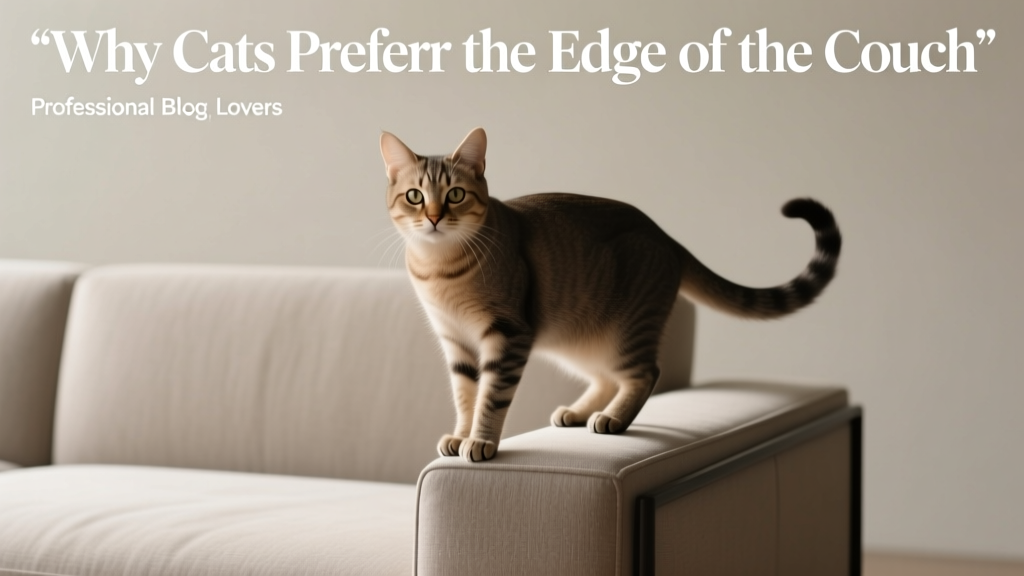
Why Cats Prefer the Edge of the Couch
You buy your cat a plush bed that looks like it belongs in a boutique hotel. You fluff it, you place it in a sunny spot, you even sprinkle a little catnip like you’re hosting a tiny spa retreat. And where does your cat choose to lounge? The narrow edge of the couch—half on, half off—like a furry acrobat who missed the memo about comfort.
Maybe it’s the armrest: paws tucked, chin propped, eyes half-closed in that “I’m relaxed but don’t test me” expression. Or it’s the very lip of the cushion, where one sudden stretch could mean sliding off… yet somehow they look more secure than you’ve ever felt in your life. If you’ve wondered whether your cat is being dramatic, strategic, or just plain weird, the truth is: it’s a little bit of all three—and it makes perfect sense in cat logic.
1) The scientific (and evolutionary) reason: edges = advantage
Cats are small predators who are also, historically, potential prey. That double identity shapes almost everything they do. The edge of the couch offers a set of benefits that would have been useful for a wildcat navigating brush, rocks, and tight hiding places.
- Visibility and surveillance: From an edge, a cat can monitor the room with minimal effort. One side is “open” (the room), and one side is “protected” (the couch back or arm). That reduces the number of angles they need to watch.
- Fast escape routes: Cats like positions that offer options. On the edge, they can launch into the room, drop behind the couch, or spring up onto the backrest. It’s the feline version of sitting near the exit.
- Boundary control: Edges are natural borders. Many cats find comfort in clear lines: the end of a cushion, the seam between pillows, the armrest that creates a “wall.” Boundaries help them predict what might happen next.
- Comfort through pressure: Cats often like to press their bodies against something—an armrest, a back cushion, even your leg—because it provides physical feedback and a sense of security. The edge creates a firm contact point.
In short: your couch edge isn’t a random choice. It’s a vantage point, a safety plan, and a sensory comfort tool—rolled into one smug little loaf.
2) A detailed breakdown: different “edge of couch” scenarios and what’s going on
Not all couch-edge lounging is the same. Context matters, and your cat’s exact pose can tell you a lot.
The armrest sentinel
Your cat perches on the armrest like a decorative gargoyle, tail draped neatly, gaze tracking every footstep. This is classic watchtower behavior. The armrest is elevated, narrow, and usually near the center of household activity—perfect for supervising humans who clearly require oversight.
Common in: Social cats, curious cats, cats who want to be near you without being touched, cats who feel they must monitor other pets.
The half-on, half-off drape
Front half on the cushion, back half sliding toward gravity, one leg dangling like they’re melting. This often suggests deep relaxation and thermal comfort. Couch edges can be cooler (more airflow) or warmer (near a person, a throw blanket, or a sunbeam hitting the side).
Common in: Confident cats, cats who run warm, cats who enjoy “casual contact” with you but don’t want full cuddles.
The seam-hugger
Some cats align their entire body along the edge seam, curled tightly like a comma. Seams and edges provide tactile cues—a gentle pressure that helps them feel positioned and safe. It’s similar to why some cats love boxes: a defined boundary makes the world feel manageable.
Common in: Anxious cats, cats new to the home, cats who startle easily, older cats who prefer stability.
The “I own this spot” end cushion
Your cat chooses the very end cushion, especially if it’s “your spot.” This can be about scent and social bonding. The end cushion often holds concentrated human scent from where you sit, lean, or rest your arm.
Common in: Cats strongly bonded to one person, cats who like to be close but not in laps, cats who are subtly claiming shared territory.
The back-of-couch rail rider
Not exactly the edge of the seat, but still an edge choice: your cat balances on the narrow top of the couch back like a tightrope walker. This is height + edge, a powerful combination for cats. Height gives them information. The narrow rail gives them control and a clear “line” to follow.
Common in: Athletic cats, young cats, cats in multi-pet homes, cats who want to be above the action.
3) What this behavior says about your cat’s mood and feelings
The couch edge can be a feline mood ring. Look at the body language paired with the location.
- Relaxed and content: Soft eyes, slow blinks, loose tail, paws tucked, body slightly sprawled. The edge is simply a preferred lounge zone.
- Curious and engaged: Ears forward, whiskers relaxed-forward, head tracking sounds, tail tip twitching gently. They’re gathering information—like a little furry detective.
- Wary or conflicted: Body tight, ears swiveling, tail wrapped close, frequent scanning. The edge offers a “ready-to-go” position. This doesn’t always mean fear; it can mean they’re unsure.
- Overstimulated or wanting space: Ears slightly sideways (“airplane ears”), skin rippling, tail thumping. The edge can be a polite boundary: “I’m here, but don’t crowd me.”
- Seeking comfort: Pressing their side firmly against the couch arm, kneading, purring, or settling with a deep sigh. Edges can feel like a supportive hug.
One of the most useful takeaways: edge-sitting often means your cat wants to be part of the household scene while still feeling in control of contact and escape. That’s not aloofness—it’s self-management.
4) Related behaviors you might notice (and why they’re connected)
If your cat is an “edge enthusiast,” you may also see these familiar quirks:
- Sitting in doorways or hallways: Strategic choke points for monitoring movement and scents.
- Choosing high perches: Tops of bookcases, cat trees, refrigerator patrol routes—height adds safety and information.
- Box obsession: Enclosed edges on all sides. A box is basically edge behavior in 3D.
- Loafing against walls or furniture: Reducing “attack angles” and increasing a sense of security.
- Following you… but from a few feet away: A mobile version of edge preference: closeness with autonomy.
- Claiming the end of the bed: The bed edge is another boundary-rich spot—plus it’s often cooler and less wiggly than the center.
5) When couch-edge lounging is normal vs. when it might be a concern
Most of the time, this behavior is completely normal—just classic cat strategy wrapped in a cute pose. But there are a few situations where a sudden change in “edge habits” is worth a closer look.
Likely normal
- Your cat has always favored edges and seems otherwise healthy.
- They alternate between edges and other spots depending on time of day, noise level, or who’s home.
- Their body language looks relaxed (soft posture, calm breathing).
Potential concern
- Sudden hiding or hypervigilance: If your previously snuggly cat starts perching on edges, scanning constantly, and avoiding the center of the room, something in the environment may be stressing them (new pet, construction noise, neighborhood cats outside, changes in routine).
- Balance issues: If your cat slips, wobbles, misjudges jumps, or seems uneasy on narrow surfaces, that can signal pain, ear/vestibular problems, vision changes, or neurological issues. A vet check is a good idea.
- Signs of discomfort: Reluctance to jump down, stiffness, crouched posture, or irritability when touched can point to arthritis or other pain—especially in older cats.
- Compulsive restlessness: If your cat can’t settle, constantly changes positions, or seems unable to get comfortable, that’s worth discussing with your vet.
If you’re ever unsure, take a short video of the behavior (especially any wobbling or hesitation) and share it with your veterinarian. Small details matter.
6) Tips for responding to (or encouraging) the behavior
You don’t need to “fix” couch-edge preference. But you can use it to make your home more cat-friendly and your relationship smoother.
- Respect the edge as a boundary: If your cat chooses the armrest and leans away when you reach out, try talking softly or offering a slow blink instead of petting. Let them invite contact.
- Create better perches: Add a cat tree near the living room or a window perch. Many cats pick couch edges because it’s the best vantage point available.
- Offer “supported edges”: If your cat likes narrow spots, consider a firm bolster bed or a couch-side cat bed with raised sides. They get the boundary feeling without the risk of sliding off.
- Use scent to make spots appealing: Place a soft throw or a worn T-shirt in a safer lounging area. Familiar scent can compete with the couch edge’s appeal.
- Manage multi-pet dynamics: In homes with dogs or other cats, edge-perching can be a way to avoid being approached. Add vertical space and multiple resting areas to reduce tension.
- Reinforce calm choices: If your cat settles nicely in a safe perch, reward with a treat or gentle praise (if they like it). Cats repeat what works.
One surprisingly effective trick: if your cat loves the couch edge because it’s near you, place a cat bed on a chair or ottoman adjacent to the couch. Many cats will happily “parallel hang out” once the location meets their criteria: close, elevated or defined, and easy to leave.
7) Fun facts and research-flavored nuggets about edge love
- Cats are experts at micro-territories: They don’t just think in rooms; they think in routes, corners, perches, and “decision points.” The edge of the couch is a decision point with excellent information flow.
- Whiskers help with edge navigation: Whiskers (vibrissae) detect airflow and nearby surfaces, helping cats judge space and maintain confident balance on narrow spots.
- “Thigmotaxis” is a real thing: Many animals (including cats) show a preference for moving along walls and edges, especially when uncertain. It’s a safety strategy: fewer directions to monitor.
- Cats can be social without being touchy: Edge-sitting is often a sign of social interest with controlled proximity—your cat’s version of hanging out without small talk.
8) FAQ: common questions about cats and couch edges
Why does my cat sit on the edge of the couch and stare at me?
Usually it’s a mix of social bonding and information gathering. Your cat may be waiting for a routine (dinner, playtime), checking your mood, or simply enjoying being near you without committing to lap time. Look for soft eyes and slow blinks—those are friendly signals.
Is my cat anxious if they always choose the edge?
Not necessarily. Many confident cats love edges because they offer control and a great view. Anxiety is more likely if you see tense posture, frequent startle responses, hiding more than usual, or a sudden change from previous habits.
Why won’t my cat use the cat bed I bought?
The bed might be too open, too soft, too exposed, or placed in a low-traffic area where your cat feels “out of the loop.” Try moving it near the living room, adding a familiar-smelling blanket, or choosing a bed with raised sides to mimic the security of an edge.
My cat falls off the couch edge sometimes. Should I stop them?
If it happens occasionally and your cat seems unbothered, it may just be a sleepy miscalculation. But repeated falls, wobbling, or hesitation can signal a medical issue (pain, vision changes, vestibular problems). In that case, it’s worth scheduling a veterinary exam and providing safer, wider perches.
Why does my cat choose the edge when guests come over?
Edges offer a “safe participation” zone: your cat can observe newcomers while maintaining a quick exit route. It’s a very normal way for cats to manage social uncertainty. Give them options—vertical perches, quiet rooms, and permission not to interact.
Do cats prefer edges more in multi-pet homes?
Often, yes. Edges and elevated spots reduce unwanted approaches and help cats feel they have control over interactions. If your cat edge-perches around another pet, adding more vertical space and separate resources (beds, litter boxes, feeding stations) can ease tension.
Cats may look like they’re choosing the most inconvenient seat in the house, but the edge of the couch is prime feline real estate: great visibility, clear boundaries, and a quick getaway plan—all while staying close to you. Next time you see your cat balancing like a tiny lounge-panther on the armrest, you can smile knowing it’s not random. It’s your cat feeling informed, secure, and just a little bit in charge.
Does your cat have a favorite “edge spot” (couch arm, windowsill, top of the chair like a throne)? Share your funniest or most puzzling couch-edge stories with the Cat Lovers Base community at catloversbase.com—we’d love to hear how your cat turns ordinary furniture into a strategic command center.