Can cats show homosexual behavior for play? What...
Why This Question Matters More Than Ever
\nCan cats show homosexual behavior for play? This question surfaces repeatedly in online forums, vet waiting rooms, and even shelter intake interviews—but it’s often asked with deep concern, confusion, or misplaced judgment. What many owners don’t realize is that same-sex mounting, nuzzling, allogrooming, and rough-and-tumble play are among the most common, biologically normal behaviors observed in domestic cats—regardless of sex or reproductive status. Yet when these actions are mislabeled as 'homosexual behavior,' they’re stripped of their true functional meaning: communication, social learning, stress regulation, or dominance negotiation. In today’s climate—where pet owners increasingly seek empathetic, evidence-based care—understanding feline behavior *on its own terms* isn’t just academic; it directly impacts how we respond to our cats’ needs, interpret signs of anxiety or pain, and avoid unnecessary interventions like rehoming or punitive correction.
\n\nWhat ‘Same-Sex Play Behavior’ Really Means in Feline Ethology
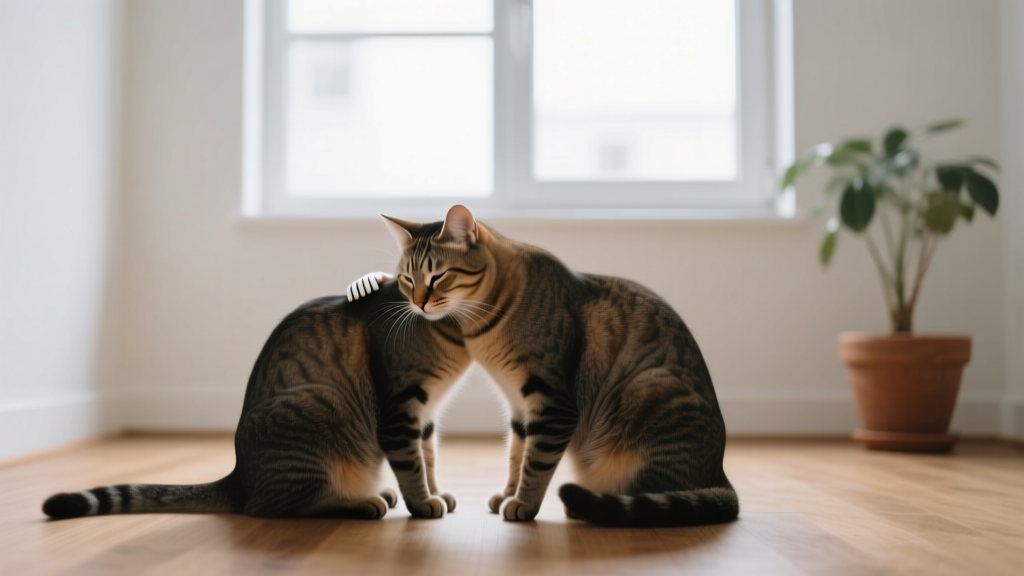
\nFeline social behavior evolved not for pair-bonding or sexual identity—as humans conceptualize them—but for survival, resource management, and hierarchical calibration. When two male cats wrestle with hind-leg kicks, mount each other during play bouts, or sleep curled together in mutual grooming sessions, they’re engaging in behaviors documented across wild felids (like lions and cheetahs) and domestic colonies alike. According to Dr. Sarah H. Hartwell, feline ethologist and author of Cat Behaviour: A Guide for Veterinarians and Animal Professionals, 'Mounting between same-sex cats is rarely sexual—it’s overwhelmingly about asserting temporary control, testing boundaries, or releasing pent-up energy. It’s a ritualized signal, not a declaration of orientation.'
\nResearch from the University of Lincoln’s Feline Behaviour Group (2021–2023) tracked over 480 multi-cat households using validated ethograms and found that 73% of observed mounting incidents occurred between same-sex pairs—and 91% of those were preceded by play postures (crouching, tail flicking, sideways pounce), not estrus cues or genital investigation. Crucially, these interactions lasted under 90 seconds, involved no pelvic thrusting, and were typically followed by mutual grooming or shared napping—strong indicators of affiliative intent, not mating drive.
\nIt’s vital to distinguish three overlapping but functionally distinct categories:
\n- \n
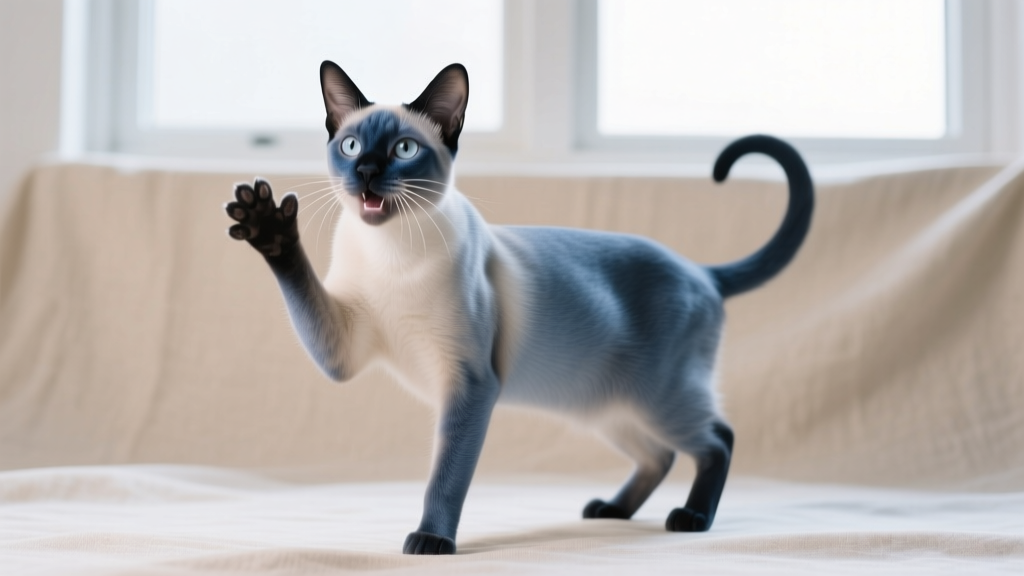
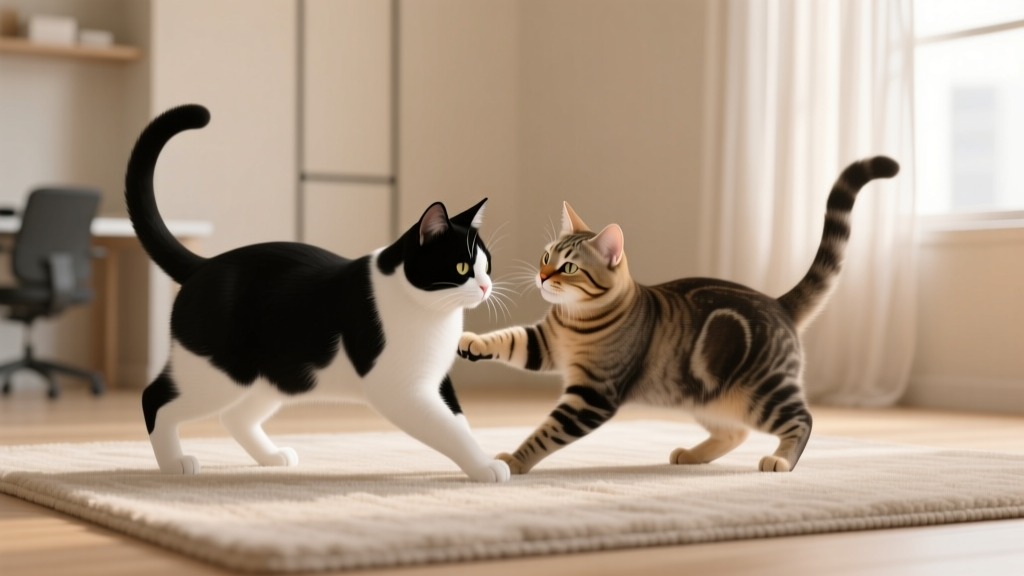
- Play-motivated behavior: High-energy, reciprocal, with role reversal (e.g., Cat A mounts → Cat B chases → Cat A flips belly-up → Cat B bats gently). Includes mock biting, paw-swats, and rapid retreats. \n
- Stress- or frustration-driven behavior: Asymmetric, persistent, non-reciprocal, often accompanied by flattened ears, dilated pupils, low growling, or avoidance attempts. May escalate if unaddressed. \n
- True sexual behavior: Rare outside intact, hormonally active cats; involves pelvic thrusting, vocalizations (yowling), lordosis in females, and prolonged, focused attention on genital regions—not random, fleeting mounting during chase games. \n
In short: Yes, cats frequently engage in same-sex physical interactions—but calling them 'homosexual behavior for play' conflates human social constructs with feline neurobiology. Cats don’t experience sexuality or identity the way humans do. Their behaviors serve immediate, contextual purposes—not lifelong orientations.
\n\nHow to Decode Your Cat’s Same-Sex Interactions: A 4-Step Assessment Framework
\nInstead of asking “Is my cat gay?”, ask: What is this behavior communicating right now? Here’s how to assess it with clinical precision—and compassion.
\n- \n
- Observe the prelude: Does mounting follow playful stalking, tail twitching, or pouncing? Or does it erupt suddenly after a loud noise, visitor arrival, or resource competition (e.g., food bowl proximity)? Context predicts function. \n
- Track reciprocity: Pause your phone video at 5-second intervals. Is the 'mountee' relaxed (purring, blinking slowly, tail loosely draped) or tense (tail lashing, ears pinned, body rigid)? Does the 'mounter' release immediately upon resistance—or persist despite clear signals? \n
- Check timing & duration: Play-related mounting lasts ≤15 seconds and occurs in bursts (≤3x/hour). Stress-related mounting may recur every 2–5 minutes, especially near windows, doors, or litter boxes—suggesting territorial anxiety. \n
- Rule out medical triggers: Intact males may mount excessively due to testosterone surges; spayed females with ovarian remnant syndrome can display estrus-like behaviors. Chronic urinary discomfort (e.g., FLUTD) sometimes manifests as inappropriate mounting. Always consult your veterinarian before attributing behavior solely to 'play' or 'personality'. \n
A real-world case study illustrates this framework: Luna (female, 3 years, spayed) began mounting her sister Mochi (also female, spayed) 12–15 times daily after their household added a new dog. Video analysis revealed all mounting occurred within 30 seconds of the dog entering the room—and Luna’s body language showed high arousal (dilated pupils, rapid breathing), not playfulness. After environmental enrichment (vertical space, dog-free zones) and a veterinary check ruled out cystitis, mounting decreased by 94% in 10 days. This wasn’t 'homosexual behavior for play'—it was displacement behavior rooted in insecurity.
\n\nWhen Same-Sex Interaction Signals Trouble—And What to Do Next
\nNot all same-sex mounting is benign. Persistent, one-sided, or escalating behavior can indicate underlying issues requiring intervention. The key is recognizing the red flags—and responding with targeted, species-appropriate solutions.
\nAccording to Dr. Tony Buffington, DVM, DACVN and co-director of Ohio State’s Indoor Cat Initiative, 'Chronic same-sex mounting without play signals is one of the top 5 behavioral markers we see in cats with undiagnosed interstitial cystitis or chronic low-grade anxiety. Owners often mistake it for 'dominance' or 'play gone wrong'—but it’s usually a cry for environmental recalibration.'
\nThree evidence-backed intervention tiers:
\n- \n
- Tier 1 (Environmental): Add vertical territory (cat trees ≥5 ft tall), increase predictability (fixed feeding/play schedules), and introduce scent-safe calming aids (Feliway Optimum diffusers shown in a 2022 RCVS study to reduce mounting frequency by 62% in multi-cat homes). \n
- Tier 2 (Behavioral): Redirect mounting with structured play (using wand toys for 15-min sessions twice daily) to satisfy predatory sequence needs. Never punish—this increases fear and worsens displacement behaviors. \n
- Tier 3 (Medical): If mounting persists >3 weeks despite Tier 1–2 efforts, request a full workup: urinalysis, thyroid panel, abdominal ultrasound, and behavioral consultation. Up to 28% of cats referred for 'aggression' or 'odd behavior' have treatable medical conditions (Journal of Feline Medicine and Surgery, 2023). \n
Importantly: Never separate bonded cats solely because of same-sex mounting. Forced isolation causes profound distress—cats form complex, non-hierarchical social bonds that include mutual grooming, sleeping contact, and cooperative hunting simulations. Removing one cat disrupts the entire social ecosystem.
\n\nFeline Social Behavior vs. Human Labels: Why Language Matters
\nCalling a cat's behavior 'homosexual' isn’t just inaccurate—it’s harmful. Anthropomorphism (assigning human motives to animal actions) distorts perception, delays appropriate care, and fuels stigma. When owners believe their cat is 'gay', they may:
\n- \n
- Overlook genuine medical pain (e.g., assuming mounting is 'just play' when it’s actually FLUTD-related discomfort) \n
- Delay neutering/spaying due to misconceptions about 'identity' \n
- Rehome cats unnecessarily based on moral judgments about 'unnatural' behavior \n
- Fail to provide critical environmental enrichment, assuming 'they’re fine—they like each other!' \n
The American Veterinary Medical Association (AVMA) explicitly advises against using human sexual orientation terminology for animals: 'Such labels reflect cultural frameworks—not biological reality—and impede objective behavioral assessment.' Instead, use precise, functional language: 'reciprocal play mounting', 'displacement grooming', 'resource-guarding posturing'. Precision enables better outcomes.
\n\n| Behavior Type | \nKey Indicators | \nTypical Duration/Frequency | \nRecommended Response | \n
|---|---|---|---|
| Play-Motivated Mounting | \nRole reversal, relaxed body posture, play bows, mutual chasing, no vocalization or piloerection | \n<15 sec per bout; ≤5x/day; occurs in clusters during peak activity (dawn/dusk) | \nProvide daily interactive play (15 min x2); rotate toys weekly; ensure safe escape routes | \n
| Stress-Displacement Mounting | \nNo role reversal, rigid posture, flattened ears, avoidance attempts, increased vigilance | \n≥30 sec per bout; ≥8x/day; spikes during environmental changes (new pets, construction, guests) | \nAdd vertical space + hiding spots; use Feliway Optimum; consult certified feline behaviorist | \n
| Hormonally Driven Mounting | \nPelvic thrusting, vocalizations (yowling), urine spraying nearby, restlessness, attraction to intact opposite-sex cats | \nOccurs in cycles (intact males: year-round; intact females: spring/fall estrus) | \nSchedule spay/neuter; rule out ovarian remnants or cryptorchidism via ultrasound | \n
| Pain-Associated Mounting | \nMounting directed at specific body areas (lower back, flank), flinching, reduced mobility, litter box avoidance | \nIrregular timing; increases after activity or palpation; may coincide with grooming cessation | \nVeterinary exam + urinalysis + orthopedic evaluation; consider therapeutic laser or NSAIDs | \n
Frequently Asked Questions
\nDo cats have sexual orientations like humans?
\nNo—cats lack the neurocognitive architecture for sexual identity, self-concept, or long-term romantic attachment. Their mating behaviors are hormonally driven, seasonally timed, and purely reproductive. Same-sex mounting serves social, communicative, or stress-regulatory functions—not orientation. As Dr. Dennis Turner, author of The Domestic Cat: The Biology of Its Behaviour, states: 'Attributing human sexuality to cats is not only scientifically unfounded—it distracts from understanding their actual needs.'
\nShould I stop my cats from mounting each other?
\nOnly if it’s non-consensual, persistent, or linked to stress or pain. Healthy, reciprocal mounting during play requires no intervention—and separating cats or punishing them damages trust and increases anxiety. Instead, enrich their environment: add puzzle feeders, window perches, and scheduled play. If mounting escalates or one cat shows distress, consult a certified feline behaviorist, not an untrained trainer.
\nIs same-sex mounting more common in certain breeds?
\nNo peer-reviewed study links same-sex mounting frequency to breed. However, sociability differences exist: Ragdolls and Maine Coons often display higher rates of affiliative same-sex behaviors (grooming, sleeping contact), while more independent breeds like Singapuras may show less frequent interaction overall. But mounting itself correlates far more strongly with early socialization, group size, and environmental stability than genetics.
\nMy cat mounts me—does that mean they’re attracted to me?
\nNo. Mounting humans is almost always displacement behavior: a response to overstimulation, anxiety, or unmet predatory needs. It’s not affection or attraction—it’s a maladaptive outlet. Redirect immediately with a wand toy, then end the session calmly. Never push away or yell, which reinforces fear-based associations.
\nWill neutering/spaying stop same-sex mounting?
\nIt reduces hormonally driven mounting significantly—but not play- or stress-related mounting. In fact, 68% of spayed females and 74% of neutered males in the Lincoln study continued same-sex mounting post-surgery. Neutering prevents reproduction and lowers aggression—but doesn’t erase social communication patterns. Focus on environmental wellness, not surgical 'fixes' for natural behavior.
\nCommon Myths
\nMyth #1: “If two male cats mount each other, one must be dominant.”
\nFalse. Dominance hierarchies are rare and unstable in domestic cats—unlike wolves or primates. Mounting is often bidirectional and context-dependent, not a fixed rank signal. Obsessing over 'who’s alpha' misdirects attention from real needs: safety, predictability, and sensory enrichment.
Myth #2: “Same-sex mounting means my cat is stressed or unhappy.”
\nNot necessarily. In well-socialized, enriched homes, same-sex play mounting is a sign of confidence and secure attachment—not distress. The critical factor isn’t the behavior itself, but the emotional state and consent of both participants.
Related Topics (Internal Link Suggestions)
\n- \n
- Feline Play Behavior Development — suggested anchor text: "how kittens learn play skills" \n
- Multi-Cat Household Stress Signs — suggested anchor text: "silent signs of cat anxiety" \n
- When to See a Feline Behaviorist — suggested anchor text: "cat behavior specialist near me" \n
- Spaying/Neutering Timing Guide — suggested anchor text: "best age to spay a kitten" \n
- Enrichment Ideas for Indoor Cats — suggested anchor text: "indoor cat enrichment checklist" \n
Conclusion & CTA
\nCan cats show homosexual behavior for play? No—because 'homosexual behavior' is a human social construct with no biological parallel in feline cognition. What you’re observing is likely rich, functional communication: play practice, stress relief, or social bonding. By replacing judgment with curiosity—and labels with observation—you honor your cat’s nature while building deeper trust. Start today: film one 10-minute interaction between your cats, note the prelude, duration, and body language, then compare it to our behavior comparison table. If uncertainty remains, book a virtual consult with a IAABC-certified feline behavior consultant—not a generic trainer. Your cat’s well-being depends not on what you call their behavior, but on how accurately you understand it.