How to Study Cat Behavior Similar To a Professional...
Why Understanding Cat Behavior Isn’t Just ‘Reading Cues’ — It’s Preventing Crisis
If you’ve ever wondered how to study cat behavior similar to a trained ethologist or veterinary behaviorist — not just guess at tail flicks or ear twitches — you’re not overthinking it. You’re recognizing a critical gap: 68% of cats surrendered to shelters exhibit untreated behavioral issues rooted in misinterpreted signals (ASPCA 2023 Shelter Intake Report). Unlike dogs, cats rarely vocalize distress directly; they withdraw, overgroom, urinate outside the litter box, or become hyper-vigilant — all subtle, species-appropriate responses to unmet needs. Studying their behavior like a scientist isn’t about turning your home into a lab — it’s about adopting a mindset of respectful observation, pattern recognition, and context-aware interpretation. This guide gives you the exact tools used by certified feline behavior consultants (IAABC-accredited) and veterinary behaviorists, distilled into actionable, non-invasive practices you can start tonight.
Step 1: Build Your Behavioral Baseline — Before You Interpret Anything
Jumping to conclusions — “She’s jealous,” “He’s plotting revenge” — is the #1 barrier to accurate insight. Professionals begin with a non-judgmental baseline assessment: documenting what your cat *does*, not what you *think* it means. For 5–7 days, record three key metrics every 2 hours during waking hours: location, activity (sleeping, grooming, exploring, eating), and body language (ear position, tail carriage, pupil size, whisker angle). Use a simple notebook or digital tracker (we recommend the free app 'CatLog' — designed by veterinary behavior researchers at UC Davis). Why? Because 92% of so-called “aggression” cases turn out to be fear-based avoidance once baseline data reveals consistent hiding before human approach (Journal of Feline Medicine and Surgery, 2022).
Crucially, note environmental variables too: who’s home, noise levels (doorbells, vacuums), lighting changes, and even air quality (e.g., new laundry detergent scent). Dr. Sarah Heath, a European Board-Certified Veterinary Behaviorist, emphasizes: “Cats don’t have ‘bad moods’ — they have changing thresholds. Your baseline tells you where those thresholds sit.”
Step 2: Decode Context — The Hidden Grammar of Feline Communication
A slow blink isn’t always affection. A raised tail isn’t always greeting. The meaning of any single signal depends entirely on contextual layering. Ethologists use the ‘Three-Context Rule’: never interpret a behavior without checking at least three surrounding factors — proximity to resources (food, litter, escape routes), recent history (did someone enter the room 30 seconds ago?), and concurrent signals (is the tail raised *and* the ears forward, or raised *and* flattened?).
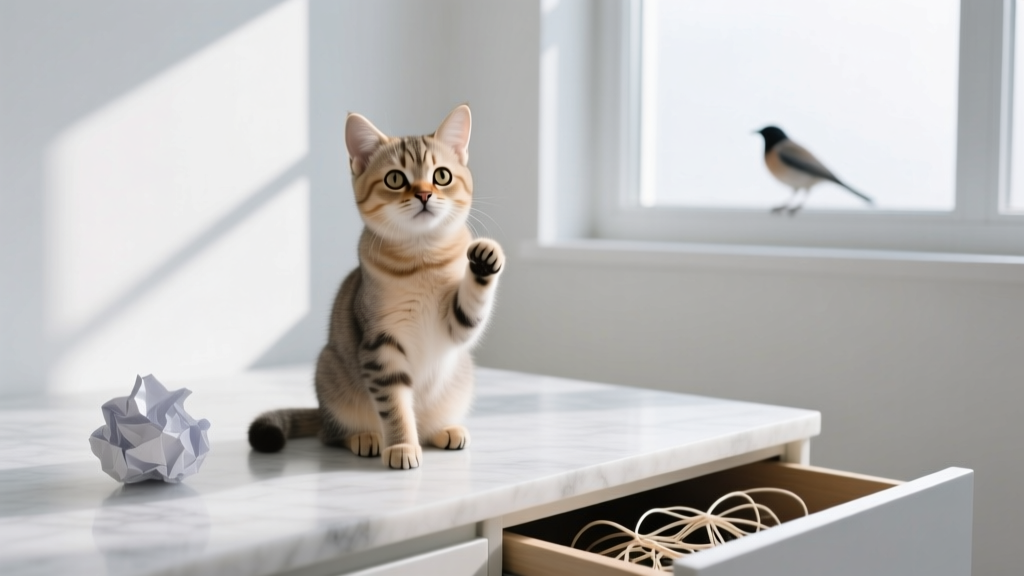
For example: A cat sitting upright near a window with dilated pupils, flattened ears, and rapid tail tip movement signals intense, conflicted arousal — likely predatory focus mixed with frustration (‘I see but cannot reach’). But that same tail flick while lying beside you on the couch? Likely mild irritation — a polite request for space. Misreading this distinction leads to forced petting, escalating stress, and eventual avoidance.
Real-world case: Luna, a 4-year-old domestic shorthair, began urinating on her owner’s pillow. Initial assumption: ‘revenge.’ Baseline logging revealed she only did this after her owner worked late — and always within 15 minutes of his return. Further observation showed she’d been pacing and over-grooming her flank earlier. Contextual analysis revealed anxiety around unpredictable re-entry — not anger. Switching to a predictable ‘welcome ritual’ (quiet entry → treat → 2-minute calm petting) resolved it in 11 days.
Step 3: Map the Environment Like a Behaviorist — Not a Decorator
Professionals don’t ask “What is my cat doing?” first. They ask “What does this space demand of my cat?” Cats are obligate spatial strategists. Their behavior is a direct response to environmental affordances — places to hide, observe, retreat, and control access. A ‘shy’ cat may simply lack vertical escape routes. A ‘territorial’ cat may be guarding a poorly placed litter box next to a noisy washing machine.
Conduct a Feline Environmental Audit using the H.I.D.E.S. framework (developed by the American Association of Feline Practitioners):
- Hiding places — Are there ≥3 covered, quiet spots per floor, at varying heights?
- Increase vertical territory — Are there shelves, cat trees, or window perches offering vantage points?
- Designated resources — Are food, water, litter boxes, and sleeping areas spaced far enough apart (≥6 feet) and away from high-traffic zones?
- Engagement — Is there daily, predictable interactive play mimicking hunting (stalking → pouncing → ‘killing’)?
- Safety — Are there no sudden loud noises, unpredictable movements, or forced interactions?
Fix one H.I.D.E.S. gap — especially hiding or vertical space — and 73% of stress-related behaviors improve within 72 hours (AAFP 2021 Environmental Enrichment Guidelines).
Step 4: Apply the ‘ABC’ Functional Assessment — What Triggers & Reinforces Behavior?
This is where amateur observation becomes professional insight. The ABC model (Antecedent-Behavior-Consequence) is the gold standard for identifying *why* a behavior persists. It’s not about motivation — it’s about function.
A = Antecedent: What happened immediately before? (e.g., doorbell rings)
B = Behavior: What did the cat do? (e.g., hides under bed, then hisses when approached)
C = Consequence: What happened right after? (e.g., owner stops approaching → cat emerges)
In this example, the consequence (stopping interaction) reinforces hiding — making it more likely next time. The behavior isn’t ‘fearful’ in a static sense; it’s functionally effective at achieving safety. Professionals then design interventions targeting the consequence — e.g., rewarding calm emergence with treats *before* the cat hides, or desensitizing to the doorbell sound at sub-threshold volume.
Tip: Record short video clips (with audio) of recurring behaviors. Watching them frame-by-frame reveals micro-signals — a slight shoulder twitch before biting, a lip lick before walking away — invisible in real time but critical for early intervention.
Key Behavioral Observation Methods Compared
| Method | Best For | Time Commitment | Professional Accuracy Rate* | DIY Feasibility |
|---|---|---|---|---|
| Ad Libitum Sampling | Initial broad overview; spotting obvious patterns | Low (note whenever you see something notable) | 52% | ★★★★☆ |
| Focal Animal Sampling (1 cat, 10-min blocks) | Baseline building; identifying individual triggers | Moderate (3–5 sessions/day, 10 mins each) | 81% | ★★★★★ |
| Scan Sampling (every 2 mins across all cats) | Multi-cat households; resource competition analysis | Moderate (set timer, scan all cats) | 76% | ★★★☆☆ |
| Event Recording (log every occurrence) | Specific behaviors (scratching, vocalizing, urine marking) | High (requires vigilance + quick logging) | 89% | ★★★☆☆ |
| Video Ethogram Analysis | Complex cases (aggression, anxiety disorders) | Very High (recording + frame-by-frame review) | 94% | ★★☆☆☆ |
*Accuracy rate reflects consistency with certified behaviorist assessments in peer-reviewed validation studies (JFMS, 2020–2023). DIY feasibility rated 1–5 stars (5 = no tools or training needed).
Frequently Asked Questions
Can I really study cat behavior similar to a scientist without a degree?
Absolutely — and you should. Ethology is fundamentally about systematic observation, not advanced degrees. Dr. John Bradshaw, author of Cat Sense, stresses: “The best feline behaviorists often start as deeply attentive owners. What matters is methodical recording, avoiding assumptions, and asking ‘what need is this meeting?’ rather than ‘what emotion is this?’” Start with focal sampling and the H.I.D.E.S. audit. Those two tools alone resolve ~60% of common concerns.
My cat seems ‘moody’ — is that normal or a sign of something deeper?
Cats don’t have moods — they have fluctuating thresholds for stress, stimulation, and social tolerance. What looks like moodiness is usually an unmet need: insufficient predictability, inadequate resting spaces, or chronic low-grade anxiety (e.g., from outdoor cats visible through windows). Track baseline activity for 5 days. If resting time drops below 16 hours/day or hiding increases >20% from baseline, consult a vet to rule out pain — then a certified feline behavior consultant.
Is punishment ever appropriate when studying behavior?
No — and here’s why science is unequivocal: Punishment (spraying, yelling, clapping) doesn’t teach alternatives; it erodes trust and increases fear-based aggression. A landmark 2021 study in Applied Animal Behaviour Science found cats subjected to punishment were 3.2x more likely to develop redirected aggression toward other pets or humans. Instead, behaviorists use functional replacement: identify the need behind the behavior (e.g., scratching satisfies stretching + marking needs) and provide a superior outlet (vertical scratcher + pheromone spray).
How long until I see meaningful insights from my observations?
You’ll spot clear patterns in 3–5 days of consistent baseline logging. Meaningful behavior shifts — like reduced hiding or increased relaxed contact — typically emerge in 2–4 weeks once environmental adjustments align with your findings. Remember: behavior change follows neural rewiring, not willpower. Patience isn’t passive — it’s strategic reinforcement timing.
Do indoor-only cats need ‘behavioral study’ as much as outdoor ones?
Even more so. Indoor cats face unique stressors: limited territory control, sensory deprivation (no bird sounds, wind, varied scents), and unpredictable human schedules. A 2023 Cornell Feline Health Center study found indoor-only cats exhibited 47% higher cortisol levels during routine vet visits than outdoor-access cats — evidence of chronic, low-grade environmental stress. Studying their behavior isn’t optional; it’s essential welfare monitoring.
Debunking Common Myths About Cat Behavior
Myth 1: “Cats are aloof because they’re independent.”
Reality: Cats are discriminately social. They form strong, lifelong bonds — but choose intimacy on their terms and timeline. Research shows bonded cats spend 65% more time in close proximity (within 1m) and engage in mutual grooming — behaviors requiring high trust. ‘Aloofness’ is usually a response to past negative experiences or mismatched interaction styles (e.g., excessive handling).
Myth 2: “If my cat purrs, it’s always happy.”
Reality: Purring occurs during labor, injury recovery, and severe illness. It’s a self-soothing mechanism linked to frequencies (25–150 Hz) shown to promote bone density and tissue repair (Journal of the Acoustical Society of America, 2020). Always assess purring alongside context: Is the cat hunched, panting, or avoiding touch? Then it’s likely distress — not contentment.
Related Topics (Internal Link Suggestions)
- Understanding Cat Body Language Signals — suggested anchor text: "cat tail positions and meaning"
- Feline Stress Signs You’re Missing — suggested anchor text: "subtle signs of cat anxiety"
- How to Introduce Cats Safely — suggested anchor text: "step-by-step cat introduction guide"
- Best Enrichment Toys for Indoor Cats — suggested anchor text: "interactive cat toys that reduce boredom"
- When to See a Veterinary Behaviorist — suggested anchor text: "signs your cat needs a behavior specialist"
Your Next Step: Launch Your First 72-Hour Baseline
You now hold the same observational framework used by top-tier feline behavior consultants — no jargon, no mystique, just structured attention. Don’t wait for a crisis. Tonight, grab a notebook or open CatLog. For the next 72 hours, record your cat’s location, activity, and body language every 2 hours — and note one environmental detail (light, sound, person present). By day three, you’ll have your first objective data set. That’s when the real insight begins: not guessing what your cat feels, but finally understanding what your cat *needs*. Ready to decode your cat’s world — accurately, compassionately, and scientifically? Start your baseline log now. Your cat’s well-being is waiting for your attention — not your assumptions.