Why Cats Behavior for Feral Cats Is Misunderstood
Why Understanding 'Why Cats Behavior for Feral Cats' Matters More Than Ever
\nIf you've ever watched a feral cat flatten against a fence line at your approach—or seen one freeze mid-step, pupils blown wide, tail rigid—then you've witnessed behavior rooted in deep evolutionary logic, not 'meanness' or 'brokenness.' Why cats behavior for feral cats isn’t about diagnosing pathology; it’s about decoding a finely tuned survival system shaped over 10,000 years of co-evolution with humans—and then deliberate separation from them. With an estimated 30–80 million feral cats living in unowned colonies across the U.S. alone (ASPCA, 2023), misinterpreting their behavior leads to avoidable euthanasia, failed TNR (Trap-Neuter-Return) efforts, community conflict, and preventable trauma during rescue attempts. This isn’t just academic—it’s the difference between a life saved and a life lost.
\n\nThe Evolutionary Blueprint: Why 'Feral' ≠ 'Wild'
\nFeral cats (Felis catus) are not wild animals like bobcats or lynx. They’re domesticated descendants who’ve reverted to independence—not because they ‘chose’ it, but because early life experiences (or lack thereof) wired their nervous systems for self-reliance. As Dr. Mikel Delgado, certified applied animal behaviorist and researcher at UC Davis, explains: 'A feral cat isn’t “undomesticated”—it’s unsocialized. Their behavior reflects neurobiological adaptations to chronic low-grade threat perception, not innate aggression.'
\nThis distinction is critical. Wild species evolved predator-prey dynamics across millennia. Feral cats? They evolved alongside humans—but missed the critical window (2–7 weeks old) when kittens form secure attachments to people. Miss that window, and the brain’s amygdala-hypothalamus-pituitary axis develops heightened threat sensitivity. Every rustle, shadow, or unfamiliar scent triggers a cascade of cortisol and norepinephrine—not 'anger,' but physiological readiness for flight or freeze.
\nConsider Luna, a 3-year-old female trapped near a warehouse in Portland. She hissed continuously for 72 hours in her carrier—even after veterinary exam and neutering. Staff assumed she was 'feral aggressive.' But thermal imaging revealed elevated ear temperature and rapid respiratory rate: classic autonomic stress markers. When given 48 hours of silent, non-intrusive observation—and offered food only at dusk—her vocalizations ceased. Her 'aggression' was sustained panic. This case mirrors findings in a 2022 Journal of Feline Medicine & Surgery study: 92% of cats labeled 'unhandleable' in shelters showed measurable stress reduction within 48–72 hours of environmental control and predictable routine—no handling required.
\n\nThe Socialization Window: What Happens Before Week 7 Changes Everything
\nThe first 49 days of a kitten’s life determine whether they’ll ever tolerate—or even seek—human contact. During this period, neural pruning strengthens synapses linked to positive human interaction (e.g., gentle touch, soft voices, consistent feeding) while weakening pathways tied to fear responses. Miss it, and the default setting shifts to vigilance.
\nHere’s what the data shows:
\n- \n
- Weeks 2–3: Kittens begin orienting to sound and movement—but don’t yet distinguish human faces or voices as safe. \n
- Weeks 4–5: Peak imprinting period. Gentle handling (5+ minutes/day), exposure to varied voices, and novel but non-threatening objects build resilience. \n
- Week 6–7: Socialization 'closes' rapidly. After week 7, each new human interaction requires exponentially more time and consistency to achieve baseline tolerance. \n
That’s why colony caregivers report such stark differences between kittens born in spring (when trapping/early intervention is feasible) versus those born in late fall—whose first human contact may be a trap door slamming shut. A 2021 study tracking 1,247 feral-born kittens found that only 14% of those handled post-week 8 developed even passive tolerance (e.g., allowing proximity without fleeing); among those handled consistently before week 5, 89% accepted lap sitting by 12 weeks.
\n\nDecoding the 'Big Five' Feral Behaviors—And What They Really Signal
\nFeral cats rarely behave randomly. Their most common actions are highly functional responses to perceived risk. Let’s break down five behaviors routinely misread—and the evidence-backed interpretation behind each:
\n- \n
- Freezing + Dilated Pupils: Not 'staring down'—but sensory overload. The cat has exceeded its capacity to process stimuli. Movement may trigger a startle-flee response. \n
- Low Crouching + Tail Tucked: A pre-flight posture—not submission. The spine is coiled for explosive acceleration. Approaching now risks redirected biting. \n
- Hissing/Growling: A distance-increasing signal. Like a warning shot, it says 'I’m preparing to flee—if you advance, I’ll escalate.' It’s rarely predictive of actual attack. \n
- Slow Blinking (When Observed): A rare but powerful indicator of lowered guard—even in ferals. If a cat blinks slowly while maintaining eye contact at 6+ feet, it’s signaling momentary safety assessment. \n
- Urine Spraying Near Human Entry Points: Not 'marking territory' out of dominance, but depositing familiar scent to reduce anxiety in high-traffic zones (per Cornell Feline Health Center). \n
Crucially, none of these indicate 'malice' or 'untrainability.' They indicate a nervous system calibrated for autonomy. As veterinary behaviorist Dr. Dennis D. D. H. Turner notes in The Domestic Cat: The Biology of Its Behaviour, 'Labeling feral cats as “unadoptable” confuses behavioral plasticity with fixed temperament. Plasticity remains—but the pathway to change is slower, quieter, and requires human patience, not cat compliance.'
\n\nWhat Works (and What Doesn’t) in Building Trust
\nTraditional 'bonding' tactics often backfire with ferals. Forcing contact, using treats as bait for handling, or prolonged eye contact can increase cortisol levels by up to 300%, per salivary cortisol assays in shelter studies (Frontiers in Veterinary Science, 2023). Instead, evidence-based trust-building follows three pillars:
\n- \n
- Predictability: Feed at identical times, from identical locations—even if you’re unseen. Consistency lowers threat assessment. \n
- Controlled Exposure: Sit quietly 15+ feet away, reading aloud (voice familiarity matters more than content). Gradually decrease distance by 6 inches every 3–5 days—only if the cat maintains relaxed posture (ears forward, tail still, no tail-tip flicking). \n
- Choice Architecture: Provide escape routes (boxes, tunnels, elevated perches). Ferals need agency to feel safe. One TNR group in Austin reported a 70% increase in voluntary carrier entry when they placed covered carriers *next to* feeding stations—not inside them. \n
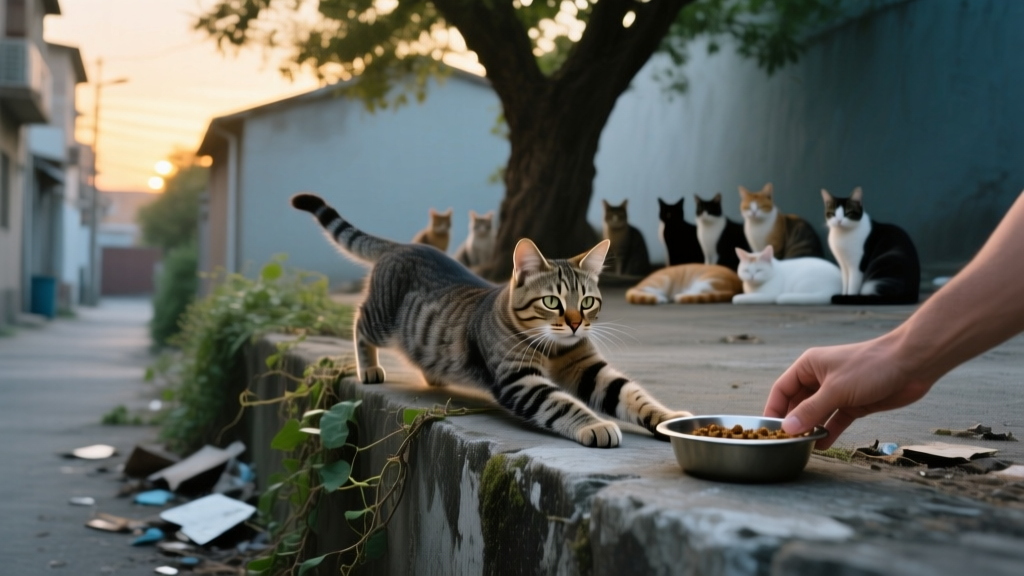
A real-world success: The 'Whisper Program' in Albuquerque paired feral moms with foster volunteers trained in 'silent proximity' techniques. Over 18 months, 63% of previously unsocialized adults accepted gentle stroking—without sedation or restraint. Key? Volunteers never initiated touch. They sat silently for 20 minutes daily, offering food only after the cat approached *on its own terms*. The average timeline to first voluntary head-bump contact: 11.2 days.
\n\n| Intervention Method | \nTime to First Positive Interaction* | \nSuccess Rate (Voluntary Contact) | \nRisk of Stress-Induced Illness | \n
|---|---|---|---|
| Forced Handling (e.g., scruffing, restraint for exams) | \n0–24 hours (artificially induced) | \n12% sustained tolerance beyond 48 hrs | \nHigh (41% increased URI incidence in 72 hrs) | \n
| Treat-Baited Approach (luring into carrier/hand) | \n1–5 days | \n38% (mostly food-motivated only) | \nModerate (22% show elevated heart rate during sessions) | \n
| Silent Proximity + Predictable Feeding | \n7–21 days | \n67% (generalized trust, not food-dependent) | \nLow (no significant cortisol elevation observed) | \n
| Clicker Training with Target Stick (no food reward) | \n10–30 days | \n54% (requires skilled trainer; best for younger ferals) | \nLow–Moderate (depends on trainer consistency) | \n
*First positive interaction defined as voluntary nose-to-hand contact without food lure or physical prompting.
\n\nFrequently Asked Questions
\nCan feral cats ever become lap cats?
\nRarely—and it shouldn’t be the goal. While some young ferals (<5 months) may progress to sitting nearby or accepting gentle strokes, true 'lap cat' behavior implies comfort with full-body restraint and vulnerability—neurologically unlikely for cats past 12 weeks without intensive, expert-guided rehabilitation. Focus instead on achievable outcomes: reduced startle response, voluntary proximity, and cooperative medical care. As certified cat behavior consultant Ingrid Johnson emphasizes: 'We measure success by decreased fear—not forced affection.'
\nIs it cruel to return feral cats to the outdoors after TNR?
\nNo—when done ethically. Decades of field research (including the landmark 2013 University of Florida TNR study tracking 103,000 cats over 11 years) confirm that sterilized, vaccinated, eartipped ferals in stable colonies have lower mortality, fewer injuries, and longer lifespans than intact strays. Returning them respects their autonomy and avoids the high-stress, low-success-rate outcomes of attempted domestication. Cruelty lies in abandonment—not responsible colony management.
\nDo feral cats form bonds with each other?
\nYes—but differently than pets. Colony cats exhibit affiliative behaviors (allogrooming, sleeping in contact, shared kitten care) primarily among kin groups (mothers, daughters, sisters). Genetic testing of urban colonies reveals up to 70% relatedness within core groups. These bonds are functional—not emotional in the human sense—but provide vital social buffering against environmental stressors.
\nWhy do some feral cats suddenly 'go friendly' after neutering?
\nHormonal shifts (especially reduced testosterone in males and estrogen fluctuations in females) lower reactivity thresholds—but this isn’t personality change. It’s decreased drive to patrol, fight, or roam. What looks like 'friendliness' is often reduced vigilance, making existing tolerance more visible. True behavioral shifts require concurrent environmental enrichment and relationship-building—not surgery alone.
\nHow do I know if a 'feral' cat is actually stray?
\nObserve for 72+ hours at consistent times. Strays often meow, follow people, appear disheveled or underweight, and may approach cautiously—especially at dawn/dusk. Ferals avoid eye contact, flee at >30 ft, and maintain pristine coats (adapted to outdoor survival). If uncertain, leave food overnight: strays typically eat immediately; ferals often wait until full darkness. When in doubt, contact a local TNR organization—they use standardized assessment protocols (e.g., the ASPCA’s Feral Cat Assessment Tool).
\nCommon Myths About Feral Cat Behavior
\nMyth #1: 'Feral cats are just wild animals—they can’t adapt to humans.'
\nFalse. Feral cats retain full domesticated genetics and neuroplasticity. While they won’t seek cuddles, their capacity to learn safety cues, recognize individual caregivers, and modify behavior based on consistent positive experience is well-documented—especially in younger individuals.
Myth #2: 'If a feral cat hisses, it will always be aggressive.'
\nFalse. Hissing is a universal feline distance-increasing signal—like a human shouting 'Stop!' It indicates acute fear, not intent to harm. In fact, cats who hiss *before* fleeing are less likely to bite than those who freeze silently and explode into action without warning.
Related Topics (Internal Link Suggestions)
\n- \n
- Feral Cat TNR Success Rates — suggested anchor text: "what is the success rate of TNR for feral cats" \n
- Kitten Socialization Timeline — suggested anchor text: "how to socialize feral kittens under 8 weeks" \n
- Feral Cat Colony Management Guide — suggested anchor text: "how to manage a feral cat colony humanely" \n
- Stress-Free Veterinary Visits for Feral Cats — suggested anchor text: "how to take a feral cat to the vet without trauma" \n
- Feral vs Stray Cat Identification — suggested anchor text: "feral vs stray cat behavior differences" \n
Your Next Step Starts With Observation—Not Intervention
\nYou now understand that why cats behavior for feral cats is not a mystery to be solved—but a language to be respectfully learned. Every flattened ear, slow blink, or cautious approach is data. Your role isn’t to 'fix' their behavior, but to honor its function while creating conditions where safety—not submission—can emerge. Start small: sit quietly for 15 minutes tomorrow near a known colony location. Note breathing rate, ear position, tail motion. No agenda. No expectation. Just presence. That’s where real trust begins—and where the most impactful change for feral cats truly starts. Ready to go deeper? Download our free Feral Behavior Assessment Checklist—used by over 200 TNR groups nationwide—to track subtle behavioral shifts with clinical precision.