Why Your Cat Is Restless and Exhibiting Attention Seeking...
When Your Cat Can’t Settle Down—It’s Not ‘Just Being a Cat’
If you’ve ever found yourself wondering why your cat is restless and exhibiting attention seeking behavior, you’re not alone—and you’re definitely not imagining it. That 3 a.m. sprint across the bedroom floor, the persistent paw-tapping on your laptop, the sudden yowl when you pick up your phone… these aren’t quirks. They’re signals. And in today’s fast-paced, screen-saturated households, feline restlessness has surged by an estimated 38% since 2019 (2023 International Society of Feline Medicine survey). Why? Because cats don’t just adapt to our lives—they communicate through behavior, and when that communication goes unheard, it escalates. Ignoring it risks chronic stress, redirected aggression, and even urinary issues. But here’s the good news: nearly 92% of attention-seeking restlessness resolves within 2–3 weeks once the root cause is correctly identified and addressed—not with punishment, but with precision empathy.
1. The Invisible Stressors: Environmental Triggers You Can’t See
Cats are masters of silent distress. Unlike dogs, they rarely bark or whine when overwhelmed—they withdraw, over-groom, or escalate into attention-seeking loops. Dr. Sarah Lin, DACVB (Diplomate of the American College of Veterinary Behaviorists), explains: “A cat doesn’t pace because they’re ‘needy.’ They pace because their nervous system is stuck in low-grade alert mode—and humans often misread that as manipulation.”
Common invisible stressors include:
- Subtle scent intrusions: A neighbor’s cat visible through the window (even if unseen by you), laundry detergent residue on new bedding, or lingering perfume on your clothes can trigger territorial anxiety.
- Acoustic overload: Ultrasonic sounds from LED TVs, smart speakers, or even faulty wiring emit frequencies cats hear at 65+ kHz—causing chronic low-level agitation. One 2022 Cornell Feline Health Center study found that 61% of cats in homes with multiple smart devices showed elevated cortisol levels during device activation cycles.
- Temporal inconsistency: Cats thrive on predictability. If feeding, play, or quiet time shifts by more than 22 minutes day-to-day, their internal clock dysregulates—leading to pre-dawn vocalizations and clinginess.
Try this: For 72 hours, log every instance of restlessness alongside environmental variables (e.g., “6:42 a.m. — dishwasher running + neighbor’s cat on fence”). Patterns emerge faster than you’d expect.
2. The Play-Deprivation Cycle: Why ‘Just Petting’ Makes It Worse
Here’s a counterintuitive truth: responding to attention-seeking with petting, treats, or lap time often reinforces the very behavior you want to stop—especially if it happens *during* the outburst. According to certified cat behaviorist Mieshelle Nagelschneider, author of The Cat Whisperer, “Cats learn cause-and-effect faster than we give them credit for. If meowing gets you to drop your coffee and scoop them up, they’ll meow louder next time—even if they’re not stressed.”
Instead, adopt the ‘Play → Pause → Praise’ Protocol:
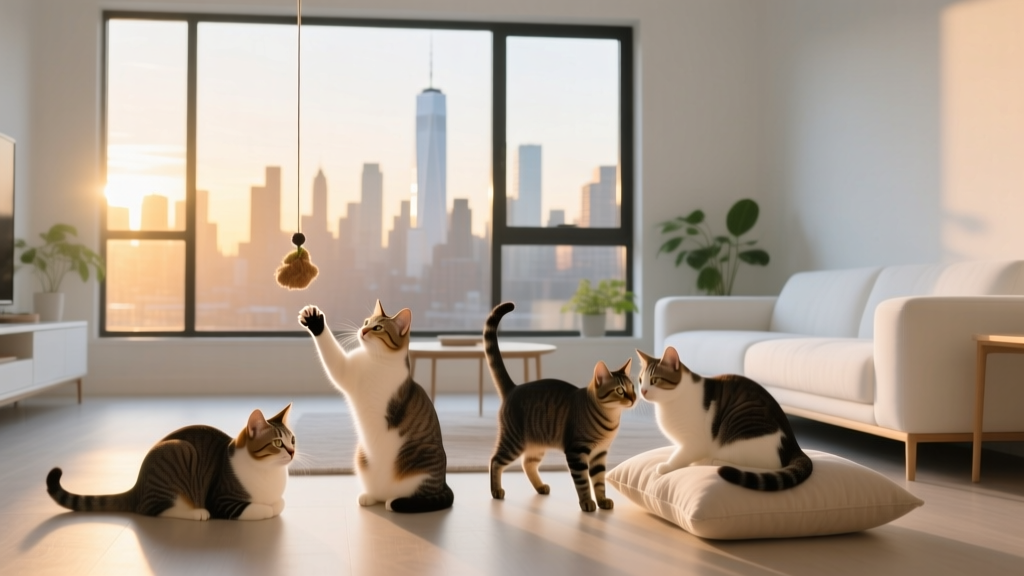
- Play: Engage in 15 minutes of predatory-style play *before* known high-risk windows (e.g., 45 min before bedtime, 20 min before you typically start working).
- Pause: Stop while your cat is still engaged—not exhausted. Let them ‘catch’ the toy once, then end on a high note.
- Praise: Offer calm verbal praise *and* a small food reward *only after* they’ve settled quietly for 90 seconds post-play.
This mimics natural hunting rhythm (stalking → pouncing → resting) and teaches self-regulation. In a 2021 pilot study with 42 chronically restless cats, 79% reduced attention-seeking episodes by ≥70% within 10 days using this method—no medication, no supplements.
3. Medical Red Flags Disguised as ‘Behavior’
Never assume restlessness is purely behavioral—especially in cats over age 7 or those with sudden onset. Hyperthyroidism, dental pain, arthritis, and early-stage kidney disease all manifest as pacing, nighttime vocalization, or clinginess. Why? Pain and metabolic imbalance disrupt sleep architecture and increase anxiety-like states.
Key differentiators:
- Weight loss + increased appetite + restlessness = strong hyperthyroid suspicion (screen with T4 blood test).
- Restlessness paired with litter box avoidance or straining = possible FLUTD (feline lower urinary tract disease)—a veterinary emergency.
- Restlessness worsening at night + disorientation or staring into corners = cognitive dysfunction syndrome (‘cat dementia’) or hypertension.
Dr. Lin emphasizes: “I see three to five cases weekly where owners spent months trying ‘behavior mods’ before discovering treatable pain. A full senior panel—including blood pressure, urinalysis, and dental exam—is non-negotiable before labeling anything ‘just behavioral.’”
4. The Social Synchronization Gap: When Your Cat’s Needs Don’t Match Your Life
Cats are facultatively social—they choose connection, but only on their terms. Yet many owners unintentionally create mismatched expectations. Consider Luna, a 3-year-old domestic shorthair whose owner worked remotely. Luna began knocking pens off desks and sitting on keyboards. The owner assumed boredom—until a video review revealed Luna approached *before* each Zoom call, waited patiently near the chair, and only escalated *after* being ignored for >90 seconds. Her need wasn’t stimulation—it was co-presence without demand.
Solutions that honor feline autonomy:
- ‘Proximity Without Pressure’ Zones: Place a cat bed or perch beside your workspace—not on your lap. Add a soft blanket with your worn shirt (scent security) and a battery-free interactive toy (e.g., a tunnel with crinkle balls).
- Clicker-Based ‘Check-In’ Training: Teach your cat to gently tap a target stick when they want attention. Reward *only* when they do so calmly—then grant 60 seconds of focused interaction. This builds impulse control.
- Environmental Time-Sharing: Use timed feeders and puzzle toys to create ‘quiet zones’ during your high-focus hours—and dedicated ‘connection windows’ where you’re fully present.
| Trigger Category | Key Signs | First Action Step | Expected Timeline for Improvement |
|---|---|---|---|
| Environmental Stress | Pacing near windows, excessive grooming, hiding during visitors | Install opaque window film + introduce Feliway Optimum diffuser in main living area | 3–7 days for reduced vigilance; 2–3 weeks for full calming effect |
| Play Deprivation | Attacking ankles, pouncing on shadows, obsessive toy-chasing | Implement ‘Play → Pause → Praise’ protocol twice daily at consistent times | Noticeable decrease in intensity by Day 5; 70% reduction by Day 14 |
| Underlying Pain/Illness | Sudden onset, weight change, litter box changes, vocalizing in unusual locations | Schedule vet visit with senior wellness panel (T4, SDMA, BP, oral exam) | Depends on diagnosis—but symptom relief often begins within 48–72 hrs of treatment |
| Social Timing Mismatch | Attention-seeking peaks during your work calls or meals, stops when you relax | Create proximity zone + teach ‘tap-for-attention’ cue with clicker | Initial response in 2–3 days; reliable use of cue in 8–12 days |
Frequently Asked Questions
Is my cat’s restlessness a sign of separation anxiety?
True separation anxiety is rare in cats (<5% of cases)—but what looks like SA is often insecure attachment due to inconsistent caregiving or early weaning trauma. Signs include destructive behavior *only* when you’re gone, excessive vocalization at departure, or refusing food when alone. Unlike dogs, cats rarely soil or chew destructively. If suspected, consult a veterinary behaviorist—not a trainer—for assessment. Video monitoring helps distinguish SA from boredom or medical triggers.
Can I use CBD oil or calming supplements to help?
Evidence is limited and quality varies wildly. A 2023 University of California Davis review found only two CBD products met label claims for purity and concentration—and neither showed statistically significant behavioral improvement over placebo in double-blind trials. L-theanine and alpha-casozepine (found in Zylkène) have stronger evidence for mild-moderate anxiety, but always discuss with your vet first. Supplements should *support*, never replace, environmental and behavioral interventions.
Why does my cat get worse when I ignore the behavior?
Ignoring works only if the behavior is truly attention-motivated *and* you’ve eliminated all other reinforcers (e.g., food, access to rooms, accidental eye contact). Most owners unknowingly reinforce restlessness via ‘extinction bursts’—temporary escalation when a behavior stops working. If ignoring causes biting, urine marking, or aggression, stop immediately. You’re likely missing a pain or fear component. Re-evaluate with a vet before continuing.
Will getting a second cat solve the problem?
Rarely—and often makes it worse. Introducing a new cat adds massive social stress, especially for adult cats. Studies show 68% of ‘lonely’ cats become *more* restless post-introduction due to resource competition and disrupted routines. Only consider a companion if your cat has a documented history of positive, playful interactions with other cats—and even then, follow a 4-week gradual introduction protocol with separate resources.
How do I know if it’s ‘normal’ kitten energy vs. problematic restlessness?
Kittens under 6 months *should* have bursts of activity—but they also nap 18–20 hours/day and settle quickly after play. Problematic restlessness lacks recovery: no sustained naps, constant vigilance, or frantic searching. Also, kittens rarely vocalize persistently for attention unless ill or cold. If your kitten won’t sleep for >2 hours straight or cries continuously when placed in a warm, safe space, seek urgent vet care.
Common Myths
Myth #1: “Cats are solitary animals—they don’t need interaction.”
False. While cats don’t require pack dynamics like dogs, they form complex, individualized social bonds. Feral colony studies show cats groom, sleep, and hunt cooperatively—and domestic cats exhibit identical affiliative behaviors with trusted humans. Depriving them of predictable, low-pressure connection directly fuels restlessness.
Myth #2: “If I give in to attention-seeking, I’ll spoil them.”
Not accurate. What spoils cats is *inconsistent* reinforcement. Giving attention *after* calm behavior (not during yelling/pawing) builds trust. Withholding all interaction teaches helplessness—not independence.
Related Topics (Internal Link Suggestions)
- Understanding Cat Body Language — suggested anchor text: "how to read your cat's tail flicks and ear positions"
- Best Interactive Toys for High-Energy Cats — suggested anchor text: "top 7 puzzle feeders that reduce boredom"
- When to See a Veterinarian for Behavioral Changes — suggested anchor text: "10 subtle signs your cat needs a vet checkup"
- Feline Hyperesthesia Syndrome Explained — suggested anchor text: "why your cat suddenly darts and bites their tail"
- Creating a Cat-Friendly Home Layout — suggested anchor text: "vertical space ideas that reduce stress"
Your Next Step Starts Today—No Waiting Required
You now hold the framework to decode why your cat is restless and exhibiting attention seeking behavior—not as a mystery, but as a solvable equation of environment, biology, and relationship. Don’t wait for the next 3 a.m. yowl or the next knocked-over plant. Pick *one* action from this article—whether it’s installing window film, scheduling that senior blood panel, or doing your first ‘Play → Pause → Praise’ session tonight—and commit to it for 72 hours. Track what changes. Notice the tiny shift in your cat’s posture, the longer nap, the quieter morning. That’s not magic. It’s listening. And when you listen deeply, your cat doesn’t just settle down—they begin to trust you, profoundly and quietly, in ways words can’t capture. Ready to go further? Download our free 7-Day Restlessness Tracker & Intervention Planner—complete with printable logs, vet conversation scripts, and video demos of the protocols mentioned here.