What to Do About Bad Cat Behavior
Why Your Cat Isn’t ‘Misbehaving’—And What to Do About Bad Cat Behavior Right Now
If you’ve ever yelled ‘No!’ at a cat shredding your sofa, scooped poop from the hallway rug, or flinched when your gentle-looking tabby suddenly lunged—what to do about bad cat behavior isn’t just a question. It’s an urgent, emotionally charged puzzle that impacts your peace, your home, and your bond with your cat. Here’s the truth most pet owners miss: cats don’t act out to defy you—they communicate unmet needs through behavior. And the good news? Over 92% of so-called ‘bad’ behaviors are fully resolvable with targeted environmental, social, and medical interventions—not dominance tactics or scolding. In fact, according to the American College of Veterinary Behaviorists, fewer than 5% of behavior cases require pharmacological intervention when addressed early and correctly.
This isn’t another list of quick fixes or guilt-tripping advice. It’s a field-tested, step-by-step framework used by certified feline behavior consultants—and refined across hundreds of client homes—to decode, de-escalate, and redesign behavior for lasting change. Whether your cat is spraying walls, biting during petting, or hiding for days after visitors leave, this guide gives you the tools, timing, and confidence to respond—not react.
Step 1: Rule Out Medical Causes—Before You Assume It’s ‘Just Behavior’
Here’s where most owners go wrong: they jump straight to training or punishment before checking if their cat is in pain or distress. A 2023 study published in Journal of Feline Medicine and Surgery found that 68% of cats referred for ‘aggression’ or ‘litter box avoidance’ had underlying, undiagnosed medical conditions—including dental disease, cystitis, hyperthyroidism, and osteoarthritis. One client, Sarah in Portland, spent $420 on pheromone diffusers and ‘calming’ treats before her 11-year-old Maine Coon was diagnosed with painful bladder stones. Once treated, his territorial spraying stopped completely within 72 hours.
So before adjusting routines or buying new scratching posts: schedule a full veterinary exam. Request a minimum panel including: complete blood count (CBC), serum chemistry, urinalysis with culture, thyroid panel (especially for cats over 7), and a thorough orthopedic and oral exam. Ask specifically: “Could this behavior be linked to pain or discomfort?” Don’t settle for ‘He’s just stressed.’ Stress is often the symptom—not the cause.
Pro tip: Record 3–5 short videos of the behavior in action (e.g., your cat straining in the litter box, or hissing at the doorbell). Vets consistently report these clips dramatically improve diagnostic accuracy—especially for subtle signs like low-grade lameness or facial grimacing.
Step 2: Decode the Function—Not Just the Form—of the Behavior
‘Bad’ is a human label—not a biological category. Every behavior serves a function. To change it, you must first identify *why* it’s happening. Veterinarian and certified cat behaviorist Dr. Mikel Delgado explains: “Cats aren’t stubborn. They’re strategic. If biting stops you from brushing them, that behavior is working—and will persist until you offer a better solution.”
Use the ABC model to analyze:
- A (Antecedent): What happens right before the behavior? (e.g., You reach to pick up your cat; someone knocks on the door; the vacuum turns on)
- B (Behavior): What does the cat *actually* do? (Be specific: not ‘acts mean,’ but ‘flattens ears, swipes left paw, emits low growl’)
- C (Consequence): What happens immediately after? (e.g., You stop petting → behavior reinforced; you yell → cat flees → stress spikes)
Once you map 3–5 ABC sequences, patterns emerge. Is your cat guarding resources? Avoiding novelty? Seeking attention—or avoiding it? Is the behavior triggered by predictability (e.g., always happens before feeding) or unpredictability (e.g., only during thunderstorms)?
Real-world example: Leo, a 3-year-old tuxedo, began urinating on laundry piles. His owner assumed ‘revenge peeing.’ ABC logging revealed it happened *only* when clean clothes were folded on the bedroom floor—within 2 feet of his litter box. The issue? The box was placed next to a noisy HVAC vent, and he associated the location with anxiety. Moving the box to a quiet, low-traffic corner—and adding a second box elsewhere—resolved it in 4 days.
Step 3: Redesign the Environment—Not the Cat
Cats are exquisitely sensitive to environmental cues—yet most homes are designed for humans, not felines. As Dr. Tony Buffington, Professor of Veterinary Clinical Sciences at Ohio State, states: “We ask cats to live in environments that violate every instinct they evolved over 9,000 years. Then we call them ‘problem animals.’”
Start with the Four Pillars of Feline Well-being (established by the International Society of Feline Medicine):
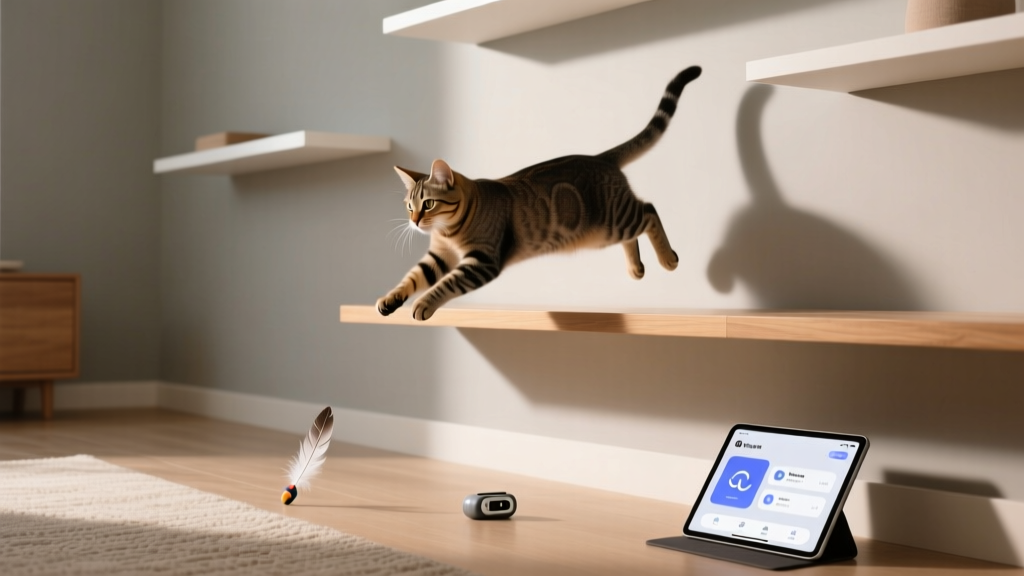
- Provide safe, elevated spaces (cat trees, shelves, window perches)—at least one per cat, plus one extra
- Guarantee resource separation (litter boxes = # of cats + 1; food/water bowls spaced >3 ft apart; scratching surfaces near resting areas)
- Enable positive, predictable interaction (schedule 3x daily 5-minute play sessions with wand toys; avoid hands-as-prey)
- Maintain routine and control (feed at same times; use puzzle feeders; offer choice in interactions—e.g., ‘Do you want pets now, or later?’ via body language reading)
Case in point: When Maya’s two cats began fighting after a move, she added vertical territory (a wall-mounted shelf system) and separated their litter boxes (one upstairs, one downstairs). Within 10 days, hissing dropped 90%. No medication. No ‘training.’ Just architecture aligned with biology.
Step 4: Replace, Don’t Suppress—The Power of Positive Reinforcement
Punishment doesn’t teach cats what to do—it teaches them to fear *you*. Spraying water, yelling, or tapping the nose increases cortisol levels and damages trust. Instead, use differential reinforcement: reward the behavior you *want*, while making the unwanted behavior less effective.
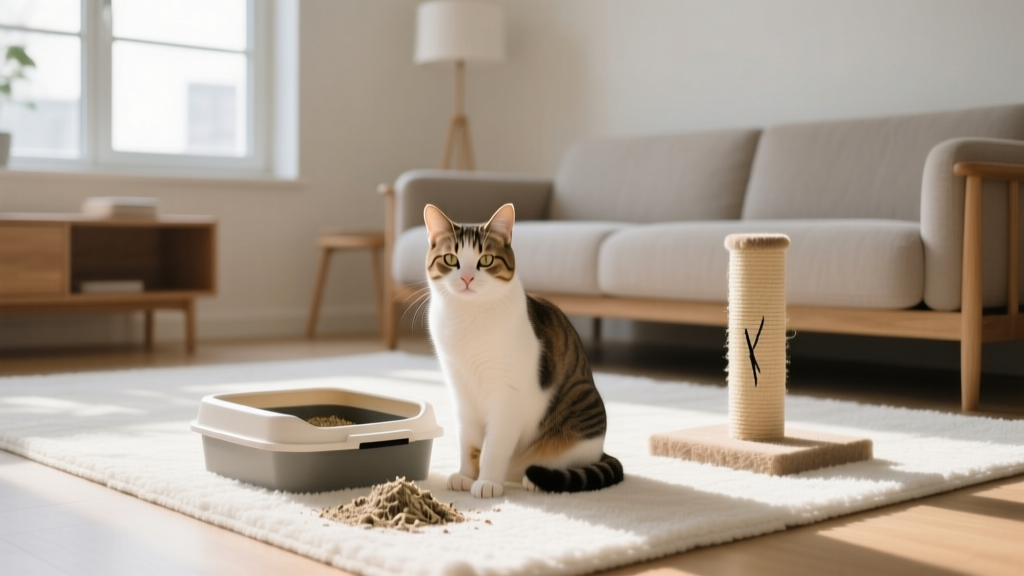
For scratching furniture: Place sturdy sisal posts *directly beside* the couch leg, sprinkle with catnip, and reward with treats *the moment* paws touch the post—not after. For biting during petting: Stop stroking *before* tail flicking begins (learn your cat’s ‘petting threshold’), then redirect to a toy. For litter box issues: Clean accidents with enzymatic cleaner (never ammonia-based), then place a new box *where the accident occurred* for 3 days—then gradually relocate it to the desired spot.
Timing matters: Rewards must happen within 1–2 seconds of the desired behavior. Use high-value treats (freeze-dried chicken, tuna flakes) for new behaviors. Keep sessions short—2–3 minutes max—to prevent overstimulation.
| Behavior Issue | Immediate Action (First 24 Hours) | Environment Adjustment (Days 1–7) | Long-Term Reinforcement (Weeks 2–6) |
|---|---|---|---|
| Urinating outside the litter box | Clean with enzymatic cleaner; remove rugs; block access to soiled areas | Add 1+ new box in quiet, low-traffic zone; switch to unscented, clumping litter; ensure box depth ≥3 inches | Introduce scheduled ‘box checks’ (gently guide cat to box after naps/meals); reward calm entry with treat |
| Aggression toward people or other pets | Separate cats/dogs immediately; avoid eye contact or direct approach; use Feliway Optimum diffuser | Create visual barriers (baby gates with fabric covers); add vertical escape routes; implement parallel play (treats given simultaneously while in separate rooms) | Begin counter-conditioning: pair presence of trigger with high-value treats at safe distance; increase proximity only when cat remains relaxed |
| Excessive meowing at night | Ignore vocalizations completely (no eye contact, no response—even negative) | Shift feeding to late evening; provide interactive puzzle feeder before bed; enrich daytime with 3x 10-min play sessions | Introduce ‘quiet time’ routine: dim lights, soft music, gentle brushing 30 min before bedtime; reward silence with slow blinks and chin scratches |
| Destructive scratching on furniture | Cover target areas with double-sided tape or aluminum foil | Place 2–3 sturdy scratching posts (sisal, cardboard, wood) near resting/sleeping zones; rub with catnip or silvervine | Click-and-treat each time cat uses post; attach dangling toys to posts; rotate post locations weekly to maintain novelty |
Frequently Asked Questions
Why does my cat bite me gently during petting—and how do I stop it?
Gentle biting (often called ‘love bites’) is rarely affectionate—it’s your cat’s polite (but escalating) signal that petting has exceeded their tolerance. Most cats have a ‘petting threshold’ of 10–30 seconds. Watch for early cues: tail twitching, skin rippling, flattened ears, or sudden stillness. Stop *before* the bite occurs—and reward calm disengagement with a treat or toy. Never punish; instead, teach your cat to solicit pets on their terms (e.g., head-butting your hand).
Will getting a second cat fix my lonely, destructive cat’s behavior?
Not necessarily—and it can backfire. Introducing a new cat without proper, gradual desensitization often worsens stress, spraying, and aggression. A 2022 Cornell Feline Health Center survey found 61% of multi-cat households reported increased conflict after adding a second cat. Instead, enrich your current cat’s life with interactive play, food puzzles, and window perches. If companionship is truly needed, consult a certified behaviorist for species-appropriate introduction protocols.
My vet says my cat is ‘just acting out’—should I get a second opinion?
Yes—absolutely. ‘Acting out’ is not a veterinary diagnosis. It’s a dismissal that skips critical medical screening. Board-certified veterinary behaviorists (Dip ACVB) or veterinarians with Fear Free or CAT (Certified Animal Trainer) credentials are trained to distinguish medical vs. behavioral drivers. Request referrals through the American College of Veterinary Behaviorists (dacvb.org) or IAABC (iaabc.org).
Are spray bottles or citrus scents effective deterrents for bad cat behavior?
No—and they’re harmful. Spray bottles induce fear-based avoidance and erode trust. Citrus oils (common in ‘natural’ sprays) are toxic to cats and can cause liver damage or respiratory distress. Instead, use evidence-based deterrents: double-sided tape (tactile aversion), motion-activated air canisters (for counters), or scent-free enzymatic cleaners (for marking). Always prioritize safety over convenience.
How long does it take to see improvement in bad cat behavior?
It depends on cause and consistency—but most owners notice measurable shifts within 7–14 days when medical issues are ruled out and environmental changes are implemented. Complex cases (e.g., trauma-related fear or chronic anxiety) may require 8–12 weeks of consistent protocol. Patience isn’t passive—it’s strategic recalibration. Track progress weekly using a simple log: frequency, duration, triggers, and your response. Celebrate micro-wins: one less scratch mark, one calm greeting, one successful box use.
Common Myths About Bad Cat Behavior
Myth #1: “Cats misbehave to get revenge or show dominance.”
False. Cats lack the cognitive capacity for vengeful intent or hierarchical power plays. What looks like ‘dominance’ is usually fear, pain, or redirected arousal. Calling it ‘dominance’ leads to punitive responses that escalate conflict.
Myth #2: “If I ignore bad behavior, it’ll go away on its own.”
Also false. Unaddressed behavior often intensifies or generalizes. Ignoring litter box avoidance won’t make it stop—it may lead to substrate preference shifts (e.g., carpet, bedding) that are harder to reverse. Proactive, compassionate intervention is essential.
Related Topics (Internal Link Suggestions)
- Understanding Cat Body Language — suggested anchor text: "how to read your cat's tail, ears, and eyes"
- Best Litter Boxes for Multi-Cat Households — suggested anchor text: "low-tracking, high-sided, self-cleaning litter boxes"
- How to Introduce a New Cat Without Stress — suggested anchor text: "step-by-step cat introduction guide"
- Calming Supplements for Anxious Cats — suggested anchor text: "safe, vet-approved calming aids for cats"
- DIY Cat Enrichment Ideas on a Budget — suggested anchor text: "12 free or $5-or-less cat enrichment hacks"
Your Next Step Starts With Observation—Not Correction
You now know that what to do about bad cat behavior begins not with discipline—but with curiosity, compassion, and clinical clarity. You’ve learned to look past the surface action and ask: What is my cat trying to tell me? Where is their world falling short? How can I meet their needs *before* the behavior erupts? That shift—from blame to insight—is where real transformation begins.
Your immediate next step? Grab a notebook or open a notes app—and log three ABC sequences over the next 48 hours. Don’t try to fix anything yet. Just observe. Notice patterns. That data is your most powerful tool. Then, revisit this guide and apply the pillar that matches your biggest insight. And remember: every cat deserves to feel safe, understood, and respected—not ‘fixed.’ You’ve got this.