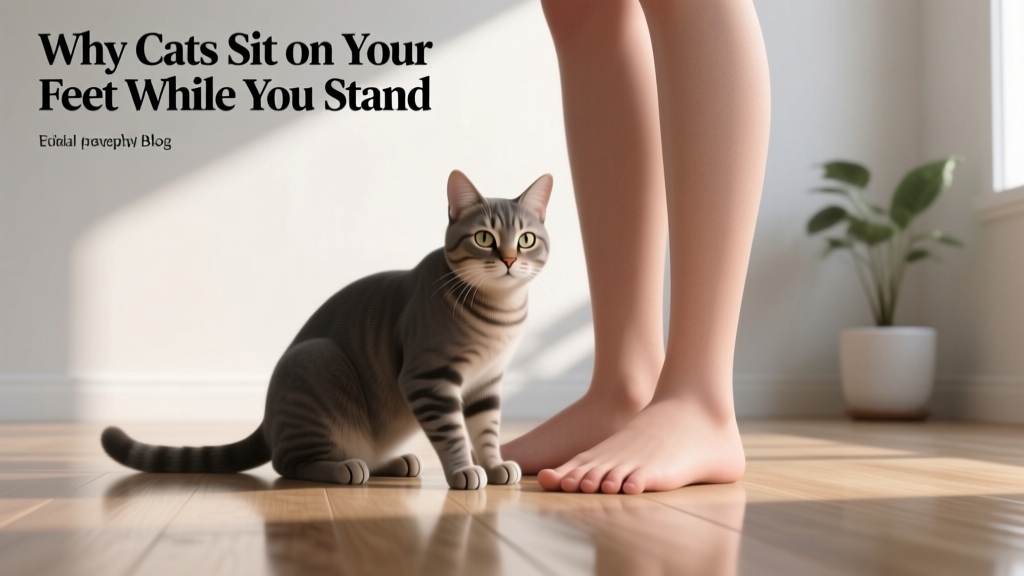
Why Cats Sit on Your Feet While You Stand
You’re at the kitchen counter making coffee. Or brushing your teeth. Or waiting for the microwave to beep. You’re standing still for two seconds—two—and suddenly you feel a warm, soft “thunk” against your ankles. Your cat has parked their entire body on your feet like you’re a pair of heated slippers they personally ordered.
If you’ve ever looked down and thought, “Why… my feet?” you’re in good company. This is one of those classic cat behaviors that feels quirky, affectionate, mildly inconvenient, and weirdly flattering all at once. And like most cat things, it’s not random. There are a few solid reasons your cat chooses your feet as the perfect sitting spot.
The science (and evolution) behind the “foot sit”
Cats are small predators, but they’re also prey to larger animals in the wild. That combination shaped a brain that’s always balancing: seek safety, keep control of the space, and stay close to resources (food, warmth, shelter… and you).
Standing humans create a tall, stable “landmark” in the home. When your cat sits on your feet, they’re doing a few evolutionary-smart things at once:
- Claiming a safe zone: Your body is a big protective presence. Sitting pressed against you reduces the number of directions anything “surprising” can approach from.
- Staying connected to the group: Cats aren’t solitary robots—they form social bonds. In friendly cat colonies, individuals rest close together, touch, and co-sleep.
- Conserving heat: Cats love warmth. Your feet (and the air around your legs) are often warmer than the surrounding floor, especially on tile.
- Gathering information: Cats are scent-driven. Your socks, shoes, and the floor around you carry a story: where you’ve been, who you’ve interacted with, what you stepped on (gross, but informative).
In short: your cat isn’t just being adorable. They’re choosing a strategic, cozy, information-rich spot next to someone they trust.
What’s really going on? Different contexts that change the meaning
Not all “cats on feet” moments are the same. The context tells you whether this is affection, anxiety, routine, or a polite attempt at controlling your schedule.
1) The “You’re finally still” sit
Cats are masters at timing. If you’ve been walking around, they may hold back. The second you stop—at the sink, the fridge, the closet—they swoop in. This is often simple: your cat wants contact, and standing still is their best chance.
What it looks like: A relaxed flop against your ankles, maybe a slow blink, maybe a small purr that feels like it’s coming from your socks.
2) The “Don’t leave” foot anchor
Some cats sit on feet when they suspect you’re about to move. Shoes go on, keys jingle, you hover near the door… and suddenly your cat becomes a living paperweight.
What it looks like: They position themselves on your feet rather than beside you. They may stare up at you, meow, or cling a little harder than usual.
This can be affectionate (“I’ll miss you”) or mildly anxious (“I hate change and I’d like you to stop making it happen”).
3) The “You are mine” territorial sit
Cats are territorial, but “territory” often means relationships too. Sitting on your feet can be a subtle social signal to other pets: this human is part of my safe circle.
What it looks like: Your cat sits on your feet when another cat or dog is nearby, or when visitors are over. They may glance at the other animal, then settle more firmly.
4) The “Feeding time negotiation” sit
Some cats learn that sitting on your feet is a highly effective reminder. It’s hard to ignore a cat you can’t move without gently nudging.
What it looks like: Sitting on feet + staring at the food area + tiny chirps. If you move, they re-attach like Velcro.
5) The “Cold floor, warm human” sit
If your home has cold flooring, your cat may use your feet the way they use a sunny windowsill. Warmth is a resource, and you are conveniently portable.
What it looks like: More common in winter, mornings, or after your cat wakes from a nap and wants a warm-up spot.
What sitting on your feet says about your cat’s mood
Your cat’s body language will tell you whether this is pure affection, mild stress, or something in between.
- Content and affectionate: Loose body, tail resting softly, slow blinks, purring, kneading your foot (yes, it’s weird), leaning their weight into you.
- Seeking reassurance: Slightly tense body, ears pivoting often, scanning the environment, staying glued to you when there’s noise or visitors.
- Playful mischief: They sit briefly, then bat at your shoelaces, ambush your pant leg, or dart away. This is often a “bored cat” signature.
- Overstimulated or irritated: Tail flicking sharply, skin twitching, growly purr (rare but real), ears angled back. In this case, they may be using your feet as a “buffer,” but they don’t want touch.
Most of the time, foot-sitting is a compliment. Your cat is choosing closeness in a way that feels safe and low-pressure.
Related behaviors you might also notice
If your cat sits on your feet, you’ll often see a few cousin behaviors—same emotional theme, different execution:
- Shadowing you room to room: You can’t pee alone. This is not a you problem; it’s a cat bonding strategy.
- “Checking in” by bumping your legs: A quick head-butt or body rub is social scent marking—your cat’s version of exchanging business cards.
- Sitting on your shoes or laundry: Shoes smell like “outside you,” and laundry smells like “home you.” Both are comforting.
- Parking near your ankles during conversations: Cats often choose the edge of social activity. It’s close, but not chaotic.
- Sleeping on your feet in bed: Same concept: warmth + proximity + gentle control over your movements (“Don’t roll away from me”).
When it’s normal… and when it might be a concern
Normal: Your cat sits on your feet occasionally or daily, seems relaxed, eats normally, plays, and is generally acting like themselves.
Possibly a concern if foot-sitting shows up suddenly or becomes intense, especially alongside other changes. Watch for:
- New clinginess or anxiety: Following you frantically, vocalizing more, hiding less or more than usual.
- Fear triggers: Construction noise, a new pet, new roommate, moving furniture—cats often cling when their environment feels unpredictable.
- Signs of pain or illness: Less play, reduced appetite, changes in litter box habits, stiffness, or reluctance to jump. Some cats seek extra contact when they don’t feel well.
- Compulsive “blocking” behavior: If your cat repeatedly sits on your feet and becomes distressed when you move, it may signal separation-related stress or insecurity.
If you’re seeing behavior changes plus appetite/litter box changes, or your cat seems uncomfortable, a vet check is a smart first step. For anxiety patterns, a qualified cat behavior professional can help you identify triggers and build a plan.
How to respond (and how to encourage it in a healthy way)
If you enjoy the foot-sits, you can absolutely reinforce them—without accidentally teaching your cat to trip you at the worst possible moment.
Do this if you want to encourage the behavior
- Reward calm contact: When your cat sits gently and you’re steady, offer quiet praise or a small treat after a few seconds. You’re reinforcing “polite closeness,” not ankle-attacks.
- Create a nearby alternative: Place a small mat, bed, or heated pad near where you stand most (kitchen, bathroom sink). Many cats will choose “feet or bed” depending on mood.
- Use predictable routines: Cats love patterns. If your cat foot-sits around mealtime, feed on a schedule and add a short play session beforehand to reduce demanding behavior.
- Offer scent comfort: Leave a worn (clean-ish) t-shirt in their favorite spot. It can satisfy the “I want my human smell” need without requiring your ankles.
Do this if you need your feet back
- Move slowly and predictably: Sudden steps can startle a cat and create a negative association. Shift weight gently, give a verbal cue (“Oops, moving”), and step away calmly.
- Redirect instead of pushing: Lure your cat to a nearby spot with a treat toss or a wand toy. Repeated pushing can feel threatening to some cats.
- Teach a station behavior: You can train “go to mat” using treats. It’s a lifesaver when you’re cooking or carrying laundry.
The goal is to keep the message clear: closeness is welcome, but safety and consent go both ways—your cat shouldn’t get stepped on, and you shouldn’t live as a hostage to adorable ankles.
Fun facts and research-y nuggets about “cats on feet”
- Cats use social scent to build a “group smell.” Rubbing and leaning transfer pheromones from facial and body glands. Sitting on your feet is a low-effort way to stay in that shared scent bubble.
- Physical contact can be a security behavior. In many social animals, touching a trusted individual reduces vigilance. Your cat may relax faster when they’re pressed against you.
- Cats prefer predictable, steady contact. Feet are stable when you’re standing still—less grabby than hands, less face-to-face intensity than lap time.
- Some cats choose feet over laps for control. A lap can be “too much” (more restraint, more direct petting). Feet allow closeness with an easy escape route.
FAQ: Common questions about cats sitting on your feet
Is my cat being possessive when they sit on my feet?
Sometimes, yes—though “possessive” in cats often looks like social claiming, not jealousy the way humans mean it. If your cat does it more around other pets or visitors, they may be signaling, “This is my safe person.”
Why does my cat sit on my feet only when I’m cooking?
Cooking areas combine routine, smell, and attention. Your cat may have learned that standing at the counter predicts food (for you, or eventually for them). They’re also close enough to monitor you and potentially intercept a dropped morsel.
My cat sits on my feet and bites my ankles—what gives?
This is usually over-arousal or play, especially in younger cats. If the sit turns into ankle biting, add more daily play (wand toy “hunt” sessions), avoid moving your feet in a way that triggers chasing, and reward calm sitting while redirecting bitey moments to a toy.
Do cats sit on feet because they’re cold?
Cold can be a big factor, especially on tile or in winter. If your cat does this more in the morning or after lying still, warmth is likely part of the motivation. A heated cat bed or warm mat nearby can help.
Should I worry if my cat suddenly becomes glued to my feet?
If it’s a sudden change, look for stressors (new pet, schedule change, loud noises) and monitor for health signs (appetite, litter box, mobility). Sudden clinginess can be emotional—or physical discomfort. When in doubt, start with a vet check.
How do I stop my cat from sitting on my feet without hurting their feelings?
Redirect and replace. Give them a nearby “approved spot” (mat/bed), reward them for choosing it, and move calmly when you need to step away. Cats don’t take it personally the way we do—they just follow what works and feels safe.
When a cat sits on your feet, they’re usually saying some version of: “You’re my safe place. Also, you’re warm. Also, please do not leave.” It’s a small behavior with a big emotional backstory—comfort, bonding, routine, and the cat instinct to stay close to what matters.
If your cat is a dedicated foot-sitter (or has an even funnier “I must touch you at all times” habit), share your story with the Cat Lovers Base community at catloversbase.com. Cat people live for this stuff.