Cat Behavioral Exam: What It Really Is
Why Your Cat’s ‘Weird’ Behavior Isn’t Weird at All—It’s a Cry for Clarity
So, what is cat behavioral exam? It’s not a quick glance at your cat pacing before litter box use—or a vet scribbling “stress?” on a chart after a 90-second consult. A true cat behavioral exam is a systematic, multi-layered evaluation designed to distinguish between medical illness masquerading as behavior change (like hyperthyroidism causing aggression), genuine anxiety disorders, environmental deficits, learned responses, and normal feline communication gone misunderstood. And here’s why it matters right now: over 68% of cats surrendered to shelters cite ‘behavior problems’ as the primary reason—but in 41% of those cases, a thorough behavioral exam would have revealed an undiagnosed pain source, inadequate enrichment, or treatable anxiety—with zero need for rehoming. This isn’t about fixing ‘bad cats.’ It’s about decoding their language—and finally hearing them.
What a Real Cat Behavioral Exam Actually Involves (Spoiler: It’s Not Just ‘Does Your Cat Hiss?’)
A certified feline behaviorist or veterinary behaviorist doesn’t rely on gut instinct or generic questionnaires. They follow a validated framework—often adapted from the American College of Veterinary Behaviorists (ACVB) and International Society of Feline Medicine (ISFM) guidelines—that breaks down assessment into four pillars: medical rule-out, behavioral history deep-dive, environmental audit, and functional analysis. Let’s unpack each.
1. Medical Rule-Out (Non-Negotiable First Step)
Before labeling any behavior ‘behavioral,’ professionals require recent bloodwork (CBC, chemistry panel, T4), urinalysis, and often dental x-rays or orthopedic evaluation. Why? Because chronic pain—from arthritis, cystitis, or dental disease—is the #1 driver of ‘sudden’ aggression, litter box avoidance, or withdrawal in cats over age 7. According to Dr. Sarah Heath, a European Diplomate in Veterinary Behavioral Medicine, “In my clinical practice, over half of cats referred for ‘idiopathic aggression’ had significant, untreated oral pain or degenerative joint disease.” Skipping this step turns every behavioral intervention into guesswork—and potentially dangerous delay.
2. Behavioral History Deep-Dive
This goes far beyond ‘When did it start?’ A skilled examiner asks: What was happening 72 hours before the first incident? (e.g., new pet, home renovation, visitor with perfume); What does the behavior look like frame-by-frame? (e.g., tail flick frequency, ear position, pupil dilation, duration); What stops it—and what makes it worse? This functional approach reveals patterns invisible to casual observation. For example, a cat who only eliminates outside the box when the dishwasher runs likely has noise-triggered anxiety—not ‘litter aversion.’
3. Environmental Audit
Cats don’t live in vacuums—they live in ecosystems. A certified exam includes mapping resource distribution: Are food bowls near noisy appliances? Is the litter box next to the washing machine? Are there fewer scratching posts than cats? Are vertical spaces accessible to all individuals? Research published in Journal of Feline Medicine and Surgery (2022) found that cats in homes with ≥3 elevated resting spots per cat showed 63% lower cortisol levels than those with ≤1—and were 5x less likely to develop urine marking.
4. Functional Analysis & Baseline Observation
The clinician may request 3–5 days of video logs (with timestamps) showing behavior during key windows: pre-dawn, post-meal, and evening. They analyze sequences—not isolated acts. Did the cat pace for 2 minutes, then vocalize, then scratch the door? That suggests frustration-driven displacement behavior—not random ‘craziness.’ Some vets now use AI-assisted video tools (like PetPace’s feline module) to quantify activity shifts, but human interpretation remains irreplaceable.
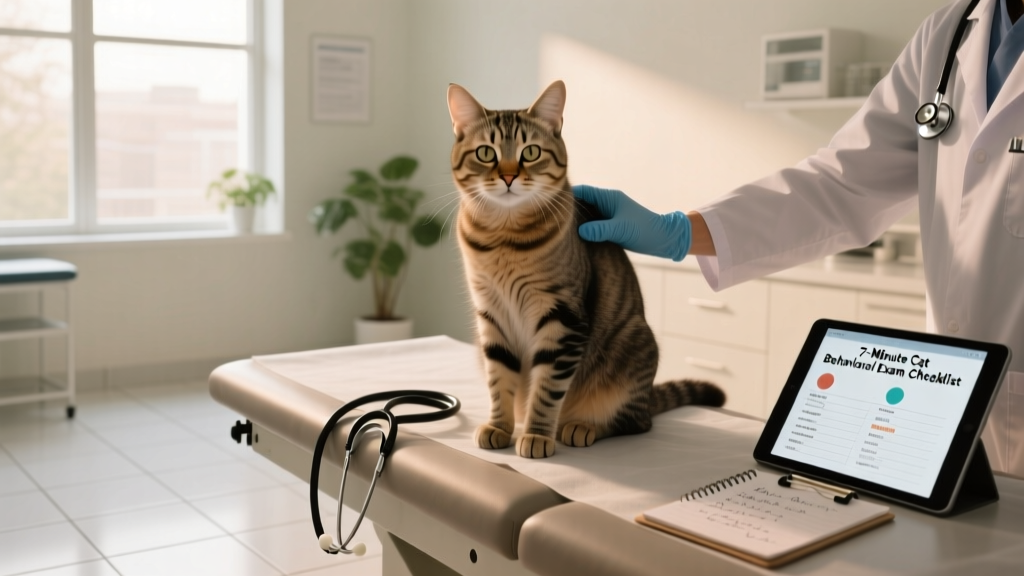
Your Role: The 7-Minute Prep Checklist Before the Appointment
You’re not just a bystander—you’re the most vital data collector. A poorly prepared owner can derail even the best exam. Here’s exactly what to gather in under 7 minutes:
- Timeline Log: Note dates/times of 3–5 recent incidents—including what happened immediately before and after (e.g., ‘May 12, 6:45 AM: Scratched couch after vacuuming; calmed after offered tuna).
- Resource Map: Sketch your home layout. Mark locations of litter boxes (how many? type of litter? scooped daily?), food/water stations (are bowls plastic? near litter?), scratching surfaces (cardboard, sisal, wood?), and safe resting zones (height, privacy, sun exposure).
- Video Snippets: Capture 30 seconds of the behavior *in context*—not just the ‘bad’ moment, but 10 seconds before and after. Show lighting, sounds, and your own proximity.
- Medical Snapshot: Bring recent lab results, medication lists (including supplements), and notes on appetite, litter box output (color/consistency/frequency), and sleep patterns.
Pro tip: Don’t say ‘he’s always been like this.’ Say ‘He started hiding under the bed every time the neighbor’s dog barks—first observed March 3, after they got the puppy.’ Specificity is your superpower.
Decoding the Report: What ‘Anxiety-Related Elimination’ Really Means (and What to Do Next)
Hearing ‘behavioral issue’ can feel like a dead end—but it’s actually the starting line. A quality behavioral exam report won’t stop at labels. It will specify function (why the behavior persists), triggers (predictable antecedents), reinforcers (what keeps it going), and intervention tiers. For instance:
“Fluffy’s inappropriate urination serves an anxiety-reduction function. Trigger: Owner leaving for work. Reinforcer: Immediate reduction in autonomic arousal (pupil constriction, slower respiration) upon voiding on soft fabric. Recommended tiered plan: 1) Environmental: Add pheromone diffuser + designated ‘safe zone’ with covered bed and food puzzle; 2) Behavioral: Graduated departure training (start with 30-sec exits); 3) Medical: Trial of gabapentin PRN for high-stress mornings—if no improvement in 2 weeks, consider fluoxetine.”
This level of specificity transforms vague worry into actionable steps. Contrast that with ‘Try Feliway and clean with enzyme cleaner’—a common but insufficient recommendation that misses root cause.
Real-world case: Luna, a 4-year-old Siamese, was labeled ‘aggressive’ after biting her owner’s ankles. Her exam revealed she’d developed redirected aggression after seeing outdoor cats through a window—then generalized to moving legs indoors. Solution? Window film + interactive play sessions timed to coincide with outdoor cat activity. Biting stopped in 11 days. No meds. No surrender.
When to Seek Help—and When to Wait (The 3-Week Rule)
Not every quirk warrants an exam—but some signals are urgent red flags. Use this threshold:
- Seek within 72 hours: Sudden vocalization changes (new yowling, silence), unexplained weight loss >5%, self-mutilation (over-grooming bald patches, ear scratches), or elimination outside the box plus straining/crying.
- Schedule within 2 weeks: New hiding >4 hrs/day, avoidance of family members, persistent inter-cat tension (blocking resources, hissing without provocation), or repetitive behaviors (tail-chasing, fabric sucking).
- Monitor—but don’t wait: If behavior is stable, non-harmful, and hasn’t worsened in 3 weeks, it may be baseline personality. But document it. Cats rarely ‘grow out of’ true pathology.
Remember: Waiting for ‘it to get worse’ costs more—emotionally and financially. A proactive exam averages $220–$380. Compare that to $1,200+ for emergency urinary blockage treatment—or the lifelong guilt of rehoming a cat whose needs were misread.
| Component | Standard Vet Visit | Certified Feline Behaviorist Exam | Veterinary Behaviorist Exam |
|---|---|---|---|
| Duration | 12–18 minutes | 60–90 minutes (includes home visit option) | 75–120 minutes + follow-up |
| Medical Workup Required? | Often skipped unless obvious symptoms | Requires recent labs + vet clearance letter | Performs or coordinates full diagnostics |
| Environmental Assessment | Rarely conducted | Detailed home map + resource audit + photo/video review | Home video analysis + in-person environmental scan |
| Behavioral Plan Specificity | Generic advice (‘more play’, ‘try Feliway’) | Step-by-step protocol with timing, criteria, and troubleshooting | Medication options + behavioral plan + progress metrics |
| Average Cost (US) | $65–$110 (exam fee only) | $180–$320 (initial) | $250–$450 (initial) + med co-pays |
Frequently Asked Questions
Is a cat behavioral exam covered by pet insurance?
Most major insurers (Trupanion, Healthy Paws, Embrace) cover veterinary behaviorist visits if a medical condition is ruled out first and the referral comes from your primary vet. Coverage typically applies to diagnostic time, prescribed medications, and follow-ups—but rarely to certified behaviorist (non-DVM) consultations. Always submit pre-authorization forms and keep itemized receipts. Note: Wellness plans rarely include behavioral exams.
Can I do a ‘DIY’ behavioral exam at home?
You can absolutely conduct preliminary observation using ISFM’s free Feline Behavioral Assessment Toolkit—but it’s not a substitute for professional evaluation. DIY efforts often miss medical mimics (e.g., mistaking kidney disease-induced lethargy for depression) or misinterpret triggers (assuming ‘play aggression’ when it’s fear-based). Think of it as gathering evidence for your expert—not replacing them.
How long does it take to see improvement after a behavioral exam?
It depends on the issue and intervention. Simple environmental fixes (adding a second litter box, blocking window access) often show change in 3–7 days. Anxiety protocols involving medication + behavior modification typically require 4–8 weeks for measurable reduction in incidents. Patience is critical: cats don’t ‘fail’ therapy—they communicate progress subtly (e.g., longer eye blinks, accepting chin scritches again, sleeping in open areas). Track micro-wins.
My cat hates carriers and car rides—will the exam still be accurate?
Yes—because reputable behaviorists prioritize low-stress assessment. Many offer telehealth initial consults (video review of environment + behavior clips), home visits, or collaborate with fear-free certified vets for in-clinic exams using calming protocols (Feliway spray, quiet rooms, minimal handling). Never force a stressed cat into a carrier for an exam—it skews data and damages trust.
Do kittens need behavioral exams?
Not routinely—but early intervention is powerful. If a kitten shows extreme fear (freezing, urinating when handled), persistent biting that doesn’t decrease by 14 weeks, or fails to socialize with humans/other pets by 12 weeks, an exam helps build resilience. Early neuroplasticity means interventions are 3x more effective before 6 months.
Common Myths About Cat Behavioral Exams
- Myth 1: “Only ‘problem cats’ need behavioral exams.”
Truth: These exams are preventive care—like dental cleanings. They identify subtle stress markers (chronic over-grooming, subtle avoidance) before they escalate into aggression or illness. Routine exams for senior cats (age 10+) are increasingly recommended by ISFM. - Myth 2: “If my cat’s acting ‘normal,’ the exam is unnecessary.”
Truth: ‘Normal’ is individual—but baseline shifts matter. A cat who suddenly sleeps 2 hours more daily, stops greeting at the door, or avoids a favorite perch may be signaling early pain or cognitive decline. Behavioral exams detect these nuances long before physical signs appear.
Related Topics (Internal Link Suggestions)
- Understanding Feline Stress Signals — suggested anchor text: "subtle signs your cat is stressed"
- How to Choose a Certified Cat Behaviorist — suggested anchor text: "finding a qualified feline behaviorist near you"
- Enrichment Ideas for Indoor Cats — suggested anchor text: "indoor cat enrichment activities"
- When Does Litter Box Avoidance Mean Medical Trouble? — suggested anchor text: "litter box issues medical causes"
- Senior Cat Cognitive Decline Signs — suggested anchor text: "is my older cat confused or anxious?"
Take Action—Your Cat Is Waiting to Be Understood
A what is cat behavioral exam question is often the first whisper of concern—the moment you realize your cat’s behavior doesn’t quite add up. Now you know it’s not a label, a last resort, or a luxury. It’s precision care. It’s empathy translated into action. So don’t wait for the 10th accident or the 3rd vet visit that ends with ‘maybe try a different litter.’ Download our free Cat Behavioral Exam Prep Checklist, schedule a consult with a vet who offers behavior-focused appointments—or ask your current vet for a referral to an ACVB diplomate. Your cat isn’t broken. They’re communicating. And with the right exam, you’ll finally understand the message.