What Cat Toys Are Best for Indoor Cats? 7 Vet
Why Choosing the Right Cat Toys Isn’t Just Fun—It’s Critical Behavioral Medicine
When you search what cat toys are best for indoor cats, you’re likely wrestling with more than just shopping—it’s a quiet plea for help. Your cat knocks things off shelves at 3 a.m., chews baseboards, overgrooms until patches appear, or stares blankly out the window for hours. These aren’t ‘quirks’—they’re behavioral red flags signaling unmet predatory, exploratory, and sensory needs. Indoor cats live 2–3x longer than outdoor cats, yet without intentional environmental enrichment, they experience chronic low-grade stress that elevates cortisol, suppresses immunity, and doubles the risk of idiopathic cystitis (a painful bladder condition), according to a landmark 2022 study in the Journal of Feline Medicine and Surgery. The right toys aren’t luxuries—they’re non-negotiable tools for neurological health, emotional regulation, and species-appropriate living.
How Indoor Life Rewires Your Cat’s Brain (And Why Generic Toys Fail)
Domestic cats retain 95% of their wild ancestor’s neuroanatomy—including a hyper-developed mesolimbic reward pathway wired for pursuit, capture, and ‘kill’ sequences. In nature, a cat performs 10–20 short hunts daily. Indoor cats average fewer than two meaningful predatory engagements per week. This mismatch triggers what Dr. Mikel Delgado, certified applied animal behaviorist and UC Davis researcher, calls ‘behavioral starvation’: the brain literally starves for dopamine-triggering activity. Generic jingle balls or dangling strings fail because they lack three critical elements: progressive challenge (escalating difficulty), sensory fidelity (realistic texture, scent, movement), and autonomy (the cat controls pacing and outcome). Without these, play becomes frustrating—not fulfilling.
Consider Luna, a 4-year-old spayed tabby adopted from a shelter. Her owner reported chronic tail-chasing, nighttime vocalization, and aggressive ‘love bites’ during petting. After a veterinary behavior consult, her enrichment plan replaced all floppy wand toys with a rotating system of puzzle feeders, scent-based hide-and-seek games, and prey-mimicking motorized toys. Within 11 days, her cortisol metabolites (measured via urine sampling) dropped 43%, and her owner reported ‘her first full night’s sleep in 18 months.’ This isn’t anecdote—it’s predictable neurobiology.
The 4 Non-Negotiable Toy Categories Every Indoor Cat Needs
Forget ‘one-size-fits-all.’ A truly effective toy strategy mirrors the natural hunting sequence: search → stalk → chase → pounce → kill → consume. Each phase engages distinct neural circuits. Here’s how to cover them all:
- Search & Stalk Toys: Low-scent, high-texture items hidden in cardboard tunnels or under blankets—think crinkle balls stuffed inside paper bags or dried catnip-filled felt mice buried in shredded paper. These activate the hippocampus and prefrontal cortex, building spatial memory and patience. Bonus: They reduce separation anxiety by giving cats purposeful solo time.
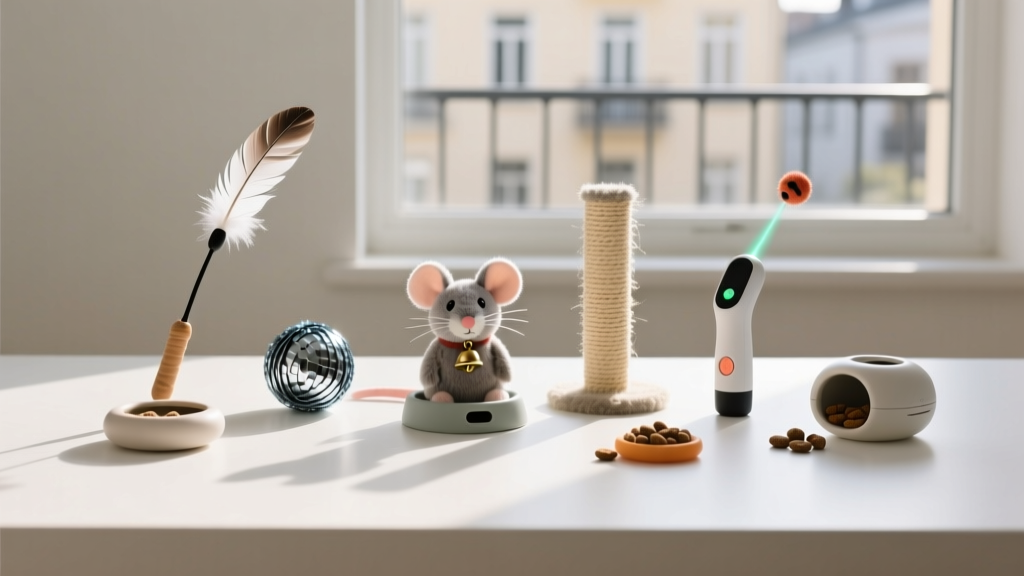
- Chase & Pounce Toys: Motorized toys with unpredictable, jerky movement (not smooth circles) simulate injured prey. Look for models with variable speed, randomized pauses, and erratic direction changes—like the FroliCat BOLT or PetSafe Frolicat Zoom. Avoid laser pointers alone; they trigger frustration without closure. Instead, pair them with a physical ‘reward toy’ (e.g., end each session with a plush mouse your cat can ‘catch’).
- Kill & Consume Toys: Toys designed for biting, kneading, and ‘killing’—think durable, catnip-infused kick toys (e.g.,SmartyKat Skitter Critters) or treat-dispensing puzzles that require manipulation to release food. This satisfies the final, most dopamine-rich stage of the hunt. As Dr. Dennis Turner, author of The Domestic Cat: The Biology of Its Behaviour, notes: ‘Without a consummatory act, play remains psychologically incomplete—and often escalates into redirected aggression.’
- Sensory & Environmental Toys: Not ‘toys’ in the traditional sense—but essential: vertical spaces (cat trees with multiple levels), window perches with bird feeders outside, and even DIY ‘scent gardens’ (safe herbs like cat grass, silver vine, or valerian root in small pots). These engage olfactory, visual, and vestibular systems, reducing stereotypic behaviors by up to 68% in clinical trials (University of Lincoln, 2021).
Vet-Reviewed Toy Safety: What Most Brands Don’t Tell You
Every year, the ASPCA Animal Poison Control Center logs over 1,200 cases of toy-related injuries in cats—most involving ingestion of string, plastic eyes, or toxic dyes. But safety goes beyond choking hazards. Here’s what vets prioritize:
- Fabric Integrity: Avoid plush toys with glued-on parts or synthetic fur that sheds microplastics. Opt for double-stitched seams and food-grade dyes (look for OEKO-TEX Standard 100 certification).
- String Length: If using wand toys, ensure strings are no longer than 12 inches and always supervised. Longer strings increase intestinal obstruction risk if swallowed—a leading cause of emergency surgery in young cats.
- Motorized Toy Design: Check for enclosed motors (no exposed gears), chew-resistant casings, and auto-shutoff timers (≥15 min). Overheating motors can melt plastic and emit harmful VOCs.
- Catnip Alternatives: While 50–70% of cats respond to catnip, many don’t—and some overstimulate. Silver vine (Actinidia polygama) elicits response in 80% of cats, including seniors and kittens, and has no known toxicity. Valerian root is another safe, potent option.
Dr. Sarah Wooten, DVM and veterinary advisor for the International Cat Care organization, stresses: ‘Toys should pass the “toddler test”: if it’s unsafe for a 2-year-old human, it’s unsafe for your cat. Their digestive tracts are far less forgiving than ours.’
Real-World Toy Rotation System: How to Keep Play Engaging (Without Buying 50 Toys)
Novelty fatigue is real—even for cats. A 2023 University of Guelph study found cats lose interest in toys after just 3–5 minutes of continuous exposure. The solution isn’t more toys—it’s strategic rotation. Here’s a proven 7-day system used by feline behavior clinics:
| Day | Toy Group | Key Action | Why It Works |
|---|---|---|---|
| Monday | Search & Stalk | Bury 3 different textured toys (crinkle ball, wool mouse, pinecone) in a cardboard box filled with shredded paper. Add 1 tsp silver vine powder. | Engages olfaction + tactile exploration; novelty resets attention span. |
| Wednesday | Chase & Pounce | Use motorized toy for 5 min, then switch to wand toy with feather lure for 3 min, ending with a plush ‘kill’ toy. | Mimics natural hunt progression; prevents over-arousal from motorized-only play. |
| Friday | Kill & Consume | Fill a slow-feeder puzzle with ⅓ of daily kibble; add 2 freeze-dried treats inside compartments. | Links feeding to predatory behavior—reducing begging and food obsession. |
| Saturday | Sensory & Environmental | Rotate window perch location; place bird feeder outside new window; spray valerian mist on scratching post. | Refreshes visual/olfactory input—critical for preventing apathy in senior cats. |
Rotate toys weekly—not daily—to avoid overwhelming your cat. Store unused toys in sealed containers away from sight (cats remember locations!). Introduce only one new toy per week to assess preference and safety. Track engagement in a simple log: toy name, duration of active play, signs of frustration (tail flicking, growling), and whether cat carried it to sleeping area afterward (a strong sign of bonding and security).
Frequently Asked Questions
Can I use dog toys for my indoor cat?
No—dog toys pose serious risks for cats. Many contain stuffing materials (polyester fiberfill) that cause intestinal blockages if ingested. Dog chew toys are often too hard, risking dental fractures. And dog puzzle feeders have openings too large for cats to manipulate, causing frustration. Stick to cat-specific designs tested for feline jaw strength, size, and predatory instinct.
Are battery-operated toys safe for unsupervised play?
Only if explicitly labeled ‘unsupervised-safe’ by a veterinary behaviorist-reviewed brand (e.g., FroliCat, PetSafe). Most motorized toys require supervision due to entanglement, overheating, or chewing risks. If you must leave a toy out, choose passive options: treat balls that roll slowly, cardboard tunnels, or hanging rope toys with secure mounting. Never leave lasers, strings, or small detachable parts unattended.
My cat ignores all toys—does that mean something’s wrong?
Not necessarily—but it warrants investigation. First, rule out pain: arthritis, dental disease, or hyperthyroidism can sap play drive. Have your vet perform a full exam, including orthopedic and oral checks. If medically cleared, try ‘prey priming’: rub silver vine on toys 10 minutes before offering, or mimic rodent sounds (soft squeaks) while moving toys erratically. Some cats respond only to specific textures—try rawhide strips, cork, or untreated wood. Patience and observation beat force-feeding play.
How many toys does my indoor cat really need?
Quality over quantity: 5–7 well-chosen, rotated toys cover all behavioral needs. More creates clutter and dilutes novelty. Focus on diversity of function—not aesthetics. A single high-quality puzzle feeder, one motorized chase toy, two scent-based search items, one kick toy, and one environmental enrichment item (perch, tunnel, or window setup) is optimal for most households. Adjust based on your cat’s age, energy, and medical status.
Is it okay to use food as a toy reward?
Yes—and it’s highly recommended. Food-based play taps directly into the ‘consume’ phase of predation. Use measured portions of your cat’s daily kibble in puzzle toys, or reserve 10% of calories for treat-based games. Avoid high-calorie commercial treats; opt for freeze-dried chicken, salmon, or liver. Never use food rewards for punishment or coercion—this erodes trust and creates food aversion.
Debunking Common Myths About Indoor Cat Toys
- Myth #1: “Cats just need a ball of yarn.” Yarn, string, ribbon, and rubber bands are among the top causes of linear foreign body obstructions—requiring emergency surgery. The American Veterinary Medical Association reports 1 in 4 string-related surgeries results in partial bowel resection. Safer alternatives: knotted cotton ropes (supervised), silicone ‘yarn’ toys, or interactive wands with retractable cords.
- Myth #2: “If my cat doesn’t play with it right away, it’s a bad toy.” Cats assess novelty through cautious investigation—not instant pouncing. Allow 2–3 days of passive exposure (leave toy near sleeping spot) before active play. Many cats prefer toys that smell like you (rub on sleeve first) or carry natural scents (silver vine, catnip, or even a drop of tuna water on fabric).
Related Topics (Internal Link Suggestions)
- Indoor Cat Enrichment Checklist — suggested anchor text: "indoor cat enrichment checklist"
- Best Cat Trees for Small Apartments — suggested anchor text: "best cat trees for small apartments"
- How to Stop Cat Boredom Aggression — suggested anchor text: "how to stop cat boredom aggression"
- Catnip vs Silver Vine: Which Is Better? — suggested anchor text: "catnip vs silver vine"
- Veterinary Behaviorist Near Me — suggested anchor text: "find a certified feline behaviorist"
Your Next Step: Build One Toy Kit Today (It Takes 12 Minutes)
You don’t need to overhaul everything at once. Start with a single, evidence-based ‘Stress-Relief Starter Kit’ built around your cat’s current behavior: If they’re destructive, begin with a search-and-stalk kit (cardboard box + crinkle ball + silver vine). If they’re lethargic, start with a chase-and-pounce combo (motorized toy + plush ‘kill’ toy). Set a timer for 12 minutes today—research the one item you’ll buy first, read its safety specs, and schedule your first rotation. Remember: every minute of species-appropriate play lowers stress hormones, strengthens your bond, and adds measurable quality years to your cat’s life. Your cat isn’t asking for entertainment. They’re asking for dignity, purpose, and the chance to be exactly who they evolved to be.