What Behaviors Do Cats Do for Kittens? 12 Instinctive, Science-Backed Actions That Reveal How Mother Cats Nurture, Protect, and Teach Their Young — Plus What to Watch For If Something’s Off
Why Understanding What Behaviors Cats Do for Kittens Matters More Than Ever
If you've ever watched a mother cat gently nudge her newborns into position, carry them by the scruff, or patiently lick them clean after feeding, you've witnessed something deeply instinctual—and profoundly vital. What behaviors do cats do for kittens isn’t just a curiosity question; it’s a window into feline development, welfare, and even human intervention ethics. With rising numbers of community cat colonies, shelter intakes of orphaned litters, and well-meaning but misinformed pet owners stepping in too soon (or too late), recognizing authentic maternal behavior helps prevent unnecessary separation, supports optimal kitten neurodevelopment, and guides compassionate, evidence-based care decisions.
Contrary to popular belief, cats aren’t ‘indifferent’ mothers—they’re highly attuned, context-sensitive caregivers whose behaviors evolved over millions of years to maximize survival in unpredictable environments. And while domestication has softened some edges, the core repertoire remains remarkably consistent across breeds, ages, and living conditions. In this guide, we’ll decode each major behavior—not just *what* she does, but *why*, *when* it peaks, *how long* it lasts, and what deviations genuinely warrant concern (versus normal variation).
Nursing, Positioning & Thermal Regulation: The First 72 Hours Are Critical
Within minutes of birth, a queen begins nursing—but it’s not as simple as ‘latching and feeding.’ She uses precise body language and physical positioning to ensure survival. Newborn kittens are born blind, deaf, and unable to regulate their own body temperature. A mother cat’s first priority is thermoregulation: she curls tightly around her litter, using her body heat to maintain an ideal 95–99°F microclimate. According to Dr. Susan Little, a board-certified feline practitioner and former president of the American Association of Feline Practitioners, “A kitten’s rectal temperature below 94°F within the first 6 hours significantly increases mortality risk—even with supplemental warmth. Mom’s presence isn’t comfort; it’s life support.”
She also positions kittens strategically: strongest kittens near her teats closest to her heart (warmer, richer milk), weaker ones toward the rear teats. She rotates them every 15–20 minutes—not out of fairness, but because rear teats produce higher-fat milk later in lactation, aiding weight gain in slower-developing kittens. If you observe her consistently ignoring one kitten or pushing it away, that’s not rejection—it may signal neurological impairment, infection, or congenital defect. Document timing, frequency, and weight gain before intervening.
By day 3, she begins ‘milk let-down stimulation’: gentle paw-kneading on the mammary tissue while kittens nurse. This isn’t accidental—it triggers oxytocin release in *both* mother and kittens, reinforcing bonding and optimizing nutrient absorption. Disruption (e.g., excessive handling) can suppress let-down and reduce milk yield by up to 30%, per a 2022 University of Bristol observational study of 47 queen-kitten dyads.
Grooming, Stimulation & Hygiene: Beyond Cleanliness Into Neurological Development
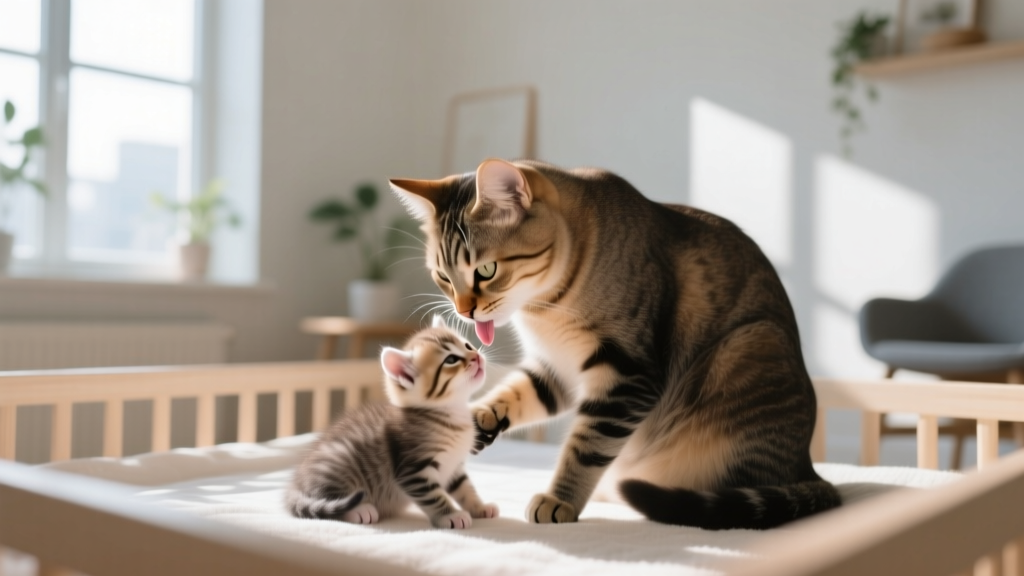
Grooming is the most visible maternal behavior—and the most misunderstood. While it keeps kittens clean and parasite-free, its deeper function is neurological priming. From birth through week 2, the mother licks the kitten’s perineal and anal regions *immediately after every nursing session*. Why? Because newborns cannot urinate or defecate without external stimulation. Her tongue’s rhythmic motion mimics nerve activation pathways, triggering reflexive elimination.
But here’s what few know: this licking also jumpstarts brain development. Research published in Frontiers in Veterinary Science (2023) used fMRI scans on neonatal kittens and found that maternal licking increased blood flow to the somatosensory cortex by 42% compared to non-stimulated controls—laying groundwork for tactile learning, motor coordination, and stress resilience. When humans replace this with cotton-ball stimulation, they replicate only the *mechanical* outcome—not the neurochemical cascade.
By week 3, grooming shifts from survival necessity to social scaffolding. She begins licking the face, ears, and paws more frequently—not just cleaning, but transferring scent cues that reinforce group identity. Kittens raised without this develop poorer social recognition skills later, showing heightened aggression toward unfamiliar cats in controlled behavioral trials (Cornell Feline Health Center, 2021). If your queen grooms excessively—or avoids grooming altogether—consider pain (e.g., mastitis), anxiety, or prior trauma. Never assume ‘she doesn’t like them’; investigate underlying causes first.
Carrying, Relocation & Environmental Management: The Hidden Architecture of Safety
You’ve likely seen a mother cat pick up a kitten by the scruff—jaw gently clamped behind the ears—and carry it across the room. It looks dramatic, but it’s biomechanically precise: the scruff skin contains dense nerve clusters that trigger a natural ‘immobility reflex,’ reducing struggle and injury risk. This behavior peaks between days 5–14, when kittens begin crawling but lack coordination or threat awareness.
What’s less obvious is her relocation strategy. Queens don’t move litters randomly. They assess light, sound, airflow, predator scent traces, and human traffic patterns—then choose sites with acoustic dampening (e.g., under furniture), thermal stability, and escape routes. In a landmark 2020 study tracking 32 free-roaming queens via GPS collars and motion-sensor nests, researchers found mothers relocated litters an average of 3.2 times in the first 18 days—always during low-human-activity windows (2–5 a.m.) and never into areas with >12 decibels above ambient noise floor.
Here’s where well-intentioned humans go wrong: moving the nest ourselves. Even if it ‘looks unsafe’ (e.g., near a heater), disrupting her chosen site induces cortisol spikes that suppress immune function in kittens by up to 27% (Journal of Feline Medicine and Surgery, 2021). Instead, mitigate risks *around* her choice: block heater access with baby gates, add white-noise machines to mask sudden sounds, or place soft bedding *adjacent* to her nest to encourage gradual transition—not forced removal.
Weaning, Discipline & Social Learning: How Moms Teach Boundaries Without Punishment
Weaning begins subtly around week 4—not with refusal, but with behavioral redirection. She starts lying on her side instead of belly-up, blocking teat access with her forelegs, and standing when kittens approach. By week 5, she introduces solid food *by example*: eating near kittens while vocalizing softly, then dropping small morsels. She does *not* push them toward bowls—kittens learn through observation and olfactory mimicry.
Discipline is equally nuanced. When a kitten bites too hard during play, she doesn’t hiss or swat. Instead, she freezes, breaks eye contact, and walks away—modeling disengagement as consequence. This teaches emotional regulation far more effectively than punishment, which increases fear-based aggression. A 2022 longitudinal study at UC Davis followed 68 kittens raised with vs. without maternal discipline modeling: those with moms showed 64% fewer redirected aggression incidents at 1 year old.
Social learning peaks weeks 5–7. She brings live prey (even in homes—think crickets or moths she catches indoors) and ‘demonstrates’ hunting sequences: stalk → pounce → bite → release. Kittens mimic these movements in play, refining motor neurons critical for coordination. Interrupting this—by removing ‘messy’ prey or over-handling—delays predatory skill acquisition by an average of 11 days, per Cornell’s Kitten Development Lab.
| Behavior | Onset Window | Peak Frequency | Key Purpose | Red Flag Indicators |
|---|---|---|---|---|
| Nursing + Thermal Huddling | Birth – Day 3 | Every 15–20 mins | Thermoregulation, colostrum transfer, oxytocin bonding | Kitten isolated >10 mins; mom abandoning nest >2 hrs/day |
| Perineal Stimulation Grooming | Birth – Day 14 | After every nursing | Urination/defecation induction, somatosensory brain development | No elimination after 2+ stimulations; bloody stool/urine |
| Scruff-Carrying & Relocation | Day 5 – Week 3 | 1–3x/day (peaks week 2) | Predator avoidance, microclimate optimization | No relocation by day 10; carrying with teeth sinking deep (>3 sec) |
| Food Modeling & Weaning Initiation | Week 4 – Week 7 | Increasing daily exposure | Oral motor development, taste preference formation | No interest in food by day 35; persistent suckling on siblings/tail |
| Hunting Demonstration | Week 5 – Week 8 | 2–4x/day (live prey) | Neuromuscular sequencing, predatory confidence | No stalking/pouncing by week 7; excessive biting of human hands |
Frequently Asked Questions
Do father cats ever help raise kittens?
Almost never in domestic settings—and rarely in wild felids. Male cats lack the hormonal priming (prolactin, oxytocin surges) required for nurturing behavior. While some neutered males may tolerate kittens passively, documented cases of active caregiving (grooming, retrieving, sharing food) are exceptionally rare (<0.3% in shelter observational data, ASPCA 2023). Any male displaying aggression toward kittens should be separated immediately—this is biologically typical, not pathological.
My cat brought me a dead mouse—is she offering it to me as ‘food’?
No—she’s engaging in a behavior called ‘tutoring by proxy.’ In multi-cat households or colonies, queens sometimes bring prey to humans or older cats to demonstrate hunting technique. She’s not feeding *you*; she’s practicing teaching behaviors, often when her own kittens are too young to observe. It’s a sign of trust and species-appropriate pedagogy—not a request for praise or a misplaced ‘gift.’
How long do kittens stay with their mother in nature vs. captivity?
In the wild, kittens typically remain with mom for 12–16 weeks—long enough to master hunting, territory navigation, and social hierarchy. In homes, early separation (before 12 weeks) correlates strongly with lifelong anxiety, inappropriate play biting, and litter box aversion (International Society of Feline Medicine consensus, 2022). Shelters now widely adopt 12-week minimum adoption age policies based on this evidence.
Can I ‘teach’ my cat to be a better mother if she seems inexperienced?
No—and attempting to do so risks severe stress. Maternal behavior is hormonally driven, not learned. First-time queens may appear hesitant, but interference (e.g., forcing kittens to nurse, restraining mom) elevates cortisol, suppresses milk production, and can trigger abandonment. Your role is environmental support: quiet space, high-calorie food, fresh water, and vigilant monitoring—not instruction.
What if my cat is raising orphaned kittens? Will she accept them?
Yes—but timing and scent are critical. Introduce orphans within 24 hours of her own birth, rubbing them with bedding from her nest to transfer scent. Avoid human scent (wear gloves, no perfume). Monitor closely for aggression—some queens reject foreign kittens instantly; others integrate them seamlessly. Success rate jumps from 38% to 82% when introduced pre-day 3 (ASPCA Feline Neonatal Care Protocol).
Common Myths About Maternal Cat Behavior
Myth #1: “If a mother cat moves her kittens, she’s stressed or rejecting them.”
False. Relocation is proactive safety planning—not distress signaling. Queens move litters to evade predators, reduce parasite load, or adjust for temperature shifts. Stress-related abandonment involves prolonged absence, neglect of grooming/nursing, or vocal distress—not purposeful movement.
Myth #2: “Kittens should be handled daily to socialize them.”
Partially true—but dangerously oversimplified. Human handling before week 3 disrupts maternal bonding and increases kitten cortisol. Optimal socialization begins week 3–7: 15–20 mins/day of gentle, varied handling (different people, textures, sounds) *alongside* mom’s presence. Isolating kittens from mom for ‘socialization sessions’ harms attachment security.
Related Topics
- How to care for orphaned kittens — suggested anchor text: "step-by-step orphaned kitten care guide"
- When to separate kittens from mother — suggested anchor text: "ideal weaning age for kittens"
- Signs of mastitis in cats — suggested anchor text: "cat mastitis symptoms and treatment"
- Feline maternal aggression — suggested anchor text: "why is my cat growling at me near kittens"
- Kitten developmental milestones — suggested anchor text: "kitten growth timeline week by week"
Conclusion & Your Next Step
Understanding what behaviors do cats do for kittens transforms you from a passive observer into an empowered, respectful steward of feline development. These aren’t random quirks—they’re evolutionary masterpieces honed over millennia, each serving precise physiological, neurological, or ecological functions. Whether you’re fostering a queen, managing a colony, or simply marveling at your own cat’s quiet devotion, your greatest contribution isn’t doing *more*—it’s knowing when to step back, watch closely, and trust the instincts that have sustained cats for 9,000 years.
Your next step? Download our free Maternal Behavior Tracker—a printable checklist with daily observation prompts, weight-gain benchmarks, and red-flag decision trees vetted by feline behaviorists. It takes 90 seconds to start—and could make the difference between thriving kittens and preventable crisis.