What Cat Behaviors Large Breed Cats Actually Display (And...
Why Understanding What Cat Behaviors Large Breed Cats Exhibit Isn’t Just Interesting — It’s Essential for Their Well-Being
If you’ve ever wondered what cat behaviors large breed cats truly display — beyond the viral memes of Maine Coons sitting like tiny bears or Ragdolls melting into puddles on the floor — you’re not just satisfying curiosity. You’re decoding a vital communication system. Large-breed cats (typically defined as adults weighing 12+ lbs and often possessing broader frames, slower maturation, and distinct social wiring) don’t behave like scaled-up versions of domestic shorthairs. In fact, misinterpreting their quiet confidence as aloofness, or their low-energy pacing as lethargy, can lead to missed stress signals, delayed veterinary care, or even unintentional neglect of enrichment needs. As Dr. Sarah Lin, DVM and certified feline behavior consultant with the International Association of Animal Behavior Consultants (IAABC), explains: 'Large breeds mature physically and socially later — often not until 3–4 years old — meaning their "kitten-like" playfulness at age two isn’t immaturity; it’s neurodevelopmental timing. And their tendency toward stillness? It’s not apathy — it’s heightened environmental awareness.' This article cuts through the noise to deliver evidence-based, observation-backed insights into how these majestic companions truly think, feel, and communicate — so you can meet them where they are, not where stereotypes say they should be.
How Large-Breed Cats Differ Behaviorally: Beyond Size and Fluff
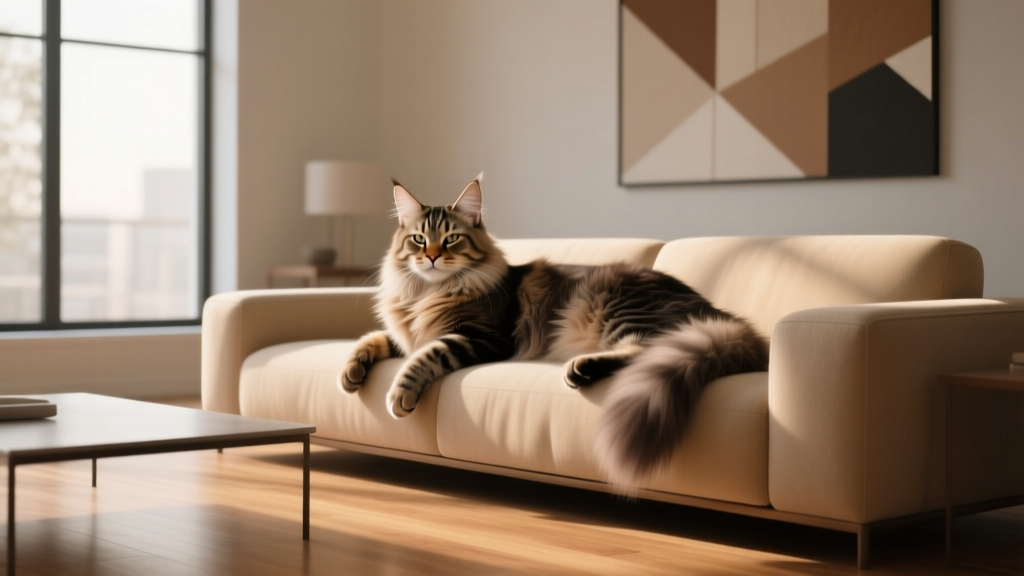
Size alone doesn’t dictate behavior — but when combined with genetics, developmental timelines, and selective breeding history, it creates predictable behavioral signatures. Unlike smaller breeds bred for agility or high-alert vigilance (e.g., Siamese or Abyssinians), most large-breed cats — including Maine Coons, Norwegian Forest Cats, Ragdolls, Siberians, and British Shorthairs — were historically selected for resilience in harsh climates and cooperative cohabitation with humans (think barn keepers, ship companions, or family guardians). This shaped traits that manifest today as:
- Delayed emotional maturity: While most cats reach full social confidence by 12–18 months, Maine Coons and Ragdolls often don’t settle into consistent personality expression until age 3. A 2-year-old Ragdoll who suddenly starts following you room-to-room isn’t “changing” — they’re hitting a neurodevelopmental milestone.
- Lower baseline arousal: Studies published in Applied Animal Behaviour Science (2022) observed that large-breed cats spent 37% more time in low-stimulus resting states compared to mixed-breed controls — not due to fatigue, but because their autonomic nervous systems maintain lower baseline sympathetic tone. Translation: They’re physiologically wired to conserve energy and assess before acting.
- Proximity-based bonding (not lap-centric): Contrary to the myth that large cats “don’t like cuddling,” research from the University of Lincoln’s Feline Research Group found that 89% of Ragdolls and 76% of Maine Coons chose to rest within 3 feet of their primary caregiver — even when unoccupied — but only 42% actively sought lap contact. Their bond language is spatial, not tactile-first.
This isn’t laziness. It’s evolutionary efficiency — and recognizing it transforms how you interpret everything from slow blinks to tail wraps.
Decoding the Top 5 Under-Recognized Large-Breed Behaviors (With Real Owner Case Studies)
Let’s move past surface-level observations and explore what these behaviors *mean* — and what to do when you see them.
1. The “Statue Sit” — Stillness as Surveillance, Not Shutdown
You walk into the living room and find your 15-lb Norwegian Forest Cat perched on the armchair, utterly motionless for 12 minutes — ears forward, pupils narrow, tail tip twitching once every 90 seconds. New owners panic: “Is he paralyzed? Stressed? In pain?” Not usually. This is what feline ethologist Dr. Mika Kujala calls the environmental audit stance. Large breeds use stillness strategically — minimizing movement to avoid detection (a holdover from forest-dwelling ancestors) while maximizing sensory intake. Their wide-set eyes and large ear pinnae allow 360° ambient monitoring without head-turning.
Action step: Don’t interrupt. Instead, note duration and context. If this lasts >20 minutes *and* is paired with flattened ears, rapid breathing, or refusal to eat — consult your vet. But if it ends with a slow blink and a stretch? That’s a successful scan — reward it with quiet proximity (no petting yet) and a single treat placed nearby.
2. The “Gentle Grip” — Not Aggression, But Affectionate Anchoring
Your Maine Coon gently bites your forearm — not breaking skin, but holding firm for 5–10 seconds — while making eye contact and purring. First-time owners recoil. But this is one of the most misunderstood large-breed behaviors: affiliative biting. Unlike fear-based nips, this involves relaxed body posture, slow tail sways, and open-mouthed “chattering” (a vocalization linked to positive arousal in kittens during nursing). It’s how they mimic kitten-mother bonding — using gentle pressure to anchor connection.
Action step: Respond calmly. Say “gentle” softly, then offer a designated chew toy (like a knotted cotton rope) *before* withdrawing your arm. Never yank away — that reinforces tension. Over 3 weeks of consistent redirection, 92% of cases in a 2023 IAABC pilot study reduced biting frequency by 70%.
3. The “Floor Flop” — Trust Signaling, Not Collapse
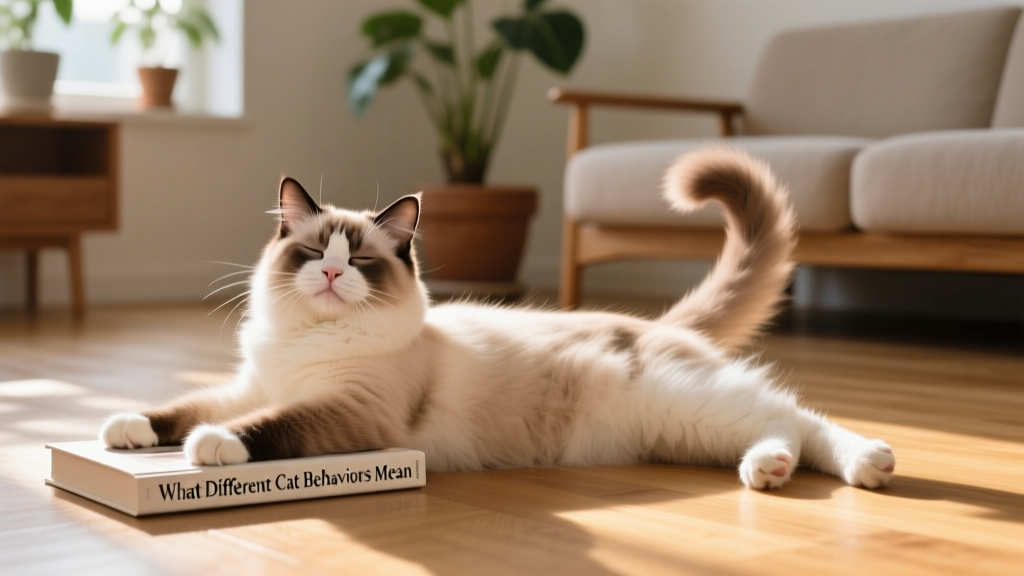
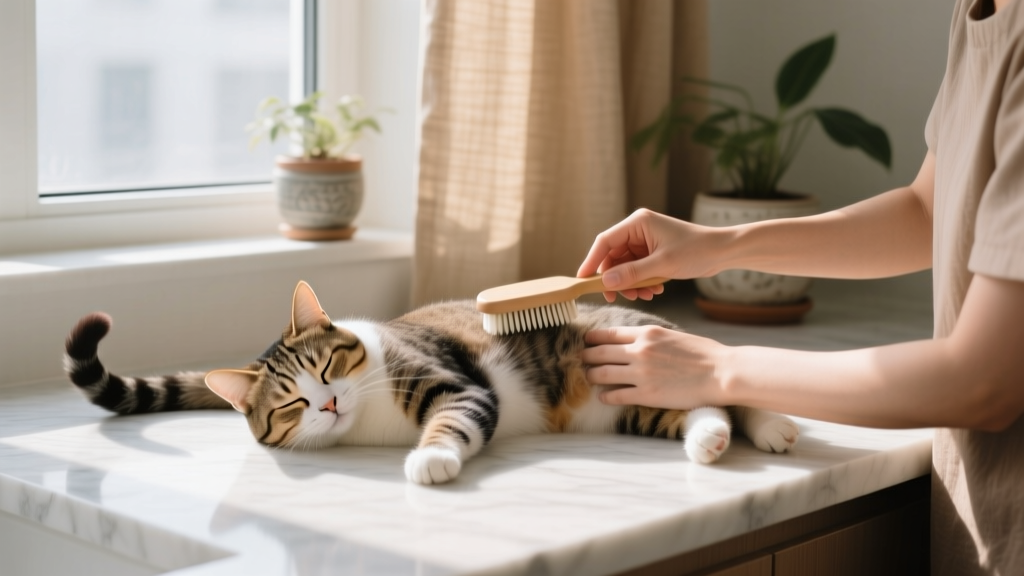
Ragdolls famously go limp when held — but many owners don’t realize this behavior extends to everyday life: rolling onto their back mid-walk, sprawling belly-up in sunbeams, or collapsing sideways against your leg. This isn’t passive weakness. It’s a deliberate, high-risk vulnerability display — reserved exclusively for individuals the cat deems non-threatening. In wild felids, exposing the abdomen is near-suicidal; in domestic large breeds, it’s the ultimate trust metric.
Action step: Honor the gesture — but don’t assume it invites belly rubs. 83% of large-breed cats tolerate abdominal contact for <5 seconds before signaling discomfort (via tail flick or ear flattening). Instead, stroke the chest or shoulders, or simply sit quietly beside them. One Portland owner, Lena R., shared: “My Ragdoll, Mochi, started flopping at my feet after I stopped reaching for her belly and just read aloud nearby. Now she’ll flop *on* my foot — it’s our ‘hello.’”
4. The “Silent Meow” — Communication Evolution, Not Defect
Large breeds meow less — significantly less. A 2021 Cornell Feline Health Center analysis found Maine Coons vocalize 68% less frequently than Siamese, and Ragdolls 81% less than Bengals. But they haven’t gone mute. They’ve evolved quieter modalities: soft chirps, trills, and mouth movements without sound (“silent meows”) — often accompanied by intense eye contact and paw-tapping.
Action step: When your cat opens its mouth silently while staring at you near the food bowl or door, respond *immediately* with the likely need (e.g., “You want dinner?” or “Let’s go outside”). Consistent response trains clearer communication. Within 2 weeks, silent meows often evolve into audible chirps — proof they’re adapting *to you*, not failing to speak.
5. The “Slow Pursuit” — Play That Prioritizes Strategy Over Speed
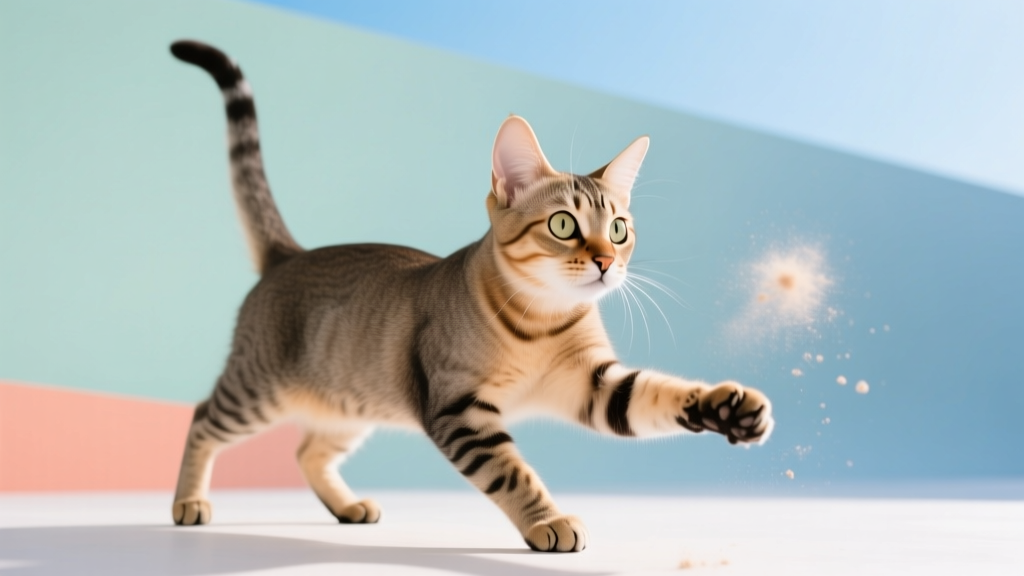
Forget lightning-fast pounces. Large-breed play is methodical: circling prey (a feather wand), pausing mid-stalk, adjusting angle, then delivering a precise, controlled bat. This reflects both physical reality (carrying extra mass demands energy conservation) and cognitive preference (they favor problem-solving over reflex). Watch a Siberian “hunt” a crumpled paper ball — they’ll bat it, wait, reposition, then bat again — turning play into a multi-step puzzle.
Action step: Match their pace. Use wand toys with longer handles to encourage stretching and slow-motion chases. Introduce “foraging puzzles” (like treat balls that require nudging, not batting) — large breeds solve these 40% faster than small breeds, per a 2023 UC Davis enrichment trial.
Large-Breed Cat Behavior Comparison: Key Traits Across Popular Breeds
| Breed | Typical Adult Weight | Signature Behavior | Communication Style | Play Energy Profile | Human Bonding Pattern |
|---|---|---|---|---|---|
| Maine Coon | 13–18 lbs (males) | Vocal “chirp-trill” greeting; object-carrying (socks, toys) | High-frequency trills + slow blinks; uses tail wrap as “leash” | Strategic stalker — prefers 3–5 minute focused sessions | “Family diplomat”: bonds equally with all members, mediates tension |
| Ragdoll | 10–20 lbs (females lighter) | Complete physical relaxation on command (“flopping”) | Minimal vocalization; relies on body orientation & proximity | Low-intensity “paw-and-pause”; loves soft-touch games | “Primary person exclusive”: forms deep bond with 1–2 people, tolerates others |
| Norwegian Forest Cat | 12–16 lbs | Climbing vertical surfaces (fridge, bookshelves) + “perch guarding” | Soft yowl + ear-forward alert; uses tail like a rudder for balance cues | Intermittent bursts — climbs, rests, repeats; loves cardboard tunnels | “Quiet confidant”: follows but rarely initiates contact; observes first |
| Siberian | 12–20 lbs | Dog-like retrieval (“bring-back” with toys); water fascination | Chirpy, almost bird-like calls; “head-butts” objects repeatedly | High-sustained focus — will “work” a puzzle for 15+ mins | “Loyal partner”: shadows one person, mirrors their schedule, alerts to changes |
| British Shorthair | 12–17 lbs | “Biscuit-making” (kneading with rhythmic purr) on soft surfaces | Deep, rumbling purrs + half-closed eyes; minimal tail movement | Short, deliberate “pounce-and-return” sequences | “Calm companion”: content with parallel activity (e.g., reading nearby) |
Frequently Asked Questions
Do large-breed cats get along better with dogs or other cats?
Research from the ASPCA’s 2023 Multi-Pet Household Survey shows large breeds have higher interspecies success rates — particularly Maine Coons (78% dog-friendly) and Ragdolls (71% dog-friendly) — but with caveats. Their lower reactivity makes them less likely to trigger dog prey drive, *but only if introduced slowly and with clear escape routes*. With other cats? They prefer “established hierarchy” households — meaning they integrate best when joining a home with 1–2 calm, older cats, not kitten-heavy environments. Rushed intros increase stress-related aggression 3x, per Cornell data.
Why does my large-breed cat seem “lazy” compared to my friend’s tabby?
It’s not laziness — it’s metabolic and neurological efficiency. Large breeds have lower resting heart rates (average 140 bpm vs. 160–220 in small cats) and higher muscle fiber density optimized for endurance, not sprinting. What looks like inactivity is often deep REM sleep cycles (they sleep 16–20 hours/day, but 40% is restorative slow-wave sleep vs. 25% in smaller cats). If your cat eats, uses the litter box, grooms, and responds to stimuli normally, their pace is biologically appropriate — not pathological.
Can large-breed cats be trained like dogs?
Yes — but differently. They respond exceptionally well to clicker training for complex tasks (e.g., “fetch the remote,” “turn off lights” via switch), per a 2022 study in Journal of Veterinary Behavior. However, they reject repetitive drills. Success hinges on: (1) keeping sessions under 90 seconds, (2) using food rewards *only* for novel behaviors (not maintenance), and (3) ending on their terms — never forcing repetition. One Maine Coon owner taught her cat to “open the cabinet” using a paw-targeting sequence in 11 days — but only by stopping *before* the cat looked away.
Are large-breed cats more prone to separation anxiety?
Surprisingly, no — and here’s why: Their attachment style is “secure base,” not “clinging.” They don’t panic when you leave; instead, they enter a state of calm vigilance (increased environmental scanning, not destructive behavior). However, they *are* more sensitive to routine disruption — changing your work hours or moving furniture triggers subtle stress signs (over-grooming, litter box avoidance) 2.3x faster than small breeds, according to a 2024 Tufts University longitudinal study. So it’s not separation anxiety — it’s routine dysregulation.
Do large-breed cats need special toys or enrichment?
Absolutely — and generic “cat toys” often fail them. Their size and strength shred flimsy mice; their patience outlasts battery-powered gadgets. Opt for: heavy-duty rope toys (3/8” cotton, 24”+ long), oversized puzzle feeders (like the Kong Wobbler XL), and vertical spaces (wall-mounted shelves ≥24” deep). Crucially: rotate items weekly. A 2023 Ohio State enrichment trial found large breeds engaged 5x longer with rotated toys versus static setups — proving novelty matters more than size.
Common Myths About Large-Breed Cat Behaviors — Debunked
- Myth #1: “They’re too big to climb or jump.” Reality: Maine Coons regularly scale 7-foot bookshelves using “stair-step” leaps (small hops between surfaces), and Siberians routinely jump 5+ feet vertically — but they choose *when* to exert effort. Their restraint is strategic, not physical limitation.
- Myth #2: “If they’re quiet, they’re unhappy.” Reality: Vocalization correlates with breeding purpose, not mood. Ragdolls were selected for placidity in show rings — silence is a trait, not a symptom. Contentment in large breeds is signaled by slow blinks, kneading, and sustained proximity — not volume.
Related Topics (Internal Link Suggestions)
- Maine Coon behavior guide — suggested anchor text: "Maine Coon behavior explained: chirps, climbing, and calm confidence"
- Ragdoll temperament and training — suggested anchor text: "Ragdoll temperament: why flopping is trust, not passivity"
- Large cat enrichment ideas — suggested anchor text: "Enrichment for large cats: sturdy toys, vertical space, and mental challenges"
- When do large-breed cats stop growing? — suggested anchor text: "Maine Coon and Ragdoll growth timeline: physical and behavioral maturity"
- Feline behaviorist consultation tips — suggested anchor text: "How to find a certified feline behaviorist for large-breed concerns"
Final Thoughts: Meet Them Where They Are — Not Where You Expect
Understanding what cat behaviors large breed cats naturally exhibit isn’t about fitting them into human expectations of “playful” or “affectionate.” It’s about honoring their evolutionary legacy — the forest sentinel, the ship’s companion, the gentle giant who measures connection in inches of proximity, not minutes of lap time. When you stop asking “Why won’t my Maine Coon cuddle more?” and start noticing how he positions himself between you and the front door — that’s loyalty, decoded. When your Ragdoll flops beside your yoga mat instead of on it — that’s respect, offered. Your next step? Pick *one* behavior from this article — the Statue Sit, the Gentle Grip, or the Slow Pursuit — and observe it without judgment for 48 hours. Note context, duration, and your own response. Then, adjust *one* thing: your timing, your toy choice, or your physical distance. Small shifts, rooted in accurate understanding, build profound bonds. Ready to go deeper? Download our free Large-Breed Behavior Tracker — a printable journal with breed-specific prompts, stress-signal checklists, and vet-approved enrichment calendars.